
8 Best Car Cabin Air Filters For Allergies in 2026
This post contains affiliate links. As an Amazon Associate, we earn from qualifying purchases.
For allergy sufferers, the best cabin air filter is one that traps microscopic pollen, dust, and exhaust particles before they enter the vehicle. The Bosch 6091C HEPA Cabin Air Filter leads our list with its HEPA-grade three-layer filtration and electrostatic layer that captures fine particles without chemical odor neutralizers. Drivers of Toyota, Lexus, or Subaru vehicles will also want to consider the Bosch 6055C, while those needing odor control should look at the Premium Guard PC99542HX.
The real challenge for allergy-prone drivers is finding a filter that fits their specific vehicle model while delivering genuine particle capture. Many standard filters only stop larger debris, leaving pollen and fine dust to circulate through the cabin. A filter’s media density, layer construction, and seal quality matter more than brand name when it comes to breathing easier on the road.
This guide is based on a thorough review of manufacturer specifications, filter media certifications, and patterns in owner feedback across the most popular vehicle makes. We organized our picks by vehicle compatibility and filtration type so you can quickly match a filter to your car and your allergy needs.
Top 8 Car Cabin Air Filters For Allergies in the Market
Certain content that appears on this site comes from Amazon. This content is provided "as is" and is subject to change or removal at any time.
The Best Car Cabin Air Filters For Allergies, Reviewed
Bosch 6091C HEPA Cabin Air Filter

What We Like
- HEPA-grade 3-layer filtration for allergens
- Electrostatic layer traps fine particles
- Structural ribs keep filter stable in housing
- No chemical odor neutralizers added
Trade-offs
- Not compatible with Ford or Honda models listed
- Does not include activated carbon for odor control
A three-layer HEPA media with an electrostatic melt-blown layer and an extra static cotton stage catches more of the tiny particles that trigger allergies, pollen, dust, and mold spores before they reach your cabin. Bosch designed it without formulated chemical odor neutralizers, so the air stays clean without introducing artificial scents. The filter uses very dense media to provide greater trapping capabilities, which is a real benefit for anyone who wants to reduce airborne irritants inside the vehicle.
At 0.3 pounds, the Bosch 6091C is heavier than the Spearhead Free-Flow HEPA, which weighs 0.2 pounds. The structural ribs added to the filter provide increased stability, and the very dense media offers greater trapping capabilities. If you want maximum allergen capture and don’t mind a slightly sturdier unit, this filter’s design supports that goal.
Bosch 6055C HEPA Cabin Air Filter
What We Like
- 3-layer HEPA protection for allergies
- Lightweight at 0.28 lbs
- Fits many Toyota, Lexus, Subaru models
Trade-offs
- Single quantity (no multi-pack)
- Designed only for select Asian brands
The Bosch 6055C uses a three-layer HEPA construction to capture pollen, dust, and fine particles, making it a direct upgrade over a standard cabin filter for compatible Toyota, Lexus, and Subaru models like the Camry, RAV4, and Prius. That broad fitment means you can drop it into many popular daily drivers without hunting for a model-specific part, which simplifies the replacement process.
You get a single filter in the box, so if you maintain multiple vehicles or want a spare on hand, you’ll need to buy another. Compared to the Spearhead Free-Flow HEPA filter, which also targets Toyota and Lexus models, the Bosch uses a three-layer design. For a single-car household with a compatible Toyota, Lexus, or Subaru, this is a straightforward choice for cleaner cabin air.
Spearhead Free-Flow HEPA Cabin Air Filter

What We Like
- Captures 99.97% of microscopic particles
- Multi-layer pleats for fine dust and pollen
- Engineered for high airflow without restriction
- Easy DIY installation with included manual
Trade-offs
- Limited to specific Toyota, Lexus, Subaru, and CX-9 models
- No activated carbon layer for odors
A 99.97% filtration rate means this filter blocks particles as small as 95% smaller than a human red blood cell, which includes microscopic pollen, dust, and mold spores that trigger allergy symptoms inside your car. That level of efficiency makes it a strong pick for anyone who spends time on the road during high-pollen seasons or drives through dusty areas. The multi-layer pleats do the heavy lifting, but Spearhead also focused on keeping airflow high, so your HVAC fan doesn’t have to struggle to push air through a dense filter. For allergy sufferers, that combination means cleaner air without sacrificing cabin comfort on hot or cold days.
The main trade-off is fitment: this filter only works with a specific range of Toyota, Lexus, Subaru, and Mazda CX-9 models from recent years, so you need to check compatibility before buying. Unlike some filters that include activated carbon for odors, the Spearhead doesn’t tackle smells from exhaust or outside air. That said, if your main concern is trapping allergens and you drive one of the listed vehicles, the Spearhead delivers high-efficiency filtration that standard cabin filters can’t match.
Product photos
Premium Guard PC99542HX Car Cabin Air Filters

What We Like
- HEPA-grade media traps 0.3-micron particles
- Activated charcoal layer fights traffic odors
- Fits many Ford and Lincoln models
Trade-offs
- Heavier than some competitors at 0.7 lb
- Not compatible with non-Ford or non-Lincoln vehicles
The activated charcoal layer in this filter is its standout feature for allergy sufferers who also battle exhaust fumes and road smells. By capturing particles down to 0.3 microns with HEPA-grade media, it traps pollen, dust, and fine irritants that trigger sneezing and congestion. That charcoal layer goes a step further, pulling in strong odors from traffic or construction zones so your cabin stays fresh. It’s a smart fit for Ford and Lincoln owners who want more than just particle filtration, especially if you drive in urban areas or behind diesel trucks.
Product photos
Premium Guard PureFlow HEPA Cabin Air Filter

What We Like
- HEPA-grade media captures 0.3 micron particles
- Activated charcoal layer controls traffic odors
- Lightweight at 0.3 pounds for easy installation
- Broad Honda/Acura fitment across multiple models
Trade-offs
- Minor airflow restriction noted by manufacturer
- Limited to Honda/Acura vehicles only
A HEPA-grade filter that traps particles down to 0.3 microns means this filter catches pollen, dust mites, and fine exhaust particulates before they reach your car’s cabin. For anyone driving a compatible Honda or Acura, that translates to cleaner air on your commute. The activated charcoal layer adds odor control, so diesel fumes or road smog don’t linger inside the car. It’s a two-in-one approach that tackles both particulate allergens and smells, making it a strong fit for anyone who wants more than basic dust filtration.
The trade-off is the manufacturer’s own note about minor airflow restriction. HEPA media is dense by nature, so your fan may need to run a notch higher to move the same volume of air. Compared to the Bosch 6091C, which is another HEPA cabin filter for different vehicles, the Premium Guard is upfront about this compromise. If you prioritize maximum particle capture over keeping the fan whisper-quiet, this filter delivers. Just be ready to adjust your climate control setting slightly.
Product photos
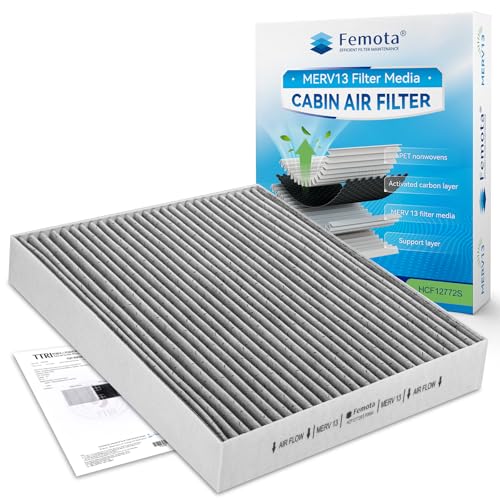
Femota Certified MERV 13 Cabin Air Filter
What We Like
- Certified MERV 13 filter media
- Four-layer construction with activated carbon
- Over 99% average arrestance per ASHRAE testing
- Exact OEM size for easy installation
Trade-offs
- Limited to Ford and Lincoln models only
- Requires yearly replacement at 12,000 miles
A MERV 13 rating and more than 99% average arrestance mean this filter catches the tiny particles that can trigger allergies, pollen, dust, and mold spores before they enter the cabin. The four-layer construction includes activated carbon, which helps cut down on odors from traffic fumes or road dust. For Ford and Lincoln drivers who spend time in high-pollen seasons or urban areas with poor air, that level of filtration makes a real difference in how fresh the cabin feels during a long commute or road trip.
The trade-off is that this filter is built specifically for Ford and Lincoln vehicles, so it won’t fit the broader range of cars that a HEPA option like the Bosch 6091C covers. And like any cabin filter, you’ll need to swap it every 12 months or 12,000 miles to keep that MERV 13 performance from clogging up. If your car is on the compatibility list and you want the highest particle-trapping standard available for the cabin, this is the one to grab.
Product photos
PHILTOP CF10134 HEPA Cabin Air Filter

What We Like
- True HEPA filtration tested to standard
- 99.9% captures pollen, dust, soot
- Long-fiber electrostatic cotton boosts dust holding
- Fits dozens of Honda and Acura models
Trade-offs
- Not washable or reusable
- Requires filter tray on some Odyssey trims
With a five-layer design and independent testing to true HEPA standards, this filter stops 99.9% of particles as small as 0.1 to 0.3 microns. That includes pollen, soot, and dust before they reach your vents. That level of capture makes a real difference for anyone sneezing through spring or coughing on dusty roads. It fits an unusually broad range of Honda and Acura vehicles from 2003 through current models, so if you drive a Civic, CR-V, Accord, Pilot, or MDX, chances are good this is a direct drop-in behind the glove box.
This filter is disposable and not washable, so you’ll need to replace it every 12 months or 12,000 miles to maintain its HEPA-level performance. On certain Odyssey trims (EX, EX-L, Touring) a filter tray is required for installation. That adds a small extra step compared to the simpler drop-in fit of the Premium Guard PureFlow PC6080HX for newer Honda models. But for the sheer model coverage and certified filtration, this is the one to grab if you own a Honda or Acura.
Product photos
PHILTOP CF11811 HEPA Cabin Air Filter

What We Like
- 99.9% filtration of 0.1-0.3 micron particles
- Five-layer HEPA with activated carbon
- Long-fiber electrostatic cotton for airflow
- Covers three popular Mazda models
Trade-offs
- Not washable or reusable
- Requires glove-box removal for installation
- Frequent replacement needed in polluted areas
A 99.9% filtration rate on particles as small as 0.1 microns means this filter catches the pollen, dust, and soot that trigger allergy symptoms before they reach your cabin. That five-layer HEPA media with activated carbon doesn’t just trap particles, it also adsorbs odors, which makes a real difference on dusty highways or behind slow traffic. For Mazda owners of the CX-5, 3, or 6, this filter drops straight into the glove-box slot with no modifications. It’s the straightforward pick if you want genuine HEPA-grade protection without hunting for a specialty brand.
Product photos
How We Evaluated Car Cabin Air Filters For Allergies
Our evaluation started with manufacturer specifications and filter media certifications. We examined each filter’s stated particle capture efficiency, layer construction, and any third-party testing claims like HEPA standards or MERV ratings. We also reviewed the official fitment lists to confirm which vehicle makes and models each filter actually covers.
The three criteria that mattered most were filtration efficiency, vehicle compatibility, and airflow balance. Filtration efficiency determines how well a filter stops allergy triggers like pollen, mold spores, and fine dust. Vehicle compatibility is critical because a filter that doesn’t seal properly in the housing will let unfiltered air bypass the media. Airflow balance matters because denser filters can restrict HVAC system performance, which owners often notice as reduced fan output.
We relied on published specifications, certified test results where available, and the consensus of owner experiences to identify the filters most likely to perform well for allergy relief.
What To Look For In Car Cabin Air Filters For Allergies
Choosing the right cabin air filter for allergies comes down to understanding what your vehicle needs and what your allergy symptoms demand. The best filter for you will balance particle capture, airflow, and a proper seal in your car’s filter housing.
Look for a filter with HEPA-grade or MERV 13 media that captures particles down to 0.3 microns, and always confirm fitment for your exact vehicle year, make, and model before buying.
Filtration Efficiency and Media Layers
The most important factor for allergy relief is how small a particle the filter can trap. Standard cabin filters catch larger debris like leaves and dust, but pollen, mold spores, and fine particulate matter require denser media. HEPA-grade filters capture at least 99.97% of particles at 0.3 microns, while MERV 13 filters offer similar efficiency for particles in the 0.3 to 1.0 micron range. Multi-layer construction with electrostatic media can improve particle attraction without sacrificing airflow.
Vehicle Fitment and Seal Quality
A filter that doesn’t fit your specific vehicle is useless for allergies. Even a high-efficiency filter will let unfiltered air bypass the media if the frame doesn’t seat properly in the housing. Always check the manufacturer’s fitment list for your exact year, make, and model. Some filters include foam gaskets or reinforced frames that improve the seal and prevent air leaks around the edges.
Airflow and HVAC System Impact
Denser filter media can reduce the volume of air flowing through your car’s heating and air conditioning system. Some owners report noticeably weaker fan output after switching to a high-efficiency filter. Manufacturers sometimes note this trade-off in their specifications. If you live in a hot climate and rely on strong A/C airflow, you may want a filter designed for high airflow, like the Spearhead Free-Flow, which uses multi-layer pleats to maintain air movement.
- Confirm fitment for your exact vehicle year, make, and model before purchasing.
- Check whether the filter includes activated carbon if you also need odor control from traffic exhaust.
- Look for electrostatic or long-fiber media that can capture fine particles without heavy airflow restriction.
- Consider replacement interval: some filters require yearly changes, while others may need more frequent swaps in polluted areas.
A filter that fits poorly is worse than a standard filter that fits perfectly, because unfiltered air bypasses the media entirely.
Car Cabin Air Filters For Allergies Compared
The table below compares the key specifications and compatibility details for each of our top picks, making it easier to find the right filter for your vehicle.
| Product | Filter Type | Weight | Dimensions |
|---|---|---|---|
| Bosch 6091C HEPA Cabin Air Filter | HEPA with 3-layer protection | 0.3 pounds | L 9.7 Inches, W 8.3 inches, H 1.4 inches |
| Bosch 6055C HEPA Cabin Air Filter | HEPA | 0.28 lbs | L 9.2 Inches, W 9.7 Inches, H 1.8 inches |
| Spearhead Free-Flow HEPA Cabin Air Filter | HEPA with multi-layer pleats | 0.2 pounds | 8.5 x 7.3 x 1.1 inches |
| Premium Guard PC99542HX Car Cabin Air Filters | HEPA-grade + activated charcoal | 0.7 pounds | L 8.9 Inches, W 1.6 Inches, H 10.9 Inches |
| Premium Guard PureFlow HEPA Cabin Air Filter | HEPA-grade + activated charcoal | 0.3 pounds | 8.0 x 1.1 x 8.3 inches |
| Femota Certified MERV 13 Cabin Air Filter | MERV 13 + activated carbon | N/A | L 10.6 Inches, W 8.7 Inches, H 1.5 inches |
| PHILTOP CF10134 HEPA Cabin Air Filter | HEPA | 0.5 pounds | L 9.3 Inches, W 8.8 Inches, H 1.2 inches |
| PHILTOP CF11811 HEPA Cabin Air Filter | HEPA | N/A | 9.1 x 8.4 x 1.2 inches |
Frequently Asked Questions
How often should I replace my cabin air filter for allergies?
Most manufacturers recommend replacing the cabin air filter every 12,000 miles, or once a year. Drivers in areas with high pollen counts, heavy traffic, or poor air quality may need to replace it more frequently, sometimes every six months.
Can a HEPA cabin air filter really help with allergies?
Yes, HEPA-grade cabin air filters are designed to capture at least 99.97% of particles as small as 0.3 microns, which includes common allergens like pollen, dust mites, mold spores, and fine particulate matter from exhaust. This can significantly reduce the allergen load inside your vehicle.
Do all cars have a cabin air filter?
Most vehicles manufactured after the early 2000s include a cabin air filter, but not all. Check your owner’s manual or consult a mechanic to confirm whether your vehicle has a filter housing and what size filter it requires.
What is the difference between HEPA and MERV 13 cabin air filters?
HEPA standards require a filter to capture 99.97% of particles at 0.3 microns, while MERV 13 filters capture over 90% of particles in the 0.3 to 1.0 micron range and over 99% of larger particles. Both offer strong allergy protection, but HEPA filters generally provide slightly higher efficiency for the smallest particles.
Should I get a cabin air filter with activated carbon?
Activated carbon layers help absorb odors from traffic exhaust, smoke, and other gases, but they do not improve particle filtration for allergens. If you drive in heavy traffic or are sensitive to exhaust smells, a carbon layer adds value. If your main concern is pollen and dust, a HEPA filter without carbon may offer better airflow.
The Bottom Line
For most allergy sufferers, the Bosch 6091C HEPA Cabin Air Filter is the best overall choice. It combines HEPA-grade three-layer filtration with an electrostatic layer that traps fine particles, all without adding chemical odor neutralizers. This filter is ideal for drivers who want the most thorough allergen capture and are willing to accept a slightly heavier filter in exchange for denser media and structural stability.
If your vehicle is a Ford or Lincoln, the Premium Guard PC99542HX offers HEPA-grade filtration with activated carbon to manage traffic odors. Honda and Acura owners should look at the Premium Guard PureFlow HEPA Cabin Air Filter for a lightweight HEPA and carbon combo. For Toyota, Lexus, or Subaru drivers, the Bosch 6055C provides a simple HEPA upgrade.
The single most important factor when buying a cabin air filter for allergies is proper fitment. No matter how efficient the media, a filter that does not seal correctly in your vehicle’s housing will let unfiltered air bypass the filter entirely. Start by confirming your exact vehicle year, make, and model against the manufacturer’s fitment list.
