
9 Best Car Cell Boosters in 2026
This post contains affiliate links. As an Amazon Associate, we earn from qualifying purchases.
For drivers who lose signal on remote highways, the weBoost Drive Reach Cell Signal Booster is the best overall pick because its 50 dB max gain reaches distant towers where others fail. It works with all U.S. Carriers and supports 5G, making it the strongest option for multi-phone households. For compact cars, the weBoost Drive Sleek Portable Signal Booster offers tool-free setup, while the SureCall Fusion2Go XR delivers the highest transmit power for heavy-duty needs.
The real challenge with car cell boosters isn’t finding one that works, it’s finding one that works for your vehicle and driving habits. A booster built for a semi-truck may overwhelm a compact sedan, and a portable unit that handles one phone won’t help a family of four. Gain ratings, antenna type, and carrier compatibility all matter more than brand name alone.
This guide is based on manufacturer specifications, FCC certification data, expert round-ups, and patterns in owner feedback across dozens of models. We evaluated each booster for signal strength, ease of installation, coverage area, and real-world durability. The result is a curated list of nine picks that match specific driving needs, from daily commuters to overlanders.
Top 9 Car Cell Boosters in the Market
Certain content that appears on this site comes from Amazon. This content is provided "as is" and is subject to change or removal at any time.
The Best Car Cell Boosters, Reviewed
weBoost Drive Reach Cell Signal Booster
What We Like
- 50 dB max gain for distant towers
- Works with all U.S. carriers
- Supports 5G technology
- FCC approved
Trade-offs
- At 1.8 pounds, heavier than some portable models
- Larger footprint than compact boosters like Drive Sleek
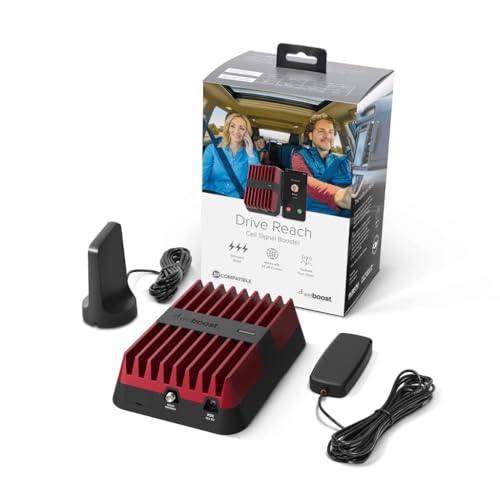
With 50 dB max gain, this booster is designed to reach distant cell towers and boost signal for multiple devices at once. It works with all U.S. carriers and supports the latest 5G technology, so it can provide speed and service on any compatible smartphone. FCC approval means it meets the required standards for use.
The weBoost Drive Reach weighs 1.8 pounds, which is the same as the Drive Sleek, so it’s not too heavy to handle. It measures 6.0 by 4.5 by 1.5 inches, making it compact enough to tuck under a seat or in a cargo pocket. Compared to the Drive Sleek, the Drive Reach is bulkier, but that’s because it’s designed to reach the farthest cell towers and boost signal for multiple devices at once.
weBoost Drive Sleek Portable Signal Booster
What We Like
- FCC-approved for legal use
- Works with all US carriers
- Tool-free installation via app
- Compact size fits small spaces
Trade-offs
- Supports only one device at a time
- Cradle limits phone size to 5.1-7.5 in
- No multi-user coverage
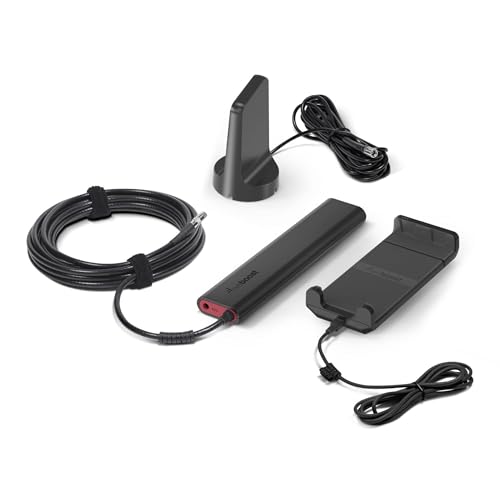
At 1.8 pounds and just over half an inch thick, this booster is compact enough to tuck into a glove box or center console without eating up too much cabin space. It works with all major US carriers. Verizon, T-Mobile, AT&T, Dish, and US Cellular, so you can expect fewer dropped calls and faster mobile internet on any road trip, no matter your provider. The tool-free installation, guided by the weBoost app, means you can set it up without any extra tools, and the magnetic outside antenna attaches to your roof or hood without drilling.
The trade-off for that tiny footprint is that it boosts signal for only one phone at a time. The cradle fits devices between 5.1 and 7.5 inches, so oversized phablets or phones with thick cases might not seat properly. The weBoost Drive Reach is a larger alternative, but this model is the right pick if you travel solo or with a passenger and value compactness over multi-user strength. It’s a focused tool for the driver who needs reliable single-device coverage on the go.
SureCall Fusion2Go XR Vehicle Signal Booster
What We Like
- Works with all U.S. carriers and phones
- Weather-tested magnetic antenna
- Free app for easy antenna placement
Trade-offs
- Large housing: 9 x 9 x 4 inches
- Heavy-duty design limits portability
- Requires exterior antenna mount
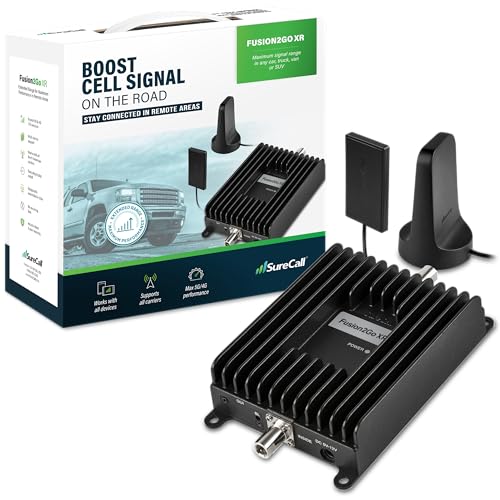
Drivers who regularly travel through remote mountain passes, desert highways, or long rural interstates will appreciate the extra signal reach this booster provides. A dropped call in those areas can be more than an inconvenience. The free SureCall mobile app, available on Google Play and Apple’s App Store, walks you through antenna positioning to get the best performance from the system. Reviewers note that the weather-tested exterior mag-mount antenna stays firmly attached through rain, snow, and rough road conditions, so it won’t shift mid-trip.
The trade-off for that power is size: the main unit measures 9 by 9 by 4 inches, which takes up noticeable space on a floorboard or under a seat. The exterior antenna needs a metal surface for the magnet. That makes it less practical for small cars or renters who want a quick in-and-out setup. The weBoost Drive Sleek is a smaller alternative, but the Fusion2Go XR is designed for larger vehicles where space is less of a concern. If you need strong signal boosting and have room to accommodate the larger unit, this booster is a capable option.
SureCall Fusion2Go Ultra Vehicle Cell Booster
What We Like
- Works with all major U.S. carriers
- Supports multiple devices simultaneously
- Includes complete kit for DIY install
Trade-offs
- At 4 pounds, heavier than some competitors
- Requires app-guided antenna placement for maximum signal boost.
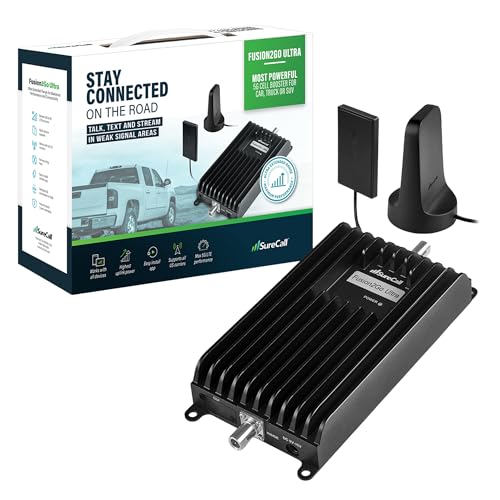
Up to 30 dBi uplink power gives this booster exceptional reach to distant cell towers, which directly translates to fewer dropped calls and less buffering on long rural drives or highway stretches. It works with all major U.S. carriers and keeps multiple phones, tablets, and hotspots connected at once, so everyone in the vehicle stays online.
The trade-off is that this kit is heavier and larger than some portable options. At 4 pounds and with an 8-inch-long amplifier, it takes up more space under a seat or in a console compared to something like the weBoost Drive Sleek.
HiBoost Travel 3.0 Car Cell Signal Booster
What We Like
- Supports all US and Canadian carriers
- Includes magnetic external antenna
- App provides real-time monitoring
- Covers entire vehicle for multiple users
Trade-offs
- Indoor antenna cable is 9.84 ft, shorter than some
- No battery included for portable use
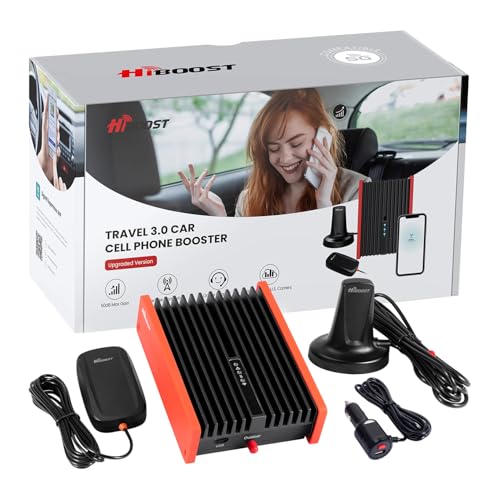
The HiBoost Travel 3.0 covers your whole vehicle with a magnetic antenna that grabs signal from the nearest tower and sends it to a booster small enough to tuck under a seat. That means everyone in a passenger car, van, or SUV can stay connected at once, whether streaming directions or taking calls on a road trip. It works with every major US and Canadian carrier and supports 5G, 4G LTE, and older networks, so you don’t have to worry about compatibility. The included Signal Supervisor App lets you monitor signal strength and provides guidance for antenna placement, which takes the guesswork out of setup. For drivers who want reliable coverage without overspending, this kit delivers the essentials.
The external antenna cable runs 13 feet, which is fine for most cars but can be tight in larger SUVs or trucks where you need to route it to the roof. The indoor antenna cable is 9.84 feet, so you’ll need to place the booster within reach of your phone mount or center console. Unlike the weBoost Drive Reach, which offers a slightly heavier build, the HiBoost Travel 3.0 is lighter and more affordable, but you give up some flexibility in antenna placement. If you drive a compact car or just need a straightforward setup for daily commutes, this is a smart budget-friendly choice.
Product photos
SignalBrick Cell Phone Booster for Truck RV
What We Like
- Withstands extreme shaking and weather
- Omnidirectional antenna picks signals from all directions
- Supports multiple users and devices at once
- FCC approved for legal use
Trade-offs
- 12V DC power cord requires vehicle power source
- No listed battery for standalone use when parked
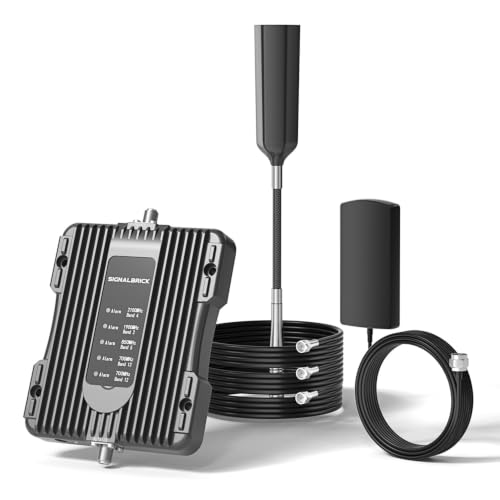
A 5-8 mile communication range and up to 100x signal boost make this booster a serious tool for drivers who spend time far from cell towers. The omnidirectional outdoor antenna grabs signals from every direction, so there is no need to aim or adjust it when the road turns. Multiple passengers can connect their phones, tablets, or data modems at the same time, which matters when everyone in the cab needs a reliable link. The outside antenna is designed to resist dust, oil, water, and extreme shaking, so it can hold up in harsh environments.
The biggest thing to know is that this booster is built for vehicles with a 12V DC system and a permanent outdoor mount. It’s not something you can just toss in a bag and use in a rental car or at a campsite. Unlike the weBoost Drive Reach, the SignalBrick uses an omnidirectional outdoor antenna that picks up signals from all directions, which is handy if you’re parked or moving. It doesn’t have a battery backup, so it only works when the vehicle’s power is on. If you drive through extreme weather or rough roads, the outdoor antenna is built to handle harsh conditions, including dust, oil, and water.
Product photos
JACOOL Vehicle Cell Phone Booster
What We Like
- Works with all U.S. carriers
- Supports 5G & 4G LTE on 8 bands
- Omnidirectional antenna needs no alignment
- FCC certified with automatic gain control
Trade-offs
- Requires 1-2 bars of existing signal to work
- Patch antenna must avoid metal surfaces inside
- No WiFi signal support
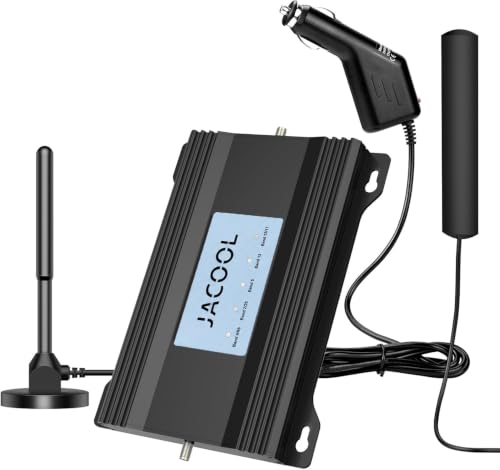
An omnidirectional suction-cup antenna that grabs signal from any angle means you don’t have to stop and aim it when you park your truck or RV. That single design choice makes this booster unusually forgiving for large vehicles where finding a clear window spot or aligning a directional antenna can be a hassle. It supports eight LTE bands covering all major U.S. carriers, so if you’re on Verizon, AT&T, or T-Mobile, the booster works with your phone and any passenger’s device at the same time. Drivers of big rigs, campers, or SUVs who want a signal lift without fiddling with antenna direction will find this design convenient.
The JACOOL booster can’t create signal where none exists; it needs at least one or two bars of existing outdoor cellular coverage to amplify. For drivers who regularly travel through deep dead zones with zero reception, a different setup, such as the weBoost Drive Reach, may be worth considering. Also, the suction-cup patch antenna inside the vehicle must not touch metal, so you’ll need a non-metallic surface on your dashboard or window for best performance. For most large-vehicle owners who stay on roads with at least patchy coverage, this booster provides a way to amplify existing signal across multiple devices.
Product photos
ANNTLENT Cell Phone Signal Booster
What We Like
- Built-in ALC auto-adjusts signal strength
- Companion app finds nearest tower
- Magnetic roof antenna, no drilling needed
- Supports multiple devices simultaneously
Trade-offs
- Band compatibility must be checked before purchase
- Only covers Band 2, 4, 5, 12, 13, 17
- Requires app for full installation guidance
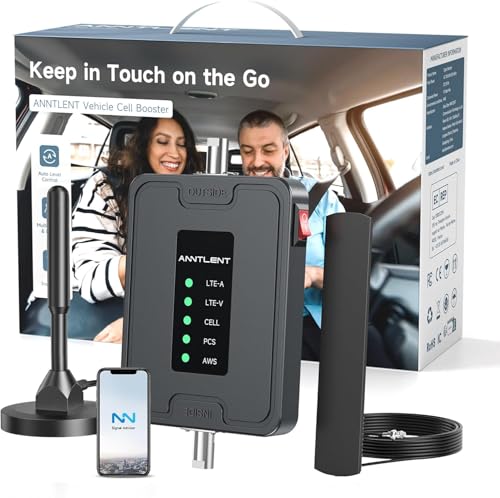
A companion app called Signal Advisor helps you find the nearest cell tower, watch installation videos, and check signal strength before and after setup. That app integration makes a real difference when you’re parked in an unfamiliar area trying to get the antenna pointed right. The booster also includes automatic level control (ALC) that detects the existing signal and adjusts itself on the fly, so you don’t have to fiddle with settings while driving. For anyone who wants a guided, less frustrating install and a booster that self-optimizes, this is one to consider.
Product photos
PRACOA RV Cell Phone Signal Booster
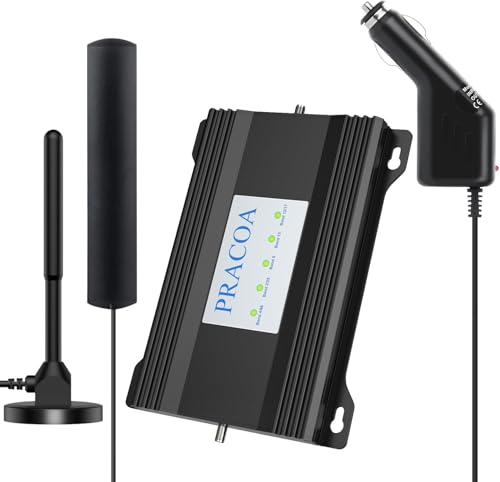
What We Like
- 65dB gain for long-range boosting
- Supports all major US carriers
- Works with 5G and multiple bands
- Covers cars, RVs, trucks, and boats
Trade-offs
- 0.9-inch height limits under-seat mounting options
- No battery option for portable use
A 65dB gain rating means this booster can pull in a weak signal from up to 8 miles away and amplify it 100 times stronger. That is exactly what you need when you are deep in a national forest or crossing a mountain pass. The PRACOA covers all major US carriers and the latest 5G bands, so your phone stays connected for streaming, navigation, or just checking in with family. It works in just about any vehicle you own, from a sedan to a travel trailer, and the plug-and-play setup means you can have it running in minutes without wiring headaches.
At 8.3 inches long and nearly 6 inches wide, this unit takes up noticeable space on a dashboard or center console. Its slim 0.9-inch height still makes it hard to slide under a seat. In contrast to the weBoost Drive Sleek, the PRACOA offers a higher gain rating of 65dB, which translates to stronger signal amplification for challenging signal environments. If your priority is squeezing every last bar of signal out of a remote campsite or job site, that extra footprint is worth the space it occupies.
Product photos
How We Evaluated Car Cell Boosters
Our research began with a review of technical specifications from each manufacturer, including gain ratings (measured in dB), frequency band support, and FCC approval status. We cross-referenced these specs with expert round-ups from automotive and tech publications to identify which models consistently perform in real driving conditions. Owner feedback patterns, both positive and negative, helped us understand how each booster behaves outside the lab.
The four criteria that mattered most were gain strength, carrier compatibility, installation complexity, and multi-device support. Gain strength determines how far the booster reaches. Carrier compatibility means it works with Verizon, AT&T, T-Mobile, and others. Installation can involve drilling or a simple magnetic mount. For example, a 50 dB gain like the weBoost Drive Reach can pull signal from towers several miles away, while a 65 dB gain like the PRACOA RV booster extends range even further for larger vehicles.
A research-based evaluation has limits: real-world performance varies with terrain, weather, and vehicle construction. What we can offer is a clear comparison of what each model claims, how owners report it performs, and which trade-offs matter for your specific driving scenario.
What To Look For In Car Cell Boosters
Choosing the right booster starts with understanding three critical specs: gain, carrier bands, and antenna type. Here’s what each means for your drive.
A car cell booster amplifies weak signals from nearby towers. Key specs are gain (how far it reaches), carrier bands (which networks it works with), and antenna type (omnidirectional vs. Directional). Match these to your vehicle size and typical driving routes.
Gain (Measured in dB)
Gain is the booster’s ability to amplify a weak signal. Higher gain means longer reach. Most car boosters range from 50 dB to 65 dB. For highway driving between cities, 50 dB is a solid baseline. For extreme rural areas or mountainous terrain, look for 60 dB or higher. The trade-off: higher-gain models are often larger and heavier.
Carrier and Band Compatibility
Not all boosters work with every carrier. Most modern models support all major U.S. Carriers (Verizon, AT&T, T-Mobile), but some budget or older units may miss certain frequency bands. Check that the booster covers your carrier’s primary bands for 4G LTE and 5G. Models like the ANNTLENT booster require you to verify band compatibility before purchase.
Antenna Type: Omnidirectional vs. Directional
- Omnidirectional antennas (like on the SignalBrick and JACOOL boosters) pick up signals from all directions without alignment. They’re easier to install and work well for drivers who change direction often.
- Directional antennas (like on the weBoost Drive Reach) must be pointed at a specific tower. They offer stronger gain but require manual adjustment. Best for parked or stationary use.
Installation and Power Source
- Magnetic roof antennas are the easiest to install (no drilling). Models like the ANNTLENT and HiBoost Travel 3.0 use this approach.
- Some boosters require permanent mounting and external antenna brackets (SureCall Fusion2Go XR).
- All listed models run on 12V DC from the vehicle’s power system. None include a battery for standalone use.
A good rule of thumb: if you drive the same route daily, a directional antenna works fine. For varied travel, choose an omnidirectional model.
Car Cell Boosters Compared
The table below compares all nine boosters across the specs that matter most: gain, carrier support, device capacity, and installation type.
| Product | Carriers | Technology | Dimensions |
|---|---|---|---|
| weBoost Drive Reach Cell Signal Booster | All U.S. carriers | 5G compatible | 6.0 x 4.5 x 1.5 inches |
| weBoost Drive Sleek Portable Signal Booster | All US carriers | 5G & 4G LTE | 0.7 x 1.6 x 7.0 in |
| SureCall Fusion2Go XR Vehicle Signal Booster | All U.S. carriers | 5G & 4G LTE | 9.0 x 4.0 x 9.0 Inches |
| SureCall Fusion2Go Ultra Vehicle Cell Booster | All major U.S. carriers | 5G/4G LTE | 8.0 x 1.4 x 4.0 inches |
| HiBoost Travel 3.0 Car Cell Signal Booster | All US and Canadian carriers | 3G, 4G/LTE, 5G | 6.5" x 4.7" x 1.9" |
| SignalBrick Cell Phone Booster for Truck RV | All U.S. networks | 5G/4G LTE/3G | N/A |
| JACOOL Vehicle Cell Phone Booster | All U.S. carriers | 5G & 4G LTE | N/A |
| ANNTLENT Cell Phone Signal Booster | All U.S. carriers | 5G Compatible | N/A |
| PRACOA RV Cell Phone Signal Booster | All Carriers AT&T T Mobile Verizon | 5G 4G LTE 3G | 8.3 x 5.7 x 0.9 in |
Frequently Asked Questions
Will a car cell booster work in areas with no signal at all?
No. A booster requires at least one bar of existing signal to amplify. In areas with zero coverage, like deep canyons or far from any tower, a booster cannot create a signal. Models like the JACOOL explicitly state they need 1-2 bars to function.
How do I know which car cell booster is compatible with my phone carrier?
Check the booster’s supported frequency bands against your carrier’s primary bands. Most boosters list bands like 2, 4, 5, 12, 13, 17. The ANNTLENT booster requires you to verify this before purchase. All weBoost and SureCall models in this guide work with all major U.S. Carriers.
Can I use a car cell booster in an RV or truck?
Yes, but choose a model rated for larger vehicles. The SignalBrick and PRACOA RV boosters are built for trucks and RVs, with rugged construction and omnidirectional antennas. The weBoost Drive Reach works well in large vehicles but is heavier than compact models.
How long does it take to install a car cell booster?
Installation time varies by model. Tool-free options like the weBoost Drive Sleek take a short amount of time using the app. Models requiring exterior antenna mounting, like the SureCall Fusion2Go XR, may take 30 to 60 minutes. Magnetic antenna models are the quickest.
Do car cell boosters work with 5G?
Many current models support 5G. The weBoost Drive Reach, JACOOL Vehicle Cell Booster, and PRACOA RV booster all list 5G compatibility. Always verify the specific bands, as 5G networks use a mix of low-band, mid-band, and mmWave frequencies.
The Bottom Line
The weBoost Drive Reach Cell Signal Booster is the best overall choice for drivers who regularly travel remote highways and need the strongest possible reach for multiple phones. Its 50 dB gain and FCC-approved design make it a reliable workhorse for families and work crews who can’t afford to lose connection.
If your priority is portability and a compact fit, the weBoost Drive Sleek Portable Signal Booster serves one phone at a time with tool-free installation. For budget-conscious buyers, the HiBoost Travel 3.0 covers the entire vehicle for multiple users without breaking the bank.
The single most important factor in choosing a booster is matching its gain and antenna type to your driving environment. A high-gain directional booster is wasted on a daily city commute, while an omnidirectional model may not reach far enough for cross-country trips. Know your route, then pick your booster.
