
10 Best Car Jumper Cables in 2026
This post contains affiliate links. As an Amazon Associate, we earn from qualifying purchases.
The TOPDC 4 Gauge Heavy Duty Jumper Cables earn our Best Overall recommendation for their UL certification, 20-foot length, and insulated clamps that make jump-starting safer in extreme temperatures. For truck owners, the Goodyear Heavy Duty set offers weather-resistant durability, while the EXTRESPO kit adds gloves and brushes for a complete roadside solution.
A dead battery is stressful enough without worrying whether your cables will reach or deliver enough power. The right gauge, length, and safety features can turn a frustrating wait into a quick fix.
This guide is based on a careful review of specifications, manufacturer documentation, expert round-ups, and patterns in owner feedback. We break down what matters most so you can choose cables that match your vehicle and climate.
Top 10 Car Jumper Cables in the Market
Certain content that appears on this site comes from Amazon. This content is provided "as is" and is subject to change or removal at any time.
The Best Car Jumper Cables, Reviewed
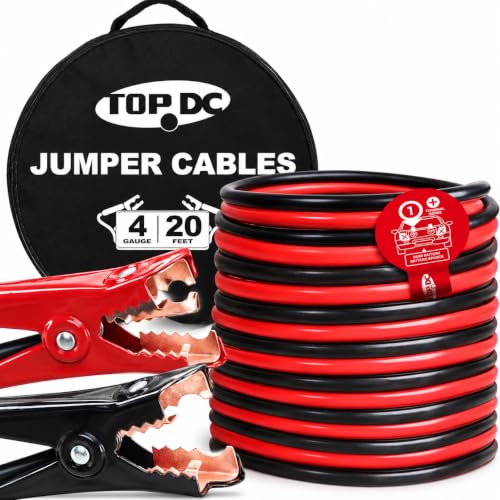
TOPDC 4 Gauge Heavy Duty Jumper Cables
What We Like
- UL certified for extreme temperatures
- 20-foot length reaches most vehicles
- Insulated clamps prevent electric shock
- Includes 600D Oxford storage bag
Trade-offs
- CCA is less conductive than pure copper
- 20 feet can be bulky to store
A 20-foot cable length means you can reach a dead battery even when parked awkwardly in a driveway or lot. The UL listing at temperatures from -40°F to 140°F gives real assurance that these clamps and insulation won’t crack or fail when you need them most. The four reinforced alligator jaws grip both top-post and side-terminal batteries securely, while the insulating rubber on the clamps protects you from accidental shocks. For the driver who wants a dependable set of cables that balance reach, safety, and cold-weather reliability, this is a straightforward choice that doesn’t overcomplicate the job.
The 4-gauge Copper Clad Aluminum wire offers a balance of flexibility and corrosion resistance, though some users may prefer pure copper for maximum conductivity. For most car and SUV batteries, this cable set provides reliable performance. Compared to the NOONE 2 Gauge Jumper Cable, the TOPDC includes a carry bag for storage. The NOONE offers reverse polarity protection and a thicker 2-gauge wire, features that may appeal to those who frequently jump heavy trucks or want extra safety against incorrect connections.
Product photos
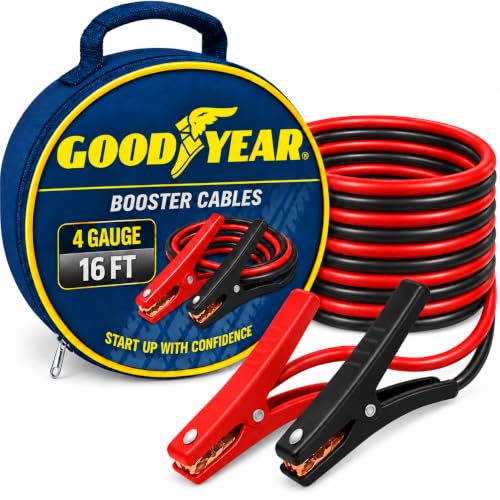
Goodyear Heavy Duty Jumper Cables
What We Like
- 4 gauge wire for efficient energy transfer
- 16 ft length for flexible vehicle positioning
- Weather-resistant PVC insulation stays flexible
- Includes durable carrying case for storage
Trade-offs
- 4 gauge wire is heavier than 6 gauge alternatives
- No polarity protection or smart features mentioned
A 4-gauge wire paired with 16 feet of reach means these cables deliver enough current to jump-start a truck battery without forcing you to park bumper-to-bumper. The 4-gauge construction handles the demands of larger batteries, while the weather-resistant PVC insulation stays pliable even in cold roadside conditions. For truck owners who want a reliable set that stores neatly in a carrying case and works across their whole fleet of vehicles, this is a practical, no-nonsense choice.
The 4-gauge wire delivers efficient energy transfer, so you get a quick jump-start without waiting around. At 16 feet, the cables reach between vehicles without repositioning, though the TOPDC 4 Gauge set offers 20 feet for tighter parking situations. If you want a trusted brand and a compact kit that stores easily in a carrying case, these Goodyear cables get the job done with no unnecessary extras.
Product photos
EXTRESPO Heavy Duty Jumper Cables

What We Like
- UL listed for safety assurance
- Works from -40°F to 140°F
- Flexible cable stays pliable in cold
- Includes carrying case, gloves, and brushes
Trade-offs
- 600A peak limits use with large diesel engines
- Copper clad aluminum less conductive than pure copper
- 4-gauge wire is heavier and less flexible than thinner gauges
A UL-listed rating means these cables meet independent safety standards, a reassurance that matters when you’re leaning over a live battery in the dark. The 20-foot length gives you room to park nose-to-nose or even offset, and the included gloves and brushes turn a simple cable set into a ready roadside kit. You get the basics for a clean, protected jump start without hunting for tools afterward. It’s a thoughtful package for drivers who want one grab-and-go solution for their trunk.
The trade-off is that 600 amps of instantaneous current, while fine for most gas engines up to 6.0 liters and small diesels, won’t fire a big diesel pickup or a commercial truck. A 1000-amp set like the POWERBEST 0 Gauge can handle those bigger engines. And the copper-clad aluminum core, though flexible in the cold, doesn’t conduct electricity as efficiently as pure copper. For the typical car or SUV owner who wants a complete kit with solid safety certification, this is a well-rounded choice. For heavy-duty towing or farm use, you’ll want thicker wire and higher amperage.
Product photos
NOONE 2 Gauge Jumper Cable

What We Like
- S7 reverse polarity protection
- LCD digital voltage display
- UL listed insulated clamps
- Includes carry bag and gloves
Trade-offs
- 20-foot length limits reach with large trucks
- No reverse polarity alert when connected correctly
The reverse polarity protection is the standout reason to pick this set over others. If you’ve ever clipped a jumper cable backward and watched sparks fly, you know the value of a system that aims to prevent short-circuits and connection errors. It lights a red indicator when you connect it wrong. An LCD screen monitors battery voltage during charging, so you can keep an eye on the charge level. The 2-gauge wire handles up to 600 amps of instantaneous current, which covers vans, large SUVs, full-size cars, mid-size cars, trucks, and small cars. UL-listed clamps with non-conducting rubber covering add safety and durability. For drivers who want peace of mind and a clear read on battery health, this is a smart pick in the guide.
The trade-off is that 20 feet of cable and 600 amps won’t cover every scenario. If you regularly jump a diesel pickup or need to reach battery-to-battery across a long driveway, a longer or higher-amp cable may be needed. But for most everyday situations, sedans, crossovers, minivans, and even larger SUVs, the NOONE’s protection features and included gloves and carry bag make it a well-equipped kit. The three-year after-sales support from the brand is a nice bonus for long-term confidence.
Product photos
POWERBEST 0 Gauge Jumper Cables

What We Like
- 30-foot length reaches awkward battery placements
- Clamps have non-conductive rubber spark prevention
- Works in extreme cold down to -40°F
Trade-offs
- Copper-clad aluminum is less conductive than pure copper
- No reverse polarity protection built into clamps
A 0-gauge cable with 1000A peak current means this set can wake up a dead 6.0-liter diesel truck or a large SUV without breaking a sweat.
If you’re only jumping a compact car once a year, the extra length and thickness become overkill and a chore to coil back into the carry bag.
Product photos
Energizer 1 Gauge Jumper Cables

What We Like
- 30-foot length for rear-access jump starts
- Permanent installation kit with quick connect plug
- Includes carry bag for transport and storage
Trade-offs
- At 11 pounds, it is heavy for casual carry
- Overkill for compact cars with small engines
Thirty feet of 1-gauge cable means you can jump-start a dead battery from behind a tow truck or SUV without needing to pull up nose-to-nose. That extra reach, paired with the permanent installation kit and quick connect plug, makes this set a real time-saver for roadside assistance work or anyone who regularly helps stranded drivers. The cables remain flexible even at minus forty degrees Celsius, so cold mornings won’t turn them into a frozen rod.
At eleven pounds, this is not a set you toss in a glove box for emergencies; it lives in a trunk or a service truck. Compared to the lighter 4-gauge options like the TOPDC, the Energizer gives you more reach, but it demands more storage space and muscle to carry. For daily drivers who only need an occasional boost, a shorter, lighter cable makes more sense. For fleet operators, recovery crews, or anyone with a large vehicle, the extra length and thick gauge are worth the heft.
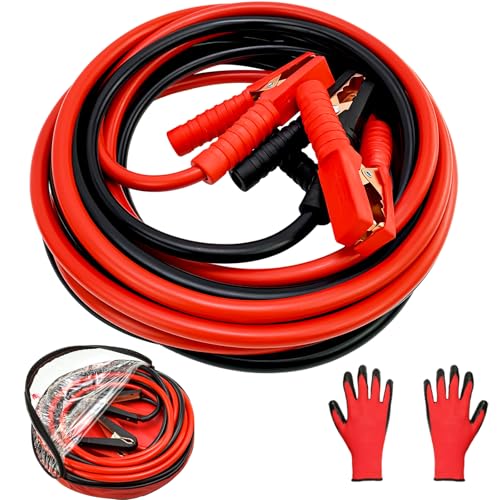
iMeshbean 0 Gauge Jumper Cables
What We Like
- 0-gauge for maximum current flow
- 3000A peak for diesel engines
- 20 ft length for easy reach
- Includes carry bag and gloves
Trade-offs
- Heavy at 8.4 lb for storage
- Overkill for compact car batteries
The trade-off is heft: at 8.4 pounds, this cable is noticeably heavier than a 4-gauge set like the TOPDC 4 Gauge. That weight comes from the thick cable construction, but it means you won’t want it bouncing around in a small car’s trunk. For anyone who regularly jump-starts large vehicles or works with high-capacity batteries, the extra bulk is a fair price for reliable starts.
Product photos
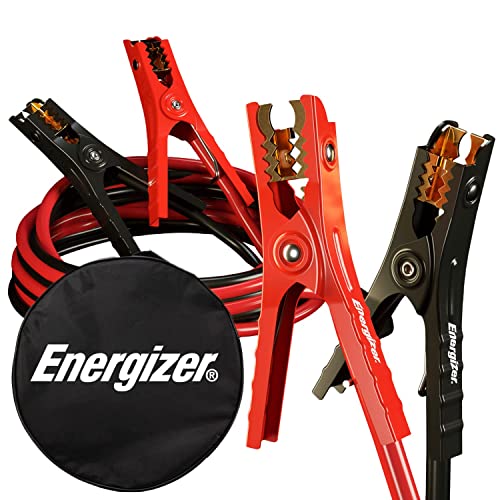
Energizer 6 Gauge Jumper Cables
What We Like
- Vinyl coating resists rust and corrosion
- Carrying bag for compact storage
- Flexible at -40°C for cold-weather use
Trade-offs
- Heavier than 4-gauge cables from TOPDC or Goodyear.
- Shorter than 20-foot cables from TOPDC or EXTRESPO.
These 16-foot, 6-gauge jumper cables use copper clad aluminum wire, which keeps them flexible even at -40°C. The thick vinyl coating protects against rust and corrosion, and the included carrying bag makes storage straightforward. For jump-starting a dead or weak battery in a truck, SUV, full-size car, mid-size car, or compact car, the length is enough to reach from one vehicle to another in most roadside situations.
The 6-gauge wire is rated for trucks, SUVs, full-size cars, mid-size cars and small/compact cars, so it covers the vast majority of everyday vehicles. The 16-foot length gives you enough reach to connect batteries in most roadside situations, though longer cables like the 20-foot TOPDC exist if you regularly park far apart. The thick vinyl coating protects against rust and corrosion, and the included carrying bag makes storage simple.
Product photos
Cartman 4 Gauge Jumper Cables

What We Like
- Rated for -25°C / -13°F operation
- 20 ft length reaches opposite-side batteries
- Rubber-insulated clamps for safe handling
- Fits both top and side post batteries
Trade-offs
- CCA conductor is less conductive than pure copper
- 20 ft cable can be cumbersome to store.
A -25°C cold tolerance means these cables stay flexible and reliable when single-digit temperatures leave other cables stiff as rebar. The 20-foot length also gives you room to park nose-to-nose or even alongside a stranded vehicle, which matters when snowbanks narrow your options. For drivers in northern climates or anyone who keeps a set in the trunk through January, the Cartman set is built for that exact moment.
The Cartman jumper cables use CCA (copper-coated aluminum) conductors, which are less conductive than pure copper, but that difference is negligible for typical cars and midsize pickups. The 20-foot length gives you flexibility to reach batteries on either side of the vehicle, and the rubber-insulated clamps fit both top and side post batteries. With a cold-weather rating down to -25°C (-13°F), these cables are built for winter emergencies, not for heavy-duty diesel trucks or large SUVs where you might notice slower cranking.
Product photos
AutoChat 6 Gauge Jumper Cables
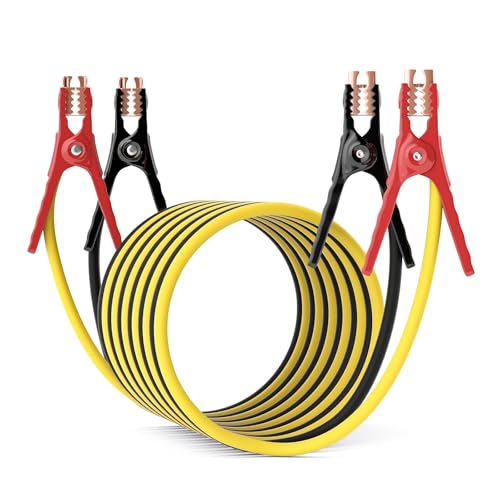
What We Like
- Alligator clamps with jagged teeth grip securely
- Works in extreme temperatures from -40℉ to 140℉
Trade-offs
- Gloves and brushes are basic add-ons, not heavy-duty
- 6-gauge wire is less effective for large trucks or SUVs
The 6-gauge cables work in extreme environments from -40℉ to 140℉, so they won’t fail in cold or hot weather. The cables are tangle-free, making setup easy. For drivers of standard cars and SUVs, these cables deliver enough power to jump-start a dead or weak battery.
Product photos
How We Evaluated Car Jumper Cables
Our evaluation focused on the specifications that determine real-world performance: wire gauge, cable length, temperature rating, and safety certifications. We compared each set’s gauge against standard vehicle battery requirements, thicker wire (lower gauge number) carries more current for larger engines, and considered how length affects reach in tight parking lots or awkward battery placements.
We also examined insulation quality and clamp design. Cold-weather flexibility is critical because stiff cables are hard to coil and connect in freezing temperatures, while well-insulated clamps reduce the risk of accidental sparks. UL listing was a key marker of safety assurance, as it indicates the product has been independently evaluated for electrical and fire hazards.
This research-led approach helps you narrow the field without needing to test cables yourself.
What To Look For In Car Jumper Cables
Choosing the right jumper cables means matching them to your vehicle’s battery and your typical driving conditions. Here are the three criteria that matter most.
The best jumper cables for your car balance wire gauge for your engine size, cable length for reach, and temperature rating for your climate.
Wire Gauge (Thickness)
The gauge number tells you how much current the cable can carry. A lower number means thicker wire and more power delivery. For most cars and SUVs, 4 or 6 gauge is sufficient. Trucks, diesel engines, and large SUVs benefit from 2 or 0 gauge to handle higher cranking amps. Thicker cables are heavier and less flexible, so avoid overbuying if you drive a compact car.
Cable Length
Longer cables give you more flexibility in parking positions, especially in crowded lots or when the dead vehicle is parked nose-first. A 20-foot length covers most situations. If you drive a truck with a side-mounted battery or frequently jump-start vehicles parked in tight spaces, consider 30-foot cables. The trade-off is bulkier storage.
Temperature Rating and Insulation
Cold weather makes standard PVC insulation stiff and hard to manage. Look for cables rated to at least -13°F or -40°F if you live in a northern climate. Rubber or specialized cold-weather insulation stays pliable when you need to connect quickly. UL certification adds peace of mind that the insulation and clamps meet safety standards.
- Check your vehicle’s battery location: top-post or side-post clamps must match
- Look for color-coded clamps (red for positive, black for negative) to avoid confusion
- Ensure the storage bag or case fits in your trunk or under a seat
- Consider a set with built-in polarity protection if you are new to jump-starting
A good rule of thumb: buy the thickest gauge you can comfortably store, in the longest length you can reasonably manage.
Car Jumper Cables Compared
The table below compares all ten jumper cable sets side by side, covering gauge, length, temperature rating, and key features to help you find the right match for your vehicle and budget.
| Product | Gauge | Length | Material | Accessories Included |
|---|---|---|---|---|
| TOPDC 4 Gauge Heavy Duty Jumper Cables | 4 Gauge | 20 Feet | Copper Clad Aluminum (CCA) | Carry Bag |
| Goodyear Heavy Duty Jumper Cables | 4 Gauge | 16 ft | Premium PVC | Carrying case |
| EXTRESPO Heavy Duty Jumper Cables | 4 Gauge | 20 ft | Copper clad aluminum | Case, gloves, brushes |
| NOONE 2 Gauge Jumper Cable | 2 Gauge | 20 Feet | thick vinyl coating | Carry Bag, Gloves |
| POWERBEST 0 Gauge Jumper Cables | 0 AWG | 30 feet | copper-clad-aluminum | Carry Bag |
| Energizer 1 Gauge Jumper Cables | 1 gauge | 30 feet | Copper clad aluminum | Carry Bag |
| iMeshbean 0 Gauge Jumper Cables | 0 Gauge | 20 ft | abrasion-resistant insulation | Carry Bag and Gloves |
| Energizer 6 Gauge Jumper Cables | 6 Gauge | 16 Feet | Copper Clad Aluminum | Carrying Bag |
| Cartman 4 Gauge Jumper Cables | 4 Gauge | 20 ft | CCA (Copper Coated Aluminum) | Carry Bag |
| AutoChat 6 Gauge Jumper Cables | 6 Gauge | 16 Feet | Thick vinyl coating | Carry bag, gloves, brushes |
Frequently Asked Questions
What gauge jumper cables do I need for my car?
For most cars and SUVs, a 4 or 6 gauge cable is sufficient. Trucks and large SUVs with bigger engines typically need a 2 or 0 gauge to deliver enough current for a reliable jump-start. Check your owner’s manual or battery specifications for the recommended cranking amps.
How long should jumper cables be?
A 20-foot length is ideal for most situations, giving you enough reach to position vehicles nose-to-nose or side-by-side. If you drive a larger truck or frequently encounter awkward parking layouts, 30-foot cables provide extra flexibility at the cost of heavier storage.
Can jumper cables be too thick?
Thicker cables (lower gauge) are better for current flow and safety, but they are also heavier and less flexible. For a compact car, a 6 gauge cable is perfectly adequate and easier to store. Choosing a very thick cable like 0 gauge for a small engine is overkill and adds unnecessary bulk.
What does UL listed mean for jumper cables?
UL listing means the product has been independently tested by Underwriters Laboratories for safety standards, including electrical shock and fire resistance. It is a mark of quality assurance that indicates the insulation, clamps, and overall construction meet recognized safety requirements.
How do I store jumper cables in my car?
Most quality jumper cables come with a carrying bag or case. Store them in your trunk or under a seat where they are accessible but out of the way. Avoid leaving cables loose in a hot trunk where they can tangle or be damaged by shifting cargo.
The Bottom Line
The TOPDC 4 Gauge Heavy Duty Jumper Cables are the best choice for most drivers, combining UL certification, a practical 20-foot length, and insulated clamps that work in extreme temperatures. If you drive a truck or need more reach, the Goodyear Heavy Duty set or the POWERBEST 0 Gauge cables offer the thickness and length for bigger batteries.
For budget-conscious shoppers or those wanting a complete kit, the EXTRESPO set includes gloves and brushes, while the Energizer 6 Gauge cables provide reliable cold-weather performance at a more accessible price point. No matter which set you choose, matching the gauge and length to your vehicle is the single most important step in making sure you get back on the road quickly.
