
10 Best Car Lithium Batteries in 2026
This post contains affiliate links. As an Amazon Associate, we earn from qualifying purchases.
For drivers ready to shed lead-acid weight and gain years of reliable starts, the Phnixino Group 94R LiFePO4 Battery earns Best Overall with its 1800 cold-cranking amps and 4000+ deep cycles. The T.E.T LITHIUM Group 47 H5 offers a dedicated Emergency Reserve, while the TPE Group 47 LiFePO4 delivers the Best Lightweight Design at just 11 pounds.
The real challenge with lithium car batteries isn’t the technology, it’s finding one that fits your vehicle’s group size, delivers enough cold-cranking amps for your climate, and matches how you actually use your car. A battery that works perfectly in a daily commuter may frustrate an RV owner who needs deep-cycle capacity.
This guide is built from manufacturer specifications, expert round-ups, and patterns in owner feedback across dozens of lithium battery models. We focused on group size compatibility, cold-cranking performance, cycle life, and weight savings to help you choose confidently.
Top 10 Car Lithium Batteries in the Market
Certain content that appears on this site comes from Amazon. This content is provided "as is" and is subject to change or removal at any time.
The Best Car Lithium Batteries, Reviewed
Phnixino Group 94R LiFePO4 Battery
What We Like
- 1800 CCA for extreme cold starts
- 4000+ deep cycles for 8-10 years
- 60% lighter than lead-acid
- Drop-in replacement for Group 94R
Trade-offs
- 24 lb is heavier than some lithium rivals
- No Bluetooth or app for battery monitoring
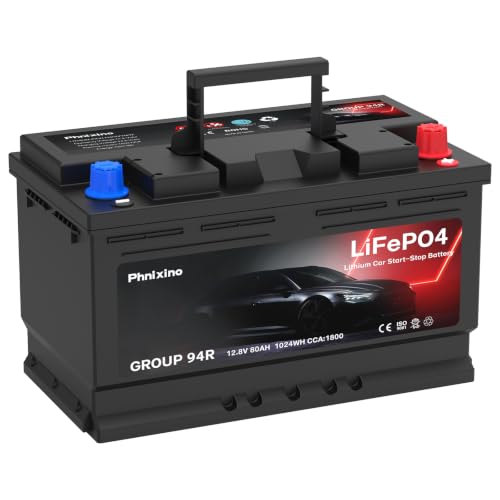
With 1800 cold cranking amps, this battery fires up even turbocharged or high-compression engines in subzero weather, and it keeps doing it for 4000 cycles, roughly eight to ten years of daily use. That kind of longevity makes it a one-time upgrade for drivers who want to ditch lead-acid for good. It fits directly into any Group 94R tray without modifications, and at 24 pounds it shaves off significant weight from the front end, which helps handling and fuel economy.
The trade-off is that 24 pounds, while lighter than a lead-acid equivalent, is still heavier than some lithium competitors like the T.E.T Group 47 H5 at 12.1 pounds. But for a straightforward daily driver that needs reliable cold starts and a decade of service, the 1800 CCA and 4000-cycle life are hard to beat.
Product photos
T.E.T LITHIUM Group 47 H5 Battery
What We Like
- 20% emergency starting reserve
- App battery status monitoring
- Built-in BMS protection
- Lightweight 12.1 lb design
Trade-offs
- Only 40Ah capacity limits deep cycling
- Reserve is for emergency, not routine use
- App monitoring requires connection between trips
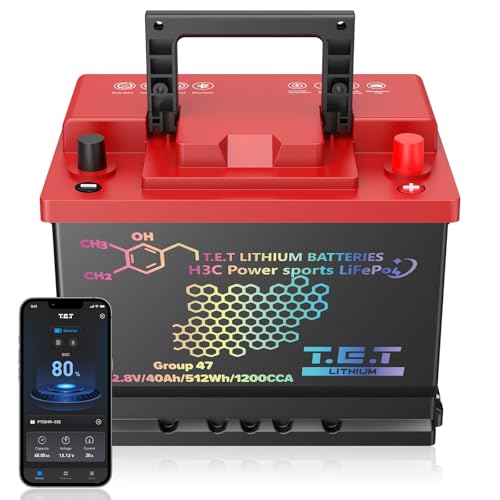
A dedicated 20% emergency starting reserve means this battery holds back a portion of its charge specifically for when your car’s charging system fails. That’s a rare and practical safety net. The built-in BMS and app monitoring let you check battery status between trips, so you can see if the reserve is still available. For drivers who want a lightweight lithium battery with a backup starting reserve, the T.E.T LITHIUM Group 47 H5 offers that feature.
The 40Ah capacity is smaller than the Phnixino Group 94R’s 80Ah. If you need more capacity for extended use without the engine running, the T.E.T’s lower Ah rating means less energy stored. But if your priority is a lightweight battery that emphasizes starting reliability over deep-cycle capacity, this design fits that need. Just remember the emergency reserve is exactly that, a backup, not a fix for a failing alternator.
Product photos
T.E.T LITHIUM Group 48 Starter Battery
What We Like
- Bluetooth app for real-time monitoring
- 20% emergency starting reserve
- 1500-cycle lifespan at full discharge
- Built-in BMS protection circuits
Trade-offs
- App required for smart features to work
- No included charger or battery listed
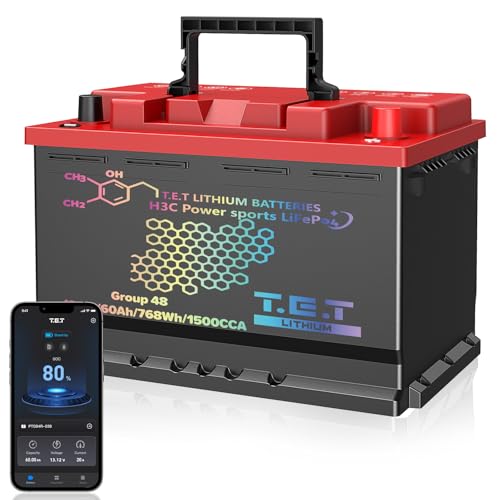
A Bluetooth app that lets you check battery health, toggle power, and even set anti-theft alerts from your phone is the standout feature here. That kind of real-time visibility means you can catch a weak cell before it leaves you stranded. The 20% emergency starting reserve gives you a genuine second chance if you do forget to turn off the dome lights. It’s built for the driver who wants to stay connected to their battery’s state of mind, not just its voltage. The 1500-cycle lifespan at full depth of discharge means it will outlast a typical AGM battery by years in daily start-stop use.
If your vehicle calls for a Group 48 case size and you prioritize smartphone oversight over raw cranking amps, this battery’s app-driven approach and emergency reserve make it a smart fit. Just be prepared to keep your phone handy, because the best monitoring features live entirely in that Bluetooth connection.
Product photos
TPE Group 47 LiFePO4 Car Battery

What We Like
- Weighs only 11 pounds for easy handling
- LiFePO4 chemistry with BMS for safety
- Emergency switch gives 10 extra minutes
- Up to 700 CCA practical starting power
Trade-offs
- No app monitoring for battery status
- Emergency switch can lock if accidentally pressed
At just 11 pounds, this battery cuts nearly half the weight of a traditional lead-acid unit, making installation and handling noticeably easier. The LiFePO4 chemistry paired with a built-in BMS handles start-stop systems and high-demand electronics while protecting against overcharge and deep discharge. That lightweight design also means less strain on your vehicle’s mounting tray and a potential fuel savings of up to 20%, according to the manufacturer. For drivers who swap batteries themselves or want to shed weight without sacrificing cranking power, this is a practical upgrade that fits standard Group 47 spaces.
The emergency switch system has a catch: if the battery drops to 30% charge, the BMS triggers a three-minute warning then shuts off power. That leaves you only a 10-minute window after pressing the silver button. That’s fine for a quick jump-start but not a substitute for a reserve capacity you can monitor. Compared to the T.E.T LITHIUM Group 47 H5, which offers app-based status tracking and a 20% starting reserve, the TPE gives you less visibility into your battery’s health. It’s a straightforward, lightweight choice for those who want simplicity over smart features.
Product photos
Wuldnmar Group 47 LiFePO4 Battery

What We Like
- Lightweight at 11 pounds
- 600 CCA tested to 850 CCA
- LiFePO4 chemistry for long cycle life
- Built-in BMS for overcharge protection
Trade-offs
- Requires a 12V 10A LiFePO4 charger, not included
- Requires a specific LiFePO4 charger for recharging.
Weighing 11 pounds, this Wuldnmar Group 47 LiFePO4 battery is a lightweight option for drivers looking to reduce front-end weight. Its 600 CCA rating, tested up to 850 CCA, provides enough starting power for most daily drivers and start-stop systems. The LiFePO4 chemistry supports thousands of charge cycles, making it a reliable choice for budget-conscious owners who want a straightforward lithium battery without extras like app monitoring.
The trade-off comes in raw cranking power: at 600 CCA, it falls short of the T.E.T LITHIUM Group 47 H5’s 1200 CCA. So if you live in a cold climate or drive a larger engine that needs extra cold-weather punch, that model may be a better fit. Also, this battery requires a dedicated 12V 10A LiFePO4 charger for recharging, something to factor in if you don’t already own one. For most commuters and light-duty vehicles, though, the Wuldnmar delivers excellent value in a lightweight, safety-protected package.
Product photos
ECIENWELL 12V 40Ah LiFePO4 Battery
What We Like
- IP66 waterproof rating
- Emergency force-restart button
- BMS with low-temp heating
- 660CCA for reliable cold starts
Trade-offs
- Only for engines under 2.0L
- Threaded terminal needs M8 screw for some vehicles
- Must fully charge before first use
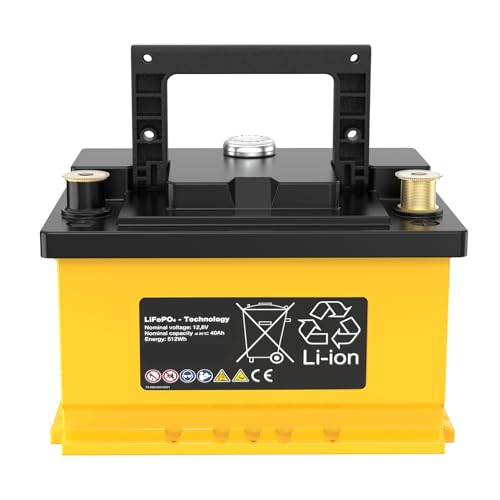
An emergency restart button is there if you accidentally drain it flat, and the IP66 waterproofing means you can install it without worrying about splashes or road spray.
Capacity is the main limitation here. With 40Ah and a 100 reserve capacity, this battery isn’t designed for large V6 or V8 engines or heavy electrical loads. For a small car or weekend vehicle, though, it offers the maintenance-free convenience and deeper cycle life of LiFePO4 chemistry. Just fully charge it before first use, and verify that the added M8 screw height, which raises total height to 9.18 inches, fits your vehicle’s battery tray.
Product photos
Power Queen 12V100Ah Marine Battery
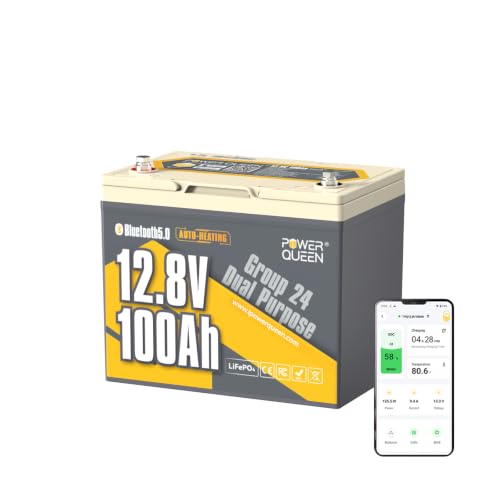
What We Like
- Dual-purpose starting and deep cycle
- 900CCA for outboards up to 250HP
- Bluetooth monitoring with 15% reserve
- Self-heating for cold-weather charging
Trade-offs
- Self-heating takes 30-100 minutes in cold
- Heavier than dedicated starting batteries
900 cold cranking amps and a 100Ah deep-cycle capacity mean this one battery handles both firing up a 250HP outboard and running a trolling motor all day. That dual-purpose design is the whole reason it works so well for boaters who want to replace a two-battery setup with something simpler and lighter to manage. Anglers who spend long days on the water will appreciate the Bluetooth monitoring that shows remaining runtime and the 15% emergency reserve that keeps power in the tank for the trip back to the dock.
That extra mass comes from the larger capacity needed for deep-cycle work, so it makes sense for marine use but feels bulky in a passenger car. For someone who needs a pure starter battery for a daily driver, the lighter T.E.T is a better fit. For a fishing boat that demands both cranking power and all-day electronics, this Power Queen delivers exactly what the dual-purpose label promises.
OMUGO Group 47 H5 LiFePO4 Battery
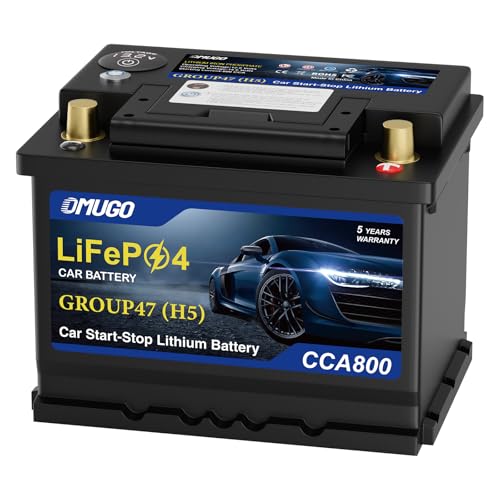
What We Like
- 800 CCA starts in -30°C cold
- Smart BMS with voltage display
- 30% lighter than lead-acid batteries
- Long-lasting LiFePO4 for start-stop systems
Trade-offs
- Group 47/H5 fit only: check polarity before ordering
- No app monitoring like some competitors
An 800 CCA rating that fires up your engine even at -30°C means this battery is built for drivers who face real winter. The LiFePO4 chemistry handles start-stop systems far longer than lead-acid, and at 11 pounds it trims weight off your front end for better steering response. That combination of cold-weather reliability, long cycle life, and lighter handling makes it a smart fit for anyone who parks outside in northern climates or drives a vehicle with frequent stop-start operation.
You give up the app-based battery monitoring found on the T.E.T LITHIUM Group 47 H5, which lets you check state of charge from your phone. Instead, OMUGO gives you a simple voltage display right on the case, less flashy but perfectly functional. Just be sure your vehicle uses Group 47/H5 dimensions and the negative-left, positive-right polarity before you buy, because this battery is built to fit that specific tray and no other.
Product photos
Phnixino Group 47 LiFePO4 Battery
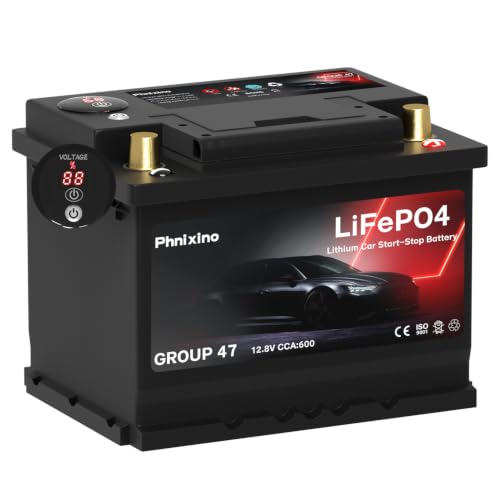
What We Like
- Built-in display shows real-time battery status
- One-touch emergency start button for stalls
- Advanced BMS protects against overcharge, over-discharge
- 2x cold cranking power vs lead-acid
Trade-offs
- Heavier than some lithium competitors at 17.0 pounds
A built-in display that shows real-time battery status and a one-touch emergency start button set this Group 47 lithium battery apart. If you’ve ever been stranded by a dead battery or a stalled engine, that button alone can save a tow truck call. The LiFePO4 chemistry also brings 2x the cold cranking power of a typical lead-acid battery, so cold mornings are less of a gamble. This is a battery for drivers who want visibility and control, not just a black box under the hood. The advanced BMS handles overcharge, over-discharge, and short circuits, which means the battery looks after itself while you drive.
At 17.0 pounds, this battery is heavier than some lithium alternatives, but that weight includes a built-in display and emergency start button that let you check battery status and restart the engine if it stalls. The 600CCA rating matches typical gasoline car needs, and the LiFePO4 chemistry with a BMS protects against overcharge and short circuits. For drivers who want real-time battery visibility without guessing, the display and button add practical convenience.
Product photos
VATRER POWER 12V 300Ah LiFePO4 Battery
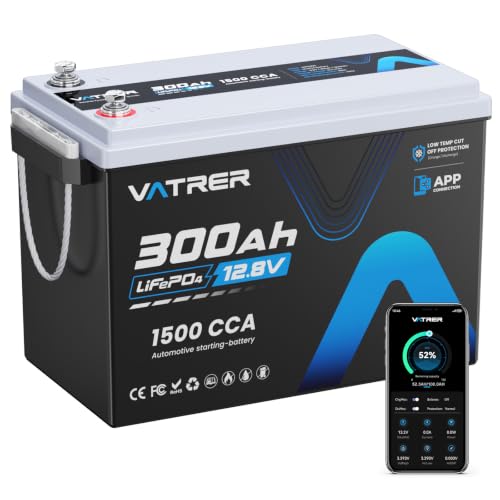
What We Like
- 300Ah deep-cycle with 5000+ cycles
- 1500A startup surge for cranking
- APP monitors voltage, current, SOC
- Expands to 61.44kWh (4P4S)
Trade-offs
- At 55.2 lb, heavy for portable use
- Large footprint (15.2 x 7.6 x 9.8 in)
- Requires 14.6V 70A charger for 4.5h full charge
A 300Ah capacity means this battery can power an RV fridge, lights, and electronics for days without recharging, or deliver a 1500-amp surge to crank a big diesel engine. It’s a true dual-purpose design: one BMS mode handles deep cycling for solar or off-grid storage, and another switches to high-rate discharge for starting. That flexibility makes it a natural fit for van lifers, boat owners, or anyone running a small cabin who also needs reliable engine starts. The app gives you real-time voltage, current, and state of charge, so you’re never guessing how much power is left.
Size and weight are the main considerations. It’s built for a permanent installation where space isn’t tight. Compared to a Group 47 LiFePO4 like the OMUGO (11 pounds, 800CCA), the VATRER POWER is clearly for stationary or semi-permanent setups rather than daily driving. If you need a lightweight starter battery for a commuter car, this is overkill. But if you want one battery that handles both deep storage and cranking without compromise, the capacity and dual-mode BMS deliver exactly that.
Product photos
How We Evaluated Car Lithium Batteries
Our evaluation started with a deep look at manufacturer specifications and engineering documentation for each battery’s chemistry, dimensions, and electrical ratings. We cross-referenced these against the most common vehicle group sizes to identify true drop-in replacements versus batteries that require modifications.
Three criteria drove our rankings: cold-cranking amps (CCA) for reliable starting in cold weather, cycle life for long-term value, and weight reduction versus comparable lead-acid batteries. We also weighed the importance of built-in battery management systems (BMS) that protect against overcharge, over-discharge, and temperature extremes.
A research-led approach means we rely on published data and owner feedback patterns. We cannot verify every claim about cycle life or cold-start performance in real-world conditions, but we can identify which models consistently deliver the specifications that matter most for your driving needs.
What To Look For In Car Lithium Batteries
Choosing a lithium car battery starts with matching your vehicle’s group size, then evaluating cold-cranking amps for your climate, and finally considering extras like Bluetooth monitoring or emergency reserve power.
Match the group size, check CCA for your winter temps, confirm BMS protection, and decide if app monitoring or emergency reserve matters for your driving habits.
Group Size and Fitment
Lithium batteries must physically fit your vehicle’s battery tray and match the terminal orientation. Group sizes like 94R, 47, and H5 correspond to specific dimensions and terminal layouts. A battery that doesn’t match your group size may not secure properly or reach your cables.
Cold-Cranking Amps (CCA)
CCA measures how well a battery starts an engine in cold temperatures. Lithium batteries often deliver higher CCA than their lead-acid counterparts at the same physical size. For cold climates, look for at least 600 CCA; extreme winter areas benefit from 800 CCA or more.
Battery Management System (BMS)
A BMS protects the lithium cells from overcharge, over-discharge, short circuits, and temperature extremes. It’s essential for safety and longevity. Some BMS units include low-temperature charging protection, which prevents charging below freezing to avoid cell damage.
Cycle Life and Warranty
Lithium batteries typically offer thousands of deep cycles versus a few hundred for standard lead-acid. This translates to years of additional service. Check the stated cycle life at a specific depth of discharge to understand real-world longevity.
- Verify your vehicle’s group size before purchasing
- Compare CCA ratings against your climate’s coldest expected temperature
- Confirm the BMS includes low-temperature charging protection for cold climates
- Decide whether Bluetooth monitoring or emergency reserve features justify a higher cost
- Check terminal type (top post, threaded, or side post) matches your cables
A battery that fits poorly or lacks adequate CCA for your climate will disappoint regardless of its other features.
Car Lithium Batteries Compared
The table below compares the key specifications of our top ten car lithium batteries, including group size, weight, CCA, and standout features to help you narrow your choices.
| Product | Chemistry | CCA | Weight |
|---|---|---|---|
| Phnixino Group 94R LiFePO4 Battery | LiFePO4 | 1800 | 24.0 lb |
| T.E.T LITHIUM Group 47 H5 Battery | LiFePO4 | 1200 | 12.1 lb |
| T.E.T LITHIUM Group 48 Starter Battery | LiFePO4 | N/A | 17.4 pounds |
| TPE Group 47 LiFePO4 Car Battery | LiFePO4 | 600A | 11.0 Pounds |
| Wuldnmar Group 47 LiFePO4 Battery | LiFePO4 | 600A | 11.0 Pounds |
| ECIENWELL 12V 40Ah LiFePO4 Battery | LiFePO4 | 660 | 14.8 lb |
| Power Queen 12V100Ah Marine Battery | LiFePO4 | 900CCA | 22.7 Pounds |
| OMUGO Group 47 H5 LiFePO4 Battery | LiFePO4 | 800 CCA | 11.0 lbs |
| Phnixino Group 47 LiFePO4 Battery | LiFePO4 | 600CCA | 17.0 pounds |
| VATRER POWER 12V 300Ah LiFePO4 Battery | LiFePO4 | N/A | 55.2 lb |
Frequently Asked Questions
How long do lithium car batteries last?
Lithium iron phosphate (LiFePO4) car batteries typically last 8 to 10 years with proper care, offering thousands of deep cycles depending on the model. That’s longer than standard lead-acid batteries, which usually need replacement every few years.
Can I replace my lead-acid battery with a lithium battery?
Yes, if you match the group size, terminal orientation, and voltage. Most lithium car batteries are designed as direct drop-in replacements for specific group sizes like 94R or Group 47. Always verify dimensions and terminal locations against your vehicle’s battery tray.
Do lithium car batteries work in cold weather?
Many lithium batteries include low-temperature charging protection and can still deliver high cold-cranking amps for starting. Some models feature self-heating or BMS systems that allow charging at sub-freezing temperatures. Check the minimum operating temperature and CCA rating for your climate.
What is a battery management system (BMS)?
A BMS is an electronic circuit inside the battery that monitors voltage, current, and temperature. It protects against overcharging, over-discharging, short circuits, and extreme temperatures. A BMS is essential for safe operation and long life in lithium car batteries.
Do I need a special charger for lithium car batteries?
Yes, most lithium batteries require a charger specifically designed for LiFePO4 chemistry. Standard lead-acid chargers may not charge lithium batteries correctly or could damage them. Some lithium batteries include a charger, but many require a separate purchase.
The Bottom Line
The Phnixino Group 94R LiFePO4 Battery is our Best Overall pick for drivers of sedans, SUVs, and trucks who want a straightforward drop-in replacement with massive cold-cranking power and a decade-long lifespan. Its 1800 CCA handles extreme cold starts, and the 60% weight savings over lead-acid makes handling easier.
Budget-conscious drivers should look to the Wuldnmar Group 47 LiFePO4 Battery for an affordable entry into lithium power, while those who want phone-based battery monitoring will appreciate the T.E.T LITHIUM Group 48 Starter Battery. For cold climates, the OMUGO Group 47 H5 delivers reliable starts down to -30°C.
The single most important buying decision is matching the group size to your vehicle, everything else flows from that fit. Choose a battery that drops into your tray, meets your climate’s CCA needs, and includes a capable BMS, and you’ll enjoy years of reliable, lightweight starting power.
