
10 Best Car Mobile Chargers in 2026
This post contains affiliate links. As an Amazon Associate, we earn from qualifying purchases.
For drivers who need to keep a laptop, phone, and tablet powered on the road, the Spigen ArcStation Essential 113W Car Charger earns its spot as the best overall. It delivers 113 watts across three ports, including a 100W USB-C port that can charge a MacBook Air 51% in half an hour. For those who need even more power, the Anker 167.5W 3-Port Car Charger leads the high-power category, while the Anker 75W Retractable Cable Car Charger offers a tidy solution for clutter-free interiors.
The challenge with car charging is balancing power output with port count and physical size. Not every charger can fast-charge a modern laptop, and many that do are bulky or lack the ports needed for multiple passengers. Finding the right one means matching your device needs to the charger’s real-world capabilities.
This guide is based on a careful review of manufacturer specifications, expert round-ups, and patterns in owner feedback. We break down the key features that matter most for road warriors, commuters, and families, so you can pick the charger that fits your driving style.
Top 10 Car Mobile Chargers in the Market
Certain content that appears on this site comes from Amazon. This content is provided "as is" and is subject to change or removal at any time.
The Best Car Mobile Chargers, Reviewed
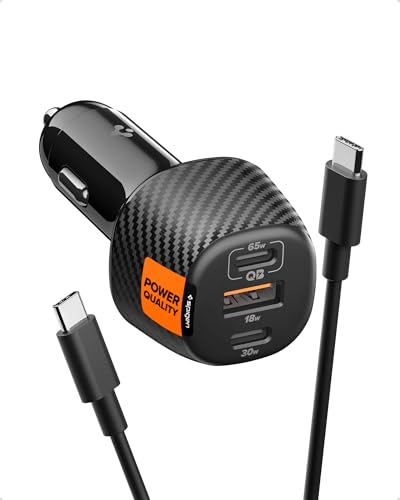
Spigen ArcStation Essential 113W Car Charger
What We Like
- 113W total across three ports
- Includes 100W USB-C cable
- Charges MacBook Air 51% in 30 min
- Compact 1.41-inch square design
Trade-offs
- USB-C2 limited to 30W
- USB-A capped at 18W
With a full 113W of total output, this charger can juice up a MacBook Air to 51% in half an hour while simultaneously topping off a Galaxy S25 Ultra to 70%. That kind of multi-device speed is rare in a package this small, just 1.4 inches square, so it won’t hog your dashboard or stick out like a sore thumb. It’s the charger you grab when you need one plug to handle a laptop, a phone, and maybe a friend’s device on a road trip, all without playing the ‘who charges first’ game.
The trade-off is that the second USB-C port delivers 30W and the USB-A only 18W, so if you’re regularly charging two high-power laptops, you’d want the Anker 167.5W model for its extra headroom. But for most drivers, one laptop, a phone or two, the Spigen’s included 100W cable and compact footprint make it the more practical everyday companion. The blue LED is a nice touch for finding ports at night, though it might annoy light-sensitive passengers on long drives.
Product photos
Anker 167.5W 3-Port Car Charger

What We Like
- 100W USB-C port charges a 16-inch MacBook Pro 0-50% in 47 minutes
- Triple-port design powers three devices at once
- Ultra-compact size won't clutter your car interior
- Includes a 3.3 ft USB-C to USB-C cable
Trade-offs
- Only one port delivers full laptop-charging speed (100W)
- No retractable cable or built-in cable storage
A 100W USB-C port means you can charge a 16-inch MacBook Pro from dead to half in 47 minutes, making this the obvious pick if you need laptop-level power on the road. With two more ports, a 45W USB-C and a 22.5W USB-A, you can juice a phone and a tablet at the same time without slowing down the main charge.
Only one port on this Anker hits that 100W peak; the second USB-C tops out at 45W, which is still fast for a phone but won’t fully power a larger laptop on its own. If you regularly need to charge two laptops simultaneously, the Spigen ArcStation Essential 113W offers a different power split, though its exact per-port output isn’t detailed here. But for most drivers who just need a single laptop charge plus phone and accessory power, this Anker delivers the highest single-port wattage in a very compact package.
Anker 75W Retractable Cable Car Charger

What We Like
- Built-in 29.5-inch retractable cable
- 45W + 30W dual-device charging
- Clutter-free cable storage system
- 18-month warranty included
Trade-offs
- 45W cable limits laptop charging speed
- Only two ports total
- Cable length fixed at 29.5 inches
The retractable cable extends more than two inches with a pull and retracts swiftly with a short pull and release, so you never wrestle with tangled cords again. That 45W cable paired with a separate 30W USB-C port means both a tablet and a phone can charge at decent speed without fighting for power. For drivers who value a tidy cabin and hate digging for cables under seats, this Anker turns the car charger into a neatly stowed tool you actually enjoy using.
The 45W on the retractable cable won’t fully charge a 14-inch MacBook Pro at its fastest rate, so power users might feel the limit. The Spigen ArcStation Essential 113W offers more total wattage and an extra port, but it lacks the integrated cable that makes this Anker so convenient. If you prioritize a clean, organized interior and charge mostly phones, tablets, and smaller laptops, the retractable design makes this a satisfying daily companion.
Product photos
UGREEN 130W 3-Port Car Charger

What We Like
- 130W total output powers laptops and tablets
- Two USB-C ports plus one USB-A
- 45W PPS fast charging for Samsung Galaxy
- Scratch-resistant finish and soft blue LED
Trade-offs
- No charging cable included in the box
With a total output of 130W, this charger can power a MacBook, iPad, or phone at top speed, making it a good fit for road trips where multiple devices need charging. The two USB-C ports and one USB-A port let you connect a mix of newer and older gadgets. The USB-C2 port supports up to 45W PPS charging, which is ideal for Samsung Galaxy S24 Ultra and other PPS-compatible phones. UGREEN includes protection against overheating, short-circuit, over-voltage, and over-current, which helps keep your devices and car safe during use.
The charger does not include any cables, so you will need to supply your own USB-C and USB-A cords. At 3.1 inches long, it is slightly longer than the Spigen ArcStation Essential 113W, which measures 2.8 inches and comes with an E-Marker cable. If you prioritize a smaller footprint, the Spigen may be a better fit. But if you need the higher wattage to charge a laptop and multiple phones at full speed, the UGREEN 130W delivers that capability.
AGEK 78W 4-Port Metal Car Charger
What We Like
- Real-time LED voltmeter for voltage check
- Aluminum alloy shell aids heat dissipation
- Four ports charge multiple devices at once
- Supports PD, PPS, and QC 3.0 protocols
Trade-offs
- Small size can be hard to grip when unplugging
- No built-in cable included
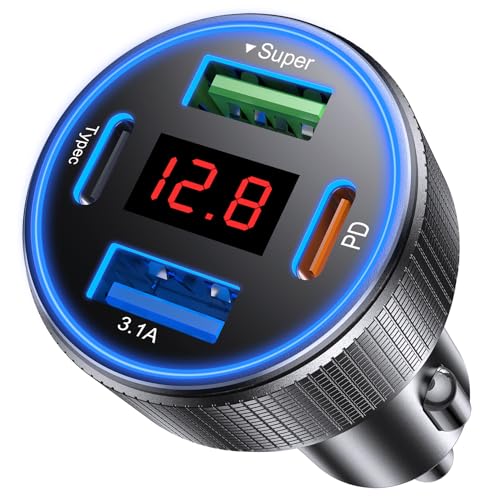
A built-in LED voltmeter that shows your vehicle’s input voltage in real time sets this charger apart. It lets you keep an eye on battery health during daily drives or long road trips without extra gear. With two USB-C and two USB-A ports sharing 78W, it can handle phones, tablets, dash cams, and GPS units all at once, making it a practical companion for families, rideshare drivers, or anyone who juggles multiple devices on the move. The aluminum alloy shell helps pull heat away during charging, and the smart chip guards against overvoltage, overcurrent, overheating, and shorts.
78 watts is enough to charge phones and tablets quickly, but it won’t power up a laptop the way a 167.5W charger like the Anker can. That’s a reasonable trade-off if you want a compact metal charger that monitors your car’s voltage while keeping four devices running. Drivers who need to check their electrical system and top off smaller gadgets will find this combination practical and space-efficient.
Belkin BoostCharge 42W Dual Port Car Charger
What We Like
- 30W USB-C PD for fast charging
- PPS adjusts voltage for Samsung devices
- Compact 0.9-inch width fits tight sockets
- Post-consumer recycled housing
Trade-offs
- Only 2 ports limit simultaneous passengers
- USB-A limited to 12W for slower charging
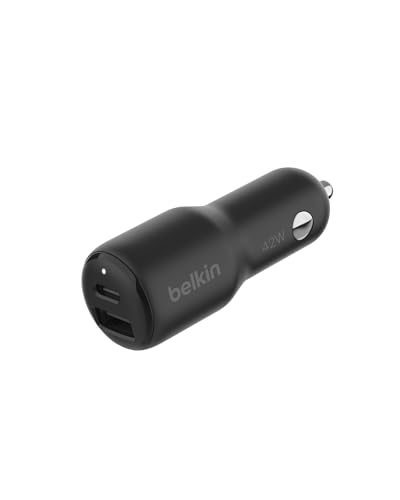
Fast charging an iPhone from zero to 50% in 21 minutes means you can get a meaningful battery boost during a short drive, not just a trickle. The 42W dual-port design fits into tight 12V sockets thanks to its one-inch width, so it won’t block the next port or stick out awkwardly. PPS technology lets it adjust voltage for Samsung Galaxy phones, delivering the right power instead of a generic slow charge.
The USB-A port on this Belkin tops out at 12W, so the second device charges at a more leisurely pace than the USB-C side. Compared to the Spigen ArcStation Essential 113W, which offers three ports and a higher total output, this Belkin is better suited for someone who values a tiny footprint over multi-device speed. For two smartphones, it is a tidy, reliable fit.
Product photos
Belkin 75W Retractable Cable Car Charger
What We Like
- Built-in retractable tangle-free cable
- 60W from cable charges laptops
- Charges iPhone 16 Pro 0-50% in 27 min
- 2-year coverage with CEW
Trade-offs
- Only 60W from retractable cable, not 75W
- No USB‑A port fast charging for older devices
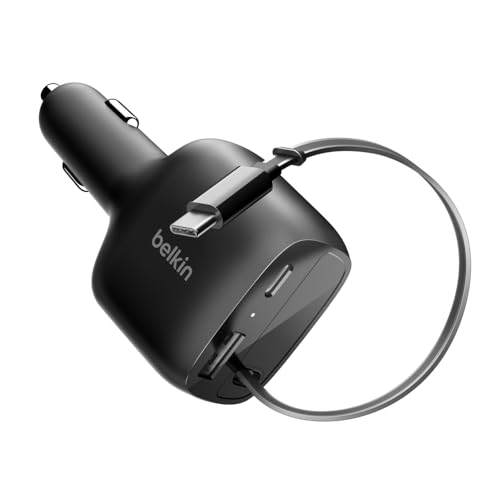
A 60W retractable USB-C cable built right into the charger means you never have to dig around for a separate cord, just pull it out, plug in, and when you’re done it snaps back tidy. That 60W is enough to charge a MacBook Air or iPad Air on the go, while the extra USB-A port lets you top off a second device at the same time. This is the charger for drivers who want one clean cable that stays in the car, not a tangle of wires sliding off the seat.
The retractable cable on this model delivers up to 60W, not the full 75W the charger can produce total. So if you plug a laptop into the cable and a phone into the USB-A port, the cable gets the priority power. Compared to the Anker 75W Retractable Cable Car Charger, which weighs slightly more at 0.3 pounds, the Belkin is a touch lighter and uses 90% post-consumer recycled materials.
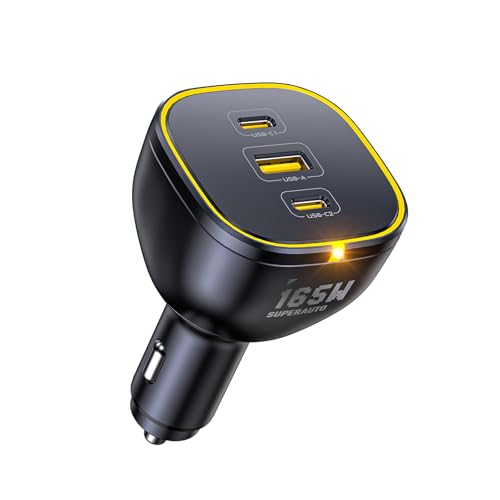
AOHI 165W PD 3.1 Car Charger
What We Like
- First car charger with constant 140W PD 3.1
- Three ports charge simultaneously without interruptions
- Aviation-grade alloy shell with fireproof design
- Supports PD 3.1, PD 3.0, QC 4.0, PPS 2.0
Trade-offs
- Requires USB-C to MagSafe 3 cable for full MacBook speed
- Heavier than some compact car chargers at 0.3 pounds
- No built-in cable, so you must carry your own
A constant 140W PD 3.1 output from a car charger means you can juice up a MacBook Pro 16 from dead to 56% in just 30 minutes, if you pair it with a USB-C to MagSafe 3 cable. This is the first car charger to hold that full 140W without dropping power, which makes it a real option for laptop power users who need serious charging on the road. With two USB-C ports and one USB-A, you can top off a phone and a tablet at the same time without any interruptions when you plug or unplug devices. The aviation-grade alloy shell and eight-layer protection add peace of mind for long trips.
You need to bring your own MagSafe 3 cable to unlock that 140W speed for a MacBook, which adds a small hassle if you forget it at home. Compared to the Anker 167.5W 3-Port Car Charger, this AOHI delivers a higher single-port output for laptops, but the Anker is more compact and lighter if portability is your priority. For anyone who regularly charges a powerful laptop in their vehicle and wants the fastest possible top-up, this charger earns its place as the go-to choice.
Product photos
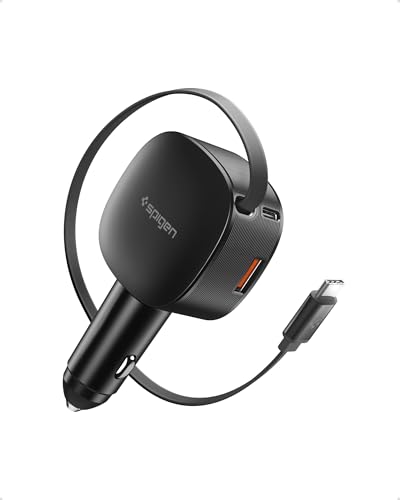
Spigen 3-in-1 60W Retractable Car Charger
What We Like
- Retractable cable snaps back with one click
- Three devices charge simultaneously
- Four-way circuit protection included
Trade-offs
- Built-in cable fixed at 28.3 inches
- 60W total output limits laptop charging capability
A retractable cable that pulls out to any length and clicks back into the housing with one press is the single most practical feature for keeping your center console free of cord spaghetti. This is the charger for anyone who values a tidy cabin over raw wattage, especially if you commute daily or share rides and hate untangling cables between trips.
The Anker 167.5W 3-Port Car Charger offers far more total power for that scenario, but it lacks any retractable cable, meaning you bring your own cords and deal with the clutter. The Spigen wins on convenience and cable management, but it is best suited for phones, tablets, and smaller gadgets rather than power-hungry laptops.
Product photos
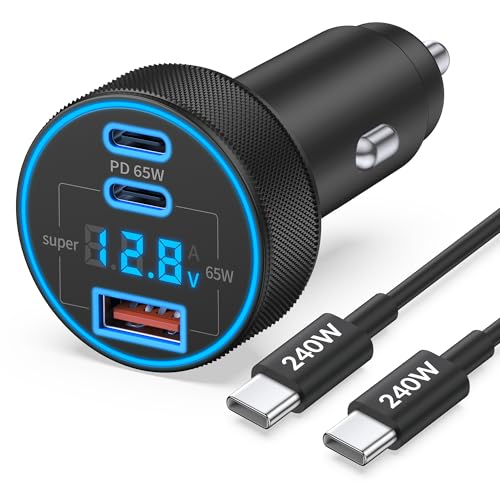
JUNVANG 130W Car Charger with Voltage Display
What We Like
- Real-time car battery voltage monitor
- 240W USB-C cable included
- Three ports with smart power distribution
Trade-offs
- Only one USB-A port for older devices
- Cable is not retractable or built into the charger
A built-in LED voltmeter shows your car battery’s voltage in real time, so you can spot a weak electrical system before it leaves you stranded. This JUNVANG charger delivers up to 130W total across three ports, and the included 240W USB-C cable means you’re ready for fast charging right out of the box. It’s a smart pick for drivers who want both phone charging and a little extra insight into their vehicle’s health, especially on long trips or older cars where battery condition matters most.
The included cable is not retractable or built into the charger, so you’ll need to keep it handy in your car. Compared to the Anker 75W Retractable Cable Car Charger, this model trades the tidy all-in-one design for higher total power and that useful voltage display. If you prefer a clutter-free setup with a cable that always stays in the car, the Anker might suit you better. But if you want the highest wattage and a battery monitor, the JUNVANG delivers where it counts.
Product photos
How We Evaluated Car Mobile Chargers
Our evaluation is research-based, drawing on manufacturer datasheets, expert technical round-ups, and common themes in owner experiences. We focused on the specifications that directly affect charging speed and usability rather than subjective impressions.
The criteria that mattered most were total power output (watts), individual port capabilities, and physical design. A charger may advertise a high total wattage, but if its USB-C ports share power or one is capped at a low output, it won’t charge a laptop at full speed. We also prioritized compactness and build quality, since a charger that protrudes too far or runs hot can be a nuisance in a tight dashboard socket.
We compared published specs like USB-C Power Delivery (PD) profiles and PPS support, and we weighed common owner feedback about reliability, heat, and cable durability. This approach gives you a clear, honest picture of what each charger can and cannot do before you buy.
What To Look For In Car Mobile Chargers
Choosing the right car charger starts with knowing your devices’ power needs and your car’s socket layout. Here are the key factors that separate a good charger from a great one.
Focus on total wattage, individual port power, and physical size. A 100W USB-C port is essential for laptop charging, while PPS support can speed up Samsung and newer Pixel phones. Compact designs prevent blocking adjacent sockets.
Total Power Output and Port Distribution
The total wattage a charger can deliver is the headline number, but how that power is split across ports matters just as much. A 130W charger with two USB-C ports may only provide 100W from one port and 30W from the other when both are in use. For laptop users, look for at least one port that can deliver 60W or more continuously. Multi-device households should check if the charger can maintain high-speed charging on two ports simultaneously.
Charging Protocols and Device Compatibility
Fast charging isn’t universal. USB-C Power Delivery (PD) is the standard for most laptops and newer phones, while Qualcomm Quick Charge (QC) is common on older Android devices. Programmable Power Supply (PPS) is a newer protocol that allows finer voltage control, often resulting in faster, cooler charging for Samsung Galaxy and Google Pixel phones. A charger that supports PD, PPS, and QC 3.0 will cover the widest range of devices.
Physical Design and Build Quality
A car charger lives in a tight space and sees temperature swings. Compact designs that fit flush or nearly flush in most sockets reduce the risk of being knocked loose. Metal housings, like aluminum alloy, dissipate heat better than plastic, which can improve long-term reliability. Also consider whether you prefer a built-in retractable cable for tidiness or separate cables for flexibility.
- Check the charger’s width to ensure it won’t block adjacent power outlets or USB ports in your car.
- Look for a model with a built-in voltmeter if you want to monitor your car battery’s health while driving.
- For retractable cable models, verify the cable length is long enough to reach your device from the socket.
- Consider the warranty length; longer coverage often indicates greater manufacturer confidence.
A good rule of thumb: match the charger’s highest single-port wattage to your laptop’s charging requirements, then ensure the remaining ports offer enough power for your phone or tablet.
Car Mobile Chargers Compared
The table below compares the key specs of our top picks side-by-side, making it easy to see which charger best fits your power needs and budget.
| Product | Total Power | Ports | Dimensions |
|---|---|---|---|
| Spigen ArcStation Essential 113W Car Charger | 113W | 2 USB-C, 1 USB-A | 2.8 × 1.2 × 1.2 inches |
| Anker 167.5W 3-Port Car Charger | 167.5W | 3 (2 USB-C, 1 USB-A) | N/A |
| Anker 75W Retractable Cable Car Charger | 75W | 1 retractable USB-C (45W) + 1 USB-C (30W) | 3.2 x 1.4 x 1.4 in |
| UGREEN 130W 3-Port Car Charger | 130W | 2 USB-C, 1 USB-A | 3.1 x 1.4 x 0.9 inches |
| AGEK 78W 4-Port Metal Car Charger | 78W | 2 USB-C + 2 USB-A | 1.2 x 1.2 x 2.6 inches |
| Belkin BoostCharge 42W Dual Port Car Charger | 42W | USB-C (30W PD) + USB-A (12W) | 0.9 x 1.0 x 2.6 inches |
| Belkin 75W Retractable Cable Car Charger | 75W | 1 USB-C retractable + 1 USB-A | 1.4 x 2.0 x 3.8 inches |
| AOHI 165W PD 3.1 Car Charger | 165W | 2 USB-C, 1 USB-A | N/A |
| Spigen 3-in-1 60W Retractable Car Charger | 60W | 3 (1 built-in USB-C, 1 USB-C, 1 USB-A) | 3.9 x 2.0 x 1.1 inches |
| JUNVANG 130W Car Charger with Voltage Display | 130W Max | 2 USB-C + 1 USB-A | N/A |
Frequently Asked Questions
How many watts do I need in a car charger?
It depends on your devices. To charge a modern laptop, look for a USB-C port that delivers at least 60W. For phones, 18W to 30W is usually sufficient for fast charging. A total output of 75W or more gives you flexibility for multiple devices.
Can I charge a MacBook Pro in my car?
Yes, but you need a charger with a USB-C port that supports Power Delivery at 60W or higher. The Anker 167.5W model, for example, can charge a 16-inch MacBook Pro from 0 to 50% in about 47 minutes. Always check the charger’s output specs against your laptop’s requirements.
What is PPS charging and do I need it?
Programmable Power Supply (PPS) is a feature of the USB-C PD 3.0 standard that allows the charger to adjust voltage in small increments. This can lead to faster, more efficient charging for compatible devices like Samsung Galaxy phones and Google Pixels. It’s a nice extra but not essential if your phone doesn’t support it.
Are retractable cable car chargers reliable?
Good retractable cable chargers, like the Anker 75W model, use durable mechanisms designed for thousands of cycles. They reduce cable clutter and are convenient for daily use. However, the cable length is fixed and often shorter than a separate cable, so check that it reaches your device.
What does a voltmeter on a car charger do?
A built-in voltmeter displays your car’s battery voltage in real time. A healthy battery reads around 12.6 volts when the engine is off and 13.5 to 14.5 volts when running. This feature can alert you to a weak battery or charging system problem early.
The Bottom Line
The Spigen ArcStation Essential 113W Car Charger is our top recommendation for most drivers. Its combination of a powerful 100W USB-C port, a compact 1.41-inch square design, and an included 100W cable makes it the most versatile choice for charging a laptop and phone simultaneously without hogging dashboard space.
If your needs are more specific, one of our award picks likely fits better. The Anker 167.5W is the best bet for power users who need to charge a high-end laptop quickly, while the Anker 75W Retractable Cable model is ideal for those who prioritize a clean, cable-free interior. For a charger with a built-in voltmeter, the AGEK 78W offers a practical way to keep an eye on your battery.
The single most important factor is matching the charger’s port power to your laptop’s requirements. Everything else, port count, cable type, and physical size, is secondary once you confirm that one port can deliver the watts your primary device needs.
