
10 Best Car Sound Deadening Insulations in 2026
This post contains affiliate links. As an Amazon Associate, we earn from qualifying purchases.
For drivers tired of road noise, the Siless Hybrid 3in1 Sound Deadening Mat is the best overall car sound deadening insulation because its triple-layer design tackles vibration, heat, and noise in a single 200-mil application. The Dynamat Xtreme holds the Best Brand Heritage award for its pioneering reputation, while the FatMat Rattletrap Bulk Pack earns Best Large Coverage for whole-vehicle jobs.
Road noise, engine drone, and panel vibration turn every drive into a headache. The real challenge is finding a material that blocks sound without adding unnecessary weight, complicated installation steps, or a strong odor inside the cabin.
This guide is based on manufacturer specifications, expert round-ups, and patterns in owner feedback across ten products. We focused on what matters most: thickness, coverage, installation ease, and heat resistance.
Top 10 Car Sound Deadening Insulations in the Market
Certain content that appears on this site comes from Amazon. This content is provided "as is" and is subject to change or removal at any time.
The Best Car Sound Deadening Insulations, Reviewed
Siless Hybrid 3in1 Sound Deadening Mat

What We Like
- Triple-layer design: damping, heat barrier, sound insulation
- Thick 200 mil construction for heavy-duty noise blocking
- Peel-and-place installation, no messy adhesives required
- Covers 25 sq ft per package
Trade-offs
- No installation roller included in the package
- Coverage area smaller than some bulk packs (25 sq ft)
A three-layer composite that packs damping, heat blocking, and sound insulation into one 200-mil sheet is the reason this mat stands out. Instead of buying separate layers for vibration control and thermal protection, you get a single peel-and-place barrier that handles low-frequency road noise, exhaust heat, and rattles at once. For someone who wants a straightforward upgrade without juggling multiple products or spraying on messy adhesives, this design simplifies the whole job.
This mat’s 200-mil thickness is more than double that of typical 80-mil sound deadeners, so it’s designed to tackle noise, vibration, and heat all in one layer rather than stacking separate products. You get 25 square feet per pack, which covers a pair of car doors or a trunk floor, but larger areas like a full van might need two boxes. It’s a purpose-built solution if you want a single material that handles multiple jobs without layering.
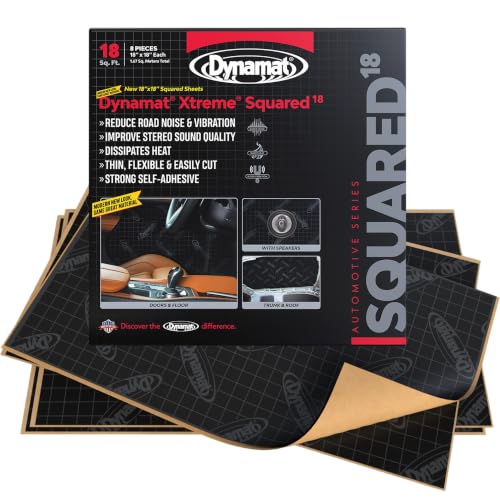
Dynamat Xtreme Sound Deadening Mat
What We Like
- Pioneering brand that created the category
- Self-adhesive backing for fast installation
Trade-offs
- Only 18 sq ft, not enough for a full vehicle
- Thinner than many 80-mil competitors
You will likely need multiple kits to do a full vehicle, and at 0.1 inches thick, it is not the thickest option on the shelf. If you are tackling a focused project like a trunk or a set of doors, this is a straightforward, reliable choice.
FatMat Rattletrap Sound Deadener Bulk Pack

What We Like
- 50 sq ft covers large areas in one roll
- Patented Super-Stick adhesive for secure bond
- Includes install kit with roller and knife
- Heat-resistant aluminum coating
Trade-offs
- Heavier than many 36 sq ft competitors at 23 lb
- 80 mil thickness is standard, not extra-thick
Fifty square feet of coverage in a single roll means you can tackle an entire car floor, trunk, and doors without piecing together multiple smaller packs. That kind of reach makes this a natural fit for full-vehicle sound-deadening projects or anyone who wants to buy once and be done. The included install kit, a roller, knife, and clear instructions, saves a trip to the hardware store, so you can start applying right away. The patented Super-Stick adhesive grabs firmly, and the heat-resistant aluminum coating holds up under the sun or near exhaust tunnels, which matters when you are covering large panels that see temperature swings.
That extra heft comes from the larger material volume, but it does make the roll a bit more awkward to maneuver in tight spaces like a trunk or footwell. If you only need to quiet a couple of doors or a small hatchback, a lighter 36-square-foot pack such as the Siless 80 mil might be easier to handle. For a full sedan, SUV, or van, the bulk pack’s coverage advantage wins out.
Product photos
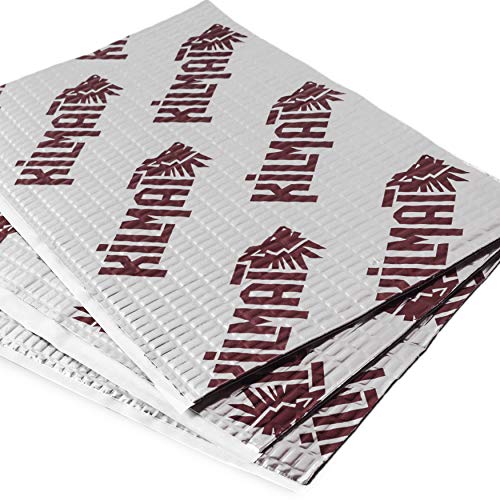
KILMAT 80 mil Sound Deadening Mat
What We Like
- Self-adhesive butyl for easy DIY install
- Embossing shows correct installation
- Handy sheet size for cutting
Trade-offs
- At 0.5 lbs/sqft, adds noticeable weight per panel
- 80 mil thickness reduces flexibility on complex curves
The trade-off is weight. At 0.5 pounds per square foot, covering a full trunk or cabin floor adds up fast, something to consider if you’re trying to keep overall vehicle weight low. Compared to the Siless Hybrid 3in1 200 mil, which offers a thicker single sheet, KILMAT keeps things simpler: one material, one thickness, no guesswork. If you prefer a straightforward approach to sound deadening and don’t mind the extra pounds, this mat is a reliable choice.
Product photos
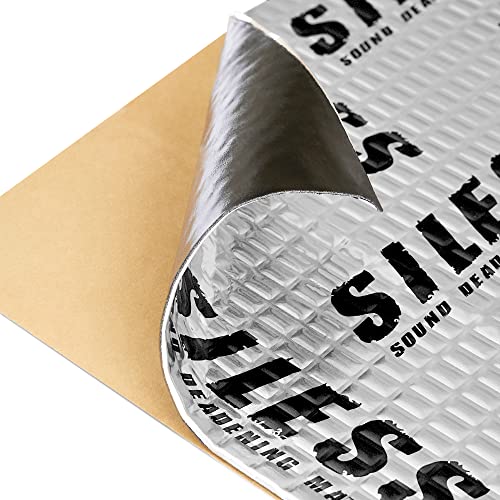
Siless 80 mil Sound Deadening Mat
What We Like
- Peel-and-place application needs no extra adhesive
- Advanced Bmastic formulation for damping
- Cost-effective for the coverage area
- Includes installation instructions in package
Trade-offs
- Roller for adhesion not included in package
- At 16.4 lb, heavy for overhead or vertical panels
The trade-off is weight: at 16.4 pounds per kit, it’s heavier than some alternatives, which can make overhead or vertical panel work more tiring. Compared to the Siless Hybrid 3in1, that product’s 200-mil thickness provides more mass per layer, but the 80-mil mat here keeps installation simpler. For someone who wants effective sound deadening without a complicated process, this kit balances performance and ease.
Product photos
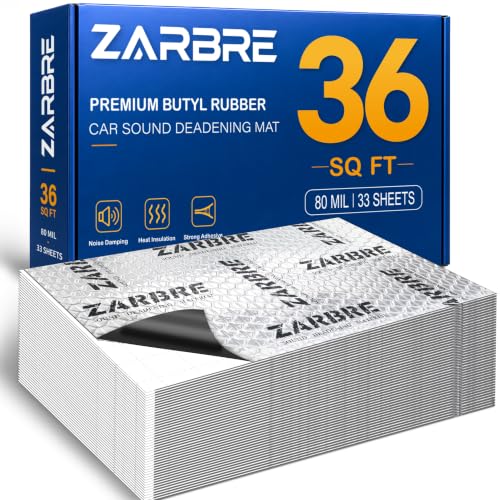
ZARBRE 80 Mil Sound Deadening Mat
What We Like
- Odorless even in summer heat
- Pure butyl with no asphalt fillers
- Waterproof and moisture-resistant
- Foolproof adhesive for easy install
Trade-offs
- At 80 mil, less sound-blocking than thicker mats
- Sheets require trimming for tight curves
Pure butyl rubber with zero asphalt fillers means this mat stays odorless even when your car bakes in summer sun, no chemical smell seeping into the cabin. That clean-air advantage makes it a strong pick for anyone sensitive to odors or upgrading a daily driver where interior comfort matters. The 80 mil thickness and 36 square foot coverage handle doors, floors, and trunks well, and the high-tack adhesive bonds firmly once you roll the embossed foil flat.
The trade-off is that 80 mil is a mid-range thickness, so it dampens vibration and road noise effectively but won’t match the sheer mass of thicker options for blocking deeper bass or heavy panel resonance. That said, for a typical sedan or hatchback project where odor is a deal-breaker and you want reliable noise reduction without overpowering your car with weight, this mat hits a practical sweet spot.
Product photos
MIKKUPPA 80 Mil Sound Deadening Mat
What We Like
- Odor-free even under extreme heat
- Triple-layer blocks heat transfer effectively
- Waterproof and moisture-resistant
- Easy to cut with scissors or knife
Trade-offs
- At 80 mil, less impact absorption than thicker mats
- 33 small sheets require more seams than larger panels
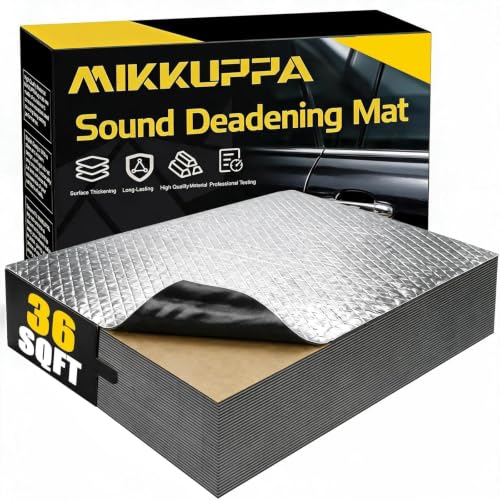
This mat uses a triple-layer build with pure butyl and a reinforced foil top to dampen panel vibrations and reduce heat transfer. That means it can help quiet road noise and keep the cabin cooler on hot days, since the butyl stays odor-free even under extreme summer heat. The 80 mil thickness keeps the material flexible enough to press into curves and corners, and the peel-and-stick adhesive holds firmly once rolled down. For a daily driver or a road trip vehicle, it offers a practical way to cut down on noise and heat without the smell that some asphalt-based mats can produce.
The 80 mil thickness means this mat is a middle-ground option for noise control, not a substitute for thicker materials if you’re chasing extreme bass damping. You get 33 small sheets at 15.7 by 9.8 inches each, which translates to more cutting and more seams during installation. That extra effort pays off when you’re patching around tight spots like door cavities and wheel wells, where larger panels would waste material. If your goal is reducing cabin heat and general road noise without breaking the bank, this mat delivers a practical balance.
Product photos
VEVOR Car Sound Deadening Mat

What We Like
- 52 sq ft covers full vehicle
- 3-layer composite for sound, heat, fire
- Self-adhesive, no extra glue needed
- 47 sheets fit tight spaces
Trade-offs
- 50 mil is thinner than many competitors
- Rolling tool not included for best adhesion
For someone working on a daily driver or a first-time sound-deadening project, the combination of generous coverage and straightforward self-adhesive installation makes this a practical, budget-friendly starting point.
The trade-off comes down to thickness. At 50 mil, this mat is thinner than many competitors. That may mean less vibration damping on large panels like the floor or roof compared to thicker options such as the Siless Hybrid 3in1 at 200 mil. If your goal is to reduce road noise and door slams without spending on premium materials, the VEVOR kit gives you plenty of material to work with and a simple peel-and-stick process.
SGM Black Premium Sound Deadening Mat
What We Like
- Withstands -49°F to 212°F
- Foil heat shield acts as radiant barrier
- 80 mil thickness for maximum vibration damping
Trade-offs
- Requires roller for best adhesion results
- Thinner than 200 mil competitors for heavy-duty blocking
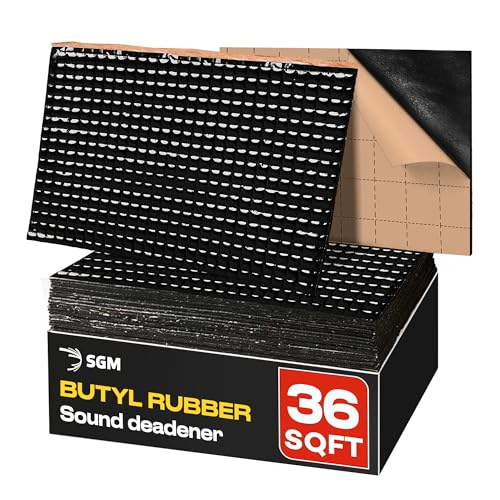
With a temperature range spanning from -49°F to 212°F, this mat handles the harshest climates without losing adhesion or flexibility. The butyl mastic stays pliable in deep cold and the foil face reflects radiant heat when the sun beats down. That makes it a strong option for drivers who park outside year-round or live where summers bake and winters bite. The 80 mil thickness delivers the vibration-killing heft needed to quiet door panels and floorpans. If extreme temperatures are your main concern, this is a mat designed to withstand them.
The trade-off is that 36 square feet of coverage may require two packs to fully cover a van or SUV, putting it in the same coverage bracket as KILMAT 80 mil. Installation follows a peel-and-place method: cut pieces to fit, remove the protective paper, and stick firmly to a metal surface. A roller helps press out air pockets for proper adhesion. For someone who needs sound deadening that holds up in a scorching desert or a frozen garage, this mat delivers where thinner or less heat-tolerant options fall short.
Product photos
NVX PRO Ultra Thick Sound Deadening Material
What We Like
- Up to 70% noise reduction
- 100% butyl rubber for lasting durability
- Designed for SPL competition systems
Trade-offs
- Only 20 sq ft per pack, not enough for a full car
- 4.5mm thickness is stiff for tight door cavities
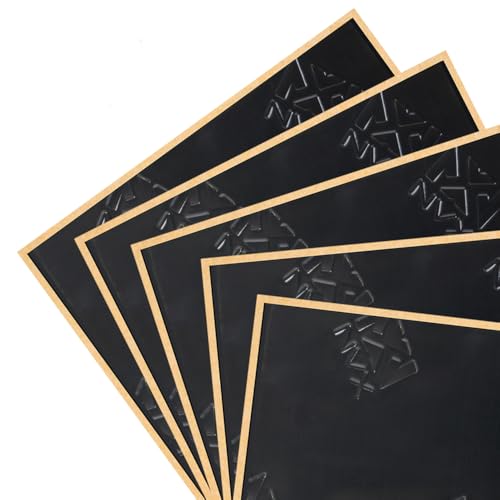
NVX engineered this material for car audio enthusiasts focused on SPL competition. The extra mass directly reduces panel flex, which is a common source of distortion in high-output systems. By stiffening the vehicle’s sheet metal, the material allows speakers to produce cleaner, louder sound without the muddiness caused by vibrating panels. This is especially valuable for competitors chasing every decibel, as minimizing structural resonance helps maximize sound pressure levels. Reviewers note that the 4.5mm thickness, more than double that of standard deadening products, provides the rigidity needed to handle extreme bass without rattling.
You get 20 square feet of coverage, which means you’ll likely need two packs for a full car, many other kits offer 36 or 50 square feet per pack. That extra thickness also makes the material stiffer to work into tight door cavities compared to thinner mats. But if your priority is maximum noise blocking and audio clarity over covering every inch on a budget, the NVX PRO delivers where it counts.
Product photos
How We Evaluated Car Sound Deadening Insulations
This evaluation is based on manufacturer-published specifications, expert round-ups from automotive audio and restoration communities, and patterns in thousands of owner feedback entries. Material composition, thickness, coverage area, adhesive quality, and temperature tolerance were compared across the ten products.
The four criteria that mattered most were thickness, coverage area per package, installation method, and heat resistance. Thickness, or mil rating, directly affects damping performance. Coverage area determines whether one roll finishes the job. Installation method matters because peel-and-place is easier than needing spray adhesive or a roller. Heat resistance is critical for vehicles in hot climates or near exhaust tunnels. We also weighed odor reports, since butyl rubber outperforms asphalt-based mats in cabin air quality.
A research-led evaluation has limits: real-world results vary by vehicle, installation skill, and driving conditions. We prioritized products with consistent positive feedback across different vehicle types and climates.
What To Look For In Car Sound Deadening Insulations
Choosing sound deadening insulation means balancing thickness, coverage, and installation demands against your vehicle’s specific noise profile and your budget.
Choose a mat with at least 80 mil thickness for meaningful noise reduction, peel-and-place adhesive for easier installation, and butyl rubber construction to avoid cabin odors in hot weather.
Thickness and Damping Performance
Thickness is the single most important factor. Mats rated at 80 mil are the standard for effective vibration damping and road noise reduction. Thicker options like the 200-mil Siless Hybrid 3in1 block more noise and add a heat barrier in one layer. Thinner mats around 50 mil work for budget builds but may require a second layer for the same result. Heavier mats add noticeable weight, so track cars or fuel-efficiency-focused builds should stick with 80 mil.
Coverage Area and Sheet Configuration
Coverage area determines whether one package finishes your vehicle. A full car typically needs 36-50 square feet. Bulk packs like the 50-sq-ft FatMat Rattletrap cover an entire sedan or SUV in one roll. Smaller packs (18-25 sq ft) work for doors, trunk floors, or targeted patches. Sheet size matters too: large sheets cover panels faster, while small sheets fit contoured spaces but create more seams.
Adhesive and Installation Requirements
Peel-and-place butyl adhesive is the easiest installation method, no spray glue, no curing time. Self-adhesive mats stick firmly at room temperature but benefit from a roller for full contact on curved panels. Some mats require a separate roller tool (not included), so factor that into your project cost. Avoid asphalt-based adhesives, which can melt or smell in hot cars.
Temperature and Odor Resistance
Butyl rubber stays flexible and odor-free across a wide temperature range. Asphalt-based mats can soften in summer heat and release a persistent smell. For vehicles in hot climates or near the firewall, look for mats rated from -49°F to 212°F, like the SGM Black Premium. Foil heat shields add a radiant barrier that reduces cabin temperature alongside noise.
- Check that the mat thickness matches your noise reduction goal (80 mil minimum, 200 mil for maximum)
- Measure your vehicle’s floor and door panels to calculate total square footage needed
- Confirm the adhesive is butyl rubber, not asphalt, to avoid cabin odors
- Decide whether you need a roller tool or can press the mat by hand
- Verify temperature tolerance if you live in a hot or cold climate
One layer of 80-mil butyl mat applied with a roller to clean metal will reduce road noise more than two layers of thin, poorly adhered mat.
Car Sound Deadening Insulations Compared
The table below compares the ten sound deadening mats across thickness, coverage, material type, and key features to help you match the right product to your project.
| Product | Thickness | Coverage | Material | Installation |
|---|---|---|---|---|
| Siless Hybrid 3in1 Sound Deadening Mat | 200 mil | 25 sq ft | Butyl mastic, PE foam, mass loaded butyl membrane | Peel and place |
| Dynamat Xtreme Sound Deadening Mat | 0.1 inches | 18 sq ft | Butyl rubber | Self-adhesive peel-and-stick |
| FatMat Rattletrap Sound Deadener Bulk Pack | 80 mil | 50 sq ft | Patented Super-Stick | Self-adhesive |
| KILMAT 80 mil Sound Deadening Mat | 80 mil | 36 sqft | Butyl and foil | Self-adhesive |
| Siless 80 mil Sound Deadening Mat | 80 mil | 36 sq ft | Butyl with Bmastic | Peel and place |
| ZARBRE 80 Mil Sound Deadening Mat | 80 mil | 36 sq ft | Pure butyl rubber | Self-adhesive |
| MIKKUPPA 80 Mil Sound Deadening Mat | 80 mil | 36 sqft | Pure butyl rubber | Self-adhesive, peel & stick |
| VEVOR Car Sound Deadening Mat | 50 mil | 52 sq ft | Butyl rubber with aluminum foil | Self-adhesive |
| SGM Black Premium Sound Deadening Mat | 80 mil | 36 sq ft | Butyl mastic with foil heat shield | Self-adhesive, peel and place |
| NVX PRO Ultra Thick Sound Deadening Material | 4.5mm | 20 sq ft | 100% Butyl Rubber | Peel-and-stick |
Frequently Asked Questions
How much sound deadening mat do I need for my car?
A typical sedan requires around 36 to 50 square feet to cover the floor, doors, and trunk. Smaller cars or partial installations need less, while SUVs and vans may need more coverage. Measure the panels you plan to cover and add extra material for waste.
Is 80 mil sound deadening thick enough?
Yes, 80 mil is the standard thickness for effective vibration damping and road noise reduction. It works well for most daily drivers and car audio builds. Thicker mats like 200 mil offer more noise blocking but add weight and cost.
Can I install sound deadening mat without a roller?
You can, but a roller ensures full contact on curved panels and around edges. Without it, air pockets reduce damping performance and the adhesive may not bond firmly. A small hand roller costs little and improves results significantly.
Does sound deadening mat help with heat?
Some mats include a foil heat shield or triple-layer design that blocks heat transfer. These are effective for firewalls, transmission tunnels, and floor pans. Standard butyl mats without a heat barrier reduce noise but not cabin temperature.
What is the difference between butyl and asphalt sound deadening?
Butyl rubber is odorless, waterproof, and stays flexible in heat and cold. Asphalt-based mats can emit a strong smell in hot weather and may soften or drip over time. Butyl costs more but provides better long-term performance and cabin air quality.
The Bottom Line
The Siless Hybrid 3in1 Sound Deadening Mat is the best overall choice for most drivers because its 200-mil triple-layer design handles vibration, heat, and noise in one application. It installs without spray adhesives and works well for doors, floors, and trunk panels on daily drivers and audio builds alike.
Budget-focused shoppers should look at the VEVOR Car Sound Deadening Mat for full-vehicle coverage at a lower thickness. Audiophiles building competition systems will want the NVX PRO Ultra Thick for maximum damping in critical panels. For extreme climates, the SGM Black Premium handles -49°F to 212°F without losing flexibility.
The single most important buying factor is thickness: choose 80 mil as your minimum, and go thicker if you want maximum noise reduction without adding a second layer.
