
10 Best Cell Phone Signal Boosters For Cars in 2026
This post contains affiliate links. As an Amazon Associate, we earn from qualifying purchases.
For drivers who lose signal on remote roads, the weBoost Drive Reach Overland is the best overall cell phone signal booster for cars. It offers 50 dB max gain built for off-road vehicles and supports 5G and 4G LTE. For a tidy daily driver setup, the weBoost Dash with Wireless Charger combines boosting with Qi2 charging. The Solid Signal Rover Duo Cross Country is the best modular kit for owners of two vehicles.
Dropped calls and dead zones are more than an annoyance, they can leave you stranded without navigation, roadside assistance, or a way to check in. What matters most in a car booster is real-world gain, carrier compatibility, and whether the installation fits your vehicle and driving style.
This guide evaluates top boosters based on specifications, manufacturer documentation, and patterns in owner feedback. We break down the key criteria so you can match a booster to your car, your trips, and your budget.
Top 10 Cell Phone Signal Boosters For Cars in the Market
Certain content that appears on this site comes from Amazon. This content is provided "as is" and is subject to change or removal at any time.
The Best Cell Phone Signal Boosters For Cars, Reviewed
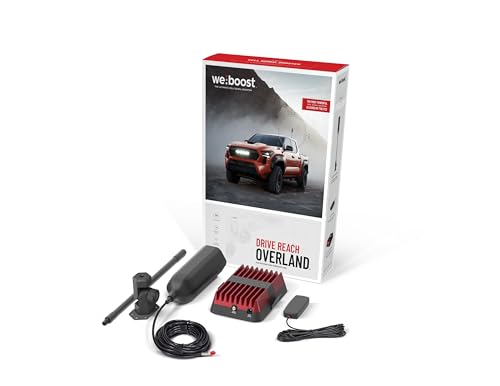
weBoost Drive Reach Overland
What We Like
- 50 dB max gain for strong signal
- Designed for off-road vehicles
- Supports 5G and 4G LTE
- Two-year warranty included
Trade-offs
- At 6.5 lb, heavy for compact cars
- Large antenna needs permanent mounting
- Overland focus limits urban use
A 50 dB max gain means this booster can pull in a weak signal from deep in the backcountry and turn it into something your phone can actually use. The weBoost Drive Reach Overland is built for the driver who spends more time on dirt than pavement, with a rugged outdoor antenna and a versatile mounting bracket that handles the bumps and dust of off-road life. It works with every major U.S. carrier and supports the latest 5G networks, so you are not stuck with yesterday’s speeds when you finally get a bar or two. If your adventures take you far from cell towers, this kit is designed to keep you connected when it matters most.
The trade-off is size and weight. It needs a permanent home on a roof rack, bull bar, or sturdy mount, which means more installation time than a lighter magnetic unit like the weBoost Dash with Wireless Charger. But that extra heft is what gives it the range and durability for serious off-road use. For daily commuters or city drivers, the smaller Dash might be a better fit.
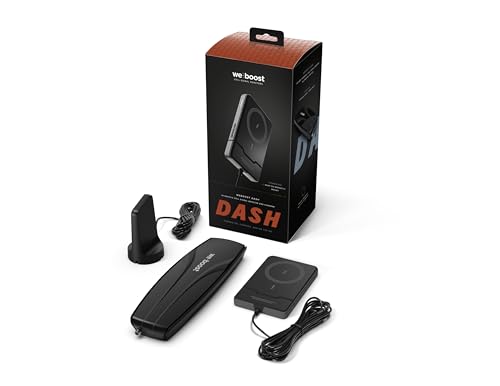
weBoost Dash with Wireless Charger
What We Like
- Combines signal booster with Qi2 wireless charger
- Magnetic mount for quick secure setup
- FCC approved and built in USA
- Works with all major US carriers
Trade-offs
- At 0.4 pounds, lightweight but not rugged for off-road
- Single device focus limits multi-user boosting
The Dash model with wireless charging combines a cellular signal booster with a Qi2-compatible wireless charger in one low-profile device. That means you can boost your 5G or 4G LTE signal from any major US carrier while charging your phone wirelessly, reducing dropped calls and slow data during travel. For daily commuters or road-trippers, this is a convenient way to keep your phone connected and powered without extra gadgets.
At 0.4 pounds with a magnetic mount, this booster is easy to move between cars, but it lacks the rugged build of larger kits like the weBoost off-road model, which is designed for off-road vehicles. If your driving stays on paved roads and you value a compact setup with built-in charging, the Dash works well. For serious off-road use or boosting multiple devices at once, a larger kit may be more suitable.
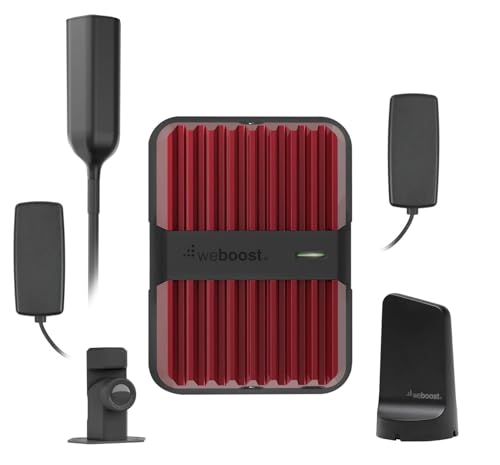
Solid Signal Rover Duo Cross Country
What We Like
- Works with two vehicles using one booster module
- Supports 5G and 4G LTE for all U.S. carriers
- Two-vehicle kit with one booster module
Trade-offs
- Booster module moves between vehicles, not permanent
- Antenna mount requires roof rack, ladder bar, or utility rail
The Rover Duo Cross Country is designed to work with two vehicles: you keep an antenna and mount on each one and move the booster module between them with minimal effort. That modular design makes it a smart pick for anyone who splits time between commuting and overlanding, because you only buy one system to cover both. It supports all major U.S. carriers on 5G and 4G LTE, and the omnidirectional antenna with a rugged 3-way adjustable mount folds down for everyday driving and flips up when you need a boost off-road.
If you only own one car and never go off-road, the extra hardware is unnecessary; but if you keep a daily driver and a weekend trail rig, this kit fits both without doubling your cost.
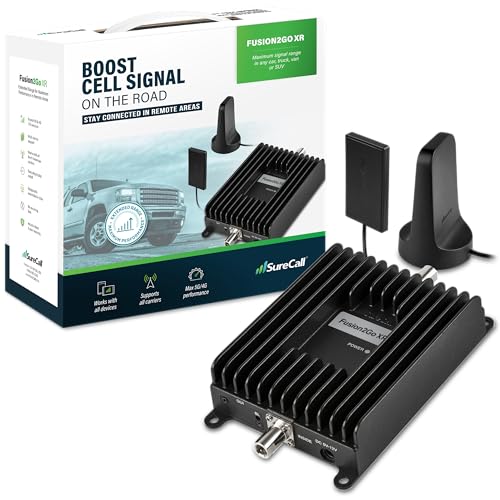
SureCall Fusion2Go XR
What We Like
- Highest transmit power in its vehicle class
- Works with all US carriers and 5G/4G LTE
- Weather-tested exterior mag-mount antenna
- Free SureCall app helps with antenna placement
Trade-offs
- Larger housing at 9 x 4 x 9 inches takes up space
- DIY setup needs app guidance for best placement
The SureCall Fusion2Go XR is advertised as the highest transmit powered in-vehicle cell phone signal booster, which means it can maintain a connection in areas where weaker boosters might not. It works with every major US carrier and handles both 5G and 4G LTE, so you don’t have to worry about compatibility when you switch phones or travel through areas where one network fades. The weather-tested magnetic antenna mounts securely on your vehicle, and the free SureCall app walks you through positioning it for the strongest link. This is a booster designed for drivers who regularly travel through challenging signal areas and need reliable connectivity.
The trade-off for that power is size. At 9 inches tall and 4 inches wide, the Fusion2Go XR’s main unit takes up noticeable cabin space, especially compared to a more compact option like the Dash with wireless charging. The exterior antenna also needs a metal surface for the magnet to grab, so it won’t work on fiberglass or soft-top vehicles. If you drive a truck or SUV with plenty of room and a metal roof, this booster gives you the highest transmit power available for a vehicle. If space is tight or you drive a convertible, you’d be better off with a more compact unit.
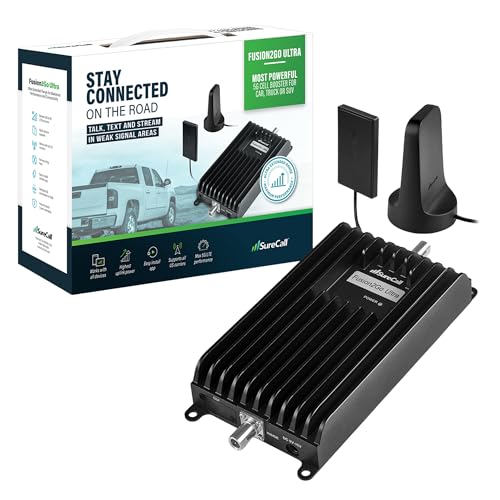
SureCall Fusion2Go Ultra
What We Like
- Highest uplink power on the market
- Boosts 5G and 4G LTE signals
- Supports multiple devices simultaneously
- Includes free SureCall setup app
Trade-offs
- At 4.0 lb, heavier than some car boosters
- Exterior antenna cable is attached, not replaceable
With up to 50 dB gain and uplink power up to 30 dBi, this booster is designed to reach distant towers, which means fewer dropped calls and less buffering when you’re miles from the nearest cell site. It supports every major U.S. carrier and handles phones, tablets, and hotspots all at once, so the whole crew stays connected. For drivers who regularly travel through weak signal zones, this kit helps maintain a connection longer than you’d get without a booster.
The 4.0-pound weight and permanently attached antenna cable mean this booster is best left in one vehicle rather than swapped between cars. For comparison, the Dash with wireless charging weighs just 0.4 pounds, so that lighter model suits frequent vehicle changes. If you prioritize extended reach and can install it permanently, the Fusion2Go Ultra’s up to 50 dB gain and high uplink power help maintain connections farther from towers.
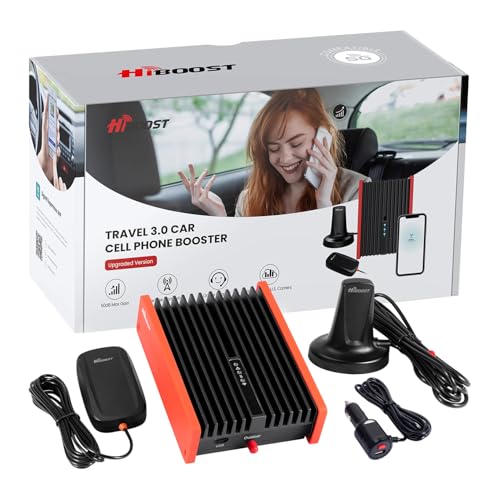
HiBoost Travel 3.0 Car Kit
What We Like
- Covers entire vehicle for multiple users
- Works with all US and Canadian carriers
- Includes HiBoost Signal Supervisor App
- Magnetic external antenna for easy setup
Trade-offs
- 13ft external antenna cable limits placement options
- Indoor antenna cable only 9.84 feet long
The HiBoost Travel 3.0 Car Kit covers your whole vehicle with amplified signal, supporting multiple users and devices across all US and Canadian carriers. That means everyone in the car, from front seat to back, can stay connected on 3G, 4G/LTE, and 5G networks without fighting over a single hotspot. It’s a strong pick for families or work crews who need reliable reception for calls, navigation, or streaming on the road. The included HiBoost Signal Supervisor App gives you real-time monitoring and antenna adjustment tips, so you can fine-tune placement without guessing.
The trade-off comes down to cabling. The magnetic external antenna has a 13-foot cable, which is plenty for most cars and SUVs, but in a long van or truck with a distant mounting spot, you might wish for more reach. Compared to the off-road weBoost model, which is built heavier for off-road abuse, the HiBoost kit is lighter and simpler to install, better for daily highway driving than for bouncing down rocky trails. If your priority is keeping a whole carload of people connected on paved roads, this kit delivers wide coverage without the bulk.
Product photos
SignalBrick Car Booster

What We Like
- Works for all passengers simultaneously
- Omni-directional antenna needs no aiming
- FCC approved for legal use
- Quick no-drill installation
Trade-offs
- Requires checking band compatibility before purchase
- Indoor antenna is a patch type, not a cradle
The SignalBrick Car Booster supports five cellular bands and works with all major US carriers, which means everyone in the vehicle can get better reception at the same time. That multi-user capability makes it a strong fit for families or carpools where several people need to stay connected during long drives through rural areas or remote highways. The omni-directional outdoor antenna picks up signals from any direction, so you don’t have to fiddle with aiming it toward a tower. Installation takes under thirty minutes with no drilling required, and the FCC certification means you’re running legal equipment.
The trade-off is that you need to verify your carrier’s frequency bands before buying, since the booster covers bands 12/17, 13, 5, 2/25, and 4 but not every band in use. If your main concern is keeping a whole crew connected rather than charging a single device, the SignalBrick’s multi-user focus gives it a clear advantage.
Product photos
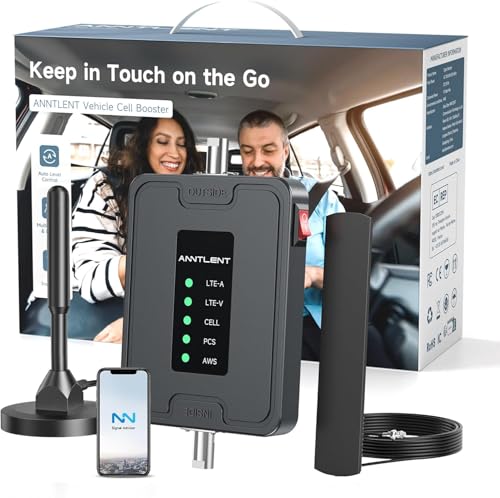
ANNTLENT Car Signal Booster
What We Like
- Built-in ALC adjusts signal automatically
- App helps find nearest tower
- Magnetic roof antenna, no drilling
- Supports multiple devices at once
Trade-offs
- Requires checking phone bands before purchase
- App needed for installation and troubleshooting
Installing a car signal booster can be tricky, but the companion app guides you through finding the nearest tower, watching setup videos, and checking signal strength before and after installation. This booster supports 4G LTE and 5G on six bands commonly used by all U.S. carriers, so everyone in the vehicle can make clear calls or stream video at the same time. An automatic level control constantly detects the existing signal and adjusts output, preventing the system from shutting down when coverage fluctuates.
Band coverage is the trade-off here. The ANNTLENT supports six bands, so you need to check that your phone’s bands match the booster’s list before buying. The magnetic roof antenna is easy to install and leaves no damage, but the app is essential for getting the most out of the system. Without it, you lose the guided setup and real-time signal feedback. For drivers who want a clear, app-guided path to better signal and are willing to verify band compatibility first, this is a smart, affordable way to stay connected on the road.
Product photos
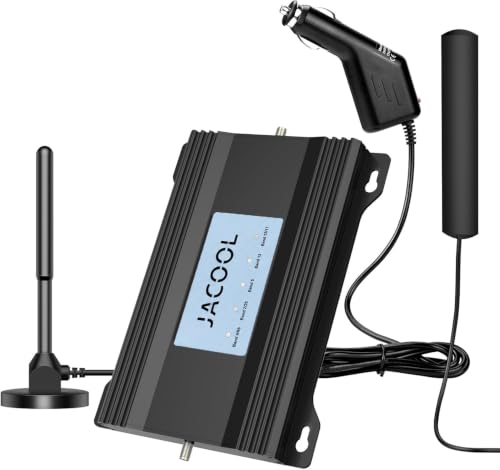
JACOOL Vehicle Cell Booster
What We Like
- Works with all major U.S. carriers
- Boosts 5G & 4G LTE for multiple devices
- Omnidirectional antenna receives from any angle
Trade-offs
- Requires 1-2 bars of outdoor signal to start
- Suction cup antenna must avoid metal surfaces
- Does not support WiFi signals
An omnidirectional suction-cup antenna that grabs signal from any direction means you don’t have to stop and aim it when you pull off the highway. That flexibility is a real time-saver on long drives, especially in a truck or RV where finding the perfect spot to park isn’t always an option.
The catch is that it needs at least one or two bars of existing outdoor signal to amplify; it cannot create coverage from nothing. And because the antenna uses a suction cup, you have to mount it away from metal surfaces or performance drops. That is a bit more fussy than the magnetic mount on the Dash with wireless charging, which attaches to steel panels. Still, for anyone driving a tall truck or RV who values multi-device support and a wide-angle antenna, the JACOOL is an FCC-certified option that delivers what it promises.
Product photos
Metarepeater LCD Car Booster
What We Like
- Real-time LCD gain monitoring
- Works with 5G and 4G LTE
- Supports multiple users and devices
- Easy no-drill magnetic installation
Trade-offs
- Requires band compatibility check before purchase
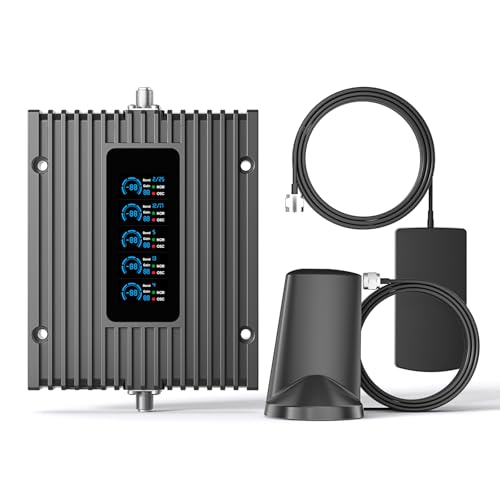
The large color LCD display on this booster shows the gain of all five frequency bands at once, so you can see exactly how strong your signal is without guessing. That real-time feedback makes it easy to adjust your driving route or position for the best reception, especially when you’re moving through areas with spotty coverage. It boosts 5G and 4G LTE for all major U.S. carriers, and the 360-degree omni-directional antenna grabs signals from any direction, so you don’t have to stop and aim it at a tower. This is the one to pick if you like knowing what your gear is doing and want to keep everyone in the car connected on long trips.
You also need to check that your phone’s frequency bands match the ones it supports before buying, since it works on bands 12/17, 13, 5, 2/25, and 4. Compared to a simpler option like the weBoost Dash, which skips the display entirely, the Metarepeater gives you that extra layer of visibility and control. If you drive a standard passenger vehicle and want to see your signal strength in real time, this is a smart fit.
Product photos
How We Evaluated Cell Phone Signal Boosters For Cars
Our evaluation is research-based: we analyzed published specifications from each manufacturer, reviewed expert round-ups from automotive and tech outlets, and looked for consistent patterns in owner feedback across forums and retailer listings.
The four criteria that mattered most were signal gain and power, carrier and network compatibility (5G and 4G LTE for all major U.S. Carriers), and installation requirements (magnetic vs. Permanent mount, cable lengths, vehicle type). The balance between coverage area and device support also played a role. A booster that works great for a single driver in a sedan may not suit a family in an SUV.
A research-led evaluation has limits: real-world performance depends on local terrain, tower distance, and vehicle construction. We cannot replicate every driving scenario, so we prioritized products with clear specifications and strong owner consensus on reliability.
What To Look For In Cell Phone Signal Boosters For Cars
Choosing the right booster means matching hardware to your driving habits, vehicle type, and the number of people who need a signal. Here are the key factors to consider.
Focus on gain (dB) for range, uplink power for sending your signal to the tower, carrier and 5G compatibility, and installation type that fits your vehicle without permanent modifications.
Signal Gain and Uplink Power
Gain, measured in decibels (dB), indicates how much the booster amplifies the signal it receives. Higher gain generally means better range in weak-signal areas. Uplink power is equally important, it determines how well your phone can send a signal back to the tower. A booster with strong uplink power helps maintain a connection when you are on the edge of coverage.
Carrier and Network Compatibility
Not all boosters work with every carrier or every cellular band. Most modern boosters support the major U.S. Carriers (AT&T, Verizon, T-Mobile) and both 5G and 4G LTE. Before purchasing, check that the booster covers the specific frequency bands used by your carrier in the areas you travel. Some boosters require you to verify band compatibility before installation.
Installation and Vehicle Fit
Boosters range from simple magnetic roof antennas that install in minutes to permanent mounts requiring drilling. Consider your vehicle type: convertibles and fiberglass roofs may not work with magnetic antennas, while off-road vehicles benefit from ruggedized mounts. Cable length matters for routing the antenna to the booster unit inside the cabin. For multi-vehicle households, a modular kit with a portable booster module can save money.
- Measure your vehicle’s roof or mounting area to ensure the antenna fits.
- Check cable lengths to see if they reach from the antenna location to your desired booster placement.
- Verify that the booster supports the number of devices you need to connect at once.
- Look for FCC approval to ensure legal operation.
- Read the return policy in case the booster does not improve your signal.
A booster needs at least a weak outside signal to work, it cannot create signal where absolutely none exists.
Cell Phone Signal Boosters For Cars Compared
The table below compares the boosters across the specs that matter most for car use, so you can quickly see which model fits your vehicle and driving needs.
| Product | Carrier Support | 5G Support | Antenna Type |
|---|---|---|---|
| weBoost Drive Reach Overland | All U.S. carriers | Yes | N/A |
| weBoost Dash with Wireless Charger | All US carriers (Verizon, AT&T, T-Mobile) | 5G/4G LTE | Magnetic mount |
| Solid Signal Rover Duo Cross Country | All U.S. carriers | 5G Ready | Omnidirectional, 3-way adjustable mount |
| SureCall Fusion2Go XR | All US carriers (Verizon, AT&T, T-Mobile) | 5G & 4G LTE | Weather-tested exterior mag-mount |
| SureCall Fusion2Go Ultra | All U.S. carriers | 5G/4G LTE | Magnet-mount exterior |
| HiBoost Travel 3.0 Car Kit | All US and Canadian carriers | 5G | Magnetic with 13ft cable |
| SignalBrick Car Booster | All major US carriers | 5G 4G LTE | Omni-directional magnetic outdoor |
| ANNTLENT Car Signal Booster | All U.S. carriers | 5G Compatible | N/A |
| JACOOL Vehicle Cell Booster | All U.S. carriers | 5G & 4G LTE | Omnidirectional suction cup |
| Metarepeater LCD Car Booster | All U.S. carriers | 5G & 4G LTE | 360° omni-directional magnetic |
Frequently Asked Questions
Do cell phone signal boosters really work in cars?
Yes, when used correctly. A booster captures an existing weak outside signal, amplifies it, and rebroadcasts it inside the vehicle. It cannot create a signal where no cellular coverage exists, but it can turn a one-bar drop-out into a usable connection for calls and data.
Can I use a car signal booster with any carrier?
Most modern boosters support all major U.S. Carriers (AT&T, Verizon, T-Mobile) and their MVNOs. However, you should verify that the booster covers the specific frequency bands your carrier uses, especially if you travel in areas with less common band allocations.
How do I install a cell phone booster in my car?
Installation involves mounting an exterior antenna (usually magnetic on the roof), routing the cable inside, and placing the indoor antenna or cradle near your phone. Many boosters include step-by-step instructions or a setup app. No-drill magnetic installations are the most common for cars.
Will a booster work in a remote area with no signal?
No. A signal booster requires at least a faint existing signal to amplify. If you are in a true dead zone with zero cellular reception from any carrier, a booster will not help. It is designed to extend the range of an existing signal, not create one.
Can multiple people use a car booster at the same time?
Yes, many boosters support multiple simultaneous connections. Models with a wider coverage area and higher output power can boost signal for all passengers and their devices. Check the product specifications for the number of users or devices supported.
The Bottom Line
For off-road adventurers and anyone who regularly travels through remote areas, the weBoost Drive Reach Overland is the best overall choice with its 50 dB max gain and rugged design for off-road vehicles. If your driving is mostly highway and daily commutes, the weBoost Dash with Wireless Charger offers a clean, all-in-one solution that keeps your phone charged and connected.
Budget-conscious buyers or those with two vehicles should consider the Solid Signal Rover Duo Cross Country, which uses one booster module across both cars. For the highest transmit power in a single vehicle, the SureCall Fusion2Go XR leads the category.
The single most important factor is honestly assessing where you drive and what signal you already have. No booster can fix zero coverage, but the right one can turn a frustrating dead zone into a reliable connection.
