
10 Best Lubes For Car Door Locks in 2026
This post contains affiliate links. As an Amazon Associate, we earn from qualifying purchases.
The Houdini Lock Lube Professional Spray is the best overall pick because its greaseless, graphite-free formula penetrates tight spaces to flush out dirt while staying dielectric safe for electronic locks. For a clean, residue-free finish, the WD-40 … Lubes takes the Best Dry Formula award, and drivers in cold climates should look to the BELL V500 for instant de-icing.
Sticky car door locks are more than an annoyance, they can lead to a broken key or a seized mechanism on a cold morning. The challenge is choosing a lubricant that won’t gum up over time, attract dust, or damage the sensitive electronics inside modern car doors.
This guide compares ten lubricants based on manufacturer specifications, expert recommendations, and patterns in owner feedback. We focus on the formula type, application method, temperature performance, and material safety that matter most for car door locks.
Top 10 Lubes For Car Door Locks in the Market
Certain content that appears on this site comes from Amazon. This content is provided "as is" and is subject to change or removal at any time.
The Best Lubes For Car Door Locks, Reviewed
Houdini Lock Lube Professional Spray

What We Like
- Greaseless, graphite-free formula leaves no sticky buildup
- Dielectric safe for electronic locks and switches
- Penetrates tight spaces to flush out dirt
- Works in sub-zero temperatures and prevents rust
Trade-offs
- 11 oz can is larger than some lock-specific lubes
- Not a dry lubricant for users who prefer no wet film
Locksmiths have trusted Houdini Lock Lube for over forty years because its greaseless, graphite-free formula drives out moisture and prevents rust even in salt-air environments. The spray penetrates deep into tight mechanisms, flushing out dirt and gunk while leaving zero sticky residue, no oil, silicone, or petroleum to gum up over time. Dielectric safety means you can use it on electronic locks without worry, and it frees frozen locks in sub-zero temperatures. For door locks, hinges, latches, and electronics, this one spray covers a wide range of applications.
The 11 oz can is larger than some targeted lock lubes, so it takes up more space in a glove box or tool bag. That extra volume also means you get more uses per can, and the formula is trusted by locksmiths for over forty years. If you prefer a dry lubricant that leaves no wet film, the 3-IN-ONE Lock Dry Lube is a good alternative. But for all-around performance on sticky locks, frozen mechanisms, and electronic access points, this spray delivers solid protection.
Product photos
WD-40 … Lubes
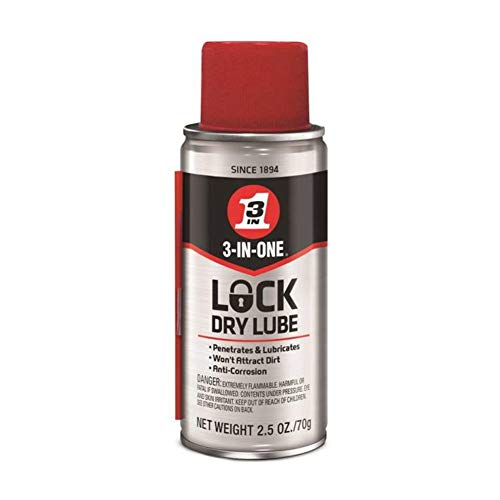
What We Like
- PTFE-based dry formula repels dirt and dust
- Residue-free finish for clean operation
- Long-lasting rust protection barrier
Trade-offs
- 2.5 oz can is small for multiple locks
- Not ideal for graphite-free lock applications.
The polytetrafluoroethylene (PTFE) in this dry lube creates a slick, clean barrier that won’t collect dust or grime the way wet lubricants do. That residue-free finish is a real advantage for car door locks, where sticky buildup can gum up the mechanism over time. It also forms a protective layer against rust, making it a solid fit for outdoor or high-traffic locks that see frequent use. For anyone who wants a no-mess solution that keeps locks turning smoothly without attracting dirt, this formula delivers on that promise.
The 2.5-ounce can is small for multiple locks, but the dry lube formula leaves a clean, residue-free finish that repels dirt and dust, ideal for high-traffic doors and outdoor locks. For a single car or a couple of padlocks, it’s enough; for larger jobs, you’d need a bigger can.
3-IN-ONE Lock Dry Lube
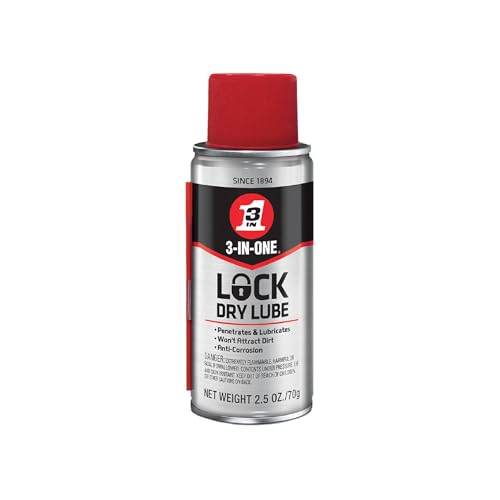
What We Like
- Quick-drying clear formula
- Won't attract dirt
- Penetrates narrow lock mechanisms
- Anti-corrosion protection film
Trade-offs
- Not safe on clear polycarbonate or polystyrene
- Small 2.5 oz can for occasional use
A 2.5-ounce aerosol that dries clear to the touch in minutes means you can lubricate a sticky car door lock and close the door without waiting around for a greasy mess to set. The attachable straw lets you reach deep into the lock cylinder, while the quick-dry formula leaves a protective film that resists corrosion and won’t attract the dust and grime that gum up locks over time. The formula is safe on metal, wood, and most plastics, though it should not be used on clear polycarbonate or polystyrene.
The 2.5-ounce can is small enough to tuck into a glove box, so it’s handy for a single sticky lock rather than a whole toolbox full of hardware. The formula dries clear within minutes and won’t attract dirt, but it’s not safe on clear polycarbonate or polystyrene, so check your lock’s interior before spraying. Compared to AGS Lock-Ease Graphite Spray, which also leaves a dry film, the 3-IN-ONE offers an attachable straw for precise application into narrow lock mechanisms.
WD-40 Specialist Dry Lube
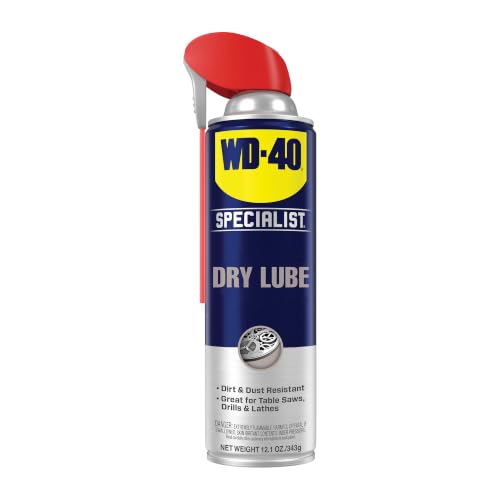
What We Like
- Dries to clean, dirt-resistant film
- Reduces friction on moving parts
- Long-lasting corrosion protection
- Works on locks, slides, hinges
Trade-offs
- Not a dedicated lock de-icer
- Requires reapplication after wet conditions
A 12.1-ounce can of dry lube that dries fast to a clean film that resists dirt and dust means this is built for locks and mechanisms that need mess-free performance. The fast-drying film keeps dirt and dust from sticking, which is exactly what you want when lubricating door locks, window tracks, slides, and small mechanisms that require clean lubrication. It also reduces friction on blades, bits, rollers, hinges, and moving machinery components, making it a versatile can for someone who maintains more than just locks.
The trade-off is that this is a dry lubricant spray designed for machinery lubrication on conveyor belts, table saws, lathes, power tools, and shop equipment. So if your only need is a quick squirt for a sticky house lock, something like Houdini Lock Lube is more targeted and easier to apply precisely. But for a lock that needs durable corrosion protection to help prevent rust and extend lifetime, the long-lasting corrosion protection and clean-film performance here justify the larger can. It’s a practical choice for the driver who wants one lubricant that can handle locks, hinges, and shop equipment without attracting a mess.
LiquidFix Door Lock Hinge Lubricant
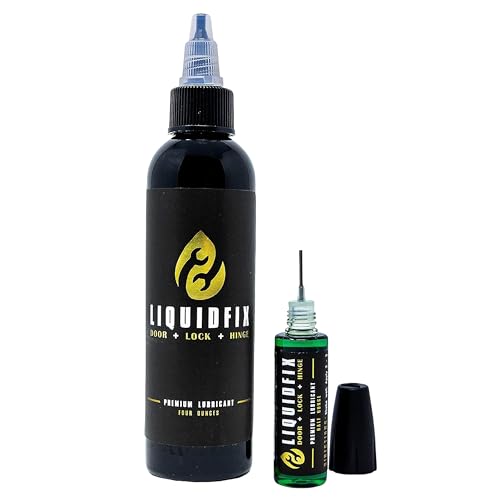
What We Like
- Precision needle tip for tight slots
- Winter formula works down to -55°F
- Two bottles for large and small jobs
- Multi-purpose: locks, hinges, tracks
Trade-offs
- Small 0.5 oz needle bottle needs refilling
- Not a spray; requires manual drop application
A freezing point of -55°F keeps this lubricant fluid in extreme cold, so door locks and hinges keep working through the harshest winters. The kit pairs a 0.5 oz needle oiler for precision drops into tight spots like lock cylinders with a 4 oz bottle for larger jobs on hinges and sliding tracks. That needle tip places lubricant exactly where needed, reducing the mess that sprays often leave behind.
The tiny needle bottle holds only half an ounce, so you’ll refill it from the larger bottle for multiple locks. That’s a minor inconvenience compared to the precision you get, especially when you’re working on a tight keyhole where a spray like Houdini Lock Lube might overspray. If you need a formula that stays fluid in deep cold and want drop-by-drop accuracy, this kit delivers that.
Product photos
AGS Lock-Ease Graphite Spray

What We Like
- Dry graphite film won't attract dust
- Rapid penetrant coats inner lock parts
- Contains no water to freeze
- Works on car locks, padlocks, deadbolts
Trade-offs
- Graphite can be messy if oversprayed
- Small 3-ounce can limits heavy-duty use
A dry graphite film that won’t gum up over time is the whole point here. AGS Lock-Ease uses a rapid penetrant to carry graphite deep into the keyway, coating pins and tumblers so keys slide smoothly. Because it leaves no sticky residue, it won’t trap dust or grit the way oil-based lubes do. That makes it a smart pick for car door locks that see a mix of weather and daily use. Especially if you’ve ever had a lock get sluggish after a few months of spraying the wrong stuff.
The can size is small at 3 ounces, so you might go through it faster if you’re treating multiple locks around the house. For comparison, the Houdini Lock Lube spray comes in an 11-ounce can, which stretches further for bigger jobs. But if your priority is a clean, dry lubricant that won’t freeze or attract grime, the AGS Lock-Ease delivers exactly that in a compact, easy-to-store can.
Product photos
JAOJAO Graphite Powder Lubricant
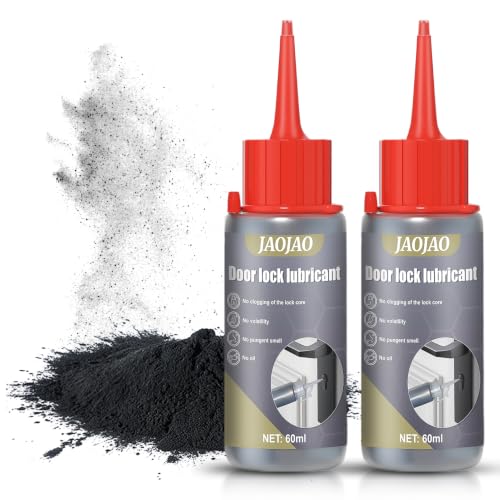
What We Like
- Precision needle tip for deep cylinder reach
- Dry graphite film won't evaporate or drip
- Stable in both freezing and hot weather
- Safe for delicate internal lock mechanisms
Trade-offs
- Powder can be messy during application
- Not a wet lubricant for hinges or latches
- Requires repeated key insertions to distribute
The precision needle tip on this 120-milliliter bottle lets you inject fine graphite powder deep into a lock cylinder without the mess of a spray. That matters most when a lock has started sticking or jamming, especially in cold weather when moisture can freeze. The dry graphite particles form a lasting film on internal tumblers that won’t freeze, gum up, or wash out, making it a reliable choice for locks that need a long-lasting dry lubricant. It suits owners who want a precise fix that won’t damage sensitive components, as the powder is specially formulated for locks.
Graphite powder is dry by design, so it won’t lubricate hinges or sliding tracks the way a wet spray would. If you need one product for both locks and hardware, Houdini Lock Lube Professional Spray offers a greaseless, graphite-free alternative that also works on door locks, hinges, latches, and electronics. But for anti-jamming performance in locks, especially in climates that swing from freezing to hot, this powder’s temperature stability and targeted application give it an advantage over wet lubes that can attract dust or stiffen over time.
Product photos
Permatex Silicone Spray Lubricant

What We Like
- Safe on paint, rubber and plastic
- Electrically insulates and waterproofs
- Does not attract dust or dirt
- Protects and renews rubber parts
Trade-offs
- Silicone spray can overspray onto unintended surfaces
- Not a dry lube for dusty lock mechanisms
A 10.25-ounce aerosol can that won’t mar paint, rubber, or plastic means you can spray door hinges, weather stripping, and lock mechanisms without worrying about damaging the surrounding trim or finish. That makes this silicone spray ideal for anyone who wants one lubricant that works across multiple surfaces around the car, not just locks, but also rubber seals, plastic bushings, and window channels. Its high silicone formula also resists attracting dust and dirt, so the lubrication stays cleaner longer than sticky greases or oils.
Because this is a silicone-based spray, it does not dry to a completely powder-like finish the way a dedicated lock lubricant such as Houdini Lock Lube does. For lock cylinders where a bone-dry feel is preferred, a dry-lube product may be a better match. But if you want one spray that safely handles locks, hinges, rubber seals, and plastic parts without damaging paint or trim, this Permatex can offers more versatility than a lock-only product.
BELL V500 Lubes

What We Like
- Thaws frozen locks instantly
- Lubricates lock cylinder
- Fits in your pocket
- Snap-on protective cap
Trade-offs
- Only 0.625 Fl. Oz. total lubricant
- Single-purpose de-icer focus limits versatility
A 0.625-ounce aerosol that fits in your pocket is the key fact here: this is the lube you grab when your car door lock is frozen solid and you need it working again in seconds. The BELL V500 is built for that exact moment, thawing ice on contact while adding a thin layer of lubricant to the cylinder. Its compact size and targeted formula mean you can keep it in your glove box or coat pocket year-round, ready for winter emergencies without carrying a bulky can.
At 0.625 ounces, this is a tiny amount, so it isn’t the lube for routine maintenance on multiple locks or for treating hinges and latches around the house. Compared to Houdini Lock Lube’s 11-ounce professional spray, the BELL V500 is a spot-treatment tool rather than a workshop staple. If your main problem is frozen car door locks a few mornings each winter, the pocket-sized can is exactly what you need. If you want a general-purpose lock lubricant that lasts through many applications, a larger can like Houdini makes more sense.
Product photos
Hillman 703185 Graphite Tube

What We Like
- Precision dispenser tip fits key slots
- Dry powder resists dust and debris
- No sticky residue like oil lubes
- Trusted Hillman brand quality
Trade-offs
- 3-gram tube is small for multiple locks
- Powder can be messy if overapplied
The Hillman 703185 Graphite Tube contains 3 grams of dry graphite powder for lubricating lock cylinders and key mechanisms. Its precision dispenser tip fits key slots, allowing targeted application inside the lock. The dry powder formula resists dust and debris buildup, unlike oil-based lubricants that leave sticky residue. This makes it suitable for home entry door locks, padlocks, car door and trunk locks, and other keyed mechanisms that need periodic graphite lubrication.
The 3-gram tube is a small amount, so it’s best for one or two locks rather than a whole set. Compared to the Houdini Lock Lube Professional Spray, which comes in an 11-ounce can and weighs 0.7 pounds, the Hillman is a smaller, more portable option. It’s a straightforward lubricant for targeted use, not a multi-purpose spray.
How We Evaluated Lubes For Car Door Locks
Our research began with a deep look at manufacturer data sheets and product descriptions for each lubricant’s chemical composition, intended use, and safety ratings. We then cross-referenced this technical information with expert round-ups from automotive maintenance publications and forums where professional mechanics and experienced DIYers share what works in real-world conditions.
The four criteria that mattered most were formula type (dry vs. Wet), temperature tolerance, application precision, and material compatibility. Dry lubricants like graphite and PTFE repel dust but require careful application, while wet lubricants penetrate deeper but can attract grime over time. We also prioritized products that clearly state their safety on electronic components, painted surfaces, and rubber seals.
An evaluation has honest limits. Instead, we synthesized the collective experience of thousands of owners to identify the lubricants that consistently solve the most common lock problems without creating new ones.
What To Look For In Lubes For Car Door Locks
Choosing the right lubricant means matching the formula to your specific lock problem. A dry lubricant works best for dusty environments, while a wet lubricant with de-icing properties is essential for freezing climates.
Look for a lubricant that matches your climate and lock type: dry formulas for dust resistance, wet formulas for deep penetration, and de-icers for freezing weather. Precision applicators help avoid messy overspray.
Formula Type: Dry vs. Wet
Dry lubricants like graphite or PTFE leave a clean film that won’t attract dust or dirt, making them ideal for lock cylinders in vehicles driven on unpaved roads or stored in dusty garages. Wet lubricants, including silicone and penetrating oils, flow deeper into tight mechanisms and provide better rust protection but can collect debris over time. Some modern car locks with electronic sensors may require a dielectric-safe wet lubricant to avoid short circuits.
Temperature Performance
A lubricant that thickens or freezes at low temperatures is useless for a winter lockout. Look for products that explicitly state their working temperature range. The LiquidFix Door Lock Hinge Lubricant remains fluid down to -55°F, while the BELL V500 is designed specifically to thaw frozen locks. For year-round use in moderate climates, a general-purpose spray like the Houdini Lock Lube works in sub-zero conditions without losing its penetrating ability.
Application Precision
Overspray is the most common complaint among lock lubricant users. A precision needle tip, like the one on the JAOJAO Graphite Powder Lubricant, allows you to inject lubricant directly into the key slot without coating the surrounding paint or rubber seals. Spray cans with straw applicators offer a middle ground, while the Hillman 703185 Graphite Tube uses a precision dispenser tip for single-lock jobs. Consider how many locks you need to treat and how much control you want over application.
- Check the lubricant’s compatibility with your car’s lock materials: painted metal, plastic, rubber, and electronic sensors.
- Match the can or bottle size to the number of locks you plan to maintain.
- Read owner feedback about messiness, graphite powder and silicone spray are common culprits.
- For vehicles with keyless entry, prioritize a dielectric-safe lubricant that won’t interfere with electronics.
A dry lubricant is usually the safest first choice for car door locks because it won’t gum up or attract dirt, but a wet de-icer is essential for drivers in freezing climates.
Lubes For Car Door Locks Compared
The table below compares each lubricant’s formula type, temperature tolerance, and key features to help you find the right match for your car’s door locks.
| Product | Formula | Size | Weight | Application |
|---|---|---|---|---|
| Houdini Lock Lube Professional Spray | Greaseless, graphite-free, no oil or silicone | 11 oz spray | 0.7 Pounds | Spray |
| WD-40 … Lubes | Dry lube with PTFE | 2.5 oz aerosol can | 0.2 pounds | Spray |
| 3-IN-ONE Lock Dry Lube | Dry lube | 2.5 oz aerosol | 0.0 Pounds | Attachable straw or wide spray |
| WD-40 Specialist Dry Lube | Dry lubricant spray | 12.1 oz can | N/A | Spray |
| LiquidFix Door Lock Hinge Lubricant | Multi-Purpose Lubricant | 4 oz + 0.5 oz needle | 0.3 pounds | Dropper + Needle |
| AGS Lock-Ease Graphite Spray | Dry graphite spray | 3 oz aerosol | 0.3 pounds | Spray |
| JAOJAO Graphite Powder Lubricant | Dry graphite powder | 120 ML | N/A | Precision needle tip |
| Permatex Silicone Spray Lubricant | High silicone, non-dust attracting | 10.25 oz aerosol | 0.6 pounds | Spray |
| BELL V500 Lubes | Aerosol spray | 0.625 Fl. Oz. | 0.0 Pounds | Spray |
| Hillman 703185 Graphite Tube | Dry graphite powder | 3 grams | 0.0 Pounds | Precision tip for key slots |
Frequently Asked Questions
Can I use WD-40 as a lubricant for car door locks?
Standard WD-40 is a water-displacing solvent, not a dedicated lubricant. It can free a sticky lock temporarily but will evaporate and leave the mechanism dry. For lasting lubrication, choose a product like the WD-40 … Lubes or the 3-IN-ONE Lock Dry Lube, both formulated specifically for lock mechanisms.
What is the difference between dry lube and wet lube for locks?
Dry lubricants leave a clean, non-sticky film that repels dust and dirt, making them ideal for lock cylinders. Wet lubricants penetrate deeper and provide better rust protection but can attract debris over time. For car door locks exposed to the elements, a dry lubricant is usually the better long-term choice.
How do I apply lubricant to a car door lock?
Insert the applicator straw or precision tip into the key slot and apply a short burst or a few drops of lubricant. Insert and remove the key several times to distribute the lubricant throughout the cylinder. Wipe away any excess from the key and the exterior of the lock to prevent staining.
Is graphite lubricant safe for car door locks?
Yes, graphite is a dry lubricant that won’t attract dust or gum up over time, making it a popular choice for car lock cylinders. Products like the AGS Lock-Ease Graphite Spray and JAOJAO Graphite Powder Lubricant are designed specifically for this purpose. Avoid overapplying, as excess graphite can be messy.
What should I do if my car door lock is frozen?
Use a dedicated lock de-icer like the BELL V500, which is designed to thaw frozen locks instantly. Insert the applicator into the key slot and spray. For ongoing prevention, apply a dry lubricant with anti-freeze properties before winter sets in. Never pour hot water on a frozen lock, as it can refreeze and cause damage.
The Bottom Line
The Houdini Lock Lube Professional Spray earns our Best Overall recommendation because it combines cleaning, lubrication, and rust protection in a single dielectric-safe formula that works in extreme cold. It is the most versatile choice for drivers who want one product for their car’s locks, hinges, and latches without worrying about sticky residue or electronic damage.
If you prefer a completely dry, dust-repelling lubricant, choose the Best Dry Formula WD-40 … Lubes or the Best Graphite Spray AGS Lock-Ease. For drivers in freezing climates who need instant thawing power, the BELL V500 is the dedicated de-icer to keep in your glove box.
The single most important factor when choosing a lock lubricant is matching the formula to your climate and driving environment. A dry lubricant for dusty roads, a wet de-icer for snowy winters, or a precision powder for a single sticky lock, the right choice keeps your car door operating smoothly for years.
