
10 Best Mid Range Car Speakers in 2026
This post contains affiliate links. As an Amazon Associate, we earn from qualifying purchases.
For drivers who want vocals and instruments to cut through clearly, the NVX XQ-Series v2 3.5″ Midrange Speakers earn the Best Overall spot. Their carbon fiber cones reduce distortion, and the shallow 1.62-inch mounting depth fits tight factory locations. The DS18 PRO-GM6B is our Best 480W Max Power pick for high-output builds, while the Skar Audio FSX65-4 offers the Best Sensitivity for those wanting maximum volume from a modest amplifier.
Factory speakers often leave midrange frequencies muddy or buried, making lyrics hard to follow and instruments sound flat. Adding dedicated midrange drivers solves this by focusing on the frequencies where the human voice and most lead instruments live, typically between 300 Hz and 5 kHz.
This guide is based on manufacturer specifications, expert round-ups, and patterns in owner feedback. We evaluated models against the criteria that matter most for a midrange upgrade—sensitivity, power handling, mounting depth, and build quality—to narrow the list to these 10.
Top 10 Mid Range Car Speakers in the Market
Certain content that appears on this site comes from Amazon. This content is provided "as is" and is subject to change or removal at any time.
The Best Mid Range Car Speakers, Reviewed
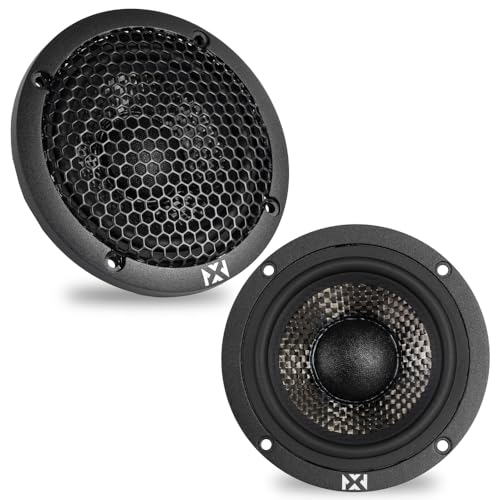
NVX XQ-Series v2 3.5" Midrange Speakers
What We Like
- Carbon fiber cones reduce distortion
- Shallow 1.62" mounting depth fits tight spots
- Includes speaker grilles for protection
- Efficient neodymium motor for strong output
Trade-offs
- 3.5" size limits bass compared to larger speakers
- 100W RMS per pair is modest for high-volume systems
A shallow 1.62-inch mounting depth lets these fit into tight dash or sail panel spots where deeper speakers won’t work. Carbon fiber cones keep distortion low and clarity high, so vocals and instruments come through cleanly even at higher volumes. The included grilles protect the drivers without adding bulk.
A 3.5-inch driver can’t match the air displacement of larger speakers like the DS18 PRO-GM6B, but that compact size and included grille let you install these in locations where bigger units won’t physically fit. If your build prioritizes clear, accurate midrange and flexible placement over raw output, these deliver exactly that.
Product photos
DS18 PRO-GM6B 6.5" Midrange Speaker

What We Like
- 480W max power for strong output
- 1.5" Kapton voice coil handles heat
- 140W RMS for sustained performance
- 8 Ohm impedance suits many systems
Trade-offs
- Sold as single speaker, not a pair
- 8 Ohm load requires compatible amplifier
With a 480W max power rating, this single 6.5″ midrange can handle high-volume playback when paired with an amplifier that can deliver that power. The 140W RMS rating means it can sustain that output for longer periods, which matters for the midrange frequencies where vocals and instruments sit. The 1.5″ Kapton voice coil is built to resist heat, so the speaker should last through extended use without degrading.
You get one speaker in the box, not a pair, so outfitting both doors means buying two. And at 8 Ohms, this speaker demands an amplifier that can deliver power at that impedance. Many aftermarket head units and stock systems output at 4 Ohms, so you may need to plan your amp selection accordingly. Compared to the Skar Audio FSX65-4, which runs at 4 Ohms and comes as a single unit too, the DS18 gives you higher max power but requires more careful system matching.
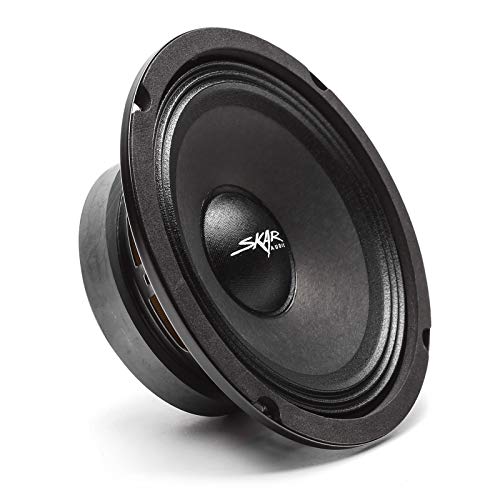
Skar Audio FSX65-4 6.5" Midrange Speaker
What We Like
- High 92.5 dB sensitivity for loud, clear output
- 150W RMS handles moderate power well
- Solid composition paper dust cap for durability
- Ferrite magnet provides reliable magnetic structure
Trade-offs
- No grille or mounting hardware included
- Sold individually, so a pair requires two purchases
A sensitivity rating of 92.5 dB means this speaker turns amplifier power into volume more efficiently than most mid-range options, so you get clean, loud sound without needing a high-end amp. That makes the Skar Audio FSX65-4 a strong fit for drivers building a system on a budget who still want punchy midrange presence in their music. Its 150W RMS rating gives it enough headroom for lively listening while staying within reach of typical aftermarket head units or small external amplifiers.
PRV AUDIO 6MR200A-4 6.5" Midrange Speakers Pair

What We Like
- Shallow 2.24-inch mounting depth
- Kevlar-loaded paper cone for clarity
- Cloth accordion surround reduces resonances
- Vented pole piece for heat dissipation
Trade-offs
- Limited to midrange frequencies only
- No crossover or tweeter included
- Not for full-range or subwoofer duty
With a mounting depth of 2.24 inches, this PRV Audio pair fits into shallow spaces such as car doors where many 6.5-inch speakers cannot. The Kevlar-loaded paper cone and cloth accordion surround are designed to control resonances, and the vented pole piece helps reduce power compression by letting heat escape. It is a dedicated midrange driver that handles 200 watts program power, making it suitable for a three-way system in tight enclosures.
These are pure midrange drivers, not a full-range solution. They cover 155 Hz to 11,000 Hz, which means you’ll need a separate tweeter and subwoofer to complete the picture. Compared to the DS18 PRO-GM6B, which runs at 8 ohms and 140 watts RMS, the PRV’s 4-ohm, 200-watt rating gives you more flexibility with common car amplifiers. If you’re after a drop-in full-range speaker, this isn’t it, but if you’re piecing together a high-output system where depth is the enemy, these earn their place.
Recoil MS65-4P 6.5" Midrange Speakers Pair

What We Like
- 600W max power handles high output
- 1.5" Kapton voice coil resists heat damage
- High-strength ferrite magnet for wide tone range
- Efficient design works from stock locations
Trade-offs
- Ferrite magnet adds weight over neodymium alternatives
- Heavy 5.9 lbs pair strains mounting locations.
A 600W max power rating (300W RMS per pair) means these 6.5-inch speakers can fill a car with clean, loud midrange without straining, even when you crank the volume. The 1.5-inch high-temperature Kapton voice coil handles the heat that builds up during long drives or spirited listening sessions, so the speaker keeps its shape and sound over time. That combination of power and durability makes this pair a strong fit for anyone upgrading from a factory system who wants a noticeable jump in clarity and output without adding an external amplifier right away.
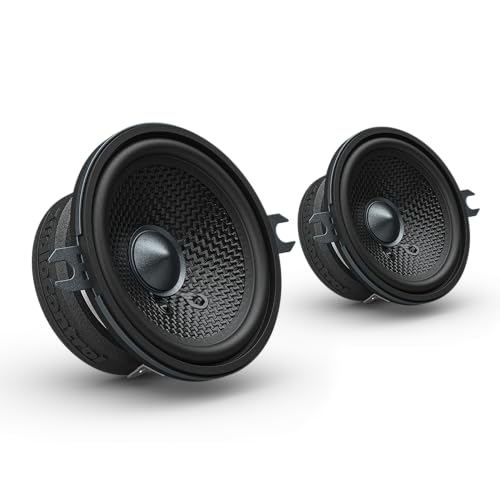
AudioControl Altitude 2.75" Component Midrange Speakers
What We Like
- Ultra-shallow 1.28" mounting depth
- Glass fiber cone with butyl rubber surround
- Includes in-line crossover for clarity
- Fits factory locations without modification
Trade-offs
- 50W RMS limits output compared to larger midranges
- 2.75" size limits low-frequency output compared to larger drivers
A mounting depth of just 1.28 inches means these speakers slide into dashboards and door panels where most midranges simply won’t fit. The glass fiber cone and butyl rubber surround keep sound clean and responsive even at low power, and the included in-line crossover helps keep distortion in check. For anyone upgrading a tight factory location without cutting or fabricating, this is a compact option that fits where others cannot.
You’ll want a dedicated amplifier to get the most out of them, and they work best as part of a full system with a subwoofer handling the low end. If space is your main constraint, these are the smart pick; if raw volume is the goal, look at the bigger options in this guide.
Product photos
AudioControl Altitude 3.5" Component Midrange Speakers

What We Like
- Shallow 1.35-inch mounting depth
- Precision-molded glass fiber cone
- Includes in-line crossover
- Butyl rubber surround for durability
Trade-offs
- 50W RMS limits output with high-power systems
- 3.5-inch size restricts deep bass response
- Requires external amplifier for best results
With a mounting depth of just 1.35 inches, these speakers fit into spots where many other midranges won’t go. The glass fiber cone and butyl rubber surround are built for clear, responsive sound, and the included in-line crossover reduces distortion in passive setups. For a cramped install, think shallow dash or door panels, this pair offers a practical solution that integrates smoothly into 2-way or 3-way systems.
At 50W and 3.5 inches, these speakers won’t match the output of a larger midrange like the NVX XQ-Series v2, which handles 100W RMS and uses carbon fiber cones. The AudioControl Altitude focuses on shallow fit over maximum power. For most space-limited builds, that trade-off makes sense: you get install flexibility and a crossover that keeps sound clean. Pair them with an amplifier to get the best performance.
Product photos
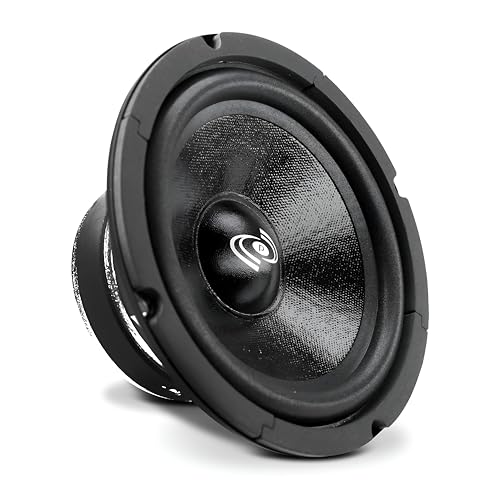
Pyle PDMR6 6.5" Sealed Back Midrange Speaker
What We Like
- 93 dB sensitivity for efficient output
- 1" KAPTON voice coil handles heat
- Sealed back design for contained sound
Trade-offs
- Limited to 200-5 kHz frequency range
- 8 Ohm impedance requires compatible system
With a 93 dB sensitivity rating, this speaker converts power into volume efficiently, meaning you get clear midrange presence without needing a massive amplifier. If you’re building a component setup that needs a focused, clean midrange to pair with separate woofers and tweeters, this Pyle fits that role well.
Its narrow 200-5 kHz frequency band means it won’t handle deep vocals or high treble on its own, you’ll need subwoofers and tweeters to fill the rest. Compared to the DS18 PRO-GM6B, which has a higher peak power rating of 480W, the Pyle is a more specialized tool. It’s best for builders who already have a plan for their system and want a reliable, sealed-back midrange that stays out of the way of other drivers.
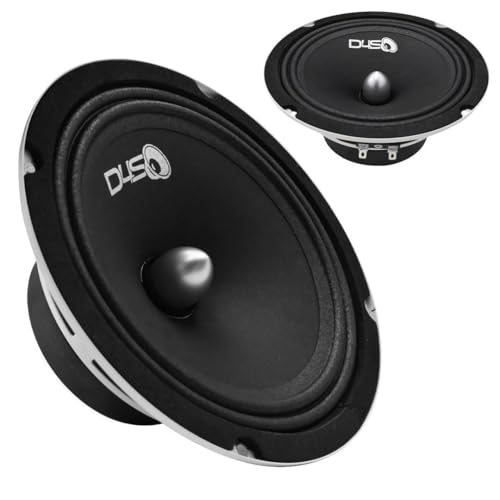
Down4Sound SFX65-8P 6.5" Midrange Speakers Pair
What We Like
- 8 Ohm impedance for high-power amps
- 92dB sensitivity for clear loud sound
- Paper cone with silver phase plug
- Uniform spade connectors for easy install
Trade-offs
- 8 Ohm impedance limits amplifier compatibility
- Narrow frequency range skips deep bass and highs
An 8 Ohm impedance makes these Down4Sound speakers a natural match for high-power amplifiers that need a stable load, so you can push clean midrange without stressing the system.
Product photos
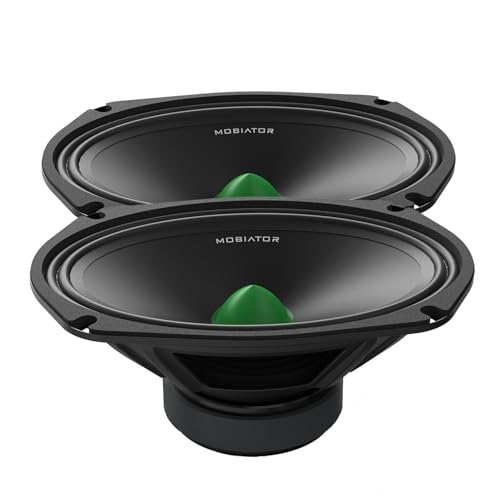
Mobiator MB-M694 6×9 Midrange Loudspeakers Pair
What We Like
- High 92dB sensitivity for loud, clear sound
- 150W RMS power handling for daily use
- 2-layer voice coil for long-term durability
- Wide frequency range covers bass to highs
Trade-offs
- 12kHz top end limits ultra-crisp treble detail
- 6×9 size requires specific mounting not found in all vehicles
The top end stops at 12kHz, so if you want shimmering cymbal crashes or airy highs, you’ll need to add a dedicated tweeter. Their 6×9 size also requires a compatible mounting location, unlike the 6.5-inch DS18 PRO-GM6B which fits many standard openings. But for a direct-fit midrange upgrade that plays loud and clean, these Mobiators pair high sensitivity with solid power handling.
Product photos
How We Evaluated Mid Range Car Speakers
Our evaluation combines manufacturer specifications, expert round-ups from automotive audio forums, and patterns in verified owner feedback. We focused on the technical details that determine real-world performance rather than marketing claims.
The four criteria that mattered most were sensitivity, power handling, mounting depth, and cone material. Sensitivity measures how efficiently a speaker converts power into volume. Power handling refers to RMS ratings for sustained use. Mounting depth is critical for fitting factory locations, and cone material affects distortion and clarity. We prioritized speakers that deliver clean midrange reproduction over those chasing peak power numbers.
A research-led evaluation has limits: we cannot replicate every vehicle’s acoustic environment or amplifier pairing. What we can do is identify the specifications and design choices that consistently lead to good results across different installations.
What To Look For In Mid Range Car Speakers
The right midrange speaker balances sensitivity, power handling, and physical fit. Here is what matters most.
Focus on sensitivity above a certain level for clean output without needing a massive amplifier, match impedance to your system (4 or 8 Ohm), and always measure your mounting depth before buying.
Sensitivity And Efficiency
Sensitivity, measured in decibels (dB), tells you how loud a speaker will play with a given amount of power. Every 3 dB increase means the speaker needs half the power to reach the same volume. For midrange speakers, look for sensitivity ratings that are high enough to work well with your system. The Skar Audio FSX65-4 leads here at 92.5 dB, meaning it produces strong output even from a factory head unit or modest amplifier. Lower sensitivity speakers require more power to keep up, which can strain smaller amps.
Power Handling: RMS Vs. Peak
RMS (Root Mean Square) power handling is the continuous power a speaker can handle, while peak power is a brief maximum. Always match your amplifier’s RMS output to the speaker’s RMS rating. The Recoil MS65-4P pair handles 600W max with a 1.5-inch Kapton voice coil for heat resistance, making it suitable for long listening sessions at higher volumes. A mismatch, too much power or too little, leads to distortion or damage.
Mounting Depth And Physical Fit
Mounting depth is the most common reason a midrange upgrade fails. Measure the space behind your factory speaker location before shopping. The AudioControl Altitude 2.75″ requires only 1.28 inches of depth, fitting most door panels without modification. The NVX XQ-Series v2 needs 1.62 inches, while the PRV AUDIO 6MR200A-4 needs 2.24 inches. Always account for the magnet structure and any adapter rings.
- Measure mounting depth with the door panel removed, not through the grille opening.
- Check for window track clearance behind the speaker location.
- Verify the speaker diameter fits your factory cutout (3.5″, 6.5″, or 6×9).
- Consider adapter brackets if your vehicle uses non-standard mounting patterns.
- Test fit a template before cutting or modifying any panels.
A speaker that does not fit physically will never sound good, no matter how impressive the specs are.
Mid Range Car Speakers Compared
The table below compares key specifications across our top picks to help you narrow your choices.
| Product | Size | Power Handling (RMS) | Impedance |
|---|---|---|---|
| NVX XQ-Series v2 3.5" Midrange Speakers | 3.5 inches | 100W RMS per pair | 4 ohms |
| DS18 PRO-GM6B 6.5" Midrange Speaker | 6.5" | 140W RMS | 8 Ohms |
| Skar Audio FSX65-4 6.5" Midrange Speaker | 6.5" | 150W RMS | 4 Ohm |
| PRV AUDIO 6MR200A-4 6.5" Midrange Speakers Pair | 6.5 | 200 Watts Program | 4 Ohm |
| Recoil MS65-4P 6.5-Inch Midrange Pro Audio Car Speakers | 6.5" | 300W RMS | 4 Ohm |
| AudioControl Altitude 2.75" Component Midrange Speakers | 2.75" | 50W | 4 Ohm |
| AudioControl Altitude 3.5" Component Midrange Speakers | 3.5 inches | 50W RMS | 4 Ohms |
| Pyle PDMR6 6.5" Sealed Back Midrange Speaker | 6.5" | 150W | 8 Ohm |
| Down4Sound SFX65-8P 6.5" Midrange Speakers Pair | 6.5 inch | 200W RMS | 8 Ohm |
| Mobiator MB-M694 6×9 Midrange Loudspeakers Pair | 6×9 inches | 150W RMS | 4 Ohms |
Frequently Asked Questions
What is the difference between midrange and coaxial speakers?
Midrange speakers reproduce only the frequencies between roughly 300 Hz and 5 kHz, focusing on vocals and lead instruments. Coaxial speakers combine a woofer and tweeter in one unit to cover a wider frequency range but often compromise midrange clarity.
Do I need an amplifier for midrange speakers?
Most dedicated midrange speakers perform best with an external amplifier because they lack the efficiency of full-range speakers designed for head unit power. The AudioControl Altitude models include in-line crossovers but still benefit from an amp. The Skar Audio FSX65-4‘s 92.5 dB sensitivity makes it one of the few that works reasonably well with a strong factory stereo.
Can I replace my factory door speakers with midrange speakers?
You can, but you will lose bass and treble because midrange speakers do not cover those frequencies. A three-way system with separate woofers, midranges, and tweeters is the ideal setup. If you want a simple replacement, look for coaxial speakers instead.
What size midrange speaker should I choose?
The size depends on your vehicle’s factory cutout. Common sizes are 3.5 inches for dash locations, 6.5 inches for doors, and 6×9 inches for rear decks. Measure your existing speaker’s diameter and mounting depth. The NVX XQ-Series v2 fits 3.5-inch locations, while the PRV AUDIO 6MR200A-4 fits standard 6.5-inch openings.
What does impedance mean for midrange speakers?
Impedance, measured in Ohms, is the electrical resistance the speaker presents to the amplifier. Most car audio systems use 4 Ohm speakers. An 8 Ohm speaker like the DS18 PRO-GM6B draws less current but requires an amplifier rated for 8 Ohm loads. Using the wrong impedance can cause an amplifier to overheat or shut down.
The Bottom Line
The NVX XQ-Series v2 3.5″ Midrange Speakers take the Best Overall award for drivers who need clear, distortion-free vocals from shallow locations where larger speakers cannot fit. Their carbon fiber cones and neodymium motor deliver clean midrange reproduction without the bulk.
For those building a high-output system, the DS18 PRO-GM6B offers the highest power handling at 480W max, while the Skar Audio FSX65-4 gives you the best sensitivity for getting loud on a smaller amplifier. The AudioControl Altitude 2.75″ is the right choice when every millimeter of mounting depth matters.
The single most important factor in choosing midrange speakers is physical fit. Measure your mounting depth and cutout size first, then match sensitivity and power handling to your amplifier. Everything else follows from there.
