
10 Best Polishings For Cars in 2026
This post contains affiliate links. As an Amazon Associate, we earn from qualifying purchases.
For car paint correction and finishing, the Chemical Guys TORQX Random Orbital Polisher is our best overall pick. Its safe dual-action motion and 800W motor make it ideal for beginners, while the lightweight 4.7 lb design reduces fatigue. For long detailing sessions, the Griot’s Garage G9 offers superior ergonomics, and the Niusken Cordless Kit provides the freedom of a battery-powered tool.
Choosing a car polisher is about matching the tool to your skill level and the job. A random orbital is safer for new users, while a rotary buffer offers more cutting power for professionals. The key factors are the tool’s power, weight, and whether you need the mobility of a cordless model.
This guide is based on a thorough analysis of manufacturer specifications, expert recommendations, and common owner feedback. We evaluated ten polishers to help you find the right tool for your paint correction goals, from simple waxing to heavy defect removal.
Top 10 Polishers For Cars in the Market
Certain content that appears on this site comes from Amazon. This content is provided "as is" and is subject to change or removal at any time.
The Best Polishers For Cars, Reviewed
Chemical Guys TORQX Random Orbital Polisher
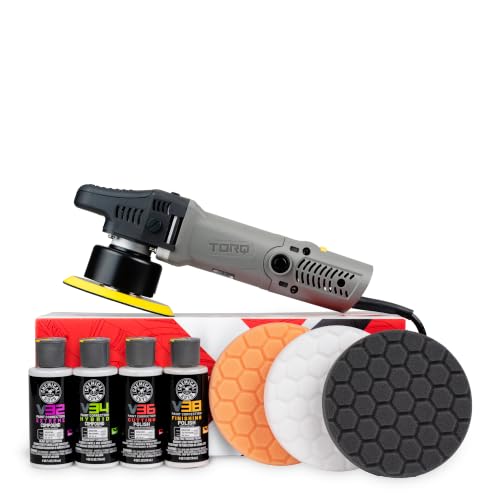
What We Like
- Safe dual action for beginners
- 800W motor for consistent torque
- Lightweight 4.7 lb design
- 9mm orbit for efficient defect removal
Trade-offs
- Corded design limits mobility
- No variable speed control listed
An 800W motor in a 4.7 lb body means this polisher delivers steady power without wearing out your arms during a full detail. The dual-action random orbit keeps the pad moving in a way that minimizes the risk of burning through clear coat, which is exactly what a beginner needs to feel confident tackling swirls and scratches. That combination of safety and consistent torque makes it a natural fit for someone who wants professional-grade results without a steep learning curve.
The trade-off is that you’re tethered to a cord, so you’ll need an extension cord to reach around the vehicle. Compared to the Griot’s Garage G9, which has a 1000W motor and variable speed, the TORQX’s 800W motor delivers consistent power but may not offer the same range of speed adjustments for different pad and compound combinations. For most DIYers doing a full car a few times a year, that simplicity is a fair exchange for the lightweight feel and beginner-friendly motion.
Griot's Garage G9 Random Orbital Polisher

What We Like
- 1000 W motor for effective paint correction
- Ergonomic double-shot rubber grip
- Fan-cooled counterbalance for smooth operation
- 6 variable speed settings for versatility
Trade-offs
- At 5.2 lb, heavier than cordless options
- Corded design limits mobility without an outlet
- Requires optional backing plate for 5" pads
A 1000-watt motor driving a 9mm orbit throw means this polisher can handle serious paint correction, removing scratches, swirls, and oxidation without bogging down under pressure. That steady power, paired with a well-balanced body and a double-shot rubber grip, makes it a natural fit for anyone planning longer detailing sessions. The contoured shroud and accessible speed dial (for both right- and left-hand users) add to the comfort, so you can focus on the finish rather than fighting the tool.
Weight is the main consideration here: at 5.2 pounds, it’s heavier than a cordless pick like the Niusken (3.3 lb), and you’re tied to a 10-foot power cord. That’s fine for a garage or driveway where you have an outlet nearby, but less ideal for quick touch-ups away from power. If you value endurance and correction power over portability, this corded dual-action polisher delivers the steady performance that makes extended use feel manageable.
Griot's Garage G8 Mini Orbital Polisher

What We Like
- 2" and 3" backing plates included
- Fan-cooled counterbalance for smooth operation
- 45% stronger gearset than previous model
- Ergonomic double-shot rubber dampening
Trade-offs
- Corded design limits mobility
- Small backing plates slow work on large panels
The included 2-inch and 3-inch backing plates make this polisher effective for small areas and tight contours where larger tools cannot fit. Its 700-watt motor and 8mm orbit provide enough power for removing scratches, swirls, and oxidation. The double-shot rubber dampening and contoured shroud grip help keep your hands comfortable during extended use, and the 6 variable speed settings let you adjust for different tasks. This is a tool designed for precision work on confined spaces, not for covering large panels quickly.
The Griot’s Garage G8 Mini Orbital Polisher is built for precision work on small areas and tight contours, not for covering large flat panels quickly. It includes 2-inch and 3-inch backing plates, so you can focus on detailed paint correction like removing scratches, swirls, and oxidation. The 700-watt motor and 8mm orbit deliver power for correction, but the compact design means you’ll need an extension cord since it’s corded. For anyone who regularly works on intricate sections of a car, this tool offers the agility and control that larger polishers lack in those spots.
Niusken Cordless Car Buffer Polisher Kit
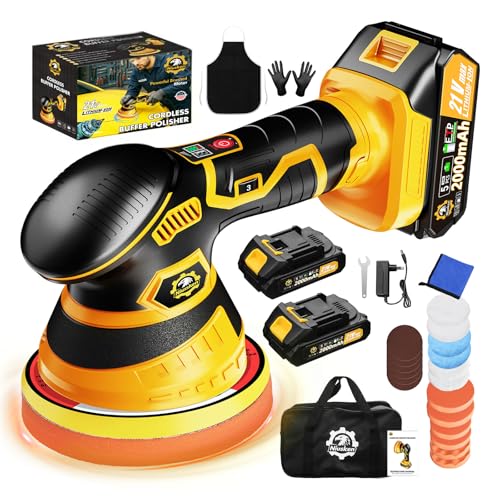
What We Like
- Cordless freedom with two included batteries
- 6-speed LED display shows battery and speed
- Lightweight 3.3 lbs for easy maneuverability
- 18-piece kit covers multiple surfaces
Trade-offs
- Battery system not compatible with DeWalt batteries
- Auto shut-off after 20 minutes at high speed
- Unique battery design limits spare-battery options
At just 3.3 pounds, this cordless buffer is light enough to handle one-handed for extended periods. The two included 21V 2000mAh batteries let you swap packs and keep working through a full sedan or SUV without waiting for a recharge. The 6-speed LED display shows your current speed and remaining battery level at a glance, so you always know what’s going on. Its cordless design and beginner-friendly random orbital action make it a practical choice for anyone new to detailing.
One catch is that the battery system is proprietary, so you cannot borrow spares from a DeWalt or Craftsman V20 lineup. Also, the overheating protection may shut the tool down after 20 minutes of continuous high-speed use, which means you will need to pause between panels. Compared to the corded Griot’s Garage G9, which weighs 5.2 pounds and plugs into a wall outlet, this Niusken is lighter and cordless but requires battery swaps and cooldown breaks. It fits the home detailer who values a lightweight tool for quick jobs over unlimited runtime.
Product photos
SPTA Cordless Mini Polisher

What We Like
- Three backing plate sizes for tight areas
- Dual-action free spinning prevents holograms
- Portable and cordless for freedom of movement
Trade-offs
- 4.3 lbs is heavier than some mini polishers
- Speed range tops at 4500 OPM for light work
The dual-action free spinning rotation reaches up to 4500 OPM, which keeps the finish hologram-free and prevents swirls even in tight spots. With a 2000 mAh battery, you can work through emblems and body lines without hunting for an outlet, making it a practical choice for quick touch-ups or cramped areas where larger polishers can’t go.
Weight is the main consideration here: at 4.3 pounds, this SPTA is heavier than some mini polishers, which can feel heavier for extended overhead or one-handed work. But the SPTA compensates with a full kit of pads and brushes, plus two batteries to keep you going. If you value portability and a complete setup over the lightest possible tool, this is a practical choice for spot corrections and detailing nooks.
Product photos
CRAFTSMAN V20 Cordless Buffer Polisher

What We Like
- 10-inch orbital pad for large area coverage
- Variable speed dial for control
- Contoured overmold grip for comfort
- VERSATRACK compatible for storage
Trade-offs
- Battery and charger not included, sold separately
- At 6.2 pounds, heavier than some cordless models
The Craftsman V20 Cordless Buffer Polisher uses a 10-inch orbital pad, which covers a large surface area so you can finish a hood or door panel in fewer passes than with a smaller pad. The variable speed dial lets you adjust the action for waxing or light correction, and the contoured overmold grip adds comfort during extended use. Because it is cordless, you are not tied to an outlet, but you must supply your own V20 battery and charger. This tool is VERSATRACK compatible for storage, though the track system is sold separately.
At 6.2 pounds, this polisher is about a pound heavier than the corded Griot’s Garage G9. Since the battery and charger cost extra, your upfront investment is higher than a corded polisher of similar capability. The Niusken cordless kit includes two batteries and a charger, though its pad is smaller. The 10-inch orbital pad on this Craftsman covers large surfaces quickly, and the variable speed dial gives you control over the work.
Product photos
DEWALT DWP849X Buffer Polisher
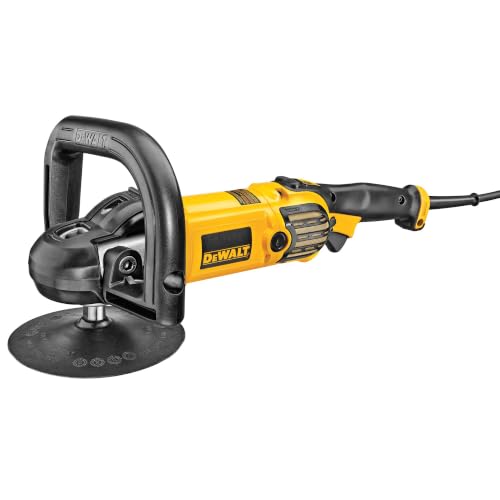
What We Like
- All ball-bearing and steel gear construction
- Rubber overmoulded gearcase for grip
- Variable speed trigger and dial
- Replaceable wool ingestion shield
Trade-offs
- Corded design limits mobility around the car
- At 6.7 pounds, heavier than some competitors
- No random orbit action; rotary requires more skill
A 12-amp motor that spins up to 3,500 RPM means this buffer has the torque to cut through heavy oxidation and swirls without bogging down. All ball-bearing construction and precision-cut steel gears support durability. The rubber overmoulded gearcase gives you a secure grip even when your hands are slick with polish. The variable speed trigger lets you feather the power for delicate wax application or crank it for paint correction. This tool is suited for someone who wants a rotary buffer with a corded design for consistent power.
A key difference is that this is a rotary buffer, not a random orbital like the Chemical Guys TORQX. That means you need a steady hand and some practice to avoid burning through clear coat, especially on curves and edges. The corded design keeps power consistent but tethers you to an outlet, and at 6.7 pounds it has more heft than the Griot’s Garage G9, so your arm will feel it after a full car. For the detailer who values raw cutting power and longevity over ease of use, this is the one to reach for.
SILVEL Buffer Polisher 1600W

What We Like
- 1600W motor for heavy correction
- 7 variable speeds from 500-3300 RPM
- Includes 6 foam and 3 wool pads
- Ergonomic front grip and D-handle
Trade-offs
- At 7.0 lb, tiring for long sessions
- Corded design limits reach without extension
- Rotary action requires skill to avoid swirls
The 1600W motor on this polisher provides enough power to remove swirls, scratches, and defects from painted vehicles, restoring shine without needing a second tool. Seven variable speeds let you adjust from 500 RPM for gentle waxing up to 3300 RPM for heavy correction, all without stopping the machine. The package includes six foam pads and three wool pads, so you can start compounding, polishing, and finishing immediately. This is a capable machine for anyone ready to tackle serious detailing work.
At seven pounds, this buffer will fatigue your arms faster than lighter models like the Griot’s Garage G9, especially during full-car jobs. Owners report it demands a steady hand and some practice to avoid leaving marks, so it is not a grab-and-go tool for casual users. If you need strong cutting power for heavy correction and are willing to learn the technique, this kit gives you everything required. For those who prefer a safer, more forgiving motion, a random orbital polisher is a better fit.
Product photos
AUTIWOZ 5 Inch DA Polisher

What We Like
- Lightweight 4.19 lb reduces fatigue
- 6 speeds with lock function
- Long 9.84 ft cord for reach
- Low-noise operation
Trade-offs
- 9 mm orbit slower on heavy correction
- Corded only, not for remote work
At just 4.19 pounds, this dual-action polisher is built for the person whose arms start aching halfway through a hood. The lightweight body and ergonomic grip let you work longer without fighting the tool, and the 9.84-foot cord means you can walk around most cars without hunting for an extension. Six speeds give you real control: speed two for spreading wax, speed four for everyday polishing, and speed six for digging out deeper swirls and scratches. The lock function keeps your setting steady, so you are not accidentally bumping the dial mid-stroke.
The 9 mm random orbit motion of this polisher is gentle on paint, so it’s ideal for maintenance polishing and waxing. Owners report it may need extra passes on deeper scratches compared to longer-stroke machines. That lighter weight, 4.19 pounds, saves your shoulders during extended use, making it a comfortable choice for enthusiasts who prioritize ease of handling. For heavy defect correction, you’d want a longer throw, but as a daily driver for light detailing, this tool delivers a swirl-free finish without wearing you out.
Protmex Cordless Car Buffer Polisher
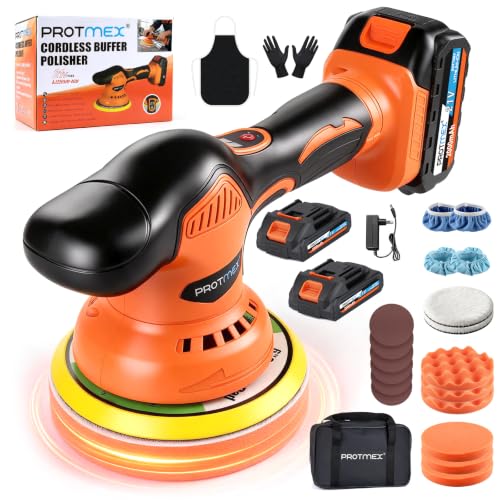
What We Like
- 6 variable speeds for different tasks
- Lightweight at 3.3 lbs with battery
- Two 2000mAh batteries included
Trade-offs
- Batteries must be fully charged before first use
- Requires pre-charging batteries before each use.
The trade-off with cordless convenience is that sustained use at higher speeds will drain a battery faster than a corded machine would, so keeping both packs charged is wise before tackling a full detail. Compared to the Griot’s Garage G9, which plugs into the wall and runs at 1000 watts, this Protmex is lighter and more portable but won’t match that continuous power for heavy correction. For waxing, light polishing, and spot touch-ups, the dual-battery setup keeps you moving, and the included accessories cover a range of applications right out of the box.
Product photos
How We Evaluated Polishers For Cars
This evaluation draws on manufacturer data, expert round-ups from the automotive detailing community, and patterns in owner feedback. We prioritized the specifications and real-world reports that matter most for paint correction.
We focused on three main criteria: power and torque for effective defect removal, weight and ergonomics for user comfort during long sessions, and operating system (random orbital vs. Rotary) for safety and skill requirements. For cordless models, battery life and system compatibility were also critical factors.
It is important to note that a research-led approach has limits. Owner satisfaction can vary with pad quality, technique, and the specific paint condition being addressed. We recommend reading user reviews for the latest feedback on durability and real-world performance.
What To Look For In Polishers For Cars
Choosing a car polisher means balancing power, safety, and comfort. Here are the key criteria to guide your decision.
Choose a dual-action (random orbital) polisher for safe, swirl-free results and a rotary polisher for maximum cutting power on heavy defects. Match the tool’s weight and corded or cordless design to your typical workspace.
Power and Torque
The motor’s power determines how well a polisher can maintain speed under pressure. A more powerful motor (measured in watts or amps) is less likely to bog down when you apply pressure for paint correction. Look for a motor with consistent torque for efficient defect removal.
Weight and Ergonomics
Polishing a car can take hours. A lighter tool (under 5 pounds) reduces arm fatigue, while ergonomic features like rubber grips and counterbalanced designs improve comfort and control. For extended use, a tool with a comfortable grip and lower vibration is a worthwhile investment.
Operating System: Random Orbital vs. Rotary
This is the most important decision. A random orbital polisher oscillates and spins, making it nearly impossible to burn paint or create holograms. It is the best choice for beginners and DIYers. A rotary buffer spins in one direction and is more powerful for heavy correction but requires significant skill to avoid damaging the paint.
- Consider a mini polisher (2-3 inch pads) for tight areas like door jambs, bumpers, and around emblems.
- For large panels like hoods and roofs, a larger pad (6-10 inches) covers more area quickly.
- Cordless models offer freedom of movement but may have shorter run times and less sustained power than corded models.
- Check if the polisher includes a carrying case or pad kit, which adds value.
The safest rule for a first-time buyer is to choose a random orbital polisher with a motor over 800 watts.
Polishers For Cars Compared
The table below compares the key specs and features of our top picks to help you see how they differ at a glance.
| Product | Motion Type | Weight | Pad Size |
|---|---|---|---|
| Chemical Guys TORQX Random Orbital Polisher | Dual action random orbital | 4.7 lb | N/A |
| Griot's Garage G9 Random Orbital Polisher | Dual action | 5.2 lb | 6" (convertible to 5") |
| Griot's Garage G8 Mini Orbital Polisher | Dual action | N/A | 2" and 3" |
| Niusken Cordless Car Buffer Polisher Kit | Random orbital | 3.3 pounds | 5-inch backing plate |
| SPTA Cordless Mini Polisher | RO/DA | 4.3 lbs | 25mm, 50mm, 80mm |
| CRAFTSMAN V20 Cordless Buffer Polisher | Orbital | 6.2 pounds | 10-inch orbital |
| DEWALT DWP849X Buffer Polisher | N/A | 6.7 pounds | 7-in-9-in |
| SILVEL Buffer Polisher 1600W | N/A | 7.0 pounds | 6 inch foam, 7 inch wool |
| AUTIWOZ 5 Inch DA Polisher | Random orbital | 4.19 lb | 5 Inch |
| Protmex Cordless Car Buffer Polisher | N/A | 3.3 lbs | 6 inch |
Frequently Asked Questions
What is the best car polisher for a beginner?
The best polisher for a beginner is a random orbital (dual-action) model. These are very safe because they won’t burn through the paint or leave swirl marks, even if you are learning. The Chemical Guys TORQX is a great starting point due to its lightweight design and safe dual-action motion.
Is a corded or cordless car polisher better?
A corded polisher provides consistent power and never runs out of battery, making it ideal for long paint correction sessions. A cordless polisher offers freedom of movement around the car without a trailing cord, but may have limitations on run time and sustained power. The choice depends on your access to power outlets and your tolerance for managing a cord.
What is the difference between a random orbital and a rotary polisher?
A random orbital polisher moves in a random, oscillating pattern that prevents heat buildup and swirl marks, making it safe for all skill levels. A rotary polisher spins in a fixed circle, offering more cutting power for heavy defects but requiring significant skill to avoid damaging the paint. Beginners should always start with a random orbital.
How much power do I need in a car polisher?
For light polishing and waxing, a motor around 800 watts is sufficient. For heavy paint correction and defect removal, look for a motor of 1000 watts or more. A more powerful motor maintains speed under pressure, which is crucial for effective cutting.
Can I use a car polisher on a motorcycle or boat?
Yes, you can use a car polisher on other painted surfaces like motorcycles, boats, and RVs. For smaller vehicles or tight areas, a mini polisher with smaller backing plates (2-3 inches) is often more maneuverable and easier to control.
The Bottom Line
For most home detailers and DIY enthusiasts, the Chemical Guys TORQX Random Orbital Polisher is the best overall choice. It offers the safe dual-action motion that beginners need, combined with enough power for effective paint correction, all in a lightweight package that won’t tire you out.
If you are a professional or plan to spend hours on paint correction, the Griot’s Garage G9 is worth paying more for due to its superior ergonomics and powerful 1000W motor. For those who need cordless freedom, the Niusken Cordless Kit provides excellent value with two included batteries.
The single most important factor in choosing a polisher is selecting the correct operating system. A random orbital polisher is the only safe and effective choice for anyone without professional rotary experience.
