
10 Best Quality Car Speakers in 2026
This post contains affiliate links. As an Amazon Associate, we earn from qualifying purchases.
For a true audio upgrade, the Pioneer A-Series Plus TS-A1681F 4-Way Coaxial Speakers deliver the best balance of accurate sound separation and wide frequency range for most drivers. If you need a speaker that fits tricky vehicle openings, the Rockford Fosgate Punch P1683 offers a FlexFit design, while the JBL Club 64 lets you adjust tweeter output to match your car’s acoustics.
Upgrading from factory speakers can feel overwhelming with all the specs and sizes. What matters most is finding a speaker that matches your car’s power, fits your door openings, and delivers the clarity you want without distortion. A quality set of speakers transforms your daily drive more than almost any other upgrade.
We evaluated these picks by analyzing manufacturer specifications, expert round-ups, and patterns in owner feedback. This guide breaks down the key specs, sensitivity, power handling, and construction, so you can match the right speaker to your vehicle and listening habits.
Top 10 Quality Car Speakers in the Market
Certain content that appears on this site comes from Amazon. This content is provided "as is" and is subject to change or removal at any time.
The Best Quality Car Speakers, Reviewed
Pioneer A-Series Plus TS-A1681F 4-Way Coaxial Speakers

What We Like
- Four-way design for accurate sound separation
- Wide 35 Hz to 29 kHz frequency range
- Includes multi-fit installation adapters
- 91 dB sensitivity for clear volume without distortion
Trade-offs
- 80W continuous power limits very high-volume builds
- Sensitivity of 91 dB is lower than some competitors.
With a frequency response of 35 Hz to 29 kHz, these speakers cover a broad range of audio frequencies, from deep lows to high treble. The 4-way design uses separate drivers for different frequency ranges, which helps produce more accurate and balanced sound reproduction. That makes the Pioneer A-Series Plus a suitable upgrade for factory speakers, offering balanced sound and enhanced bass without requiring immediate addition of a subwoofer or tweeter.
The 80-watt continuous power handling means these speakers aren’t built for competition-level SPL builds where you’re feeding hundreds of watts per channel. For daily driving, though, the included multi-fit adapters simplify installation, and the frequency response stretches from 35 Hz to 29 kHz, covering deeper bass and higher treble than many factory speakers. That range gives you more detail across different music genres without needing extra brackets.
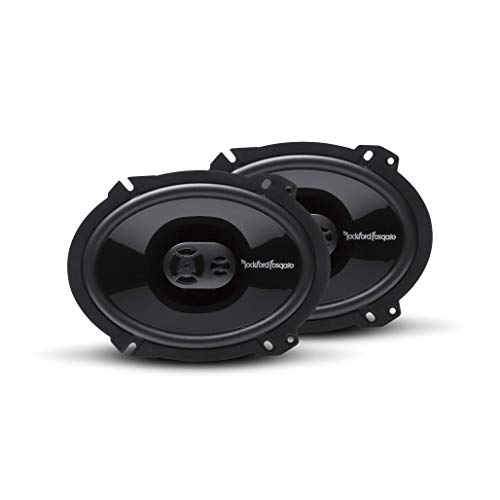
Rockford Fosgate Punch P1683 3-Way Coaxial Speakers
What We Like
- FlexFit basket slots for adjustable alignment
- Includes OEM adapter plate and mounting hardware
- PEI dome tweeter with built-in crossover
- Butyl rubber surround for accurate frequency reproduction
Trade-offs
- RMS power rating is lower than some competitors
- Heavier than many 6×8 options at 4.9 lbs
The FlexFit basket uses slots instead of fixed screw holes, so you can shift the speaker slightly to align with your factory mounting holes. That means no drilling or struggling with oversized adapters. For anyone swapping out a worn factory speaker, the included OEM adapter plate and mounting hardware make installation straightforward. The injection molded mineral filled polypropylene cone and butyl rubber surround work together to keep distortion low and sound accurate.
JBL Club 64 Two-Way Car Speakers

What We Like
- Adjustable tweeter output (0dB or +3dB)
- Plus One woofer cone for more cone area
- Edge-driven silk dome tweeter reduces harshness
- UV-resistant polypropylene cone for durability
Trade-offs
- Two-way design limits high-frequency staging vs 3-ways
With a sensitivity of 93dB (@ 2.83V), these speakers convert power into volume efficiently, so they work well with factory radios that don’t put out a lot of wattage. The adjustable tweeter output control lets you choose 0dB or +3dB to match the speaker’s placement in your car, helping keep the sound balanced. The Plus One woofer cone increases the cone area for better low-frequency output, giving you more bass than many similarly sized speakers.
The JBL Club 64’s 3.0 ohm impedance means it pulls more power than a typical 4-ohm speaker, so your factory head unit may run warmer or distort sooner if you crank it. Compared to the Pioneer A-Series Plus TS-A1681F, which splits sound across four drivers, this two-way design keeps wiring simple but can’t spread highs and mids across the cabin as precisely. For someone who wants a straightforward install with the ability to adjust tweeter output level, this speaker delivers focused performance.
Product photos
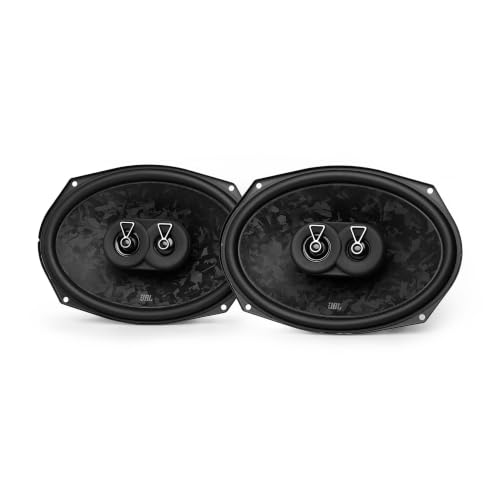
JBL Stage3 968MF 3-Way Speakers
What We Like
- Patented Plus One cone increases surface area
- Higher sensitivity for louder output
- Improved low-frequency response
- Greater musical character from design
Trade-offs
- Heavier than some 6×9 competitors at 5.6 lb
- Plus One woofer requires deeper mounting depth than factory speakers.
A patented Plus One woofer cone gives these 6×9 speakers more cone surface area than typical woofers in their class. That extra area means higher sensitivity, so you get louder sound with the same amplifier power, and it pushes low-frequency output further down for richer bass. If you want your music to feel fuller and more alive without adding a subwoofer, this design delivers a clear advantage. The JBL Stage3 968MF suits drivers who value musical character and want their rear or full-range speakers to punch above their weight in bass presence.
The trade-off is weight and fit. At 5.6 pounds per pair, these are heavier than many 6×9 coaxial speakers, which can matter if your vehicle’s mounting locations are flimsy or you’re watching total added weight. The three-way layout also takes up more mounting depth than a simpler two-way design like the JBL Club 64, so check your door or rear deck clearance before buying. For someone who wants the broadest cone area in a 6×9 package and is willing to measure first, this JBL set rewards the extra effort with noticeably bigger sound.
Product photos
Pioneer P.R.O. Series TS-M651PRO Component Speakers

What We Like
- 94 dB sensitivity for high SPL
- 500W max power handling
- Lightweight pulp cone reduces distortion
Trade-offs
- Limited low bass response at 50 Hz
- Component design requires separate crossover installation
With a 94 dB sensitivity rating, these speakers convert power into volume efficiently, making them a strong choice for listeners who want high output from modest amplifier power. The lightweight pulp cone is designed to keep distortion minimal, so clarity holds up even when you push the 500-watt peak handling. These are built for someone focused on loud, clear sound who is willing to pair them with the right amplifier and system components.
The frequency response stops at 50 Hz on the low end, which means deep bass notes below that range won’t be reproduced by these speakers alone. That is common for component speaker sets designed for high output, and it means you may want to add a subwoofer if deep bass is important to you. If you are after high SPL and are ready to build a system around these speakers, they offer the specs to support that goal. If you want a simple drop-in upgrade without extra components, a coaxial speaker might suit you better.
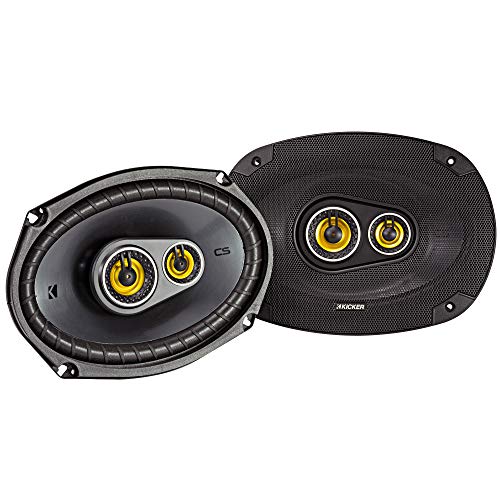
Kicker CS Series 6×9 Coaxial Speakers
What We Like
- Shallow mounting depth fits many vehicles
- UV-treated foam resists sun damage
- Neodymium tweeter magnets boost high frequencies
- Stamped-steel frame with rigid polypropylene cone
Trade-offs
- 150W peak power is modest for high-volume builds
- Coaxial design limits soundstage compared to components
A shallow mounting depth lets these 6×9 speakers drop into factory locations in trucks and SUVs, so you can upgrade without a custom install. The heavy-duty motor and extended voice coil push deeper lows, and the neodymium tweeter magnets allow for increased volume in high frequencies. If your current speakers sound muddy or thin, this pair is built to fit and deliver cleaner, fuller audio.
Peak power is 150 watts, so these won’t match the output of some other 6×9 speakers when paired with a high-output aftermarket amp. The coaxial design fixes the tweeter in place, which means you can’t adjust the soundstage like you could with a component set. But for a durable swap that resists sun and heat, the Kicker CS Series works well for truck and SUV owners who want better sound without the extra work.
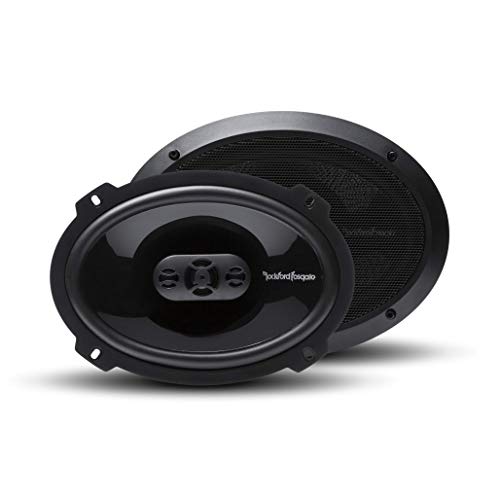
Rockford Fosgate Punch P1694 4-Way Coaxial Speakers
What We Like
- FlexFit basket design for easier alignment
- 75W RMS power handling for loud, clean playback
- PEI dome tweeter with built-in crossover
- Includes grilles, mounting hardware, and adapter plate
Trade-offs
- 4-way design adds complexity over simpler 2-way setups
- Heavier than the JBL Stage3 968MF 3-Way speakers at 5.6 pounds
With 75 watts RMS and 150 watts max power handling, these Rockford Fosgate 6×9 speakers are built for drivers who want to fill a car with loud, clear music without distortion. The injection molded mineral filled polypropylene cone and butyl rubber surround work together to handle that extra power while keeping bass tight and vocals accurate. This makes them a natural fit for anyone upgrading a factory system who plans to pair the speakers with a decent aftermarket amplifier. The included grilles, mounting hardware, and OEM adapter plate also mean less time hunting for extra parts during installation.
The trade-off comes in the form of weight. But for someone who values raw power handling and the proven build quality Rockford Fosgate is known for, these trade-offs are worth the extra effort.
Kicker KS-Series 51KSC6504 Coaxial Speakers

What We Like
- Concert-like volume without harshness
- Internally dampened polypropylene cones for detail
- Zero tweeter protrusion for easy fit
- Redesigned voice coils and crossovers
Trade-offs
- Heavier than many 6.5-inch speakers at 5.7 pounds
- Requires a powerful amplifier to reach concert-like volume
These speakers let you play at concert-like volume while keeping the smoothness and subtlety that pleases even a selective ear, thanks to internally dampened polypropylene cones and tough rubber surrounds. That means you get outstanding midrange detail and pounding bass without harshness when you turn it up. The zero tweeter protrusion (or minimal) gives a perfect fit in almost every vehicle on the road today, so installation requires no cutting or modifications.
At 5.7 pounds per pair, these are heavier than the 1.8-pound Pioneer A-Series Plus TS-A1681F. That extra weight means your door panels need solid mounting points. The 4-ohm impedance is standard for aftermarket setups, so pairing with a typical car amplifier works fine. These are a serious upgrade for drivers who prioritize clean, loud sound over lightweight components.
Product photos
JVC CS-J6930 3-Way Car Speakers

What We Like
- Carbon mica woofer for smooth mids and lows
- 400W peak power handling
- Includes grilles for protection and style
- Designed to withstand extreme car door temperatures
Trade-offs
- Heavy at 4.4 lbs for some car door installs.
- Large 6"x9" size won't fit standard 6.5" openings.
A 6×9-inch carbon mica woofer with a cloth-and-rubber hybrid surround gives these JVC speakers the ability to push clean, controlled bass without the distortion you often get from factory paper cones. That 400-watt peak rating also means they can handle a decent aftermarket head unit or small amplifier without blowing, which is exactly the kind of headroom a budget-minded shopper needs. If you want a noticeable upgrade from stock sound, clearer vocals, fuller lows, and less muddiness at higher volumes, this set delivers where it counts without demanding a big spend.
The half-inch polymer film dome tweeter is durable and cheap to produce, but it won’t deliver the same treble detail you’d get from a silk or metal dome found on pricier picks like the JBL Club 64. That matters most if you listen to acoustic instruments or cymbal-heavy music and crave airy highs. The JVCs are a straight OEM replacement that fits many cars easily, and the included grilles keep them looking tidy. Reviewers note these speakers handle 400 watts peak power and cover a frequency range of 30-22,000 Hz. That means they can play very deep bass and high treble notes.
Product photos
Kenwood KFC-1666S 2-Way Car Speakers
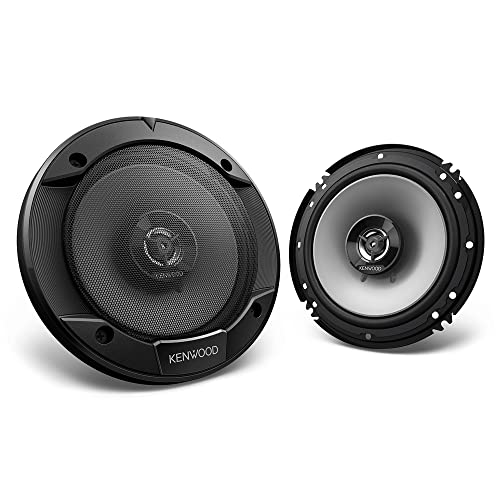
What We Like
- Grilles included for easy installation
- Polypropylene woofer with treated cloth surround
- 1" PEI balanced dome tweeter for clear highs
- Wide frequency response (40-22,000 Hz)
Trade-offs
- Lower sensitivity (90 dB) than JBL Club 64 (93 dB)
- Peak power (300W) is below Pioneer TS-A1681F (350W)
A 300-watt peak power rating means these Kenwoods can fill a cabin with sound without distorting at higher volumes, but the real draw here is how quickly they go in. The grilles are included right in the box, so you don’t have to hunt for separate mounting hardware or worry about damaging the cones during installation. For someone who wants a noticeable audio upgrade without spending an afternoon wrestling with adapters and trim panels, this set keeps things simple. The polypropylene woofer and treated cloth surround deliver a clean, punchy bass that won’t sound muddy, while the 1-inch PEI dome tweeter brings out crisp highs for vocals and cymbals.
Sensitivity sits at 90 dB, so these need a bit more power from your head unit to reach the same volume as the JBL Club 64, which offers 93 dB. That means if your factory radio is weak, the JBLs will sound louder with less effort. For a straightforward, fuss-free swap that still delivers clear highs and punchy bass, these Kenwoods are a practical choice.
Product photos
How We Evaluated Quality Car Speakers
Our evaluation started with the hard data: frequency response, sensitivity ratings, RMS power handling, and speaker dimensions. We cross-referenced these specs with manufacturer documentation to ensure accuracy. We then looked at patterns in owner feedback across thousands of reviews to understand how each speaker performs in real vehicles, not just on paper.
The four criteria that mattered most were sensitivity, power handling, frequency range, and build quality. Sensitivity determines how loud a speaker gets with limited power, while power handling reflects its ability to work with factory or aftermarket amps. Frequency range covers the breadth of sound it can reproduce, and build quality, materials like butyl rubber surrounds and polypropylene cones, resists heat and wear. Fitment was also critical, as many quality speakers fail simply because they won’t mount easily.
A research-led evaluation has limits: we don’t have a listening lab, and personal taste in sound signature varies. What we can tell you is which speakers are engineered to deliver clean, loud, and durable performance based on the specs and what owners consistently report.
What To Look For In Quality Car Speakers
Choosing car speakers is about matching specs to your vehicle and your goals. Focus on sensitivity for factory radios, power handling for amplified systems, and materials for longevity.
Focus on sensitivity (90 dB or higher) for loudness with factory power, RMS power handling to match your amp, and cone material for durability. Measure your mounting depth before buying.
Sensitivity and Power Handling
Sensitivity, measured in dB, tells you how loud a speaker gets with one watt of power. A speaker rated at 93 dB will sound significantly louder than one with a lower sensitivity rating when running off a factory head unit. For a simple upgrade without an amplifier, aim for 91 dB or higher.
Power handling comes in two numbers: RMS (continuous) and peak. RMS is the number that matters, it tells you how much power the speaker can handle cleanly. Match this to your amplifier’s output per channel.
If you’re using a factory radio, high RMS ratings don’t help because the radio can’t deliver that power.
Speaker Size and Fitment
Your car has specific speaker sizes (6.5-inch, 6×9, 5×7, etc.) and a limited mounting depth. Measure the depth from the mounting surface to the window track or door panel. Shallow-mount speakers like the Kicker CS Series are designed for tight spaces. Some speakers come with adapter plates or multi-fit brackets to ease installation. Ignoring fitment is the most common mistake, a great speaker that doesn’t fit is useless.
Cone Material and Surround Design
The cone material affects sound character and durability. Polypropylene cones resist moisture and temperature extremes, making them ideal for car doors. Paper cones can be lighter and more responsive but degrade faster in heat and humidity. The surround (the outer ring) should be rubber or foam. Butyl rubber surrounds, like those on the Rockford Fosgate Punch series, maintain their compliance for years and produce accurate bass without rattling.
- Measure your speaker opening size and mounting depth before ordering.
- Check if your car requires an adapter bracket or if the speaker includes one.
- Decide if you want a coaxial (all-in-one) or component (separate tweeter) setup.
- Confirm your stereo’s RMS output per channel to avoid overpowering or underpowering speakers.
A simple rule: for a factory radio upgrade, prioritize high sensitivity (over 91 dB) and a 2- or 3-way coaxial design for balanced sound.
Quality Car Speakers Compared
The table below compares our top picks across key specs to help you narrow down the choice based on your vehicle and listening preferences.
| Product | Type | Size | Max Power |
|---|---|---|---|
| Pioneer A-Series Plus TS-A1681F 4-Way Coaxial Speakers | 4-Way Coaxial | 6.5 inches | 350 watts |
| Rockford Fosgate Punch P1683 3-Way Coaxial Speakers | 3-Way Coaxial | 6×8 | 130W Max |
| JBL Club 64 Two-Way Car Speakers | Two-Way | 6-1/2" (160mm) | 180W Peak |
| JBL Stage3 968MF 3-Way Speakers | 3-Way Coaxial | 6 x 9 inches | N/A |
| Pioneer P.R.O. Series TS-M651PRO Component Speakers | Component | 6.5" | 500 watts |
| Kicker CS Series 6×9 Coaxial Speakers | Coaxial | 6 x 9 inches | N/A |
| Rockford Fosgate Punch P1694 4-Way Coaxial Speakers | 4-Way Coaxial | 6×9 | 150 Watts |
| Kicker KS-Series 51KSC6504 Coaxial Speakers | Coaxial | 6.5" | N/A |
| JVC CS-J6930 3-Way Car Speakers | 3-Way | 6"x9" | 400 watts |
| Kenwood KFC-1666S 2-Way Car Speakers | 2-Way | 6-1/2" | 300 watts |
Frequently Asked Questions
What size car speakers do I need?
Check your vehicle’s owner manual or measure the existing speaker opening. Common sizes include 6.5-inch, 6×9-inch, and 5×7-inch. Most listings will specify compatibility, and many include adapter brackets for common fitments.
Is it better to get 2-way, 3-way, or 4-way speakers?
A 2-way speaker has a woofer and tweeter and offers clean sound. A 3- or 4-way adds a midrange driver for better separation, but the benefit depends on build quality, a well-designed 2-way can outperform a cheap 4-way. Focus on overall speaker quality over the number of drivers.
Do I need an amplifier for new car speakers?
Not necessarily. If you choose speakers with high sensitivity (91 dB or more), they will sound louder and clearer with a factory radio. However, an amplifier unlocks the full potential of any speaker, especially those with higher RMS power ratings.
What does sensitivity (dB) mean for car speakers?
Sensitivity measures how efficiently a speaker converts power into volume. A 3 dB increase doubles the perceived loudness with the same power. For factory radios, look for 91 dB or higher. For amplified systems, sensitivity matters less because you have power to spare.
How long do quality car speakers last?
With proper installation and quality materials, speakers can last many years. Look for UV-treated surrounds and polypropylene or carbon mica cones, which resist the heat and UV exposure inside a car door. Butyl rubber surrounds are especially durable.
The Bottom Line
For most drivers, the Pioneer A-Series Plus TS-A1681F 4-Way Coaxial Speakers are the best overall choice. They offer a wide frequency range, easy installation with included adapters, and a four-way design that separates highs, mids, and lows cleanly. This is the upgrade to get if you want noticeably better sound without adding an amplifier or cutting into your doors.
If your budget is tighter, the JVC CS-J6930 delivers solid 3-way performance with a carbon mica woofer and included grilles for a simple swap. For truck and SUV owners, the Kicker CS Series 6×9 speakers offer a shallow mount and UV-treated foam surround that handles the elements. Those building a high-SPL system should look at the Pioneer P.R.O. Series TS-M651PRO components.
The single most important factor in buying car speakers is matching the speaker to your vehicle’s power and space. Measure your mounting depth, check your stereo’s output, and choose a sensitivity rating that fits your setup. Do that, and any of the speakers here will outperform your factory set.
