
10 Best Sounding Car Stereos in 2026
This post contains affiliate links. As an Amazon Associate, we earn from qualifying purchases.
For drivers who care more about audio fidelity than flashy screens, the Pioneer DMH-1600NEX Double Din Car Stereo is the best overall choice. It offers a 13-band graphic EQ and time alignment for precise sound staging. The Sony XAV-AX4000 offers even finer control with a 14-band EQ, while the Deaf Bonce DB-530DSP is built for active systems with eight RCA outputs.
A great-sounding stereo isn’t just about peak wattage. It’s about how precisely you can shape the sound inside your specific cabin, fighting road noise, uneven speaker placement, and the natural resonance of glass and plastic. The wrong head unit can leave your music sounding flat or muddy, no matter how good your speakers are.
This guide is based on manufacturer specifications, owner feedback patterns, and expert round-ups on digital signal processing and EQ tuning. We focused on the features that actually let you dial in the sound you want, from time alignment to subwoofer control.
Top 10 Car Stereos For Best Sound in the Market
Certain content that appears on this site comes from Amazon. This content is provided "as is" and is subject to change or removal at any time.
The Best Car Stereos For Best Sound, Reviewed
Pioneer DMH-1600NEX Double Din Car Stereo

What We Like
- 13-band EQ for fine-tuned sound
- Wired CarPlay and Android Auto
- External mic for clear hands-free calls
- Customizable parking guide lines
Trade-offs
- Wired smartphone connection only, no wireless
- Single camera input limits multi-camera setups
A 13-band equalizer lets you shape the audio to match your car’s cabin and speaker setup, making this receiver a strong choice for anyone who cares how their music actually sounds. The 6.8-inch capacitive touchscreen gives you quick access to wired Apple CarPlay and Android Auto, so navigation, calls, and playlists stay at your fingertips without fumbling with your phone. It balances sound customization with everyday usability, backed by Bluetooth hands-free calling and a rear-camera input that adds safety without clutter.
The catch is that smartphone mirroring requires a cable, unlike the wireless convenience of the Pioneer DMH-WT3800NEX. That floating-display model supports wireless versions of Apple’s and Google’s phone-mirroring systems, so you can leave your phone in your pocket. But for drivers who want precise control over their audio and a straightforward double-DIN fit, the DMH-1600NEX delivers where it matters most: the sound.
Pioneer DMH-WT3800NEX Floating Display Car Stereo

What We Like
- 9-inch capacitive touchscreen display
- Wireless Apple CarPlay and Android Auto
- Split-screen mode for multitasking
- Auto light/dark mode for glare reduction
Trade-offs
- Requires smartphone apps for Alexa functionality
- Heavier than typical double-DIN units at 3.8 pounds
A 9-inch capacitive touchscreen that floats above your dashboard gives you a commanding view of maps and music without taking your eyes far from the road. Wireless versions of Apple’s and Google’s phone-mirroring systems let you leave your phone in your pocket. Split-screen mode shows navigation and your playlist side by side, no more toggling back and forth. This is the stereo for drivers who want the biggest possible screen in a standard dash opening and who prioritize clear visibility in bright sunlight, thanks to the automatic light and dark mode that adjusts when the sun hits or your headlights come on.
Compared to the Pioneer DMH-1600NEX, which uses a traditional double-DIN 6.8-inch screen, this model gives you a much larger display and wireless phone integration, but at the cost of a more prominent installation. If you have the space and want a screen that feels more like a tablet than a radio, this Pioneer delivers the biggest visual experience in the guide without requiring a custom trim kit.
Sony XAV-AX4000 Multimedia Receiver

What We Like
- 14-band graphic equalizer for custom tone
- 5 addressable channels including subwoofer
- Large 6.95-inch responsive touchscreen
Trade-offs
- Single-DIN chassis limits physical controls
- No built-in amplifier power rating listed
A 1-centimeter time-alignment resolution across five addressable channels lets you fine-tune where each speaker’s sound arrives in the cabin, so you can shape the audio stage with unusual detail. The 14-band graphic equalizer gives you custom control over tone, and the four speaker channels plus a subwoofer pre-out mean you can run a full system. Despite the single-DIN chassis, the 6.95-inch touchscreen stays large enough to read maps and album art easily.
This receiver is a good fit for someone who wants to spend time dialing in a custom sound profile with the built-in DSP and equalizer, rather than just plugging in and playing. If you prefer a simpler setup with traditional controls, the Pioneer DMH-1600NEX has a double-DIN face and wired CarPlay and Android Auto, but it lacks the Sony’s 1-centimeter time alignment and 14-band EQ. For buyers who already have an external amplifier and want precise tuning in a compact single-DIN package, the Sony puts those adjustments at your fingertips without taking up extra dashboard space.
Kenwood DMX709S eXcelon Car Stereo

What We Like
- Capacitive touchscreen with high contrast ratio
- 13-Band Graphic EQ and Time Alignment
- Three camera inputs including parking guidelines
Trade-offs
- SiriusXM requires optional tuner sold separately
- Requires wired connection for CarPlay and Android Auto
The 13-band graphic equalizer and time alignment give you real control over sound staging, so you can dial in the audio to match your car’s acoustics. This unit suits drivers who want a vivid, modern interface and the ability to fine-tune their music without needing add-on processors.
Touchscreen quality and audio tuning are where this receiver stands out. The 6.8-inch capacitive glass panel delivers high contrast and vivid text, making album art and maps look crisp in direct sunlight. Owners find the touch response immediate, without the lag common on resistive screens. For sound shaping, the built-in 13-band graphic EQ allows precise frequency adjustments, while Time Alignment lets you delay individual speakers so the music arrives at your ears simultaneously. Reviewers note this level of control is usually reserved for separates or DSP units, yet here it’s integrated into a single DIN-sized chassis that fits most dash openings without adapters.
This stereo is ideal for drivers who prioritize a bright, responsive touchscreen and hands-on sound tuning over built-in satellite radio without extra hardware. The 13-band EQ and time alignment let you shape the audio precisely, while the capacitive display makes everyday use smooth. If you want satellite radio, you will need to buy the optional tuner separately.
Deaf Bonce DB-530DSP Car Stereo Head Unit

What We Like
- 8 RCA outputs for active systems
- 31-band EQ and time alignment DSP
- Smartphone app control for tuning
- Plays FLAC and WAV files
Trade-offs
- No touchscreen display
- Small 1-DIN screen for navigation
- No Apple CarPlay or Android Auto
Eight RCA outputs let you assign a dedicated channel to each speaker, which is the foundation of an active sound system. Pair that with the built-in 31-band EQ, time alignment, and crossovers, and you can fine-tune imaging and staging to your preference. This head unit is designed for someone who wants detailed control over their audio setup.
You give up the convenience of a big touchscreen and smartphone mirroring with this unit. The bright VA display works for basic information, but navigating playlists or maps is less straightforward than on a unit with a larger screen like the Pioneer DMH-1600NEX. If your priority is tuning flexibility over a touchscreen interface, the DB-530DSP puts that control in your hands via the smartphone app.
Alpine iLX-507 Multimedia Receiver

What We Like
- Wireless Apple CarPlay and Android Auto
- High-resolution 1280x720px display
- Built-in Bluetooth for calls and streaming
- FLAC playback via USB
Trade-offs
- 16 watts RMS amplifier is lower power
- 5-pound weight strains some dash mounts
A 7-inch display with 1280x720px resolution means album art, maps, and menus look crisp and vibrant right on your dashboard. This Alpine receiver is built for drivers who want to keep their phone in their pocket: wireless versions of Apple’s and Google’s phone-mirroring systems handle navigation, music, and messages without a single cable. The built-in Bluetooth also frees you from wires for hands-free calls and audio streaming, while FLAC playback via USB satisfies listeners who prefer lossless files.
The built-in amplifier delivers only 16 watts RMS, fine for casual listening with efficient speakers, but not enough to drive a high-output system without adding an external amp. Drivers who want more power from the head unit alone may need to look at other options. Best for the driver who values a clean, cable-free cabin and a sharp screen over raw wattage.
Product photos
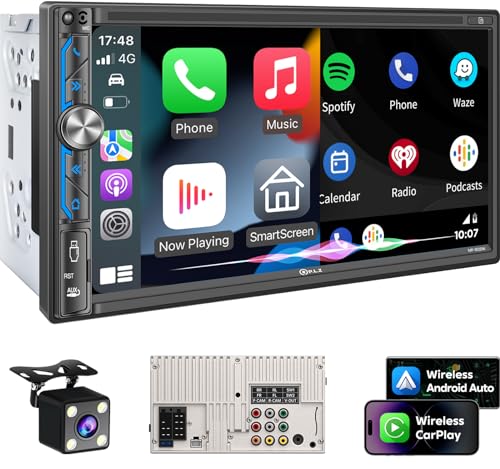
PLZ Double Din Car Stereo
What We Like
- Built-in 10-band EQ and DSP
- Two subwoofer outputs for deep bass
- Wireless Apple CarPlay & Android Auto
- Steering wheel control integration
Trade-offs
- No Wi-Fi hotspot function included
- Requires checking dashboard opening and wiring compatibility
A built-in DSP with 4.2 channels and a 10-band EQ lets you shape the sound to your exact taste, adjusting front, rear, and subwoofer levels so every seat gets balanced audio. That makes this unit a strong pick for anyone who wants to dial in their car’s acoustics without spending on an external processor. The two dedicated subwoofer outputs add room for serious low-end punch, and the 240W amplifier can drive aftermarket speakers with enough energy for daily listening.
The 240W max output isn’t built for competition-level volume or large systems that need more headroom. If you plan to run high-power speakers and push them hard, other double-DIN units may offer a higher-power amplifier section. But for most drivers who want great everyday sound with the flexibility to tune it precisely, the PLZ delivers exceptional value. Just confirm your car’s dash opening and wiring before you buy.
Product photos
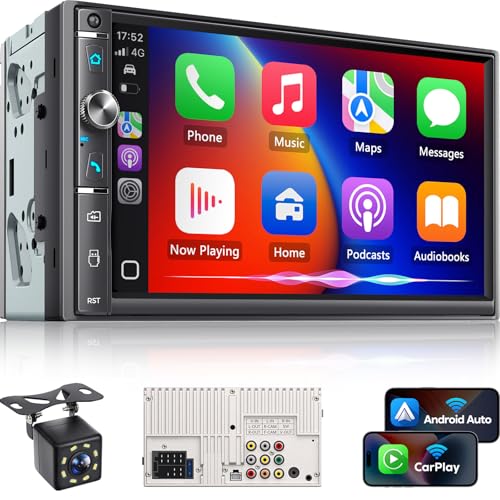
Kissound Double Din Car Stereo
What We Like
- DSP and 10-band EQ for custom sound
- Dedicated subwoofer RCA output for deep bass
- Wireless Apple CarPlay and Android Auto
- Dual microphone support for clear calls
Trade-offs
- Steering wheel control module sold separately
- Front camera not included, only rear
- No built-in navigation or HD Radio
If bass is your priority, a dedicated subwoofer RCA output lets you connect an external amplifier and sub, while the built-in DSP processor and 10-band EQ give you fine control over the low end. The 4.1-channel system delivers up to 240W max, so you can dial in rich bass without distortion. Wireless versions of Apple’s and Google’s phone-mirroring systems pair automatically when the car starts, keeping navigation and music hands-free. Reviewers note the subwoofer output supports powerful bass setups, making this a practical choice for drivers who want to add serious low-end punch.
The trade-off comes in convenience features: the steering wheel control module is sold separately, so you need to buy the recommended PAC SWI-CP2 to keep your hands on the wheel. The 7-inch screen is fixed in the dash. If you want a deep, customizable bass setup, this unit offers that. Just plan for the extra module and a front camera if you want one, the rear camera is included, but the front camera is not.
Product photos
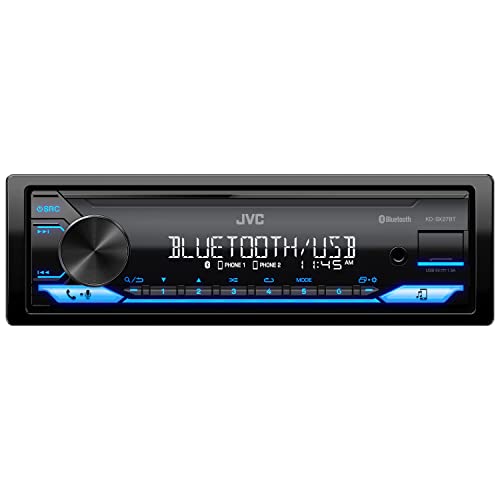
JVC KD-SX27BT Single DIN Car Stereo
What We Like
- Dual phone connection for two drivers
- 13-band EQ with Time Alignment
- 1.5A USB fast charging
- Supports high-res FLAC files
Trade-offs
- No CD/DVD disc playback
- Single DIN limits screen size
The 13-band EQ with Time Alignment lets you adjust sound so that each note reaches your ears at the same moment, which helps create a more focused listening experience. The dual phone connection is the standout reason to pick this unit. Two phones can stay paired full-time for hands-free calls, and up to five Bluetooth devices can be connected simultaneously. That is perfect for households sharing a car or for switching between work and personal phones without re-pairing every time.
The single DIN chassis keeps the unit compact, it fits easily in tight dash spaces, but you won’t get a large touchscreen display. If a big screen is your priority, the Sony XAV-AX4000 includes wireless CarPlay and Android Auto. However, if clean, adjustable audio and keeping two phones connected full-time matter more, the JVC KD-SX27BT delivers that focus without extra bulk.
Product photos
Alpine iLX-W670 Digital Multimedia Receiver

What We Like
- Dedicated Bass Boost and Mid-Bass Boost controls
- 13-band graphic EQ for fine-tuning
- 6-channel time correction for precise staging
- Subwoofer adjustments with Lighting Link for Alpine subs
Trade-offs
- Wired CarPlay and Android Auto only
- Requires Alpine PrismaLink subwoofer for lighting sync
- No wireless smartphone connection
A dedicated Sound Boost menu with expanded Bass Boost, Mid-Bass Boost, and subwoofer adjustments puts this Alpine receiver a step ahead for anyone who wants to shape their low end without digging through layers of menus. The 13-band graphic EQ and 6-channel time correction give you the tools to dial in the soundstage precisely. You can emphasize bass or create a balanced front-stage, matching your speakers and preferences.
You will need to plug in your phone every time you want CarPlay or Android Auto, there’s no wireless option here, unlike the Pioneer DMH-WT3800NEX which offers wireless connectivity. The Lighting Link feature only works with Alpine’s own PrismaLink subwoofer enclosures, so if you’re mixing brands, that visual sync won’t come into play. Still, you get sound-shaping tools that are typically found on more expensive head units.
Product photos
How We Evaluated Car Stereos For Best Sound
We built this guide by analyzing manufacturer spec sheets and owner reports to understand which features reliably deliver better audio. Because we don’t test units in a lab, we relied on documented capabilities. EQ bands, DSP channels, time alignment resolution, and RCA output counts, and cross-referenced them with what experienced installers and long-term owners say works.
The three criteria that mattered most were EQ and DSP depth, because more bands and addressable channels give you finer control over your cabin’s unique acoustics. Time alignment came next, since it lets you shift each speaker’s timing to create a believable soundstage. Finally, we weighed connectivity, a stereo that limits you to low-bitrate Bluetooth streaming can’t show off good tuning.
An honest limitation of a research-led evaluation is that we can’t measure noise floor, distortion under load, or real-world signal-to-noise ratios. We recommend reading owner discussions on forums for long-term reliability impressions before buying.
What To Look For In Car Stereos For Best Sound
Before you shop, understand that the head unit is just the command center. Your speakers, amplifier, and installation quality matter just as much to the final sound.
Focus on EQ bands (10 or more for real control), time alignment (1-centimeter resolution is ideal), and RCA preamp outputs (at least three pairs for a subwoofer and front/rear channels).
EQ Bands and DSP Channels
A graphic equalizer lets you boost or cut specific frequency ranges. More bands, 13 or 14, give you finer control over problem areas like dashboard reflections or door-panel resonance. Digital signal processing (DSP) takes this further by letting you set different EQ curves for each speaker channel. The Sony XAV-AX4000 offers a 14-band EQ across five addressable channels, while the Deaf Bonce DB-530DSP has 31 bands for the deepest tuning.
Time Alignment
Time alignment adjusts the delay of each speaker so sound from the closest driver (usually the left door) arrives at your ears at the same moment as sound from the farthest (the right rear). This creates a centered, three-dimensional soundstage. Look for units that offer time alignment in small increments for the most precise staging. The Sony XAV-AX4000 and Kenwood DMX709S both include time alignment.
Preamp Outputs and Subwoofer Control
RCA preamp outputs send an unamplified signal to external amplifiers. For a basic system with a subwoofer, you need at least three pairs: front, rear, and subwoofer. For an active system where each speaker is powered by its own amp channel, you need six to eight outputs. The Deaf Bonce DB-530DSP has eight RCA outputs for full active setups, while the Kissound Double Din includes a dedicated subwoofer RCA output for bass-heavy builds.
- Check your vehicle’s dash size before buying; double-DIN and single-DIN are not interchangeable without an adapter kit.
- Confirm the stereo has a subwoofer output if you plan to add one later.
- Look for FLAC and WAV playback if you listen to lossless audio files.
- Verify steering wheel control compatibility if you want to keep factory buttons.
- A 13-band EQ is a good minimum; 31-band DSP is for serious enthusiasts. The head unit with the most EQ bands won’t sound good if your speakers can’t handle the signal.
Car Stereos For Best Sound Compared
The table below compares the ten best sounding car stereos head-to-head, focusing on EQ bands, DSP channels, time alignment, and connectivity features that matter most for audio quality.
| Product | Screen Size | Smartphone Integration | EQ Bands |
|---|---|---|---|
| Pioneer DMH-1600NEX Double Din Car Stereo | 6.8" | Wired CarPlay & Android Auto | 13-band equalizer |
| Pioneer DMH-WT3800NEX Floating Display Car Stereo | 9 inches | Wireless Apple CarPlay & Android Auto | N/A |
| Sony XAV-AX4000 Multimedia Receiver | 6.95-inch | Wireless Car Play/Android Auto | 14-band graphic EQ |
| Kenwood DMX709S eXcelon Car Stereo | 6.95-Inch | CarPlay and Android Auto | 13-Band Graphic EQ |
| Deaf Bonce DB-530DSP Car Stereo Head Unit | N/A | N/A | 31-band EQ |
| Alpine iLX-507 Multimedia Receiver | 7 inches | Wireless Apple CarPlay & Wireless Android Auto | N/A |
| PLZ Double Din Car Stereo | 7-inch | Wireless Apple Carplay Android Auto | N/A |
| Kissound Double Din Car Stereo | 7-inch | Wireless Apple Carplay & Android Auto | 10-band EQ |
| JVC KD-SX27BT Single DIN Car Stereo | N/A | N/A | 13-Band EQ |
| Alpine iLX-W670 Digital Multimedia Receiver | 7-inch | Wired Apple CarPlay & Android Auto | 13-band graphic EQ |
Frequently Asked Questions
How many EQ bands do I need for good sound tuning?
At least 10 bands give you meaningful control over the frequency spectrum. A 13-band EQ covers sub-bass to treble with enough resolution to cut muddy mids or boost crisp highs. The Pioneer DMH-1600NEX offers a 13-band EQ, while the Sony XAV-AX4000 goes further with 14 bands.
What is time alignment in a car stereo?
Time alignment lets you delay each speaker’s output so all sound reaches your ears at the same moment. Without it, the closest speaker sounds louder and arrives first, pulling the soundstage to one side. Most quality stereos offer time alignment in small steps for precise staging.
Do I need a separate amplifier with a DSP head unit?
It depends on your speakers and goals. A DSP head unit like the Deaf Bonce DB-530DSP processes the signal but still sends a low-power signal to your speakers. For clean, loud sound, pair it with an external amplifier. If you’re running basic coaxial speakers, a good head unit with 50 watts peak per channel may be enough.
Can I use Apple CarPlay or Android Auto with a DSP-focused stereo?
Some DSP-focused units, like the Deaf Bonce DB-530DSP, do not include Apple CarPlay or Android Auto. If you want both deep tuning and smartphone integration, look at the Sony XAV-AX4000 or the Pioneer DMH-1600NEX, which combine a 13- or 14-band EQ with wired CarPlay and Android Auto.
What is the difference between a graphic EQ and a parametric EQ?
A graphic EQ has fixed frequency bands that you boost or cut by a set amount. A parametric EQ lets you choose the center frequency, adjust the bandwidth (Q factor), and set the gain for each band. Most car stereos use graphic EQs; parametric EQs are usually found in high-end DSP units.
The Bottom Line
If you want the best balance of sound tuning and everyday usability, the Pioneer DMH-1600NEX Double Din Car Stereo is our top pick. Its 13-band EQ and time alignment give you real control over your cabin’s acoustics, and wired CarPlay keeps your phone useful without draining the battery. It’s the right choice for most drivers who care about sound quality.
For deep DSP tuning with a large touchscreen, the Sony XAV-AX4000 offers a 14-band EQ and five addressable channels. If you’re building a fully active system with separate amplifiers for each speaker, the Deaf Bonce DB-530DSP gives you 31 EQ bands and eight RCA outputs. Budget-minded shoppers should look at the PLZ Double Din, which packs a 10-band EQ and DSP into an affordable package.
The single most important buying factor is having enough EQ bands and time alignment to fix your car’s specific acoustic problems. A great head unit can’t fix bad speakers or a poor install, but it gives you the tools to make the most of what you have.
