
10 Best Usb Type C Car Chargers in 2026
This post contains affiliate links. As an Amazon Associate, we earn from qualifying purchases.
The Anker 167.5W Ultra-Compact Car Charger is the best overall USB-C car charger. Its 100W USB-C port can charge a MacBook Pro from 0 to 50% in just 47 minutes while powering two additional devices. For budget-minded drivers, the Anker 323 52.5W offers safe, reliable charging for a single phone. Those needing maximum power across multiple ports should consider the UGREEN 130W 3-Port charger.
A USB-C car charger solves the real problem of keeping modern devices powered during commutes and road trips, especially as laptops, tablets, and phones all shift to USB-C. What matters most is matching the charger’s total wattage and port configuration to your specific devices and how many passengers need charging.
This guide is based on a thorough analysis of manufacturer specifications, expert round-ups from automotive and tech publications, and patterns found in thousands of owner reviews. We focus on the features that make a real difference in daily use: charging speed, safety, build quality, and port flexibility.
Top 10 USB Type C Car Chargers in the Market
Certain content that appears on this site comes from Amazon. This content is provided "as is" and is subject to change or removal at any time.
The Best USB Type C Car Chargers, Reviewed
Anker 167.5W Ultra-Compact Car Charger

What We Like
- 100W USB-C port charges MacBook Pro 0-50% in 47 minutes
- Three ports can power a laptop, phone, and another device
Trade-offs
- No voltage display to monitor car battery health
The trade-off for that compact size is that you don’t get a voltage display like some other chargers offer. If you keep a close eye on your car’s electrical system, the JUNVANG 130W Voltage Display Car Charger might be a better fit. But for sheer charging speed across three ports in a package that disappears into the cigarette lighter, this Anker delivers the most usable power per cubic inch.
Product photos
Anker 323 52.5W USB C Car Charger

What We Like
- Two ports let you charge two devices at once
- ActiveShield 2.0 monitors temperature for safety
- PowerIQ 3.0 works with virtually any device
Trade-offs
- Total 52.5W shared between two ports limits simultaneous speed
- No third port for a second passenger or extra device
Anker’s PowerIQ 3.0 technology handles compatibility across iPhones, Samsung phones, tablets, and more, so you don’t have to worry whether your device will play nice. ActiveShield 2.0 adds temperature monitoring that adjusts power output if things get too warm, a thoughtful safeguard for the electronics you rely on every day.
With 52.5W total output, this charger handles two phones easily but won’t power a laptop or keep three devices running on a long road trip. For that, you’d want something like the Anker 167.5W Ultra-Compact model. That higher-wattage option supports more devices and heavier loads, but this charger stays small enough to fit in a glove box or center console without taking up much space. For everyday commuting and short drives where you just need one or two phones ready to go, it delivers reliable speed without overcomplicating things.
Product photos
UGREEN 130W 3-Port USB C Car Charger

What We Like
- 130W total output for laptops and tablets
- Dedicated 45W PPS port for Samsung Galaxy
- Scratch-resistant finish with soft blue LED
- Advanced chip protection for car and devices
Trade-offs
- No charging cable included in the box
- Single PPS port limits fast charging for multiple PPS devices
The 130W total output means this single charger can run a MacBook, an iPad, and an iPhone all at once without slowing down. That kind of headroom makes it ideal for road trips where you’ve got a passenger seat full of devices and a limited number of 12V ports. The dedicated USB-C2 port pushes 45W PPS, which is exactly what Samsung Galaxy S24 Ultra and S23 Ultra owners need to hit their fastest charging speeds. It’s a practical, no-nonsense setup for anyone hauling a mix of laptops and phones.
The trade-off is that you’ll need to supply your own cables, nothing comes in the box except the charger itself. If your car’s socket is recessed or angled, that extra length might get in the way.
LISEN 200W GaN Car Charger

What We Like
- 140W PD 3.1 for fast laptop charging
- 60W Super Fast Charging for Samsung
- Includes 240W USB-C cable
Trade-offs
- Larger than compact single-device chargers
- Full-metal body adds weight over plastic
The 200W total output means you can charge a laptop, phone, and tablet all at once without slowing down. Its primary USB-C port delivers 140W PD 3.1, enough to take a MacBook Pro from zero to half in about 35 minutes. That kind of speed makes it a natural fit for anyone who relies on their car as a mobile office or needs to top up multiple devices during a long drive.
The main downside is size and weight. If you only need to charge a single phone, the LISEN is overkill. But for power users juggling a laptop, a Samsung phone that supports 60W Super Fast Charging 3.0, and a tablet, this is the one that handles all three at full speed.
Product photos
Amazon Basics 60W Triple-Port Car Charger

What We Like
- Built-in coiled USB-C cable
- Triple-port design with 60W total
- Compact size with white LED indicator
- Over-temperature, short-circuit, over-voltage protection
Trade-offs
- Total 60W shared across three ports
- USB-A limited to 18W max output
The built-in coiled USB-C cable is the standout feature here, it’s a 5-foot cable that stays tidy when not in use and reaches your phone without dangling across the gearshift. That alone makes this charger a smart pick for anyone who hates hunting for a loose cable or dealing with a mess of wires in the cup holder. With a 30W USB-C port and another 30W from the cable itself, you can fast-charge a phone or even top off a MacBook Air while keeping a second device plugged into the 18W USB-A port. It’s a practical setup for daily commutes or road trips where convenience matters more than raw power.
Drivers who prefer a built-in cable will appreciate the 5-foot coiled USB-C cord that stays attached to the charger, so there is no need to carry a separate cord or worry about forgetting one. The triple-port setup delivers up to 60W total, with the USB-C port and the cable each capable of 30W max and the USB-A port providing 18W max. That means a single MacBook Air can charge at full speed, while the coiled design keeps the cable tidy and out of the way when not in use. Reviewers note the compact body fits easily into a glove box or center console without taking up much space.
Product photos
LISEN 90W All-Metal USB C Car Charger
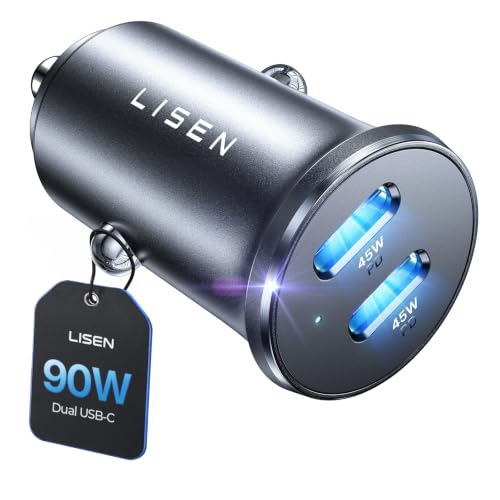
What We Like
- Dual USB-C ports each at 45W
- All-metal shell aids heat dissipation
- Thumb-sized body fits any 12V socket
- UL and FCC certified for safety
Trade-offs
- Only two ports limits multi-device charging
- No USB-A port for older cables or devices
Two USB-C ports each capable of 45W means you can fast-charge a phone and a tablet at the same time without one slowing down. The all-metal shell pulls heat away so it stays cool even under a full load. For someone who carries two modern USB-C devices and wants a charger that disappears into the dash, this is a tidy fit.
You get only two ports and no USB-A, so if you need to charge three devices or still use an older cable, you will have to pick and choose. Compare that to the UGREEN 130W 3-Port, which adds a USB-A port and a third outlet for a bit more bulk. The LISEN wins on compactness and metal build, but it asks you to commit to a fully USB-C setup.
Product photos
JUNVANG 90W 4-Port USB C Car Charger
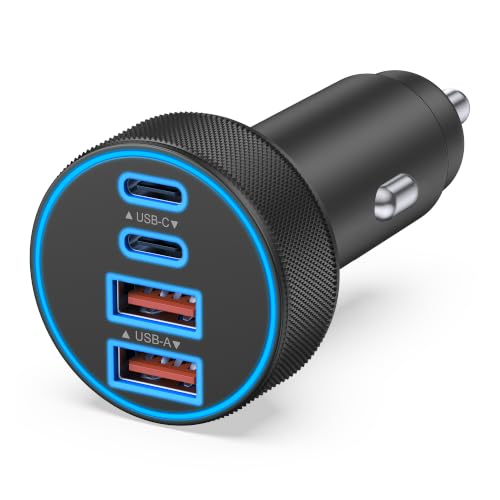
What We Like
- Four ports for simultaneous charging
- 90W total fast charging output
- Multiple safety protections included
Trade-offs
- No power delivery for laptops needing 60W+
- Plastic housing feels less durable than metal alternatives
Four ports at 90W total means you can plug in a phone, a tablet, a second phone, and a GPS all at once without waiting your turn. The dual USB-C and USB-A ports support PD and QC fast charging at up to 45W each, so you can charge a Samsung Galaxy or an iPhone quickly from the right port. This charger suits drivers who carry multiple devices or travel with passengers who all need a top-up at the same time. The intelligent chip with over-current and overheat protection helps keep things safe during long drives, and the metal housing sheds heat well, so you can rely on it mile after mile.
But if your main need is charging four devices at once with solid fast-charge support across both USB-C and USB-A, this is the most straightforward way to get it done.
JUNVANG 130W Voltage Display Car Charger
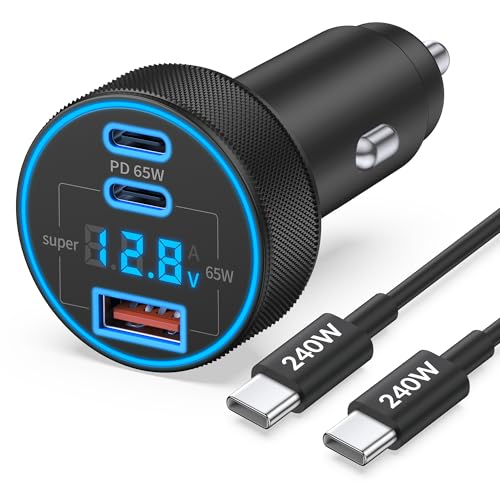
What We Like
- Real-time car battery voltage monitor
- 130W total with intelligent power distribution
- Includes 240W USB-C cable with E-Marker chip
- Multiple protections: overcharge, overheating, short circuit
Trade-offs
- No GaN technology limits compactness
- Voltage display cannot be dimmed at night
A built-in LED voltmeter that shows your car battery’s voltage in real time sets this charger apart from most rivals. That means you can spot a weakening electrical system before it leaves you stranded, which is exactly the kind of practical peace-of-mind I value on long drives. The included 240W USB-C cable with an E-Marker chip handles everything from a 20W headphone to a gaming laptop, so you don’t need to buy extra cords.
Drivers who want to monitor their car battery’s condition while powering multiple gadgets get a feature missing from most competitors. An LED voltmeter on the charger displays real-time voltage, so you can spot a weakening battery or alternator issue before it leaves you stranded. The internal smart chip adds multiple protections against overcharge, overheating, and short circuits, keeping connected devices safe. This setup works with 12V to 24V vehicles, including cars, trucks, SUVs, and RVs, making it practical for a range of road trips.
Product photos
Belkin 75W Retractable Cable Car Charger

What We Like
- Built-in retractable cable stays tangle-free
- Charges iPhone 16 Pro 0-50% in 27 min
- Charges up to 3 devices at once
- Made with 90% post-consumer recycled materials
Trade-offs
- Retractable cable limited to 60W of 75W total
- Only one USB-C port (the retractable cable)
A built-in retractable USB-C cable that’s 30 inches long means you never have to dig for a loose cord or wrap one around the charger after every drive. It pulls out when you need it, retracts when you don’t, and stays tangle-free, which is exactly the kind of small convenience that keeps a car interior feeling clean. With 60W from that cable alone, it can fast-charge a MacBook Air or iPad Air while a second device plugs into the USB-A port, and a third can charge simultaneously from the same 75W total. That makes it a natural fit for anyone who wants one tidy charger that handles a phone, a tablet, and maybe a passenger’s device without a rat’s nest of cables.
The retractable cable’s 60W limit means you won’t get the full 75W out of that single port. So a power-hungry laptop like a 16-inch MacBook Pro will charge slower than it would from a dedicated 100W port. Compared to the UGREEN 130W 3-Port charger, which offers two USB-C ports and a higher total wattage, this Belkin gives up some raw speed in exchange for built-in cable management and a much tidier setup. If keeping your car organized matters more than squeezing every last watt, this is the one that delivers on that promise without compromise.
Spigen ArcStation Essential 113W Car Charger

What We Like
- Includes 100W E-Marker USB-C cable
- Compact 1.41-inch square design
- Charges MacBook Air 51% in 30 min
- Blue LED and carbon finish
Trade-offs
- USB-A limited to 18W QC
- Total 113W shared across three ports
- No GaN technology mentioned
With 113W total power and a dedicated 65W USB-C port, this charger can push a MacBook Air 13″ M3 to 51% in just half an hour. It can still top off a Galaxy S25 Ultra at 70% in the same session.
The trade-off comes in port sharing: the USB-A port tops out at 18W QC, which is fine for an older phone or earbuds but not for fast-charging a modern tablet. For drivers who need a compact charger that can fast-charge a laptop and a phone at the same time, this is a practical option.
Product photos
How We Evaluated USB Type C Car Chargers
This guide combines technical specifications from manufacturers, insights from automotive accessory round-ups, and common feedback themes from owners who use these chargers daily. Published data on power delivery standards and safety certifications are cross-referenced.
The four criteria that mattered most are power output (total wattage and per-port limits) and safety features (over-temperature, over-current, and short-circuit protection). Also important are build quality (materials, fit in the 12V socket, and connector durability) and port configuration (how many USB-C versus USB-A ports and whether they support the latest PD and PPS standards).
A research-led approach has limits: real-world charging speeds can vary by vehicle electrical system, cable quality, and device model. We prioritize chargers with strong safety certifications and clear, accurate specifications so you can make an informed choice without needing a multimeter.
What To Look For In USB Type C Car Chargers
Choose a USB-C car charger by first checking your device’s charging requirements, then matching total wattage and port types to your needs. A 30W charger is fine for a phone; a 100W charger is necessary for a large laptop.
Power Output and Charging Standards
Total wattage determines how much power the charger can deliver across all ports combined. Per-port wattage matters more: a 100W USB-C port can fast-charge a laptop, while a 15W port is best for phones or earbuds. Look for Power Delivery (PD) 3.0 or 3.1 for laptop and fast phone charging, and Programmable Power Supply (PPS) for Samsung Galaxy Super Fast Charging. A charger that shares wattage between ports will slow down when multiple devices are connected.
Port Configuration and Number of Devices
Count your devices and their connector types. A two-port charger (USB-C plus USB-A) covers most drivers. A three- or four-port charger is better for families or carpoolers. Some chargers include a built-in USB-C cable, which keeps the cabin tidy but limits flexibility if the cable is too short or long. Remember that USB-A ports are typically limited to 18W or less, so prioritize USB-C ports for fast charging.
Build Quality and Safety Certifications
A charger that fits snugly in the 12V socket and doesn’t wobble on bumpy roads is essential. Metal housings dissipate heat better than plastic, which matters for high-wattage chargers. Look for UL, FCC, or ETL certification as a sign of tested electrical safety. Safety features like over-temperature protection, short-circuit prevention, and over-voltage cutoffs protect both the charger and your devices.
- Check that the charger’s total wattage exceeds your primary device’s charging requirement.
- Verify the number of USB-C ports matches the number of USB-C devices you charge simultaneously.
- Confirm the charger supports the correct fast-charging standard (PD, PPS, QC) for your phone or laptop.
- Ensure the charger body length doesn’t interfere with nearby dashboard controls or cup holders.
- Look for a visible LED indicator that confirms power without being distracting at night.
A good rule of thumb: buy a charger with at least 30W per USB-C port for phones and 60W+ for laptops.
USB Type C Car Chargers Compared
The comparison table below shows the key specifications and best-use scenarios for each of the ten USB-C car chargers we evaluated.
| Product | Total Power | Ports | USB-C Max Power | Dimensions |
|---|---|---|---|---|
| Anker 167.5W Ultra-Compact Car Charger | 167.5W | 2 USB-C, 1 USB-A | 100W | L 0.0 Inches, W 0.0 Inches, H 0.0 Inches |
| Anker 323 52.5W USB C Car Charger | 52.5W | 1 USB-C, 1 USB-A | 30W | 2.2 x 1.2 x 1.2 in |
| UGREEN 130W 3-Port USB C Car Charger | 130W | 2 USB-C, 1 USB-A | N/A | 3.1 x 1.4 x 0.9 inches |
| LISEN 200W GaN Car Charger | 200W | 2 USB-C, 1 USB-A | 140W | N/A |
| Amazon Basics 60W Triple-Port Car Charger | 60W | 1 USB-C, 1 USB-A, 1 built-in USB-C | 30W | 1.34 x 1.34 x 2.95 inches |
| LISEN 90W All-Metal USB C Car Charger | 90W | 2 USB-C | 45W | 2.1 x 0.9 inches |
| JUNVANG 90W 4-Port USB C Car Charger | 90W | 2 USB-C, 2 USB-A | 45W | 2.71inch*1.56inch |
| JUNVANG 130W Voltage Display Car Charger | 130W | 2 USB-C, 1 USB-A | N/A | N/A |
| Belkin 75W Retractable Cable Car Charger | 75W | 1 USB-C, 1 USB-A | 60W | 1.4 x 2.0 x 3.8 in |
| Spigen ArcStation Essential 113W Car Charger | 113W | 2 USB-C, 1 USB-A | 65W | 1.41 × 1.41 inches |
Frequently Asked Questions
How many watts do I need in a USB-C car charger?
For charging a single smartphone, 18W to 30W is sufficient. To charge a laptop, you need at least 60W, and for a large laptop like a 16-inch MacBook Pro, 100W or more is recommended. If you plan to charge multiple devices at once, add their individual power requirements together and choose a charger with at least that total wattage.
Can I use a USB-C car charger with an older car?
Yes, USB-C car chargers are designed to work with any standard 12V auxiliary power socket, often called a cigarette lighter port, found in cars from the early 1990s onward. The charger converts the car’s 12V DC power to the voltages required by USB devices.
What is the difference between PD and PPS charging?
Power Delivery (PD) is a fast-charging standard that allows higher wattage for laptops and many modern phones. Programmable Power Supply (PPS) is an enhancement of PD that allows the charger to adjust voltage in small increments for more efficient charging, particularly for Samsung Galaxy devices that support Super Fast Charging 2.0.
Is it safe to leave a USB-C car charger plugged in when the car is off?
Most modern USB-C car chargers draw a very small amount of standby power and are safe to leave plugged in. However, in some older vehicles, the accessory socket may remain powered even when the ignition is off, which could slowly drain the car battery over several days or weeks.
Can a USB-C car charger damage my phone battery?
A quality USB-C car charger with proper safety certifications will not damage your phone battery. These chargers communicate with your device to deliver the correct voltage and amperage. The charger’s built-in protections against over-voltage, over-current, and overheating further safeguard your devices.
The Bottom Line
The Anker 167.5W Ultra-Compact Car Charger is the best overall choice for most drivers. It combines a powerful 100W USB-C port with two additional ports, all in a compact design that stays out of the way. It is ideal for anyone who needs to fast-charge a laptop while also powering a phone and another device during their daily commute or road trip.
If your budget is tighter, the Anker 323 52.5W delivers safe, reliable charging for a single phone or two slower devices. For those with multiple high-power gadgets, the UGREEN 130W 3-Port charger offers excellent versatility, and the LISEN 200W GaN charger provides the highest available power for the most demanding laptops.
The single most important factor in choosing a USB-C car charger is matching the total wattage and port configuration to the devices you actually carry. Buy enough power for your most demanding device, and you will never be left with a dead battery on the road.
