
10 Best Water Deionizers For Car Washing in 2026
This post contains affiliate links. As an Amazon Associate, we earn from qualifying purchases.
For a spot-free car wash that leaves no water spots, the iSpring WGB22BD-BP Spotless Water System is our pick for best overall with its 1200-gallon capacity and built-in bypass valve. For a wall-mountable option with a TDS meter, the VEVOR Deionized Water System offers excellent value. The Aquatic Life Deionized Spot Free Car Wash Rinse System is our choice for compact design.
The real challenge with home car washing is avoiding those stubborn mineral spots that appear as water dries. A deionizer removes the dissolved solids from your tap water, letting you rinse and air-dry without a single wipe.
This guide is based on a thorough review of manufacturer specifications, expert recommendations, and patterns in owner feedback across the market. We break down the key features of 10 top-rated systems to help you find the right fit for your garage and washing routine.
Top 10 Water Deionizers For Car Washing in the Market

Certain content that appears on this site comes from Amazon. This content is provided "as is" and is subject to change or removal at any time.
The Best Water Deionizers For Car Washing, Reviewed
iSpring WGB22BD-BP Spotless Water System

What We Like
- 1200-gallon capacity for long use
- Built-in bypass valve saves filters
- Rolling cart for easy mobility
- Quick-connect garden hose setup
Trade-offs
- At 54 lb, it is heavy to lift
- Large footprint needs storage space
- Filter life depends on source water TDS
A 1,200-gallon filtration capacity means this system can handle around 240 car washes before you need to replace the filter, based on average 50 ppm source water. That kind of endurance makes it a strong fit for someone who washes multiple vehicles or wants a set-it-and-forget-it solution. The built-in bypass valve lets you switch between tap water for the initial wash and deionized water for the final rinse without disconnecting hoses, which keeps your workflow smooth. A sturdy rolling cart and standard garden-hose quick connector get you started in seconds, no plumbing skills required.
The trade-off is size and weight: at 54 pounds and roughly 38.5 inches tall, this system demands floor space and isn’t something you toss in a trunk between washes. For comparison, the VEVOR system is lighter and more compact, but its dual 4-liter resin cartridges mean more frequent refills. If you have a garage or driveway where the iSpring can stay set up, the extra capacity and rolling cart make the weight worthwhile. For someone who needs a portable system to haul to a shared wash bay, a lighter option might be easier to manage.
Product photos
VEVOR Deionized Water System

What We Like
- Built-in TDS meter for real-time monitoring
- Bypass valve switches between wash and rinse
- Wall-mount bracket for secure installation
- 330-gallon capacity at average water hardness
Trade-offs
- At 34.8 lbs, it is heavy to move frequently
- Resin replacement needed when TDS hits 30 ppm
Two 4-liter resin cartridges and a built-in TDS meter let you check water purity and know when to refill resin, which is recommended around 30 ppm. The system delivers up to 330 gallons of purified water under average 200 ppm conditions, enough for several spot-free car rinses before a refill. The bypass valve lets you use tap water for washing and soaping, then switch to filtered water for the final rinse step.
Product photos
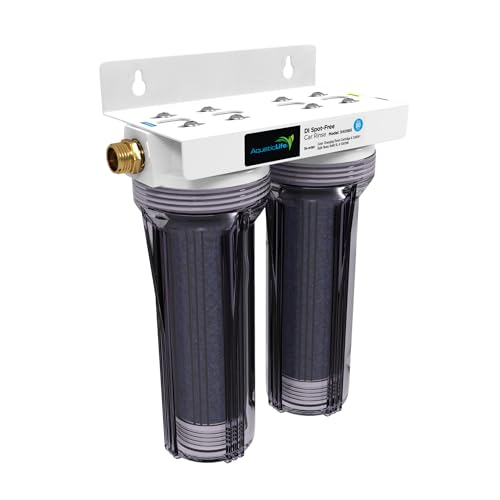
Aquatic Life Deionized Spot Free Car Wash Rinse System
What We Like
- Compact 11 x 6 x 17-inch footprint
- Includes mounting bracket for wall storage
- Two resin cartridges included upfront
- All-in-one kit with wrench and adapters
Trade-offs
- Only for final rinse, not full wash
- Cartridges deplete after 1,800-2,000 TDS each
This deionized rinse system is designed solely for the final rinse after washing, so you wash and rinse your car normally first, then switch to it for a spot-free finish. Each of the two included resin cartridges removes roughly 1,800-2,000 TDS before needing replacement, which helps prevent hard-water spots as the vehicle air dries. The kit comes with a mounting bracket and all necessary adapters, making it a ready-to-run setup that fits easily on a garage wall.
The trade-off for that compact size is that each cartridge handles about 1,800-2,000 TDS. If your tap water has high TDS or you wash large vehicles like RVs, you will replace cartridges more often than with a larger system that holds more resin. For a compact car or motorcycle owner who washes occasionally and wants a setup that stores easily, this is a straightforward, space-saving option. For frequent or high-volume washing, a system with greater resin capacity would reduce cartridge changes.
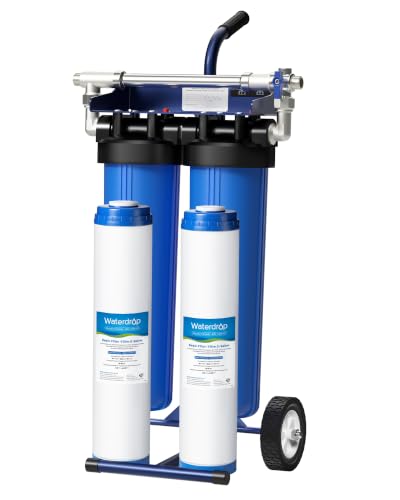
Waterdrop CWE2 Spotless Water System
What We Like
- Bypass switch for tap or filtered water
- Rust-resistant frame with quiet wheels
- Supports up to 200 spotless rinses
- Cold-tested to -4°F for durability
Trade-offs
- Large footprint at 41.4 inches tall
- Lifespan depends on local water quality
With a rated capacity of up to 200 spotless rinses on typical 50 ppm feed water, this system is built for frequent car washers who want to skip the towel-drying step entirely. The bypass valve lets you switch between tap water for the wash stage and treated water for the final rinse, so you use the resin only when it matters most. That design, paired with a rust-resistant metal frame and quiet rolling wheels, makes it a practical choice for anyone washing cars, boats, or RVs in a driveway or garage without dragging a hose around a heavy tank.
This unit demands floor space that smaller inline filters like the WaterSentinel SF-20W do not, because it stands over 41.4 inches tall and is nearly 20 inches wide. It also relies on your local water hardness to hit that 200-rinse estimate, so owners in areas with very high TDS will see fewer rinses per refill. If you have the room and wash multiple vehicles regularly, the convenience of a wheeled cart with a built-in bypass makes this a time-saver worth considering.
APEC Water CWS-300 Car Wash System

What We Like
- No hand-drying needed after rinse
- Removes 100% of spot-causing impurities
- Enhances shine on paint, chrome, glass
Trade-offs
- At 51 pounds, it is heavy to move around
- Not designed for commercial or high-volume use
The 20-inch super efficient DI filter captures dissolved solids and releases hydrogen and oxygen as water flows through, making paint, chrome, and glass shine as bright as possible. That chemistry is why you can rinse and walk away without ever picking up a drying towel, no spots, no streaks. For the home car enthusiast who wants a spot-free finish without hand-drying, this system delivers exactly that simplicity.
At 51 pounds, this is a stationary or garage-based setup rather than something you lug around the driveway or take on the road. If you need a portable system for washing an RV or boat at different locations, the lighter VEVOR Deionized Water System (about 34.8 pounds) would be easier to move. But for a dedicated home wash station where you value a no-towel-dry routine and maximum shine, the APEC CWS-300 is a straightforward, effective choice.
Max Water 2 Stage Deionized Car Rinse Unit

What We Like
- Refillable DI resin cartridges
- Compact and lightweight (10 lbs)
- Works with 3/4" standard fittings
Trade-offs
- Narrow 45-80 PSI operating range
- Filter life depends heavily on local water
At 10 pounds, this deionizer is light enough to carry with one hand, so you can move it from garage to driveway without breaking a sweat. It operates between 45 and 80 PSI, which means it works best with a hose that already has decent pressure, think typical outdoor spigot flow. The 3/4-inch NPTF ports match standard hose fittings, so hooking it up takes about a minute.
If your water pressure falls below 45 PSI, the system won’t operate efficiently, and filter life can drop to just three months in hard-water areas. Compared to the iSpring WGB22BD-BP, which weighs 54 pounds, the Max Water trades some heft for portability. It’s a focused tool for a specific setup, not a one-size-fits-all solution.
Product photos
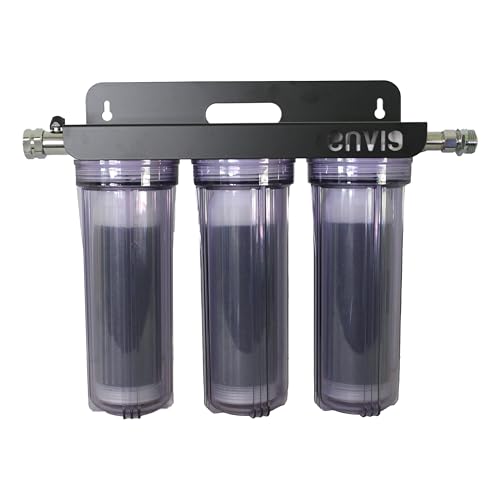
Envig CarShine Sleek Deionization System
What We Like
- Color-changing resin shows when to replace
- Bypass valve lets you wash then rinse without reconnecting
- Spot-free rinse eliminates towel drying
Trade-offs
- Filtered flow limited to 1.5-2 GPM for best TDS removal
- Warranty requires product registration
The bypass valve is a real time-saver: point it away from the filter to wash with your regular hose, then flip it toward the filter for a deionized rinse, no swapping hoses or moving equipment. For someone who wants clear feedback on resin life and a straightforward workflow, this system makes the rinse step feel effortless.
Flow is the trade-off here. While the bypass runs at full hose pressure, the filtered water is regulated to 1.5-2 GPM to maximize TDS removal, which means rinsing a large SUV or RV takes a patient hand. If you wash smaller vehicles or don’t mind a slower rinse for a guaranteed spot-free finish, the color-changing resin alone saves you the guesswork of when to swap cartridges.
Product photos
WaterSentinel SF-20W Spotless Car Wash Inline Filter
What We Like
- Compact inline design, no tools needed
- Braided reinforced transparent hose included
- Made in USA with brass crimped ends
Trade-offs
- Small resin capacity limits total gallons per filter
You simply screw it onto any standard garden hose and start washing, no bulky tanks, no mounting brackets, and no tools required. That simplicity makes it ideal for someone who washes a single car or motorcycle at home. It also works for someone who wants a deionizer they can toss in the trunk for spot-free rinses at a self-serve bay or campsite.
Capacity is the trade-off here. This compact filter weighs just 1.5 pounds and measures about a foot long, so it stows easily in a trunk or garage cabinet. For weekly washes of a single vehicle, the convenience and low weight more than make up for those limits. Reviewers note it connects to a standard garden hose in seconds with no tools required, and the included braided extension hose adds reach. Heavy-duty detailers should look at a larger system like the iSpring WGB22BD-BP, which holds 54 pounds of resin and stands over three feet tall, or the 34.8-pound VEVOR unit with dual 4-liter tanks. Those systems handle multiple cars per session without depleting the media as quickly.
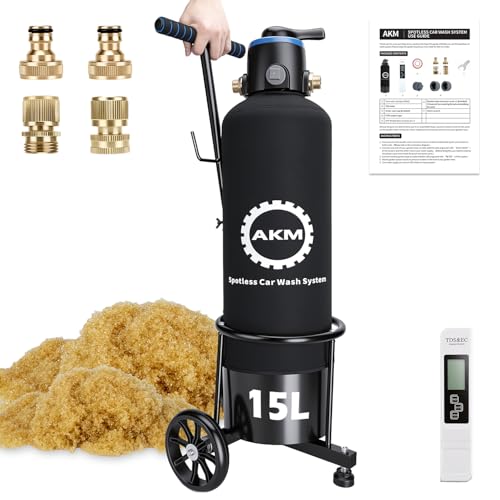
AKM Spotless Water System
What We Like
- 15L resin delivers 1,500 gallons output
- Built-in bypass valve conserves resin
- Custom mobility cart for easy moving
- Refillable tank saves long-term cost
Trade-offs
- Large tank needs driveway or garage space
- Full tank weighs 54 pounds, awkward to carry
Fifteen liters of DI resin sounds like overkill until you run the numbers: roughly 1,500 gallons of spot-free water, or about 300 car washes, before you need to refill. That kind of capacity makes this system a natural fit for anyone washing multiple vehicles regularly or tackling big jobs like RVs and boats. The included mobility cart solves the usual headache of moving a heavy tank around the driveway, and the built-in bypass valve lets you switch between plain water for the wash and treated water for the final rinse. This stretches every gallon of resin further.
Physical size is the trade-off here: a 15L tank plus cart takes up noticeable room in a garage or shed, so it isn’t the choice for apartment dwellers or folks with minimal storage. If you wash one car every other week, a smaller system like the Aquatic Life unit might serve you fine with less bulk. But if you want to fill the tank and forget refills for months, this is the one to grab.
Product photos
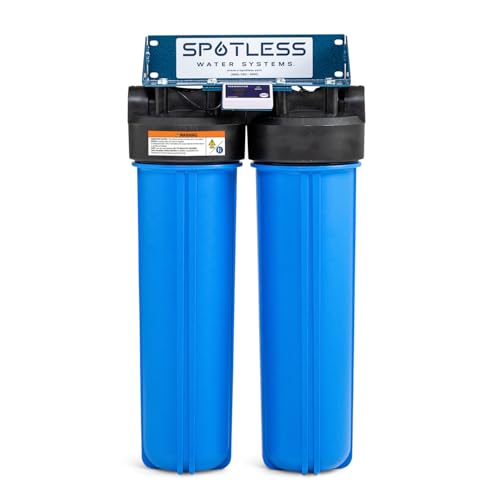
CR Spotless DIW-20 Car Wash System
What We Like
- Wall-mountable design saves floor space
- 300-gallon capacity per cartridge set
- Replaceable or refillable cartridges
- Includes all parts for immediate setup
Trade-offs
- At 27 pounds, wall mounting requires sturdy surface
- Capacity depends on your water input quality
- Cartridges need replacement after ~300 gallons
A 300-gallon deionized water capacity means you can wash a car several times before swapping cartridges, which keeps the chore simple: hook up the hose, wash, rinse, and walk away. The two 20-inch slide-in cartridges are easy to replace or refill, and the powder-coated wall mount keeps the unit off the floor and out of your way. It works for cars, trucks, RVs, boats, even solar panels and windows, so if you have multiple things to keep spot-free, this one covers them all.
The trade-off is that 27 pounds and a wall-mount design mean you need a solid wall or bracket to hang it securely, which may not suit every garage setup. If you have a dedicated wash area and want the convenience of a system that’s always ready to go, this model offers a compact, wall-mounted design that keeps the unit out of the way.
How We Evaluated Water Deionizers For Car Washing
Our evaluation focused on the specifications and design features that matter most for a spot-free car wash. We reviewed manufacturer documentation, studied expert round-ups from detailing communities, and analyzed common patterns in owner feedback to understand what makes a deionizer system work well in a home garage setting.
The three criteria that carried the most weight were capacity (total gallons of spot-free water per resin fill), convenience features (bypass valves, TDS meters, and mobility), and installation requirements (footprint, mounting options, and connection type). A system that delivers many gallons before needing a resin change saves money and hassle over time. A bypass valve lets you switch between regular hose water for washing and deionized water for rinsing without disconnecting anything.
We also considered portability and storage needs. Some systems weigh over 50 pounds and require permanent wall mounting or a dedicated floor space, while others are lightweight and compact for occasional use. No system was tested in our own garage; this is a research-led evaluation based on available product data and expert consensus.
What To Look For In Water Deionizers For Car Washing
Choosing the right deionizer comes down to understanding your water hardness, your washing volume, and your available space. Here are the key factors to consider before you buy.
A water deionizer removes dissolved minerals from tap water so your car air-dries without spots. Key buying criteria include capacity per resin fill, bypass valve availability, TDS monitoring, weight and footprint, and connection type.
Capacity and Resin Life
The total gallons of spot-free water a system delivers before the resin needs replacement is its most important spec. Systems range from small inline filters good for a few washes to large tanks rated for 1,200 to 1,500 gallons. Your local water hardness directly affects resin life, harder water depletes resin faster. If you wash multiple vehicles or have very hard water, a high-capacity system saves you money on replacement resin over time.
Bypass Valve
A bypass valve lets you use regular tap water for the soapy wash phase and then switch to deionized water for the final rinse without disconnecting hoses. This feature conserves resin since you only use filtered water when it matters. Systems without a bypass valve require you to manually swap connections between wash and rinse.
TDS Meter and Resin Monitoring
A built-in TDS (total dissolved solids) meter shows the current purity of your output water in real time. When the reading climbs above a certain threshold (typically 10-30 ppm), it signals that the resin is depleted and needs replacement. Some systems use color-changing resin that shifts from blue to amber or white, giving a visual cue without any electronics.
- Check the system’s total capacity rating based on your local water hardness.
- Look for a bypass valve to save resin during the wash phase.
- Decide if a TDS meter or color-changing resin is more useful for your routine.
- Measure your available storage space before choosing between a floor cart or wall mount.
- Verify the connection type matches your garden hose fittings.
The single most important factor is matching system capacity to your water hardness and washing frequency, buying too small means frequent, costly resin changes.
Water Deionizers For Car Washing Compared
The table below compares the 10 water deionizers across their key specifications and best-use scenarios.
| Product | Capacity | Dimensions | Weight |
|---|---|---|---|
| iSpring WGB22BD-BP Spotless Water System | 1,200 gallons | L 19.0 Inches, W 20.0 Inches, H 38.5 Inches | 54.0 pounds |
| VEVOR Deionized Water System | 330 gal at 200 ppm | 14.2 x 8.3 x 26.2 in | 34.8 lbs |
| Aquatic Life Deionized Spot Free Car Wash Rinse System | 1,800-2,000 TDS each | 11.0 x 6.0 x 17.0 inches | N/A |
| Waterdrop CWE2 Spotless Water System | Up to 200 spotless rinses | 19.0 x 19.3 x 41.4 inches | N/A |
| APEC Water CWS-300 Car Wash System | N/A | 30.0 x 15.0 x 10.0 in | 51.0 pounds |
| Max Water 2 Stage Deionized Car Rinse Unit | 3-12 months | 11.0 x 6.0 x 15.0 inches | 10.0 lbs |
| Envig CarShine Sleek Deionization System | ≥45g magnesium or 72g calcium | 18.0 x 5.0 x 12.0 in | N/A |
| WaterSentinel SF-20W Spotless Car Wash Inline Filter | N/A | 12.0 x 2.5 x 2.5 inches | 1.5 pounds |
| AKM Spotless Water System | ~1,500 gallons | N/A | N/A |
| CR Spotless DIW-20 Car Wash System | ~300 gallons per cartridge set | 15 x 15 x 25 inches | 27.0 pounds |
Frequently Asked Questions
How does a water deionizer work for car washing?
A water deionizer uses ion-exchange resin to remove dissolved minerals like calcium and magnesium from your tap water. These minerals are what cause water spots when the water dries on your car’s paint. The deionized water rinses clean and air-dries without leaving spots, so you don’t need to hand-dry the vehicle.
How many gallons of spot-free water will a deionizer produce?
The total gallons depend on the system’s resin capacity and your local water hardness. A small inline filter may produce 50 to 100 gallons before needing replacement, while a large tank system can deliver 1,200 to 1,500 gallons per resin fill. Harder water depletes resin faster, so actual output varies by location.
Do I need a bypass valve on my car wash deionizer?
A bypass valve is highly recommended because it lets you use regular hose water for washing and deionized water only for the final rinse. This extends the life of your resin significantly since you aren’t wasting filtered water during the wash phase. Systems without a bypass valve require manual disconnection between wash and rinse.
Can I use a deionizer with a pressure washer?
Some deionizers are designed to work with pressure washers, but you must check the operating pressure range. Systems like the Max Water 2 Stage Deionized Car Rinse Unit specify a narrow 45-80 PSI range, while others are intended for standard garden hose flow. Using a deionizer outside its rated pressure range can damage the unit or reduce effectiveness.
How do I know when the resin in my deionizer needs replacing?
Most systems include a TDS meter that shows the purity of your output water, when the reading rises above 10 to 30 ppm, the resin is depleted. Some systems use color-changing resin that shifts from blue to amber or white, giving a clear visual indicator. Without either feature, you will notice water spots returning on your car’s paint after rinsing.
The Bottom Line
For most home detailers with garage space, the iSpring WGB22BD-BP Spotless Water System is our best overall pick. Its 1200-gallon capacity, built-in bypass valve, and rolling cart make it a complete setup for frequent washes without frequent resin changes.
If you need a wall-mountable system with a TDS meter for real-time monitoring, the VEVOR Deionized Water System offers excellent value and a secure installation. For those with limited storage, the compact Aquatic Life Deionized Spot Free Car Wash Rinse System fits easily on a wall and includes two resin cartridges to get you started.
The most important factor is matching the system’s capacity to your local water hardness and how often you wash. A high-capacity unit saves money over time if you wash multiple vehicles or have hard water, while a smaller inline filter works fine for occasional single-car washes.
