
10 Best Generators For Food Truck in 2026
This post contains affiliate links. As an Amazon Associate, we earn from qualifying purchases.
For food truck operators, the Westinghouse iGen5000DFc Dual Fuel Inverter Generator earns our best overall pick for its combination of quiet operation, dual-fuel flexibility (gas or propane), and enough power for most kitchen gear. The Champion 4000-Watt Dual Fuel Inverter Generator is a strong choice for those who prioritize a quieter experience, while the Honda EU7000iS delivers the high capacity needed for heavy commercial equipment.
Your generator is the heart of your mobile kitchen, powering everything from refrigeration to fryers. Choosing the wrong one can mean spoiled ingredients, unhappy customers, or a trip cut short. The real challenge is balancing noise restrictions at events, fuel availability, and the total electrical draw of your cooking equipment.
We built this guide by analyzing manufacturer specifications, expert round-ups on mobile power, and patterns in owner feedback. Our goal is to help you match a generator to your specific truck layout, menu, and budget without overspending or under-powering your operation.
Top 10 Generators For Food Trucks in the Market

Certain content that appears on this site comes from Amazon. This content is provided "as is" and is subject to change or removal at any time.
The Best Generators For Food Trucks, Reviewed
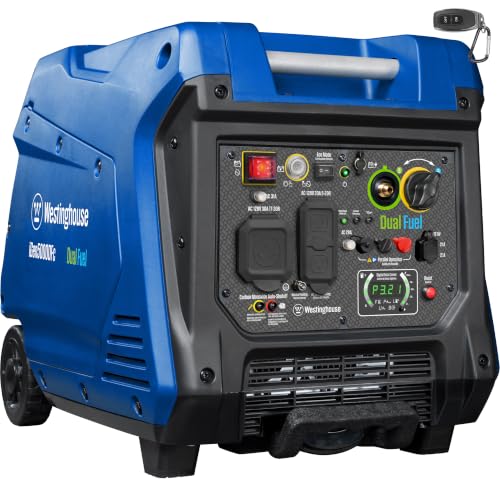
Westinghouse iGen5000DFc Dual Fuel Inverter Generator
What We Like
- Dual fuel: gas or propane
- Remote electric start key fob
- Super quiet at 52 dBA
- Parallel capable with second unit
Trade-offs
- At 105.8 lb, it is heavy to move alone
- Propane output is lower than gas
- No 240V outlet without parallel kit
With 5000 peak watts on gas and 3900 running watts, this inverter generator has the muscle to run a food truck’s fridge, fryer, and lights simultaneously without tripping breakers. The dual-fuel flexibility lets you switch to propane when gasoline is scarce or you want cleaner burning fuel. The remote start key fob means you can fire it up from the truck window on a cold morning. Its 52 dBA noise rating keeps you on good terms with neighboring vendors and customers, while the digital display shows fuel level and remaining runtime so you never guess when to refill.
The trade-off is weight: at 105.8 pounds, this is not a generator you toss in the back of a truck bed by yourself. It needs a dedicated spot on a slide-out tray or a sturdy dolly. Compared to the lighter Champion 4000-Watt Dual Fuel Inverter Generator at 51.8 pounds, the Westinghouse gives you more power and quieter operation but demands more muscle to position. For a food truck owner who values reliable power, dual fuel versatility, and low noise over portability, this is the generator that delivers.
Champion 4000-Watt Dual Fuel Inverter Generator

What We Like
- Dual fuel: gasoline or propane
- CO Shield auto shutoff system
- 64 dBA noise level at 23 feet
Trade-offs
It’s also 51.8 pounds, so while it’s far lighter than the 105.8-pound Westinghouse iGen5000DFc, you still won’t want to carry it far without a dolly.
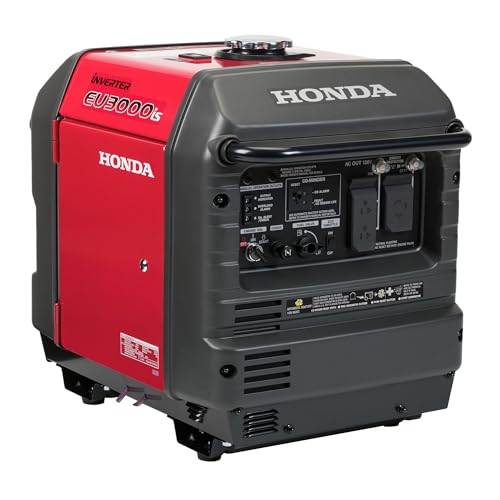
Honda EU3000iS 3000 Watt Inverter Generator
What We Like
- Super quiet 50-57 dB(A) operation
- Electric start for easy ignition
- CO-MINDER automatic CO shutoff
- Up to 19.6-hour runtime on one tank
Trade-offs
- At 144 lb, very heavy to move alone
- Gas-only fuel limits flexibility for food trucks
- Not available for California buyers
At just 50 to 57 decibels, this generator is quieter than a normal conversation, a huge advantage when you’re parked near homes or campsites. The inverter technology supplies power reliable enough for computers, while the electric start means no yanking a cord. With a runtime stretching up to 19.6 hours on a single tank, you can run through a long event without refueling. That combination of quiet operation, reliable power, and endurance makes it a natural fit for users who prioritize neighborly operation and hassle-free startup over raw output.
The big downside is weight: at 144 pounds, this isn’t a generator you’d try to move into a pickup alone. You’ll want a partner, a ramp, or a permanent mount. It also runs on gasoline only, so you won’t have the dual-fuel flexibility of a model like the Westinghouse iGen5000DFc if propane is easier to source or store. And if you’re in California, you’ll need to look at the EU3200iAC2 instead.
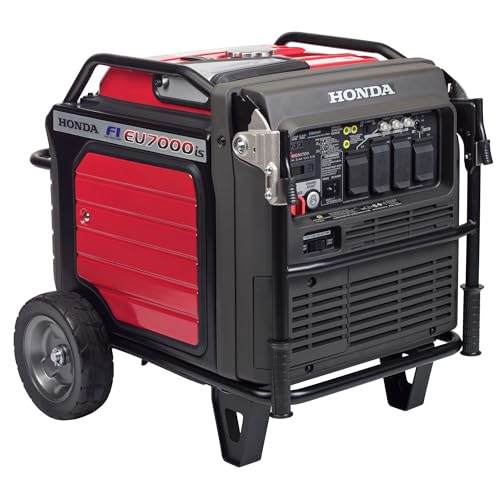
Honda EU7000iS 7000 Watt Inverter Generator
What We Like
- 7000 watts for heavy loads
- Super quiet 52-58 dB operation
- Bluetooth app control and monitoring
- CO-MINDER automatic shutoff for safety
Trade-offs
- Not available for California buyers
- Only runs on gasoline, no dual fuel
With a full 7000 watts of clean inverter power, the Honda EU7000iS can handle a food truck’s biggest draws, think commercial refrigerators, fryers, and lights all running at once, without breaking a sweat. Its super-quiet 52 to 58 dB operation means you won’t annoy neighboring vendors or customers, and the Bluetooth app lets you start, stop, and monitor the generator from your phone while you prep orders. For a food truck owner who needs reliable high capacity and minimal noise, this is the top-tier workhorse.
The real burden is sheer heft: at 263.2 pounds, this is not a generator you’d try to load into a pickup by yourself. You’ll want a ramp, dolly, or a permanent mount in your truck. Compared to the Westinghouse iGen5000DFc (105.8 lb), the Honda is more than twice as heavy, but it also delivers more wattage and Honda’s legendary build quality. It’s also gasoline-only, so if you prefer propane for longer storage or cleaner burn, you’ll need to look elsewhere. For those who can manage the weight and want maximum dependable power, this is the pick.
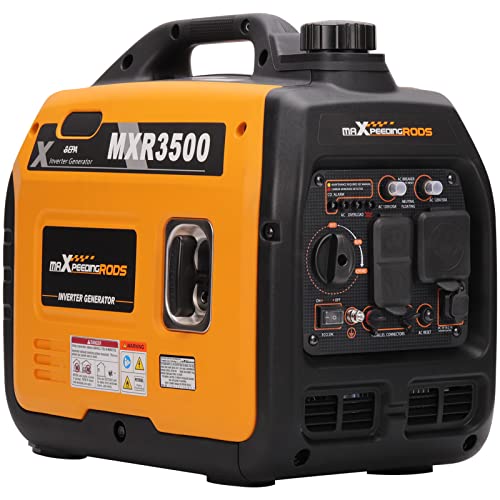
MaXpeedingrods MXR3500 3500 Watt Inverter Generator
What We Like
- Inverter tech gives clean power for electronics
- 58 dB noise level at 23 ft in Eco mode
- Includes parallel cables and RV plug
Trade-offs
- Gas only, no dual-fuel flexibility
- Gasoline only, no dual-fuel option
At 52 pounds, this generator is light enough for one person to lift into a truck bed or cart, which matters when you’re setting up at a new spot every day. The 3500 peak and 3000 running watts cover a small food truck’s basics: lights, a refrigerator, a blender, and maybe a countertop fryer, all on clean inverter power that won’t damage your point-of-sale tablet.
If your menu relies on a high-wattage griddle or an electric oven, the 3000 running watts could leave you short. But for a standard cart or trailer with modest gear, this lightweight inverter is a practical, portable partner.
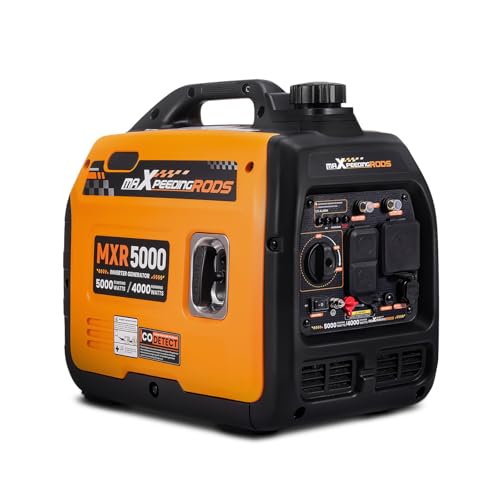
MaXpeedingrods MXR5000 5000 Watt Inverter Generator
What We Like
- 50 lbs lightweight for easy transport
- Pure sine wave protects sensitive electronics
- ECO mode saves fuel automatically
- RV-ready with compatible outlets
Trade-offs
- Gasoline only, no dual-fuel flexibility
- 4000 running watts limits heavy-draw equipment
- No electric start, recoil pull only
At 50 pounds, this 5000-peak-watt inverter generator is light enough for one person to move around a campsite or RV. It delivers 4000 running watts of clean pure sine wave power that won’t damage sensitive electronics like phones or laptops. The ECO mode automatically adjusts fuel consumption to match the load, saving gas when you are running only a few devices. For anyone who values portability over maximum power, this generator makes setup and transport genuinely easy.
This generator runs on gasoline only, so you won’t have the option to switch to propane like the Westinghouse iGen5000DFc dual-fuel model. With 4000 running watts, you’ll need to plan your loads, running a large RV air conditioner and a microwave at the same time could exceed capacity. But if you want a generator that’s light enough to move around easily, this MaXpeedingrods keeps things simple and portable.
Product photos
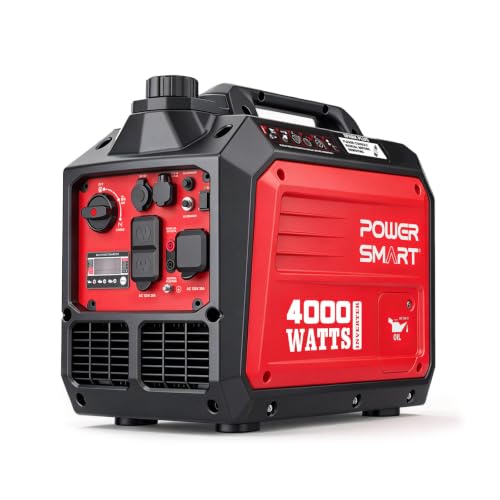
PowerSmart 4000 Watt Portable Inverter Generator
What We Like
- Clean <3% THD power
- Super quiet 59 dBA operation
- Parallel ready for double output
- 8-hour runtime on eco mode
Trade-offs
- 3200 running watts limits heavy-draw appliances
- Gas only; no dual fuel option
- At 50.7 lb, it's manageable but not ultralight
With 3200 running watts and under 3% total harmonic distortion, this inverter delivers clean power that’s safe for sensitive electronics like point-of-sale tablets or a laptop running your order system. The 59 dBA noise rating means it won’t drown out conversation or draw complaints from neighboring vendors, and the 8-hour runtime on eco mode can get you through a full shift without refueling. For a food truck operator on a tight budget who needs reliable, quiet power for a modest setup, lights, a small fridge, and a few countertop appliances, this is a smart, wallet-friendly choice.
At 3200 running watts, this generator handles delicate electronics like laptops and phones with under 3% THD clean power, but it won’t run a large deep fryer and a full-size refrigeration bank at the same time. If your menu demands higher draw equipment, the Westinghouse iGen5000DFc offers dual fuel flexibility and more headroom, though it weighs 105.8 pounds and costs more. For a truck that keeps its electrical load lean and values a quiet, affordable, and portable inverter, the PowerSmart hits a sweet spot that’s hard to beat.
Product photos
Champion 4500-Watt Electric Start Dual Fuel Inverter Generator
What We Like
- Electric start for easy ignition
- Dual fuel runs gasoline or propane
- CO Shield auto shutoff for safety
- Parallel ready for extra power
Trade-offs
- At 99.2 lb, it's heavy to move alone
- Propane output drops to 3150 running watts
- No remote start included
The Champion 4500-watt inverter generator runs on either gasoline or propane right out of the box, so you can pick whichever fuel is cheaper or easier to find. Its electric start and EZ Start Dial mean no yanking on a pull cord, and the CO Shield auto shutoff system adds peace of mind if you’re near an enclosed space. At 61 dBA, it’s quiet enough for a campground or a tailgate, and the Intelligauge lets you keep an eye on voltage, frequency, and run hours.
Weighing 99.2 pounds, this generator requires two people or a dolly to move around, so it’s best suited for a spot like an RV compartment or a garage corner rather than daily hauling. Owners note that the integrated handle and never-flat wheels make rolling it across a lawn or driveway manageable once it’s on the ground. The trade-off for that heft is a longer run time: up to 14 hours on a tank of gasoline or 21 hours on propane. That means fewer refueling stops during a weekend camping trip or a power outage.
Product photos
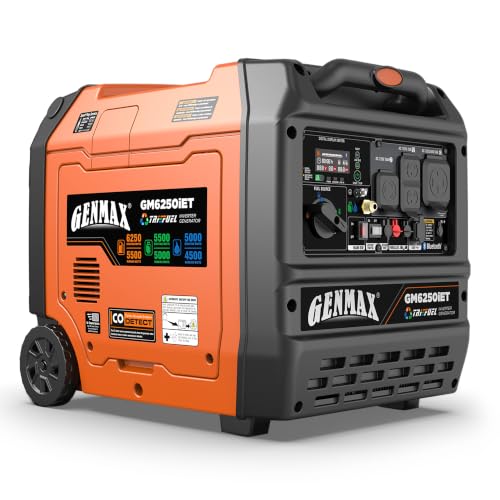
GENMAX 6250W Tri-Fuel Silent Inverter Generator
What We Like
- Tri-fuel capability: gasoline, LPG, natural gas
- Five starting methods including Bluetooth app
- 50A 120/240V outlet for heavy loads
- THD ≤ 3% for sensitive electronics
Trade-offs
- At 101 lbs, it's heavy to move alone
- Only 10-hour runtime at 25% load on gasoline
With 5500 running watts and 6250 starting watts on gasoline, this generator can handle a refrigerator, air conditioner, and power tools all at once, while its tri-fuel system lets you switch to propane or natural gas if gasoline runs low. The inverter keeps total harmonic distortion at 3% or less, so sensitive electronics like laptops and TVs run cleanly without flickering or damage. Five starting methods, electric, remote key fob, Bluetooth app, 2-wire auto start, and recoil, mean you can fire it up from inside the house or across the campsite without walking over to the unit.
The trade-off comes down to portability. At 101 pounds, this generator is heavier than the Champion 4000-Watt Dual Fuel Inverter Generator at 51.8 lbs, which is far easier to lift into a truck bed alone.
Product photos
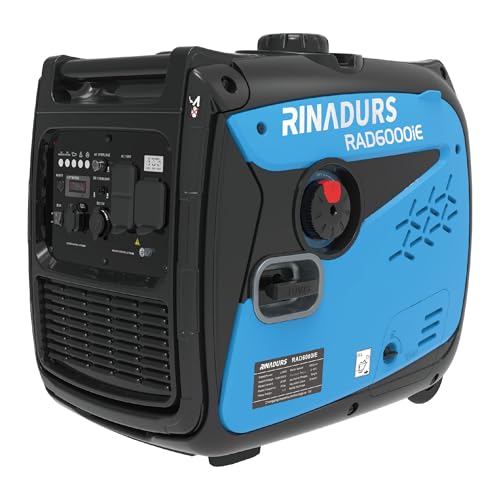
RINADURS 6000W Peak Portable Inverter Generator
What We Like
- Electric start for quick power
- CO sensor auto-shutoff protection
- Low oil and overheat protection
Trade-offs
- At 97.5 lb, it's heavy to move
- Gas-only fuel limits flexibility
- Large footprint for tight trucks
With 5500W peak power, this generator can support refrigerators, lights, fans, phones, laptops, routers, and other key devices during outages or jobsite work. That kind of capacity makes it a fit for demanding outdoor use, including food trucks and mobile food service where stable power matters. The electric start gets you running faster than a pull cord alone, and the built-in CO sensor monitors carbon monoxide levels, shutting the generator down if unsafe levels are detected.
At 97.5 pounds, this generator demands a permanent spot on a truck or a dolly to move it, not something you lift solo into a pickup bed. It runs on gasoline only, unlike the Westinghouse iGen5000DFc which also accepts propane. If your rig has the space and you want maximum power without juggling fuel types, this RINADURS delivers where it counts.
Product photos
How We Evaluated Generators For Food Trucks
Our evaluation focused on the real-world demands of a food truck. We started by examining the power output (both starting and running watts) of each model to ensure they could handle common commercial kitchen appliances like refrigerators, freezers, fryers, and griddles. We cross-referenced these specs with expert recommendations for mobile food service and typical electrical loads found in owner forums.
The three most important criteria for this category were noise level, fuel flexibility, and portability. Noise is critical for operating in residential areas or at events with sound ordinances; we prioritized generators with decibel ratings at or below a conversational level. Fuel flexibility (dual-fuel or tri-fuel capability) allows operators to switch between gasoline, propane, or natural gas depending on availability and cost. Portability matters because a generator must be moved in and out of a truck bed or storage compartment daily.
A research-led evaluation has limits: we cannot replicate every food truck setup or test units under load in a commercial kitchen. Instead, we rely on verified specs, safety certifications, and the collective experience of operators who have reported their findings online.
What To Look For In Generators For Food Trucks
Choosing a generator for your food truck means matching power output to your specific equipment, while also considering noise, fuel type, and how easily you can move the unit alone.
A food truck generator must deliver enough clean power for your cooking and refrigeration, stay quiet enough for event restrictions, and offer fuel flexibility for long days on the road.
Power Output and Surge Capacity
The most critical spec is running watts, the continuous power your generator can supply. Start by adding up the running watts of every appliance you plan to run simultaneously, lights, refrigeration, fryers, grills, and pumps. Then account for surge watts, the extra power needed when motors start (a refrigerator compressor can draw 2-3 times its running watts for a few seconds). A 4000-watt running generator may work for a small coffee cart, but a full kitchen with a fryer and refrigeration likely needs 5000-7000 running watts.
Noise Level (dBA)
Many cities and event organizers enforce strict noise limits, often measured at a certain distance. Inverter generators are typically much quieter than conventional open-frame models. Look for a decibel rating at 23 feet; a unit rated at 52-58 dBA is quiet enough to hold a conversation next to it. A generator that is too loud may get you fined or banned from future events.
Fuel Type and Runtime
Gasoline is widely available but can be less stable for storage. Propane burns cleaner and has a longer shelf life, making it a popular backup fuel. Natural gas offers the lowest fuel cost but requires a hookup, limiting mobility. Dual-fuel generators give you the option to switch based on what is available. Also consider runtime: a generator that runs 8-10 hours on a tank at half load means fewer refueling stops during a long shift.
- Add up the running watts of every appliance you will run at once, then add a 20% buffer.
- Check your local event noise limits and choose a generator rated at or below that decibel level.
- Decide if you want gasoline, propane, or both; dual-fuel models offer the most flexibility.
- Weigh the generator fully fueled; if you move it alone, keep the weight manageable.
- Look for safety features like CO shutoff and low-oil shutdown to protect your crew and equipment.
Generators For Food Trucks Compared
The table below compares each generator’s power output, noise level, fuel options, and key features side by side to help you narrow your choice.
| Product | Peak Watts | Noise Level | Weight | Fuel Type |
|---|---|---|---|---|
| Westinghouse iGen5000DFc Dual Fuel Inverter Generator | 5000 (gas) / 4500 (propane) | As low as 52 dBA | 105.8 lbs | Gas & Propane |
| Champion 4000-Watt Dual Fuel Inverter Generator | 4000 | 64 dBA at 23 ft | 51.8 lbs | Gas & Propane |
| Honda EU3000iS 3000 Watt Inverter Generator | 3000 Watts | 50-57 dB(A) | 144.0 pounds | Gasoline |
| Honda EU7000iS 7000 Watt Inverter Generator | 7000 watts | 52 to 58 dB(A) | 263.2 pounds | Gasoline |
| MaXpeedingrods MXR3500 3500 Watt Inverter Generator | 3500 | 58 dB at 23 ft | 52.0 lbs | Gasoline |
| MaXpeedingrods MXR5000 5000 Watt Inverter Generator | 5000 | N/A | 50 lbs | Gasoline |
| PowerSmart 4000 Watt Portable Inverter Generator | 4000 | 59 dBA at 23 ft | 50.7 lbs | N/A |
| Champion 4500-Watt Electric Start Dual Fuel Inverter Generator | 4500 (gas) | 61 dBA | 99.2 lb | Gas & Propane |
| GENMAX 6250W Tri-Fuel Silent Inverter Generator | 6250W (gasoline) | ~66 dB at 25% load | 101.0 lbs | Gasoline, LPG, Natural Gas |
| RINADURS 6000W Peak Portable Inverter Generator | 6000W Peak | N/A | 97.5 lbs | Gasoline |
Frequently Asked Questions
What size generator do I need for a food truck?
The size depends on your total electrical load. A small coffee or ice cream cart may run on a 3000-watt generator, while a full-service kitchen with a fryer, griddle, refrigerator, and lights typically needs 5000 to 7000 running watts. Add up the running watts of every appliance you will use at once, then add 20 percent for a safety margin.
Can I run a food truck generator on propane?
Yes, many generators are designed for dual-fuel operation, meaning they can run on either gasoline or propane. Propane burns cleaner, has a longer shelf life, and produces fewer fumes, which can be a benefit in tight spaces. However, propane typically delivers slightly less power than gasoline, so check the running wattage on propane before committing.
How quiet should a food truck generator be?
Most food truck operators should aim for a generator rated at a low decibel level at 23 feet. Many cities and event venues enforce noise limits around a moderate range. Inverter generators are generally the quietest option, with some models operating as low as 50-52 dBA, which is quiet enough for residential areas.
Is an inverter generator better for a food truck?
Yes, inverter generators are usually the better choice for food trucks. They produce cleaner power (less than 3 percent total harmonic distortion), which is safer for sensitive electronics like POS systems and digital controls on fryers or refrigerators. They are also significantly quieter and more fuel-efficient than conventional generators because the engine speed adjusts to the load.
Can I connect two generators together for more power?
Many inverter generators are parallel-ready, meaning you can connect two identical units with a parallel kit to double your power output. This is useful if you buy a smaller generator now and want to expand capacity later. Check the manufacturer’s specifications to confirm the model supports parallel operation and which kit is required.
The Bottom Line
The Westinghouse iGen5000DFc Dual Fuel Inverter Generator is our best overall pick for most food truck operators. It offers a strong balance of quiet operation, dual-fuel flexibility, and enough power for standard kitchen equipment, all at a mid-range price point. If your menu demands more wattage for heavy commercial gear, the Honda EU7000iS is worth the premium investment.
For operators on a budget or with a compact setup, the PowerSmart 4000 Watt Portable Inverter Generator delivers quiet, clean power without overspending. Those who need the ultimate fuel flexibility should consider the GENMAX 6250W Tri-Fuel Silent Inverter Generator, which runs on gasoline, propane, or natural gas.
The single most important buying factor is matching the generator’s running watts to your total appliance load with a comfortable buffer. Get that right, and you will have reliable power for every service, every event, and every day on the road.
