
10 Best Jumper Cables For Trucks in 2026
This post contains affiliate links. As an Amazon Associate, we earn from qualifying purchases.
The Energizer 1 Gauge 30ft Jumper Cables are the best overall for most truck owners, offering a long 30-foot reach and a permanent installation kit for easy use. For those with heavy-duty diesel engines, the iMeshbean 2/0 Gauge 40ft provides extra current and reach, while the SAFEMATE 00 Gauge 30ft is a top choice for a quick-connect setup.
Your truck’s large engine and often awkward battery placement mean thin, short cables won’t cut it. You need enough gauge to carry the current and enough length to reach between vehicles parked nose-to-nose or in tough spots.
This guide is based on manufacturer specifications, expert round-ups, and patterns in owner feedback. We focused on the cable gauge, length, and features that matter most for trucks and large SUVs.
Top 10 Jumper Cables For Trucks in the Market
Certain content that appears on this site comes from Amazon. This content is provided "as is" and is subject to change or removal at any time.
The Best Jumper Cables For Trucks, Reviewed
Energizer 1 Gauge 30ft Jumper Cables

What We Like
- 30-foot length reaches from behind vehicle
- Permanent installation kit and quick-connect plug
- Flexible down to -40°C
- Thick vinyl coating resists rust and corrosion
Trade-offs
- Not rated for engines larger than 6-liter diesel
An 800-amp rating and 1-gauge copper-clad aluminum wire make these cables a confident match for full-size trucks with up to 8-liter gas or 6-liter diesel engines. The 30-foot length gives you the reach to jump from behind a tow truck or roadside assistance vehicle, and the included permanent installation kit with quick-connect plug saves time when you need it most. The thick vinyl coating and flexible jacket that stays pliable down to -40°C mean these cables won’t stiffen up or corrode after a few winters in the bed of a work truck.
For most pickup and SUV owners, this Energizer kit delivers a smart balance of reach, power, and long-term corrosion protection. The 30-foot length reaches from the front of a tow truck or roadside assistance vehicle to a dead battery behind another car. Its 1-gauge copper-clad aluminum cables handle up to 800 amps, which is sufficient for gasoline engines up to 8 liters and diesel engines up to 6 liters. A thick vinyl coating shields the clamps from rust and corrosion, while the strong spring and comfortable handle keep the clamps securely positioned during a jump. The included permanent installation kit and quick-connect plug make it convenient for frequent use.
iMeshbean 2/0 Gauge 40ft Jumper Cables
What We Like
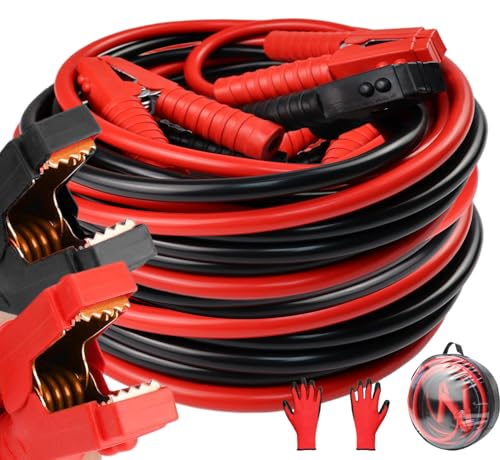
- 40ft length reaches awkward parking spots
- Includes carry case and gloves
- 5000A peak current for engines up to 9500cc
Trade-offs
- 8.4 lb is heavy to carry far
- No quick-connect plug like some rivals
- Long cable can be bulky to store
The 40-foot length gives you plenty of slack to reach a dead battery even when the donor vehicle can’t pull up nose-to-nose, which matters on job sites or tight lots. It works with both 12V and 24V systems, so it’s ready for everything from a pickup to a commercial rig.
Product photos
SAFEMATE 00 Gauge 30ft Jumper Cables

What We Like
- Quick-connect plug for permanent mounting
- Tangle-free design rated -40°F to 140°F
- Includes carry bag, gloves, and brush
- Extra thick PVC cover for drop resistance
Trade-offs
- CCA conducts less than pure copper
- Heavy 00 gauge cables are stiff in cold weather.
The quick-connect plug lets you mount one end on the battery permanently, so you can connect directly without disassembling the terminals each time. That convenience, paired with a 1500A rating and 00 gauge wire, makes this a solid fit for full-size trucks and cargo vans where you want a fast, no-hassle setup. The tangle-free jacket is engineered for temperatures from -40°F to 140°F, and the included brush and gloves mean you’re ready to clean terminals and connect safely right out of the bag.
The SAFEMATE jumper cables use copper-clad aluminum (CCA) instead of pure copper, which keeps the weight down and the price lower. But CCA doesn’t conduct electricity as efficiently as pure copper. For a heavy diesel or a big-block gas truck, the iMeshbean 2/0 gauge 5000A option offers more raw capacity and a longer 40-foot reach, though the other-products list does not specify whether it includes a quick-connect plug. If your truck is a daily driver that occasionally needs a boost from another vehicle, the SAFEMATE’s ease of use is hard to beat.
Product photos
HORUSDY 1 Gauge 25ft Jumper Cables

What We Like
- Full copper clamps with strong jagged teeth
- Smart protector with red LED and alarm for reverse polarity
- Cable stays flexible in cold weather down to -40°F
Trade-offs
- 1-gauge wire is thinner than 2/0 or 00 options
The trade-off is capacity: 800 amps and 1-gauge wire work well for vans, full-size SUVs, and standard trucks, but a heavy diesel or commercial rig may need the 2/0-gauge 40ft iMeshbean for extra current.
Product photos
FIERYRED 2/0 Gauge 30ft Jumper Cables
What We Like
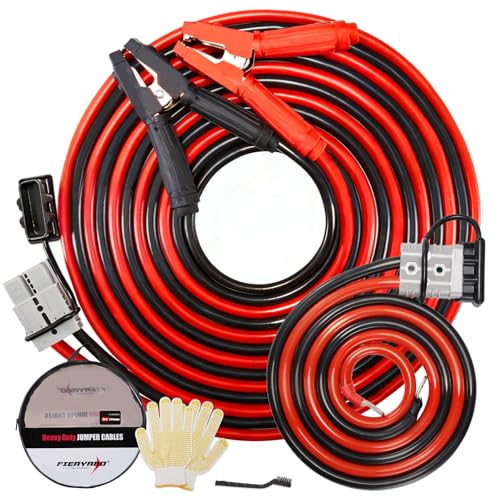
- 1500A peak for diesel trucks
- 30 ft length for awkward parking
- Flexible PVC jacket to -40°F
- Includes gloves, brush, and bag
Trade-offs
- Copper-clad aluminum less conductive than pure copper
- 30 ft length adds weight and bulk to store
With 1500 amps of peak current and a 2/0 gauge wire, this kit is built to wake a cold diesel engine when lesser cables would just sit there and heat up. The cable’s 30-foot reach gives you room to park nose-to-nose or even at awkward angles on a roadside shoulder. The Anderson quick-connect plug lets you extend the reach if you buy a second set. It’s the right choice for anyone who regularly jumps a heavy-duty truck, especially in cold weather where the PVC jacket stays flexible down to -40°F.
The conductors are copper-clad aluminum rather than pure copper, so they carry current well but not quite as efficiently as all-copper cables of the same gauge. The 1500A instant rating means it can handle the high draw of a diesel truck or large SUV, while the Energizer 1-gauge 30ft set is rated at 800A. If you drive a smaller gas vehicle and want lighter cables, the Energizer might be easier to stow.
Product photos
AutoChat 0 Gauge 30ft Jumper Cables

What We Like
- Pure copper teeth for strong grip
- 0 gauge for high current flow
- 30 ft length for long reach
- Includes carry case, gloves, brushes
Trade-offs
- At 14.0 lb, heavy to carry
- No quick-connect plug for permanent installation
A 0-gauge cable rated for up to 1000 amps of instantaneous current means this set can handle large gas and diesel engines found in trucks and SUVs. The 30-foot reach lets you connect batteries even when vehicles are parked at a distance. AutoChat pairs that heavy-duty core with four alligator clamps that have jagged teeth and springs for a strong grip on battery terminals. The included carry case, gloves, and brushes add convenience for storage and maintenance.
One trade-off is weight: at 14 pounds, these cables are noticeably heavier than a set like the 40-foot iMeshbean 2/0 gauge cables, which weigh 8.4 pounds. If you prioritize a lighter kit for frequent handling, the iMeshbean offers a longer reach at a lower weight.
Product photos
ExtreSpo 0 Gauge 25ft Jumper Cables

What We Like
- UL Listed for verified safety
- Flexible down to -40°F
- Works with 12V and 24V systems
- Includes carry bag, gloves, brushes
Trade-offs
- Copper clad aluminum less conductive than pure copper
- No quick-connect plug for permanent installation
The UL Listing on these cables confirms they can withstand up to 1000 amps of instantaneous current and work in extreme temperatures from -40°F to 140°F. So you can rely on them for jump-starting a diesel truck without worrying about insulation failure. The 25-foot length lets you park nose-to-nose or side-by-side on most jobs, and the patented clip design with solid serrated teeth and a stronger spring holds firmly onto battery terminals. This set gives you verified safety standards rather than just a high amp rating on the package.
One downside is that 25 feet may feel short if you need to reach a vehicle parked far from the donor. A longer cable like the 40-foot iMeshbean 2/0 gauge would offer more slack. And while the copper-clad aluminum keeps the cable flexible and affordable, pure copper would offer higher conductivity, though the difference is minimal for most jump-start situations. Still, for pickup and SUV owners who want a safe, well-insulated cable that comes with gloves and brushes in a carry bag, this UL Listed kit delivers verified safety without the extra cost of pure copper.
Product photos
TOPDC 0 Gauge 20ft Jumper Cables

What We Like
- 20-foot length reaches awkward battery positions
- UL-certified for -40°F to 140°F
- Includes carry bag for organized storage
- 5-year quality guarantee included
Trade-offs
- Copper-clad aluminum conducts less than pure copper
- At 9 lb, heavier than some 20-ft cables
At 9 pounds, it is heavier than some shorter pure-copper alternatives, though the extra length justifies the heft for anyone who has ever had to reposition a vehicle just to reach jumper clamps.
Product photos
Noone 1 Gauge 25ft Jumper Cables

What We Like
- Quick-connect plug for permanent install
- Remains flexible in cold winters
- Includes carry bag, gloves, brush
Trade-offs
- Copper clad aluminum, not pure copper
- 900A peak current limits use on very large diesel rigs
A 25-foot length with a quick-connect plug means you can mount one end permanently under the hood, then just plug in when you need a jump. That permanent install kit is the standout feature here, no fumbling with clamps in the rain or snow. The 1-gauge copper clad aluminum wire can withstand up to 900 amps of instantaneous current, and the cables stay flexible down to minus 40 degrees. For someone who wants a set-and-forget solution on their work truck, this design saves time and hassle every time a battery dies.
Copper clad aluminum doesn’t conduct as well as pure copper, so on a very long or heavy jump, you might notice slightly slower transfer than a pure-copper cable. If your truck lives on a job site or you jump-start the same vehicle repeatedly, the quick-connect plug makes daily use much easier. For occasional roadside rescues on a full-size diesel, the shorter cable could be tight.
Product photos
POADTOR 0 Gauge 30ft Jumper Cables

What We Like
- Quick-connect plug for permanent mount
- 30-foot reach with tangle-resistant design
- Stays flexible in -40°F cold
- Serrated teeth and reinforced springs for grip
Trade-offs
- 12.9 pounds is heavy to carry around
- CCA conducts less than pure copper
- Extension adds a connection point to manage
A 30-foot cable with a quick-connect plug that can stay mounted on your vehicle means you don’t have to reconnect cables each time you jump-start a weak battery. The jacket is tangle-resistant and stays flexible down to -40°F, which helps when you’re working in cold weather. It’s compatible with engines up to 8.0L gasoline and 6.0L diesel, so it can handle full-size cars, vans, and mid-size pickup trucks.
At 12.9 pounds, this cable is heavier than some other options, like the 40-foot iMeshbean 2/0 gauge set at 8.4 pounds, so it’s not the lightest to carry around. The copper-clad aluminum construction supports stable power transfer during engine startup, and the dual-grip design works with both top and side post batteries. If you want a setup you can plug in fast and leave attached between uses, this cable fits that need.
Product photos
How We Evaluated Jumper Cables For Trucks
We started by examining the specifications that matter most for a heavy-duty jump start: cable gauge, length, and conductor material. Thicker wire (lower gauge number) carries more current, and longer cables offer more flexibility in parking situations. We also looked at clamp quality, cold-weather performance ratings, and the inclusion of safety features like reverse-polarity protection.
Our research then focused on the practical needs of truck owners. A cable that works for a compact car will struggle with a diesel engine’s higher current draw. We prioritized cables with ratings that matched or exceeded the demands of large gas and diesel engines, and we noted which models included useful accessories like carry bags, gloves, and brushes.
Finally, we weighed the trade-offs of different designs. Quick-connect plugs are convenient for permanent installation but add complexity, while pure copper conductors offer better conductivity than copper-clad aluminum (CCA) at a higher cost. This research-led evaluation helps you choose based on your specific vehicle and usage pattern.
What To Look For In Jumper Cables For Trucks
Choosing jumper cables for a truck is different than for a car. You need to match the cable’s capacity to your engine’s size and consider how you’ll use it, whether for emergency roadside use or as a permanent under-hood tool.
Key buying criteria: Cable gauge (lower number = thicker wire = more current), length for reach, conductor material (pure copper vs. CCA), clamp quality, cold-weather flexibility, and included accessories.
Cable Gauge and Current Capacity
The gauge, or thickness, of the cable is the most critical factor. For a standard truck with a gas V8, a 1-gauge or 0-gauge cable is usually sufficient. For large diesel engines, you’ll want a 2/0 or 00 gauge cable to handle the higher current draw. The peak current rating, measured in amps, gives you a rough guide, but a thicker gauge is a more reliable indicator of capacity.
Cable Length
A 20-foot cable might work for two cars parked nose-to-nose, but trucks are longer. A 25-foot or 30-foot cable is far more practical, allowing you to reach the battery even when the vehicles are parked side-by-side or in awkward positions. The extra length also helps when the battery is on the passenger side of one vehicle and the driver’s side of another.
Conductor Material: Pure Copper vs. Copper-Clad Aluminum
Pure copper cables are the best conductors, offering lower resistance and better current flow. Copper-clad aluminum (CCA) cables are lighter and less expensive, but they conduct less electricity than pure copper for the same gauge. For a large diesel truck that needs every bit of current, pure copper is the superior choice, though it will be heavier and more expensive.
- Measure your truck’s battery location and the distance to a typical jump-start partner.
- Check your engine’s displacement (in liters) and compare it to the cable’s recommended engine size.
- Look for a cable with thick, well-insulated clamps that have strong springs and sharp teeth.
- Consider a carry bag to keep the cables clean and organized in your truck bed or under a seat.
A good rule of thumb: For a diesel truck, choose a 2/0 or 00 gauge cable at least 25 feet long. For a gas truck, a 1 or 0 gauge cable of the same length is a reasonable option.
Jumper Cables For Trucks Compared
The table below compares the key specs of each recommended set of jumper cables for trucks, helping you see at a glance which model best fits your engine size and budget.
| Product | Gauge | Length | Amperage/Peak Current |
|---|---|---|---|
| Energizer 1 Gauge 30ft Jumper Cables | 1 Gauge | 30 feet | 800A |
| iMeshbean 2/0 Gauge 40ft Jumper Cables | 2/0 | 40 ft | 5000A |
| SAFEMATE 00 Gauge 30ft Jumper Cables | 00 Gauge | 30 ft | 1500Amp |
| HORUSDY 1 Gauge 25ft Jumper Cables | 1 Gauge | 25 ft | 800A |
| FIERYRED 2/0 Gauge 30ft Jumper Cables | 2/0 | 30 ft | 1500 A |
| AutoChat 0 Gauge 30ft Jumper Cables | 0 | 30 ft | 1000 Amp |
| ExtreSpo 0 Gauge 25ft Jumper Cables | 0 Gauge | 25 ft | 1000A |
| TOPDC 0 Gauge 20ft Jumper Cables | 0 Gauge | 20 ft | 1000Amp |
| Noone 1 Gauge 25ft Jumper Cables | 1 Gauge | 25 ft | 900A |
| POADTOR 0 Gauge 30ft Jumper Cables | 0 Gauge | 30 ft | 1000Amp |
Frequently Asked Questions
What gauge jumper cables do I need for a diesel truck?
For a diesel truck, you generally need a 2/0 or 00 gauge cable. These thicker wires can handle the higher current required to start a large diesel engine, especially in cold weather. A 1-gauge cable might work for smaller diesel engines, but it’s safer to go with a thicker gauge for reliable starting.
How long should jumper cables be for a truck?
A 25-foot or 30-foot cable is recommended for most trucks. This extra length allows you to reach the battery even when the vehicles are parked side-by-side or in awkward positions. Shorter cables, like 20 feet, can be too short for a truck’s longer wheelbase and hood.
Are copper-clad aluminum jumper cables good enough?
Copper-clad aluminum (CCA) cables are a common and affordable option for many truck owners. They are less conductive than pure copper, but a thicker CCA cable (like 2/0 gauge) can still provide enough current for most gas and smaller diesel engines. For large commercial diesels, pure copper is a better choice for maximum current flow.
Can I permanently install jumper cables under my hood?
Yes, many jumper cables come with a quick-connect plug and ring terminals that allow for a permanent under-hood installation. This setup lets you connect the cables to your battery and store the clamp end in your vehicle, ready for a quick, tool-free jump start without opening the hood fully.
What does a reverse polarity alarm do?
A reverse polarity alarm is a safety feature that alerts you if you accidentally connect the clamps to the wrong battery terminals. It typically uses a red LED light and a loud beep to warn you, preventing a dangerous short circuit or damage to your vehicle’s electrical system. It’s a valuable feature for any driver.
The Bottom Line
For the vast majority of truck and SUV owners, the Energizer 1 Gauge 30ft Jumper Cables offer the best balance of reach, current capacity, and convenience with its permanent installation kit. It’s a ready-to-use solution that handles gas engines up to 8 liters and diesel engines up to 6 liters without breaking the bank.
If you drive a heavy-duty diesel pickup or a commercial vehicle, the iMeshbean 2/0 Gauge 40ft Jumper Cables provide the extra current and length you need. For those who want the fastest, most convenient setup, the SAFEMATE 00 Gauge 30ft or Noone 1 Gauge 25ft are excellent permanent-install options.
The single most important factor is matching the cable gauge to your engine. A cable that’s too thin will struggle to start your truck, especially in cold weather. Buy the thickest gauge you can reasonably afford and store, and you’ll be ready for any roadside situation.
