
10 Best Motorcycle Wheel Balancers in 2026
This post contains affiliate links. As an Amazon Associate, we earn from qualifying purchases.
For smooth, vibration-free riding, a quality wheel balancer is essential shop equipment. The Tusk Motorcycle Wheel Balancing and Truing Stand earns our top spot for its precision centering cones and four-bearing design. That setup reduces friction during balancing, which makes it a reliable choice for home mechanics and small shops. For riders who need to take their balancer on the road, the Rabaconda Motorcycle Wheel Balancer Stand offers a portable, wall-mountable design. If precision truing is your priority, the Motion Pro 08-0538 Axis Wheel Truing-Balance Stand provides a lightweight, single-sided setup.
A wobbly wheel at highway speed isn’t just uncomfortable, it’s unsafe. The right balancer helps you correct imbalances that cause vibration, uneven tire wear, and premature bearing damage. But with so many stands on the market, from budget-friendly portables to heavy-duty shop models, choosing the right one depends on your workspace. It also depends on the types of wheels you work on and whether you need truing capability.
This guide is built from manufacturer specifications, expert round-ups, and patterns found in owner feedback across the automotive community. We evaluated ten balancers on precision, capacity, portability, and value to help you find the right tool for your garage or track bag.
Top 10 Motorcycle Wheel Balancers in the Market

Certain content that appears on this site comes from Amazon. This content is provided "as is" and is subject to change or removal at any time.
The Best Motorcycle Wheel Balancers, Reviewed
Tusk Motorcycle Wheel Balancing and Truing Stand

What We Like
- Precision centering cones from 15 to 32 mm
- Four bearings reduce friction during balancing
- Adjustable frame rails fit wheels up to 21"
- Portable at 15.5 pounds, shop-ready build
Trade-offs
- Only fits wheels up to 21" diameter
- At 15.5 lb, not the lightest for frequent travel
The centering cones cover a 15 mm to 32 mm range, so you can balance everything from small dirt bike wheels to full-size 21-inch hoops without needing extra adapters. Four bearings keep the shaft spinning freely, letting you find the heavy spot quickly and accurately. It’s built for the shop or home bench, and at 15.5 pounds it’s light enough to move out of the way when the job is done. That combination of precision and portability makes it the go-to stand for anyone who services multiple bikes or does their own wheel builds.
For most riders who just want to balance a wheel after a tire change or do light truing, the Tusk stand gives you professional-grade feel without the extra cost of a full truing setup. It is a straightforward, well-built tool that handles the core job well.
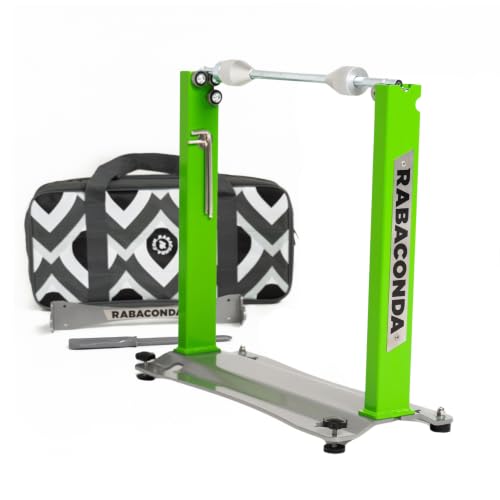
Rabaconda Motorcycle Wheel Balancer Stand
What We Like
- Wall mount bracket saves bench space
- Carry bag for compact storage and portability
- Hand Adjustable Cone System (HACS) for precision
- Includes wheel weight remover knife
Trade-offs
- At 17.4 lb, heavier than some portable stands
- No truing pointer for wheel straightening
- 17.2-inch footprint still requires flat surface
A 17.4-pound weight with a wall mount bracket means this balancer can live on your garage wall, not your workbench. That frees up valuable space for other tools. The Hand Adjustable Cone System (HACS) and low-friction ball bearings let you dial in a precise balance for smooth rides, and the included carry bag makes it easy to take to the track or a friend’s shop. This is the pick for anyone who values a tidy workspace and wants a balancer that stows away neatly between uses.
You give up a truing pointer, so this stand is strictly for balancing, not for straightening bent wheels. The Rabaconda is slightly heavier and bulkier than the Tusk stand, which weighs 15.5 lb and has a smaller 8.5-inch width. But the wall mount and carry bag make up for it if portability and storage are your priorities. It’s a focused tool for the rider who wants quick, accurate balancing without a permanent bench setup.
Motion Pro 08-0538 Axis Wheel Truing-Balance Stand

What We Like
- Single-sided design for easy spoke access
- High-quality bearings for precise balancing
- Fits most modern street and dirt bikes
- Hub cones hold wheel firmly
Trade-offs
- At 1.0 lb, less stable for heavy wheels
- 15 mm axle limits larger axle applications
- No built-in truing pointer included
At one pound, the stand can feel unsteady under a heavy wheel, so owners often mount it securely to a bench. The Motion Pro prioritizes quick adjustments and easy spoke access over sheer mass, while the Tusk stand weighs 15.5 pounds and offers a more planted platform. If you need a stand that stays put without clamping or you work with larger axle diameters, this may not be your first choice. But for focused truing work on common bike wheels, it delivers the precision the design promises.
REARACE Motorcycle Wheel Balancer Portable Tire Stand

What We Like
- Wide axle range (13-30 mm)
- Built-in leveling bubble for accuracy
- Compact and portable for track days
- Corrosion-resistant powder coating
Trade-offs
- No truing pointer included for spoke alignment
- Steel construction adds weight for transport
- Requires a perfectly flat surface to level
The REARACE stand fits most motorcycle wheels, with an axle diameter range of 13 to 30 mm and a max tire diameter of 10 by 28 inches. That covers everything from small dirt bikes to larger cruisers. Adjustable center cones lock the wheel in place, and the built-in leveling bubble along with four leveling feet allow accurate horizontal positioning on stable surfaces. That setup makes it a practical tool for balancing wheels in a garage, on a trailer, or at the track. It delivers reliable function without extra features you might not need.
This stand focuses purely on balancing and lacks a truing pointer, so if you need to correct spoke runout you’ll have to work by eye or buy a separate gauge. Its steel build, while durable, also makes it heavier to toss in a trailer than a plastic-bodied unit. But for someone whose main priority is getting a wheel balanced quickly and accurately without spending for a full truing station, the REARACE delivers exactly that at a budget-friendly value.
Product photos
Tanfix Motorcycle Wheel Balancer for Static and Dynamic Balancing
What We Like
- Supports both static and dynamic balancing
- Adjustable centering cones for precise alignment
- Durable steel construction for repeated use
- Compact design for easy storage
Trade-offs
- No truing pointer included for straightening bent rims
A wheel balancer that handles both static and dynamic balancing is rare at this level, and the Tanfix delivers exactly that. The adjustable centering cones let you securely fit wheels from sport bikes to dirt bikes, while the steel frame keeps it stable through repeated use. For a home mechanic who wants more than a basic static stand, this dual-mode capability means you can catch imbalances that a simple spin test would miss.
The Tanfix focuses purely on balancing, and for that job it performs well without extra bulk. If your work stays within balancing and you value the flexibility of both static and dynamic modes, this is a smart, no-fuss pick.
Product photos
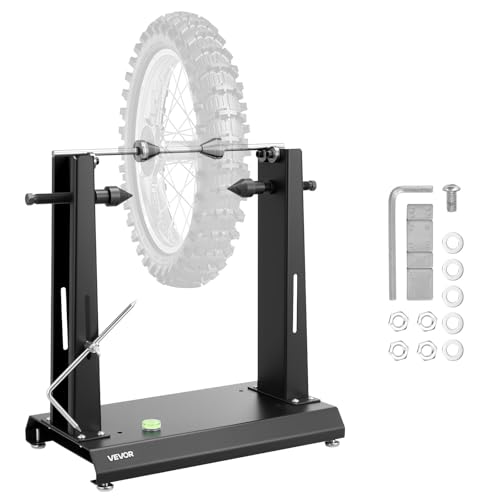
VEVOR Motorcycle Wheel Balancer and Truing Stand
What We Like
- Comes with two sets of balancing weights
- Bubble level and adjustable feet for uneven ground
- Fits both hollow and solid axles
- Truing pointer included for alignment checks
Trade-offs
- Steel frame adds weight for portable use
- Assembly required with included wrench
An 88.2-pound weight capacity means this stand can handle most motorcycle and bicycle wheels, including solid and hollow axle types up to 35 inches in diameter. The included two sets of 5-gram and 10-gram weights let you start balancing right out of the box. That practical bundle, weights plus a truing pointer and a bubble level with adjustable foot pads, gives you a complete setup without hunting for extras. It suits anyone who works on a range of wheel types, from solid axles on older bikes to hollow axles on modern machines. And it appreciates having the tools to level the stand on a sloped garage floor.
This stand is built for wheels up to 88.2 lbs, so it is not meant for heavier wheels that exceed that limit. If you need a stand for larger or heavier wheels, you may want to consider other options, but you will likely pay extra and may lose the included weights and truing pointer. For someone balancing typical motorcycle and bicycle wheels, the VEVOR delivers a complete package that covers the essentials.
Product photos
VIVOHOME Motorcycle Wheel Balancer and Truing Stand

What We Like
- 88.2 lb capacity handles heavy wheels
- 4 adjustable centering cones for grip
- Built-in spirit levels for accuracy
- Includes truing pointer for spoke work
Trade-offs
- At 22.2 lb, less portable than lighter stands
- Larger footprint than compact models
- No wall-mount option included
An 88.2-pound weight capacity means this stand can handle most motorcycle wheels up to that limit, from touring bikes to dual-sport models. The adjustable centering cones grip rims securely, and the four bearings cut friction so you get a true reading on balance. Spirit levels are included to help you set up the stand level, and the truing pointer lets you fine-tune spokes while the wheel is mounted. This is the stand for anyone who works on a range of bikes and wants one tool that won’t flinch under a heavy wheel.
At 22.2 pounds and a 19.2-inch length, it’s not something you’ll toss in a backpack for trailside repairs. The VIVOHOME is better suited to a dedicated bench or garage spot where it can stay set up, while the Rabaconda stand is lighter at 17.4 pounds and includes wall-mount brackets for compact storage. If you need portability, look elsewhere; if you want a sturdy, high-capacity stand that stays put and gets the job done, this is your pick.
Product photos
OMT Motorcycle Bike Wheel Balancer

What We Like
- Adjustable cones fit 0.5-1.5 in axles
- Four low-friction radial bearings for smooth spin
- Leveling feet keep stand stable on uneven floors
- Works with road, sport, MX, dirt, and bicycle wheels
Trade-offs
- No truing pointer included for wheel straightening
- No truing pointer for wheel straightening.
The OMT Motorcycle Bike Wheel Balancer uses four low-friction radial bearings and adjustable centering cones to handle axles from 0.5 to 1.5 inches, so it fits everything from a bicycle wheel to a dirt bike or sportbike rim. Its compact steel frame sits on adjustable feet that keep the stand planted even on a garage floor that isn’t perfectly level. For a home mechanic who works on multiple bike types, that range makes this a single stand that covers nearly every wheel in the shed.
The OMT stand handles tires up to 12 inches wide and 28 inches in diameter, which covers most road, sport, MX, dirt, and bicycle wheels. If you work on multiple bike types, that range lets you balance nearly every wheel in the shed with one stand. The adjustable feet keep the stand planted on uneven garage floors, so you don’t have to shim it yourself. The trade-off is the lack of a truing pointer for straightening spokes, if that matters, you’d need a different stand. For pure balancing, the OMT’s broad compatibility and stable base make it a practical choice for a mixed-fleet garage.
The OMT Motorcycle Bike Wheel Balancer is ideal for the home mechanic who owns multiple bike types and wants one stand that handles everything from bicycles to sport bikes and dirt bikes. Not ideal for riders with fat-tire adventure bikes or anyone who needs a built-in truing pointer for spoke straightening.
Product photos
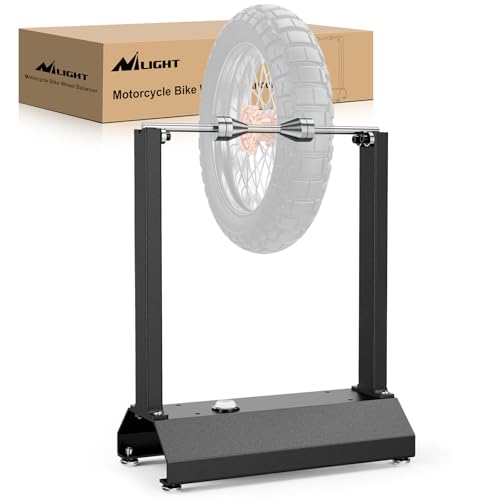
Nilight Motorcycle Bike Wheel Balancer Tire Balancer Stand
What We Like
- Adjustable leveling feet for uneven ground
- Built-in bubble level for stability
- Universal centering cones fit most axles
- Heavy-duty steel with anti-corrosion coating
Trade-offs
- At 12 pounds, less portable than lighter stands
- No truing pointer included for wheel alignment
- Only handles tires up to 12 inches wide
Four adjustable leveling feet and a built-in bubble level mean this stand stays planted even on a sloped garage floor. That stability is the reason it takes the stability award here, you can set it up once and trust the bubble won’t drift as you spin the wheel. The heavy-duty steel frame with anti-corrosion coating adds to the confidence, making it a dependable tool for precise static balancing without chasing a wobbly stand around the shop.
At 12 pounds it’s heavier than a truly portable option like the Rabaconda, which includes wall-mount brackets for bench or wall storage. You won’t be tossing this in a backpack for a track day. But if your workshop has a permanent spot for a balancer and you value a rock-solid platform over portability, the Nilight delivers exactly that. It’s built for the home mechanic who wants repeatable, fuss-free balancing on whatever floor they’ve got.
Product photos
Mkienhy Motorcycle Wheel Balancer Stand

What We Like
- Adjustable centering cone for most wheel sizes
- Four locking feet with bubble level for stability
- Smooth chrome-plated balance bar with radial bearings
Trade-offs
- No truing pointer included for wheel straightness checks
- Heavy iron construction limits portability
The four low-friction radial bearings and chrome-plated balance bar work together to locate the wheel’s heavy spot for adding weights, with the adjustable centering cone handling wheels up to a 15.74-inch radius, covering sportbikes and motocross bikes. Four locking feet and a bubble level keep the stand steady on uneven garage floors, making static balancing a practical option for home mechanics.
You will need a separate tool or a keen eye to correct a bent rim, since this stand lacks a truing pointer. The Tusk stand sits lower at 4 inches tall, so the Mkienhy requires a bit more bench height to work comfortably. Still, the heavy iron frame and powder coating should hold up to years of tire changes, and the adjustable feet mean you can set it up on a sloped driveway without shimming. It is a straightforward, capable tool for anyone who prefers doing their own wheel work.
Product photos
How We Evaluated Motorcycle Wheel Balancers
We started by analyzing the technical specifications of each stand, axle diameter range, bearing quality, weight capacity, and included accessories like truing pointers and leveling bubbles. Manufacturer documentation and product listings provided the core data on materials, dimensions, and fitment ranges.
Our evaluation focused on four key criteria: balancing precision (cone quality and bearing smoothness), wheel capacity (diameter and weight limits), portability (weight and storage features), and included extras (truing pointers, weights, leveling tools). A balancer that can’t handle your biggest wheel or won’t fit in your workspace is useless, no matter how accurate it is.
Because this is a research-led evaluation rather than a hands-on test, we relied on verified owner feedback patterns to confirm real-world performance. We looked for consistent reports of smooth spinning, secure wheel mounting, and durable construction across multiple user experiences.
What To Look For In Motorcycle Wheel Balancers
Choosing a wheel balancer means matching the tool to your wheel sizes, workspace, and whether you need to true spokes. Here’s what matters most.
A good motorcycle wheel balancer centers the wheel precisely, spins with minimal friction, and fits the axle sizes you work with. Look for adjustable centering cones, smooth bearings, and a stable base that won’t wobble.
Axle Fitment and Centering Cones
The balancer must accommodate your wheel’s axle diameter. Most stands use adjustable centering cones that grip the inner race of the bearings. Look for a wide cone range, the Tusk model covers 15 to 32 mm, while the OMT stand fits 0.5 to 1.5 inches. If you work on both dirt bikes and cruisers, a universal cone set saves you from buying adapters.
Bearing Quality and Friction
Low-friction bearings let the wheel spin freely so you can find the heavy spot. Four-bearing designs (like the Tusk) reduce drag better than two-bearing setups. Radial bearings, as used on the OMT stand, offer smooth rotation. A balancer with high-friction bearings will hide imbalances, leading to poor results.
Capacity and Stability
Check the maximum wheel diameter and weight. The VIVOHOME and VEVOR stands handle wheels up to 88.2 pounds, making them suitable for heavy touring bikes. Smaller stands cap out around 21-inch diameters. For stability on uneven floors, look for adjustable leveling feet and built-in bubble levels, features found on the Nilight and Mkienhy models.
- Measure your largest wheel’s diameter and axle size before buying.
- If you work on uneven garage floors, prioritize stands with leveling feet.
- For track-day portability, choose a balancer under 12 pounds with a carry bag.
- If you true spokes, confirm the stand includes a truing pointer.
- Consider a wall-mount bracket (like Rabaconda’s) if bench space is tight.
A balancer that fits your biggest wheel and spins freely will save you time and frustration on every tire change.
Motorcycle Wheel Balancers Compared
The table below compares the key specifications of our top picks, helping you see at a glance which balancer suits your wheel sizes, workspace, and budget.
| Product | Max Wheel Diameter | Axle Range | Bearings |
|---|---|---|---|
| Tusk Motorcycle Wheel Balancing and Truing Stand | Up to 21" | 15 mm to 32 mm | Four bearings |
| Rabaconda Motorcycle Wheel Balancer Stand | 21 in | 12-72 mm | ball bearings |
| Motion Pro 08-0538 Axis Wheel Truing-Balance Stand | N/A | 15 mm | High quality bearings |
| REARACE Motorcycle Wheel Balancer Portable Tire Stand | 10×28 inches | 13-30 mm | N/A |
| Tanfix Motorcycle Wheel Balancer for Static and Dynamic Balancing | N/A | N/A | N/A |
| VEVOR Motorcycle Wheel Balancer and Truing Stand | 35 in | 0.65 to 1.5 in | N/A |
| VIVOHOME Motorcycle Wheel Balancer and Truing Stand | 35 inches | 0.65" to 1.5" | 4 precision bearings |
| OMT Motorcycle Bike Wheel Balancer | 28 in | 0.5-1.5 in | 4 radial bearings |
| Nilight Motorcycle Bike Wheel Balancer Tire Balancer Stand | 28 inches | 0.5" to 1.5" | 4 low-friction radial bearings |
| Mkienhy Motorcycle Wheel Balancer Stand | N/A | N/A | Four low friction radial bearings |
Frequently Asked Questions
What size wheel balancer do I need?
Measure your motorcycle’s wheel diameter and axle size. Most street bikes use 17- to 21-inch wheels, while dirt bikes use 19- to 21-inch fronts. Choose a balancer that handles your largest wheel; the Tusk fits wheels up to 21 inches, while the VEVOR handles up to 35 inches for larger applications.
Can I use a motorcycle wheel balancer for bicycle wheels?
Yes, many stands work with bicycle wheels. The OMT Motorcycle Bike Wheel Balancer is designed for road, sport, MX, dirt, and bicycle wheels, making it a versatile choice for households with multiple bike types. Check the cone range to ensure it fits bicycle hub sizes.
What is the difference between static and dynamic balancing?
Static balancing finds the single heavy spot on a wheel, while dynamic balancing corrects imbalances across the wheel’s width. The Tanfix and Mkienhy stands support both methods. For most motorcycle wheels, static balancing is sufficient, but dynamic balancing provides a smoother result for high-speed riding.
Do I need a truing pointer on my wheel balancer?
A truing pointer helps you straighten bent rims and align spokes. If you work on dirt bikes or wheels with spokes, a pointer is valuable. The VIVOHOME and VEVOR stands include truing pointers. If you only balance tubeless cast wheels, you can skip the pointer and choose a simpler stand.
How heavy of a wheel can a balancer support?
Capacity varies widely. Lightweight stands like the Motion Pro (1.0 lb) are best for small wheels. Heavy-duty models like the VIVOHOME and VEVOR support up to 88.2 pounds, enough for large touring motorcycle wheels. Always check the weight limit before mounting a heavy wheel.
The Bottom Line
For most home mechanics and small shops, the Tusk Motorcycle Wheel Balancing and Truing Stand delivers the best balance of precision, capacity, and portability. Its four-bearing design and adjustable centering cones make it a reliable tool for wheels up to 21 inches, and the 15.5-pound weight is manageable for moving around the garage.
If you need a balancer that travels to the track or stores on the wall, the Rabaconda Motorcycle Wheel Balancer Stand offers excellent portability with its carry bag and wall-mount bracket. For budget-conscious riders who still want accuracy, the REARACE Motorcycle Wheel Balancer Portable Tire Stand covers a wide axle range with a built-in leveling bubble.
The single most important buying factor is fitment: make sure the balancer’s axle range and wheel diameter capacity match your bike. A perfectly balanced wheel starts with a stand that holds it securely.
