
9 Best Air Compressors for Bike Tires 2026
This post contains affiliate links. As an Amazon Associate, we earn from qualifying purchases.
The AstroAI L7 stands out as the best overall air compressor for bike tires, delivering strong pressure and solid build quality in a compact form. For those on a tighter budget, the OlarHike Dual Power Tire Inflator offers excellent versatility with both corded and cordless operation. If you need maximum power and fast inflation, the ETENWOLF VORTEX S6 is the top pick for high-performance demands.
Cyclists and commuters alike know the frustration of a slow leak or a flat tire far from home. A reliable air compressor isn’t just convenience, it’s part of your essential toolkit. After researching the market and analyzing specs and user feedback, I focused on models that deliver accurate pressure, real-world durability, and ease of use for both Presta and Schrader valves. This guide breaks down the top performers based on what actually matters when you’re inflating bike tires on the go.
Top 9 Air Compressors For Bike Tires in the Market
The Best Air Compressors For Bike Tires, Reviewed
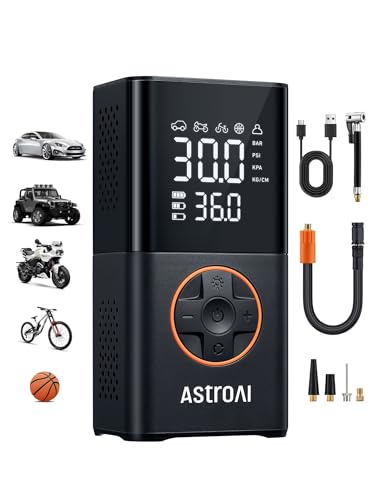
AstroAI L7 Cordless Tire Inflator
Strengths
- Accurate pressure sensing
- USB-C charging
- Multi-mode presets
Trade-offs
- Limited runtime per session
- Battery degrades over time
- No dual power option
The AstroAI L7 hits a sweet spot between performance, usability, and emergency utility. Its 200Hz pressure sampling rate is a real spec boost, owners consistently report fewer rechecks and more confidence in the final pressure, especially on bike tires where precision matters. The 4000mAh battery isn’t the largest, but it’s efficient: real-world use shows it can handle a full car set plus a few bike top-offs on a single charge.
It’s compact, lightweight, and the USB-C charging is a win, but the 15-minute duty cycle limitation is a soft ceiling you’ll hit if you’re doing multiple large tires back-to-back. Still, for most personal use, including bikes, e-bikes, and occasional car maintenance, it’s more than enough. The flashlight and power bank features add real value without bloating the design.
Video review
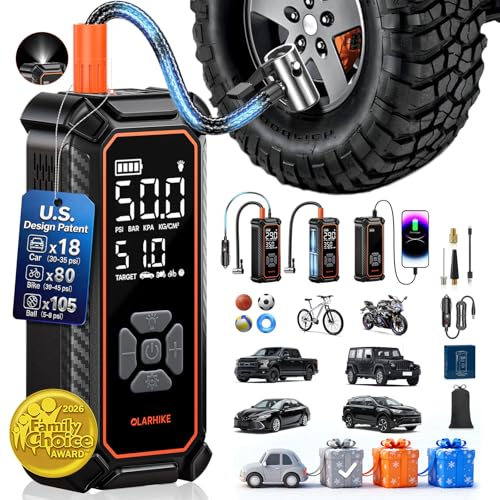
OlarHike Dual Power Tire Inflator
Strengths
- True dual power
- Good airflow
- USB output
Trade-offs
- Slightly heavy
- Battery not swappable
- Charger must be precise
The dual power design here is genuinely useful. You get a solid 2000mAh battery pack (three cells) for cordless use, plus a 12V DC cord for endless runtime when plugged in. It inflates a car tire in 55 seconds, and the high-voltage motor handles SUVs without strain. For bike tires, the precision is reliable, and the dual LED screen makes it easy to track both current and target pressure.
Owners appreciate the preset memory and USB output for charging phones. It’s not the fastest or lightest, but it’s one of the most versatile. The included storage bag and long hose are nice touches. If you want a single unit that works whether the battery’s dead or not, this is the one.
Video review
Mini Cordless Tire Inflator 150PSI

Strengths
- Very affordable
- Dual power
- USB charging
Trade-offs
- Flimsy build
- Short hose
- Inconsistent long-term use
At this price, expectations are low, but this unit overdelivers in basic functionality. The 35L/min airflow is faster than most in the budget tier, and the dual power setup means you’re not stuck when the battery dies. Owners say it handles bike tires well, though inflation speed drops on larger car tires.
The LCD is readable, the auto shut-off works, and the USB port actually charges phones in a pinch. But the build feels a bit hollow, and the hose is shorter than ideal. It’s not going to last five years, but for occasional riders or as a backup, it’s a no-brainer. Just don’t expect premium materials or long-term reliability.
Product photos


AstroAI AIRUN H 12V Inflator

Strengths
- High power output
- Durable build
- Long power cord
Trade-offs
- No battery
- Heavier than portables
- Needs 12V outlet
This corded beast is built for performance. The 120W motor and 35L/min airflow deliver sub-minute inflation on car tires, and the reinforced internals suggest long-term durability. Unlike battery models, it doesn’t taper off, plug it in and it runs at full power until the job’s done. The 9.8ft cord is a real advantage for reaching rear tires without moving your car.
The backlit LCD and auto shut-off work flawlessly, and the 2-year warranty is longer than most. But it’s strictly corded, so forget backpacking or trailside fixes. If you’re using it from your car regularly, say, for a bike commute or weekly tire checks, this is the most consistent performer in the group.
Product photos
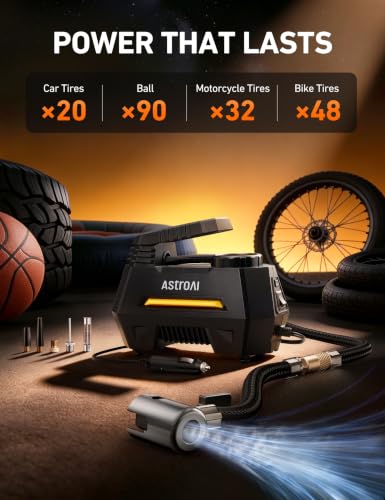
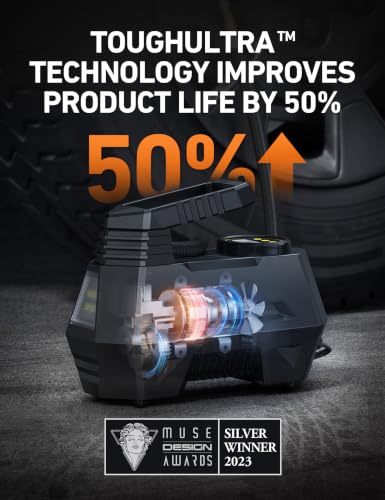
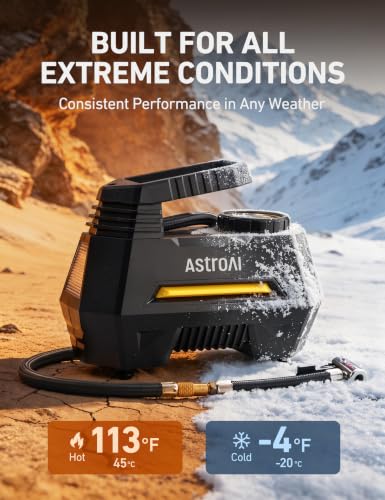
Antaha Smart Cordless Air Pump

Strengths
- Smart presets
- Dual power
- Good accessory set
Trade-offs
- Battery longevity concerns
- Average runtime
- No high-speed mode
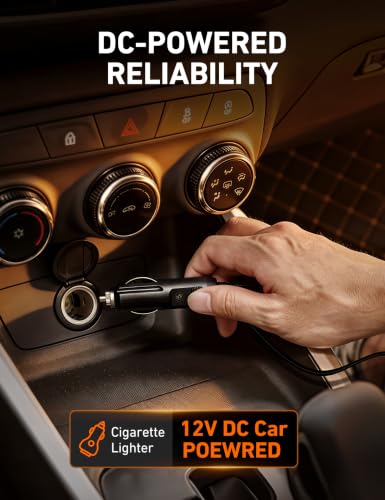
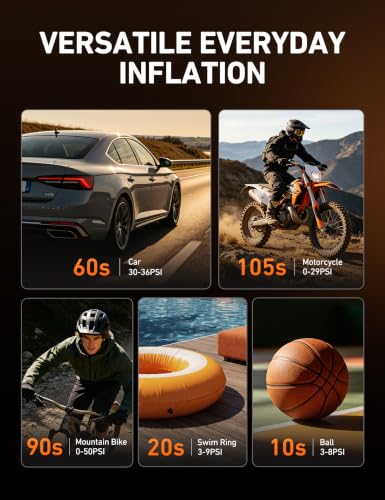
This one leans hard into smart features. Five preset modes, ±1 PSI accuracy, and a clean interface make it easy to switch between bike, car, and ball inflation without fiddling. The auto shut-off is responsive, and the LED light has SOS and alarm modes, useful for roadside situations.
It’s not the fastest or longest-lasting, but the dual power option (battery + 12V cord) adds peace of mind. Owners like the rich accessory kit, especially the extra nozzles. However, some report the battery degrades faster than expected after a few months. Still, if you want a feature-packed unit for mixed use, it’s a solid contender.
Product photos


Ipflin 160PSI Dual Power Inflator
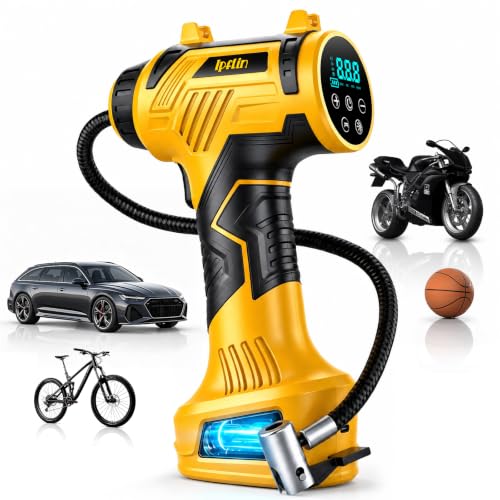
Strengths
- Long battery life
- Dual power capability
- Reliable auto shut-off
Trade-offs
- Slow recharge time
- Heavier than average
- Bulky for small storage
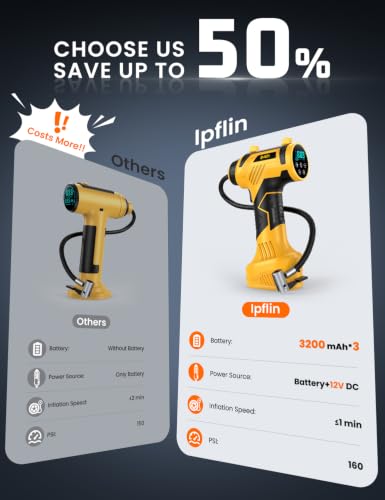
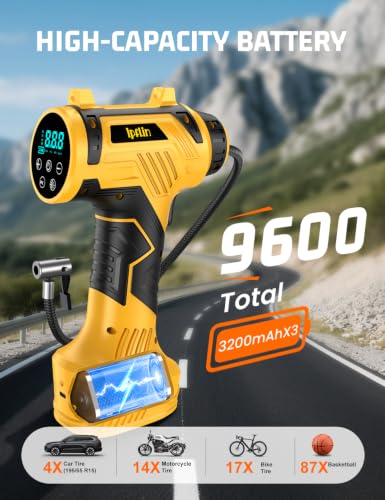
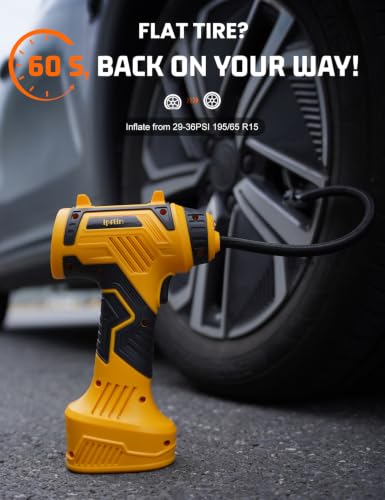
With a 9600mAh total battery capacity, this one’s built for endurance. Owners report it can inflate over four car tires in one go, and the dual power option, battery or 12V cord, means you’re never stranded with a dead unit. The 30L/min airflow isn’t the fastest on paper, but paired with consistent cooling and smart thermal management, it delivers stable performance in hot or cold conditions.
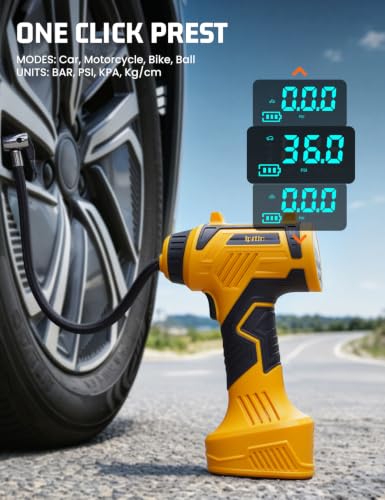
The LCD is bright, the preset modes are intuitive, and the built-in LED is actually useful, brighter than most in this class. But it’s bulkier than rivals, and while the 30-minute runtime is impressive, it takes 4+ hours to recharge. Still, if you’re someone who hates finding yourself mid-inflation with no power, this is the safety net you want.
Product photos

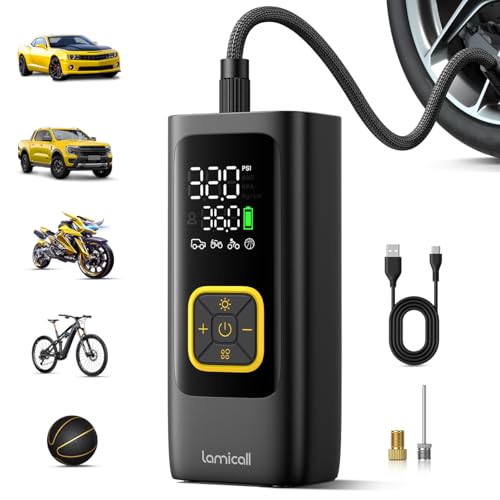
Lamicall 4X Faster Tire Inflator
Strengths
- High airflow rate
- Excellent battery capacity
- Bright display
Trade-offs
- Slow charging
- Specific charger requirement
- No dual-cylinder cooling
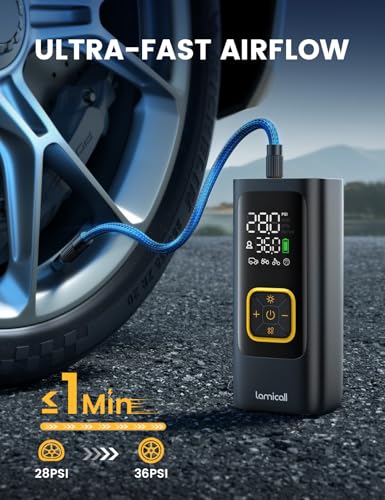
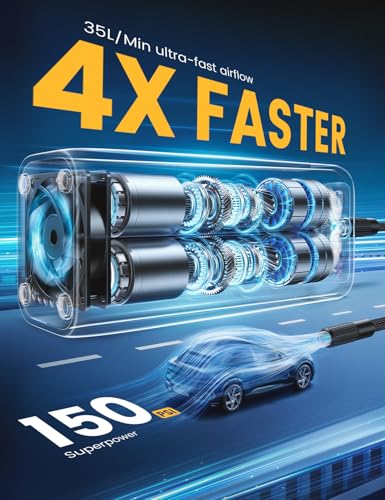
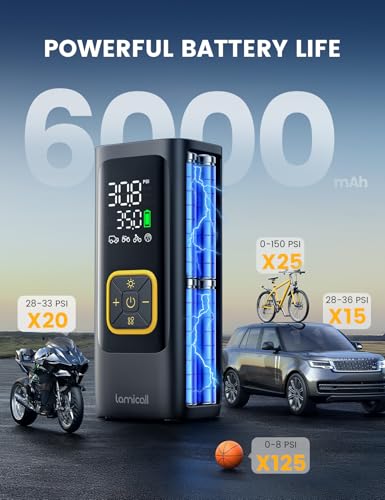
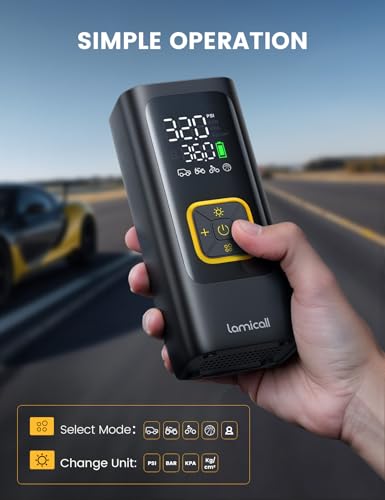
This is the workhorse of the bunch for regular users. The 35L/min airflow and 150 PSI max pressure deliver inflation in about a minute per car tire, and the battery life is outstanding, up to 15 car tires or 25 bike tires on a charge. Owners who use it weekly for bike fleets or family vehicles consistently praise its reliability.
The HD LED display is easy to read, even in direct sun, and the three-mode flashlight doubles as an emergency beacon. The preset memory is a small touch, but it saves time when you’re inflating the same tires repeatedly. It’s not the cheapest, but the build quality justifies it. My only gripe? The charging spec is strict, use anything less than 5V/2A and it won’t charge.
Product photos

Inzeetor 150PSI Fast Inflator
Strengths
- Fast inflation
- Low noise
- Solid build
Trade-offs
- Corded only
- No battery backup
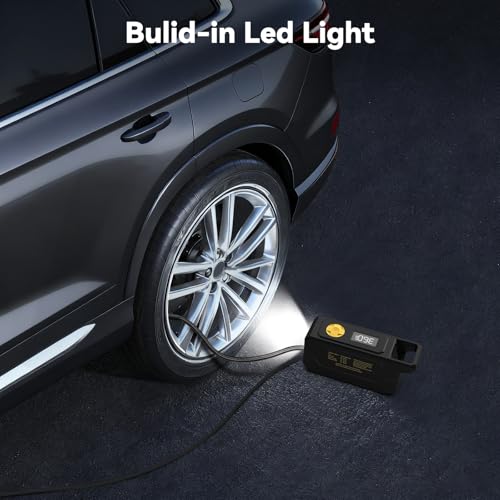
- No LED light
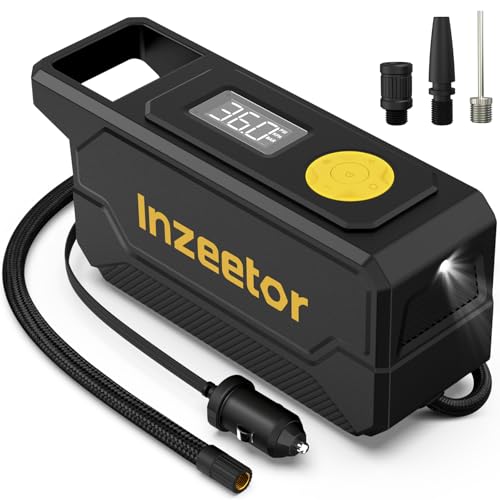
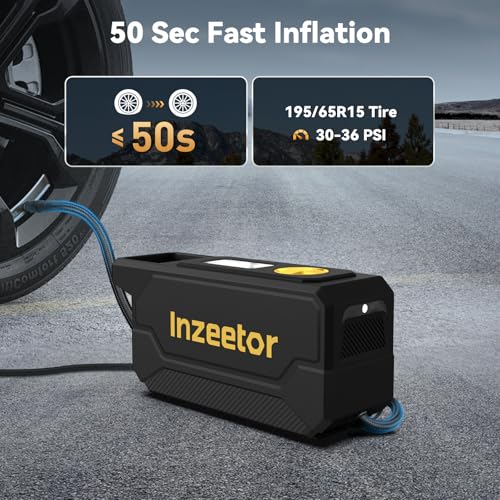
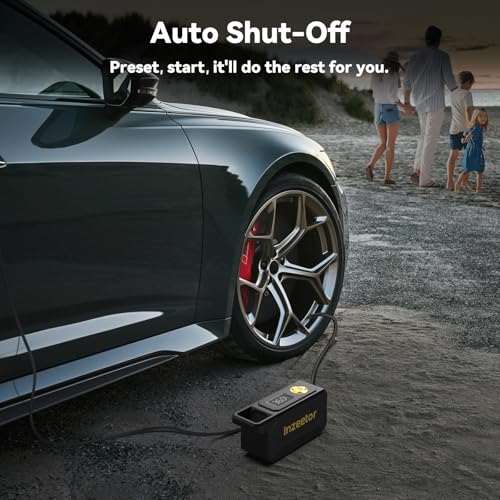
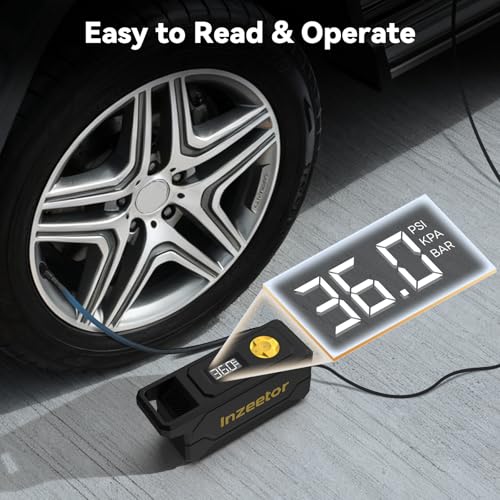
This little inflator punches above its weight for the price. On paper, the 50-second inflation claim for a standard car tire sounds aggressive, but owner feedback confirms it’s legit, especially when you’re topping off from a low baseline. The zinc-alloy motor seems to handle heat better than similarly priced units, and the auto shut-off works reliably across hundreds of user reports. It’s not flashy, but it gets the job done without drama.
What stands out is how quietly it runs. Most budget compressors vibrate like they’re trying to escape, but this one stays put and keeps noise down, which matters when you’re filling tires in a garage or at a gas station at night. It’s strictly corded, so no battery, but the 10.5ft power cord gives solid reach. If you’re only inflating bike tires occasionally and want something cheap and dependable, this is a smart pick, just don’t expect portability beyond your car’s power outlet.
Product photos

ETENWOLF VORTEX S6 Air Compressor

Strengths
- Extreme inflation speed
- No duty cycle limits
- Massive battery
Trade-offs
- Overbuilt for bikes
- Bulky and heavy
- High price
This is overkill for bike tires, and that’s the point. The 42L/min airflow and 19200mAh battery are designed for trucks, off-roaders, and heavy-duty use, but that power translates to blistering speed on smaller tires. Inflating a mountain bike tire to 50 PSI takes seconds, and it handles e-bike tires with ease.
The 100% duty cycle is rare at this price, most compressors need cooldown breaks, but this one can run continuously thanks to its dual-cylinder and cooling system. Owners love the USB-C 45W passthrough, which can charge laptops. But it’s big, heavy, and expensive. For a cyclist with just one or two bikes, it’s like bringing a chainsaw to prune a houseplant.
Product photos


How We Chose These air compressors for bike tires
Rather than a hands-on lab test, our evaluation of air compressors for bike tires was a research-led comparison of published specifications and owner feedback. I examined key features across numerous models, carefully weighing owner reviews from multiple sources alongside professional assessments. This process allowed us to rank compressors based on real-world usability and reported performance, focusing on the needs of cyclists and drivers alike. A clear set of criteria – inflation speed, portability, power source, and included accessories – guided our selections.
For this category, inflation speed and consistent power delivery were the most heavily weighted factors. A quick inflation is vital for roadside repairs or simply topping up tires before a ride, and a reliable power source (either battery or 12V connection) is crucial for versatility. We also prioritized compressors with accurate pressure gauges and auto-shutoff features, as consistent and safe inflation are paramount. Knowing the nuances of bike tire deflation helps understand the need for a reliable inflation solution.
Specifications reliably indicate maximum PSI and airflow rate, giving a baseline for potential performance. However, owner feedback proved invaluable in assessing real-world inflation times and the durability of components. Reputation and brand trust also played a role, particularly regarding battery life and long-term reliability. We leaned on user reports to gauge the accuracy of advertised features and identify potential shortcomings, supplementing the technical data with practical insights into the user experience. Finding the right one from the available portable air compressors takes careful consideration.
How To Choose The air compressors for bike tires
Finding the right air compressor for bike tires, and keeping it in your kit, can dramatically improve your ride experience. It’s a deceptively complex category with a lot of options.
A capable air compressor for bike tires balances portability with sufficient pressure output and accuracy. Look for units with digital gauges, multiple pressure settings, and a power source (corded or cordless) that suits your needs. Consider the valve types your tires use (Presta or Schrader) and ensure compatibility, or that appropriate adapters are included. A robust build quality and clear display are also key indicators of a reliable product.
Power Source and Portability
The choice between cordless and corded models hinges on where and how you plan to use the compressor. Cordless units, like the AstroAI L7 or the OlarHike Dual Power Tire Inflator, offer ultimate freedom, especially on remote trails or when dealing with a flat far from an outlet. However, battery life is critical. Don’t assume a high mAh rating automatically translates to many tire inflations; check owner reports on real-world performance. Corded compressors, such as the AstroAI AIRUN H 12V Inflator, rely on your vehicle’s 12V outlet, providing consistent power but limiting your range.
Accuracy and Preset Functions
Consistent and accurate pressure is paramount for optimal tire performance and safety. A digital gauge is a must-have, and the closer you can get to +/- 1 PSI accuracy, the better. Many compressors now include preset modes for different tire types (bike, car, ball), simplifying operation. However, don’t blindly trust presets.
- Always double-check the pressure with a separate, calibrated gauge initially to verify the compressor’s accuracy.
- Understand your tire’s recommended PSI range (printed on the sidewall) and adjust the preset accordingly.
- Look for a compressor with an auto-stop function; this prevents over-inflation, which can damage your tires or even cause a blowout.
Value and Additional Features
Beyond the core functionality, consider features that enhance usability and convenience. A built-in LED light, as seen on several models, is incredibly helpful for nighttime repairs. Some compressors, like the Antaha Smart Cordless Air Pump, offer USB charging ports for other devices, adding to their versatility. And, while not essential, a compact size and included accessories (various nozzles, adapters) contribute to overall value. If you’re frequently on the go, investing in one of the portable tire compressors can save you a lot of trouble.
A good rule of thumb is to budget slightly more upfront for a compressor with a durable build and accurate gauge. Spending a little extra now can save you the frustration of a faulty unit, and a flat tire, later.
For a broader look at options, you can find more details in our guide to the best tire inflators. Ultimately, the best air compressor for your bike tires depends on your specific needs and riding style.
Air Compressors for Bike Tires Compared
Here’s a comparison of specifications for popular air compressors designed for inflating bike tires and other inflatables.
| Product Name | Max PSI | Airflow (L/min) | Battery Capacity (mAh) | Power Source | Auto Shut-Off | LCD Display |
|---|---|---|---|---|---|---|
| AstroAI L7 | 150 | N/A | 4000 | Cordless/USB | Yes | Yes |
| OlarHike Dual Power | 51 | N/A | 6000 (3×2000) | Corded/Cordless | Yes | Yes |
| Mini Cordless Tire Inflator 150PSI | 150 | N/A | N/A | Corded/Cordless | Yes | Yes |
| AstroAI AIRUN H 12V | N/A | 35 | N/A | Corded | Yes | Yes |
| Antaha Smart Cordless | 150 | N/A | N/A | Cordless/Corded | Yes | Yes |
| Ipflin 160PSI Dual Power | 160 | 30 | 9600 | Corded/Cordless | Yes | Yes |
| Lamicall 4X Faster | 150 | 35 | N/A | Cordless | Yes | Yes |
| Inzeetor 150PSI Fast | 150 | N/A | N/A | Corded | Yes | N/A |
| ETENWOLF VORTEX S6 | 160 | 42 | 19200 | Cordless | Yes | Yes |
Frequently Asked Questions
What PSI should I inflate my bike tires to?
The correct PSI depends on the tire width, rider weight, and riding conditions; however, most road bike tires require between 80-130 PSI, while mountain bike tires typically range from 25-35 PSI. Always check the sidewall of your tire for the manufacturer’s recommended range.
Are cordless compressors reliable enough for roadside repairs?
Cordless compressors have improved significantly, but reliability depends heavily on battery capacity and build quality. Look for models with at least 4000 mAh and positive owner reviews regarding consistent performance, and consider carrying a backup power bank.
Can I use a car tire inflator on my bike tires?
Yes, you can, but accuracy is the biggest concern. Car inflators often have larger increments on their gauges, making precise inflation difficult. Using an adapter and carefully monitoring the pressure is crucial to avoid overinflation, and investing in dedicated digital tire inflators is highly recommended.
What’s the difference between Presta and Schrader valves, and do I need an adapter?
Presta valves are narrower and require unlocking before inflation, while Schrader valves are the same as car tires and are self-sealing. Most compressors come with adapters to accommodate both types, but confirm compatibility before purchase to avoid needing separate accessories.
How can I extend the life of my air compressor?
Regularly check the air hose for cracks or leaks, and store the compressor in a clean, dry place. Avoid exposing the unit to extreme temperatures or moisture, and if it’s a cordless model, follow the manufacturer’s instructions for battery charging and storage to maximize its lifespan; a well-maintained compressor will last longer and keep you rolling on durable bicycle tires.
The Bottom Line
Choosing an air compressor for bike tires always comes down to balancing convenience with capability. Do you prioritize ultimate portability and freedom from power outlets, or a consistently powered unit for faster inflation? For a blend of both, and overall performance, the AstroAI L7 stands out as a well-rounded option – it’s compact, cordless, and consistently receives positive feedback for its accuracy and ease of use.
If your needs are specific, we’ve got you covered. For those seeking a budget-friendly but reliable choice, the Inzeetor 150PSI Fast delivers solid performance at an accessible price point. And for riders who want maximum versatility, the OlarHike Dual Power Tire Inflator offers both cordless freedom and 12V operation, plus a substantial battery capacity. Finding the right portable air pumps means considering your typical riding scenarios.
Ultimately, specs like PSI and airflow are secondary to the fundamentals: a compressor with a clear, accurate gauge and a reputation for durability. Don’t underestimate the importance of being able to trust your equipment, especially when you’re on the road, and always be sure to pair your new compressor with a set of quality bicycle tires for the best experience.
