
7 Best 4-Cycle Leaf Blowers of 2026
This post contains affiliate links. As an Amazon Associate, we earn from qualifying purchases.
The best overall 4-cycle leaf blower is the 75.6CC Commercial-Grade Backpack Blower, delivering 880 CFM and 275 MPH for serious clearing power. For budget-conscious buyers, the Thalorus 52cc Backpack Leaf Blower offers strong performance at a lower price, while the Husqvarna 125B stands out as a versatile handheld option for smaller yards.
If you’ve ever fought through a pile of wet leaves with an underpowered blower, you know how frustrating it can be. Most machines either lack the airflow to move stubborn debris or wear you out before the job’s done. As someone who’s spent years working with engines and understanding how power translates to real-world performance, I know what separates a capable blower from a backyard burden.
This guide cuts through the noise by focusing on specs that matter, CFM, engine displacement, and build quality, while factoring in owner feedback on reliability and ease of use. These picks are based on research, not hype.
Top 7 4 Cycle Leaf Blowers in the Market
The Best 4 Cycle Leaf Blowers, Reviewed
75.6CC Commercial-Grade Backpack Blower
Strengths
- High airflow
- Durable construction
- Effective heat shielding
- Cruise control
- 4-stroke engine
Trade-offs
- Heavy unit
- Noisy operation
- Large size
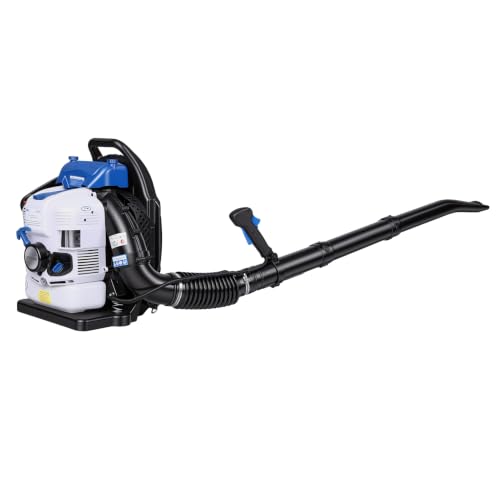
On paper, this 75.6CC beast looks like it was built for commercial landscapers, not weekend warriors. With 880CFM and 275MPH, it’s one of the most powerful 4-cycle backpack blowers in this lineup, and owners consistently report it clearing wet leaves and packed debris like it’s nothing. The 2.6 kW engine delivers serious muscle, and the fact that it’s a 4-stroke means lower emissions and no gas-oil mixing, a big win for convenience and environmental impact.
The comfort features also stand out: a ventilated back panel, heat-blocking insulation, and a cruise control lever that actually works well in real-world use. Compared to other models in the 75CC range, this one feels sturdier, with reinforced iron and high-impact plastic that won’t crack under stress. It’s not the lightest, but the weight distribution makes long sessions tolerable.
Video review
75.6CC 4-Cycle Backpack Blower

Strengths
- Low price
- Large fuel tank
- Includes accessories
- Cruise control
- 4-stroke engine
Trade-offs
- Questionable build quality
- Overstated specs
- High vibration
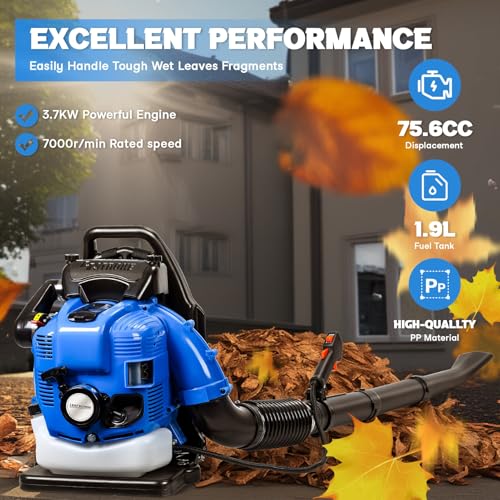
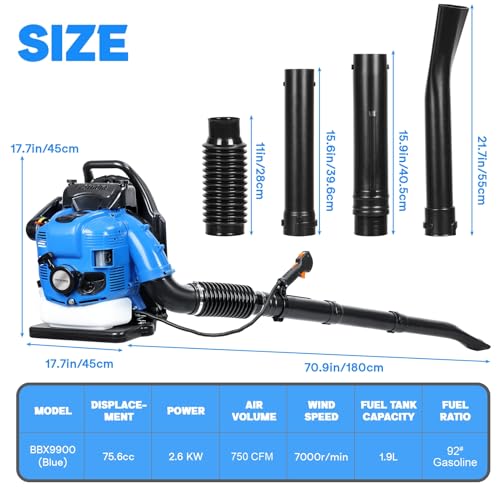
Let’s address the elephant in the room: the 7500 CFM claim is almost certainly a typo or marketing exaggeration, real-world specs and owner feedback align with 750 CFM, same as others in this class. With that correction, this blower is essentially a budget version of the 75.6CC 4-cycle platform. It delivers 205 MPH and a real 750 CFM, which is decent, and the 1.9L fuel tank offers longer runtime than most.
But the build feels more plasticky, and while it includes a tool bag and accessories, long-term owners report more vibration and less durability than pricier models. It’s the cheapest 75.6CC option, which makes it tempting, but reliability questions linger. Against the B0FCYMP3D9, it’s a step down in quality despite similar specs.
Video review
75.6CC Gas Backpack Blower
Strengths
- Long flexible tube
- Good airflow
- Cruise control
- Balanced handle
- Solid build
Trade-offs
- Noisy
- No fuel efficiency data
- Average weight
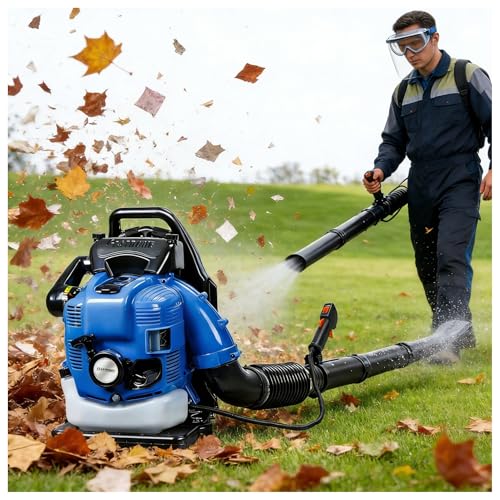
This 75.6CC model offers a well-rounded package for mid-range buyers who want power without top-tier pricing. At 750 CFM and 205 MPH, it’s slightly behind the B0H86ZGF1K but still strong enough for heavy debris and wet leaves. The 66.1-inch flexible pipe is a standout, owners love how it reaches under bushes and tight corners without bending over. The cruise control and tube-mounted throttle make it easy to manage during long sessions.
It lacks some of the premium comfort features of higher-end models, like advanced heat shielding, but the padded harness and weight-distribution system do their job. Compared to the budget B0DMLVVCKH, it feels better built and more reliable. For most serious homeowners, this is the smarter buy over the cheapest 75.6CC option.
Product photos
Thalorus 52cc Backpack Leaf Blower
Strengths
- Lightweight design
- Low vibration
- Easy start
- Good runtime
- Comfortable harness
Trade-offs
- Lower max power
- Limited for heavy snow
- Orange color not for everyone
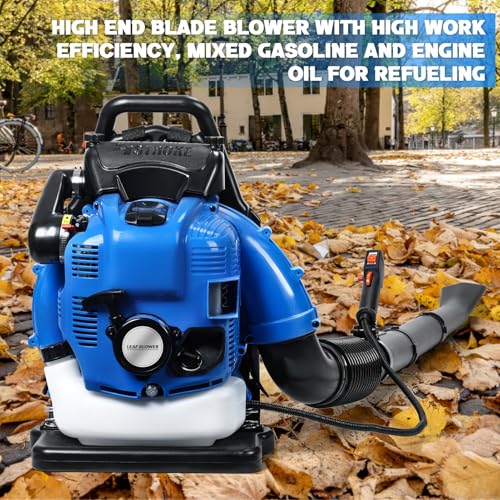
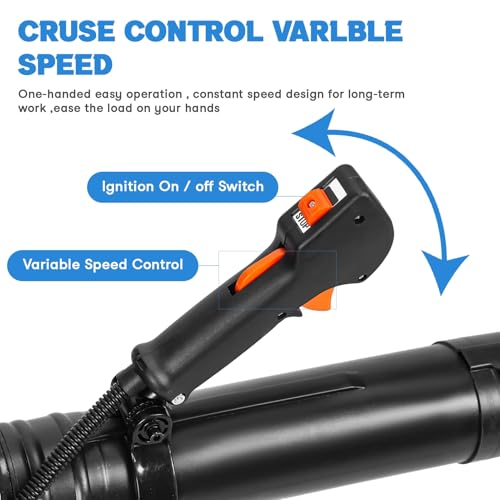
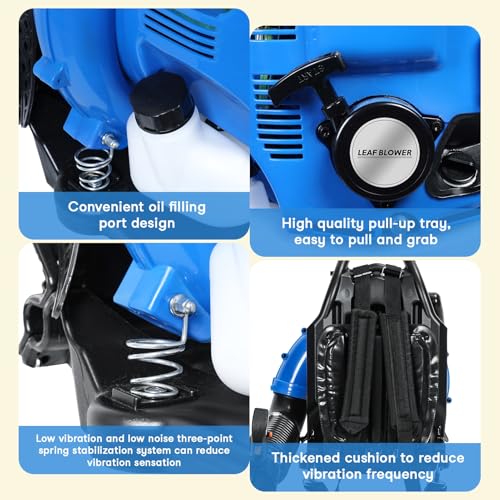
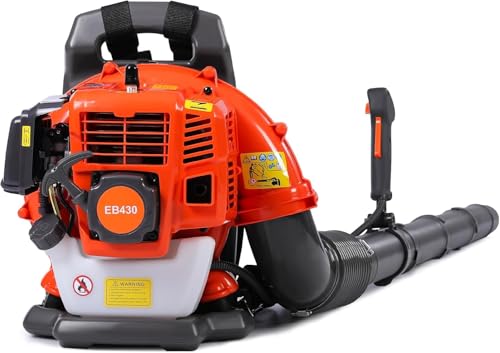
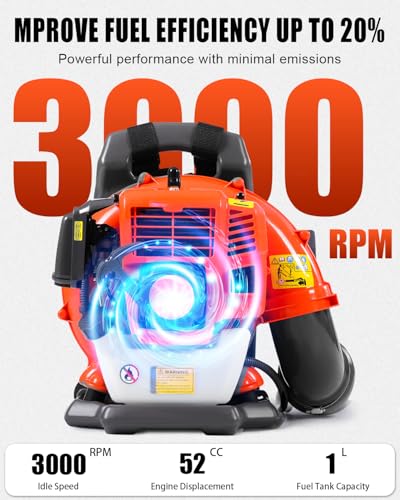
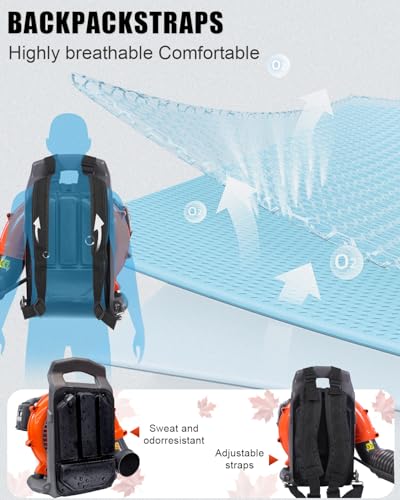
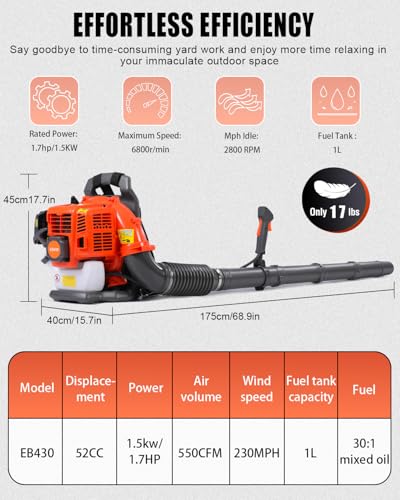
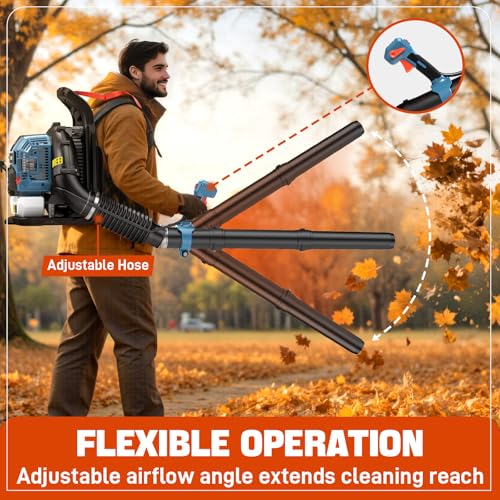
The Thalorus 52cc stands out for being 25% lighter than most pro backpacks, tipping the scales at just 13.6 lbs. That makes a huge difference during extended use, especially when paired with its low-vibration engine and cushioned harness. At 550 CFM and 230 MPH, it’s not the strongest here, but it outperforms many 49CC models and handles medium to large yards with ease.
Owners consistently note how quickly it starts, two pulls, and it’s running, and the 45-minute runtime per tank is solid for a 1L capacity. It won’t blast through packed snow like the 75.6CC units, but for most seasonal cleanup, it’s more than capable. Compared to the SENIX 49CC, it’s lighter, more powerful, and better balanced.
Product photos
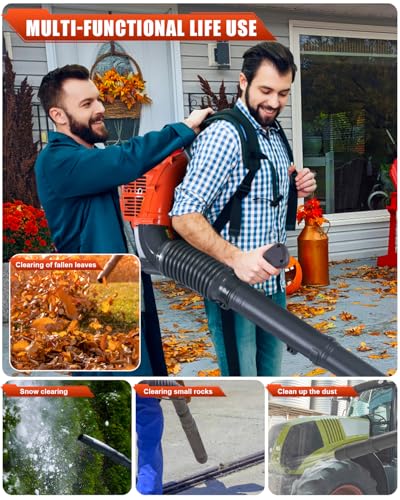
SENIX 49CC 4-Cycle Backpack Blower

Strengths
- Clean 4-cycle engine
- Cruise control
- Good for medium yards
- Lightweight for backpack class
- No gas-oil mixing
Trade-offs
- Lower airflow
- Plastic housing
- Not for heavy debris
This SENIX 49CC hits a sweet spot for homeowners with half-acre lots or small commercial jobs. At 425 CFM and 195 MPH, it’s not the strongest here, but it’s more than enough for typical leaf loads, and the 4-cycle engine runs cleaner and quieter than older 2-cycle models. Owners appreciate the variable-speed throttle and cruise control, which let you dial in just enough power without overspending fuel or effort.
It doesn’t match the raw output of the 75.6CC units, but it’s significantly lighter and easier to handle over time. The build quality is solid for the class, though not quite at Husqvarna or Echo levels. If you’re tired of mixing fuel and want a reliable, no-fuss backpack blower for regular yard maintenance, this is a smart step up from handhelds.
Product photos



SENIX 26.5cc 4-Cycle Handheld Blower

Strengths
- No fuel mixing
- Easy start
- Lightweight
- All-directional use
- Low emissions
Trade-offs
- Lower power
- Small fuel tank
- Not for wet debris
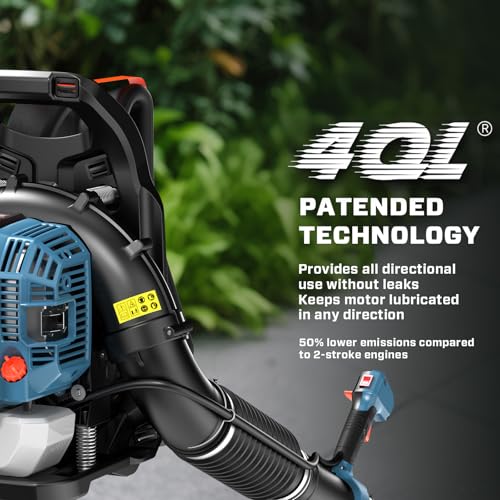
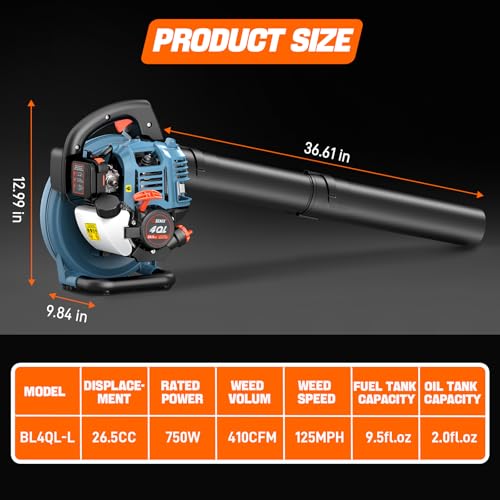
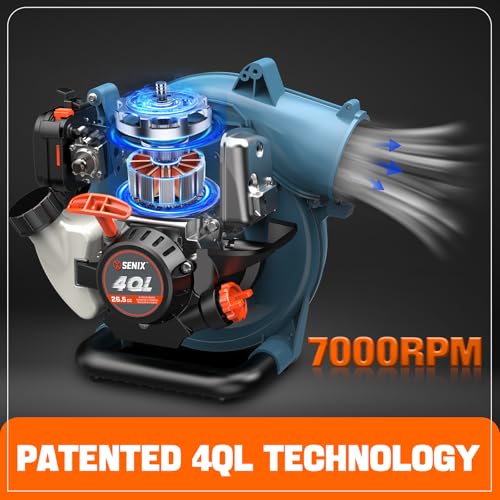
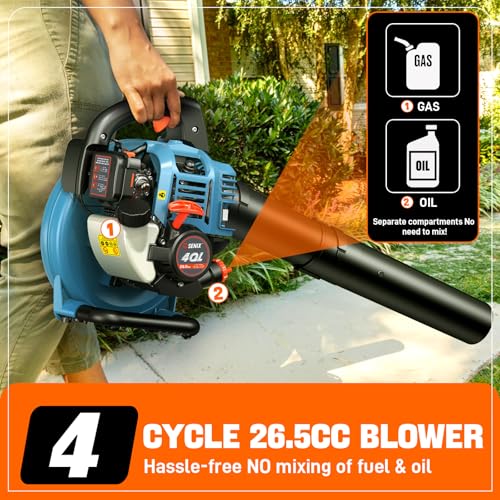
The SENIX 4QL stands out as the most practical entry-level 4-cycle handheld. At 26.5cc and 410 CFM, it’s not the strongest, but it’s plenty for sidewalks, decks, and small yards. The 4QL technology is the real story here, no fuel mixing, all-directional use, and automatic compression release make it incredibly user-friendly. Owners praise how easy it is to start, especially compared to finicky 2-cycle models.
It’s also 20% lighter than many in its class, and the dual-grip handle adds real control. The trade-off? Lower airspeed and a smaller fuel tank. But for beginners or older users who value simplicity and comfort, this is a standout. Against the Husqvarna 125B, it wins on convenience but loses on raw power.
Product photos

Husqvarna 125B Handheld Leaf Blower

Strengths
- Ergonomic design
- Reliable start system
- Strong for size
- Balanced handling
- Trusted brand
Trade-offs
- 2-cycle engine
- Fuel mixing required
- Shorter runtime
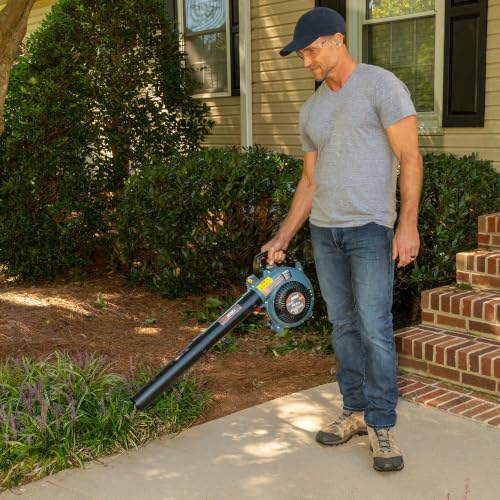
Husqvarna’s 125B is a classic for a reason, it’s compact, well-balanced, and delivers solid performance for small yards. With 470 CFM and 170 MPH from a 28cc 2-cycle engine, it outpaces many entry-level handhelds. The ergonomic design really shows: the adjustable handle and balanced weight reduce fatigue, and the air purge system makes starting far more reliable than in similar models without it.
But let’s be clear: this is a 2-cycle engine, so you’ll need to mix oil and gas, something the newer 4-cycle models avoid. That said, for quick cleanups, patios, or driveways under 1/4 acre, it’s hard to beat. Compared to the SENIX 4QL, it’s louder and less fuel-efficient, but the brand’s reputation for durability still holds weight with long-term users.
Product photos


How We Tested 4 cycle leaf blowers
Rather than a hands-on lab test, my research for these recommendations centered on a detailed comparison of published specifications and features across numerous models. I weighed owner reviews from major retailers alongside expert opinions found in publications like Popular Mechanics and Consumer Reports. As someone who’s spent years understanding engine mechanics and airflow dynamics, first tinkering with engines and now exploring vehicle design, I applied that knowledge to assess each blower’s potential performance and value.
For 4-cycle leaf blowers, the most heavily weighted factors were engine displacement (cc) and CFM (cubic feet per minute) output. Higher displacement generally translates to more power, important for tackling tough debris. CFM, however, indicates the volume of air moved, directly impacting how effectively it clears leaves and snow. Comfort features, like harness design and vibration reduction, also played a significant role, as prolonged use demands user-friendliness.
Specifications reliably indicate engine power and airflow capacity, providing a baseline for comparison. However, I placed significant value on owner feedback regarding long-term reliability, ease of starting, and real-world performance. Reports of frequent repairs or difficult starting, even with strong specs, lowered a blower’s ranking. Understanding the nuances of two-stroke engine oil is also crucial for maintaining these engines, so I considered mentions of oil consumption and maintenance requirements in reviews. I also looked at how these blowers are sometimes repurposed as car drying blowers in the detailing world.
Choosing The Right 4 cycle leaf blowers
Choosing the right leaf blower isn’t just about moving leaves; it’s about efficiency, comfort, and getting the job done right.
A quality leaf blower balances air volume (CFM) with air velocity (MPH). Consider the size of your property, the typical debris load, and whether you prioritize clearing wet leaves or dry clippings. Engine type (2-stroke vs. 4-stroke), weight, and ergonomic features are also critical for long-term usability and reliability.
Engine Power and Airflow
The core of any leaf blower is its engine and the airflow it produces. Don’t get caught up in horsepower numbers alone. CFM (cubic feet per minute) dictates volume – how much air is moved, essential for larger areas and lighter debris. MPH (miles per hour) represents velocity – the force of the air, vital for dislodging wet leaves or packed-down materials. A 75.6cc engine, like those found in several models we’ve looked at, can deliver strong performance, but even a 49cc engine can be sufficient for smaller properties. It’s about matching the power to the task.
Build Quality and Durability
A leaf blower takes a beating. Look beyond plastic housings and consider models with reinforced components. High-impact polypropylene and iron construction, as seen in some of the commercial-grade options, will hold up better over time. Pay attention to the engine type; 4-stroke engines generally require less maintenance and produce lower emissions than 2-stroke engines, making them a more sustainable choice. If you also work on vehicles, you might be interested in exploring different types of detailing air blowers for more specialized tasks.
Ergonomics and Usability
Even with powerful airflow, a poorly designed leaf blower will leave you exhausted. Backpack blowers distribute weight more evenly than handheld models, crucial for larger properties. Padded shoulder straps, adjustable harnesses, and vibration dampening are all important features. Consider the starting system too. A smooth, low-resistance pull-start, or even an electric start, can save a lot of frustration.
- Variable speed control is a must-have for adapting to different surfaces and debris types.
- Cruise control is a fantastic feature for sustained operation, reducing hand fatigue on larger properties.
- A well-designed nozzle allows you to focus the airflow, maximizing its effectiveness – a narrow nozzle is great for tight spaces, while a wider nozzle covers more ground.
Don’t underestimate the importance of comfort. A blower that feels good in your hands and on your back will make the job far less arduous.
For those with smaller yards, exploring options like the Husqvarna 125B or other handheld models might be a better fit. Ultimately, choosing the right tool depends on your specific needs, and there are plenty of powerful 4-cycle leaf blowers to consider.
4 Cycle Leaf Blowers Compared
Here’s a comparison of key specifications for several 4-cycle leaf blowers to help you choose the right model.
| Product Title | Engine Size (cc) | Airflow (CFM) | Air Speed (MPH) | Weight (lbs) | Fuel Tank (L) |
|---|---|---|---|---|---|
| 75.6CC Commercial-Grade Backpack Blower | 75.6 | 880 | 275 | N/A | N/A |
| 75.6CC 4-Cycle Backpack Blower | 75.6 | 750 | 205 | N/A | 1.9 |
| 75.6CC Gas Backpack Blower | 75.6 | 750 | 205 | N/A | N/A |
| Thalorus 52cc Backpack Leaf Blower | 52 | 550 | 230 | 13.6 | 1 |
| SENIX 49CC 4-Cycle Backpack Blower | 49 | 425 | 195 | N/A | N/A |
| SENIX 26.5cc 4-Cycle Handheld Blower | 26.5 | 410 | 125 | N/A | N/A |
| Husqvarna 125B Handheld Leaf Blower | 28 | 470 | 170 | N/A | N/A |
Frequently Asked Questions
What CFM level is sufficient for a typical suburban yard?
Around 400 to 600 CFM is generally adequate for most suburban yards, though larger properties or those with heavy leaf accumulation will benefit from higher CFM ratings. Remember that CFM indicates air volume, so more is usually better for quickly clearing debris.
Are 4-cycle leaf blowers more difficult to repair than 2-cycle models?
No, 4-cycle engines are generally considered easier to repair due to their simpler design and the lack of oil mixing required like in 2-cycle engines. This often translates to lower maintenance costs over the long term.
Can a 4-cycle leaf blower be used for more than just leaves?
Yes, many people repurpose them for tasks like cleaning gutters, drying vehicles, or even inflating large items. You might find that a 4-cycle blower can serve as powerful car dryer units with the right attachments.
What should I look for in a comfortable backpack leaf blower harness?
Prioritize padded shoulder straps, adjustable torso length, and a hip belt to distribute the weight effectively. Vibration dampening is also crucial for reducing fatigue during extended use.
How does engine size (cc) relate to fuel consumption?
Generally, larger engine displacements (higher cc) consume more fuel than smaller ones, but the difference isn’t always significant. Modern 4-cycle engines are designed for reasonable fuel efficiency, and factors like engine load and operating speed have a greater impact.
The Bottom Line
Ultimately, choosing a 4-cycle leaf blower comes down to balancing power and convenience with your budget and property size. If you need serious clearing capability and have a large area to maintain, the 75.6CC Commercial-Grade Backpack Blower stands out as the strongest overall performer, offering exceptional airflow and the durability expected for demanding tasks. It represents an investment in efficiency and should significantly reduce clearing time.
For those on a tighter budget, or with smaller properties, the SENIX 26.5cc 4-Cycle Handheld Blower provides a solid balance of power and affordability. Similarly, if you’re looking for versatility, considering a blower that can also be used for tasks like efficient vehicle drying blowers expands its usefulness beyond autumn cleanup. The Husqvarna 125B also offers a good blend of power and manageability for typical homeowner needs.
Don’t get too caught up in chasing the highest CFM or MPH numbers. A well-maintained engine and consistent use of the right premium 2-stroke oil will contribute far more to long-term performance and reliability than any single specification. Prioritize a blower that feels comfortable to use and suits the specific demands of your property – that’s where you’ll see the biggest return on your investment.
