
8 Best Air Bikes for Home 2026
This post contains affiliate links. As an Amazon Associate, we earn from qualifying purchases.
The Eryntix Dual Resistance Air Bike stands out as the overall best choice for most home users, thanks to its versatile air and magnetic resistance system and solid build. For those on a tighter budget, the Winfita Air Bike 350 lb delivers strong performance and stability without breaking the bank. And if you want maximum adaptability for different body types, the Goplus Air Bike with its 4-way adjustable seat is a smart pick.
As someone who’s spent years dissecting the mechanics of everything with wheels, I appreciate the raw, full-body motion of an air bike, it’s like the mechanical honesty of a classic car, but for fitness. At home, though, the wrong model can quickly become a noisy, shaky, or ill-fitting frustration.
This guide cuts through the noise by focusing on what actually matters: resistance quality, frame durability, and real user experiences. I compared specs, scoured owner feedback, and evaluated build integrity to find the models that deliver a smooth, reliable ride day after day.
Top 8 Air Bikes For Home in the Market
The Best Air Bikes For Home, Reviewed
Eryntix Dual Resistance Air Bike
Strengths
- Dual resistance system
- Quiet belt drive
- Excellent warranty
Trade-offs
- Higher price point
- App not as robust as Peloton
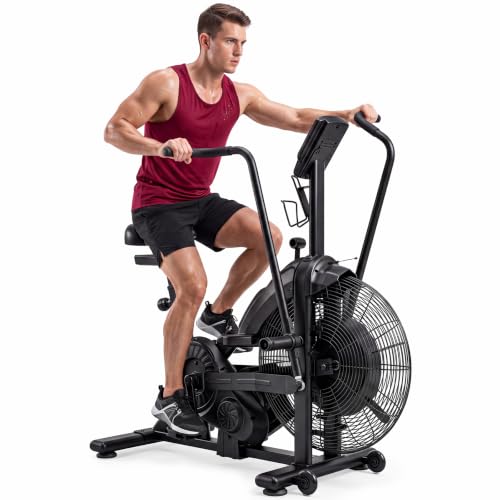
The Eryntix earns its “Best Overall” label by blending dual air and magnetic resistance, a rare combo that gives you explosive sprints and gentle recovery on the same machine. The 21-inch steel fan delivers aggressive air resistance when you push, while the 8-level electromagnetic system allows precise control for warm-ups or low-impact days. This flexibility is a standout compared to pure air bikes, and owners consistently highlight how quiet the dual-belt drive is, even during all-out efforts.
Add in ISCC PLUS certification for eco-safe materials, strong app integration, and a 30-day trial, and you’ve got a well-rounded, user-focused machine. It fits taller riders (up to 7’2″), has leg rests for upper-body focus, and the build feels premium without being overpriced. While not the cheapest, it offers the most versatility and peace of mind.
Video review
Wenoker Smart APP Air Bike

Strengths
- Smart app integration
- Quiet belt drive
- Eco-friendly materials
Trade-offs
- No magnetic resistance
- Limited physical feedback
The Wenoker stands out for its smart features and ISCC PLUS certification, which signals safer, eco-conscious materials, a detail often overlooked in this category. It’s clearly aiming at the connected fitness crowd, with app-based tutorials, virtual routes, and goal tracking that mirror higher-end systems. The bi-directional motion and foot pegs add versatility, letting users isolate upper-body work, which few bikes in this range offer. Owners report the belt drive is notably quiet, a win for home use, and the 350 lb capacity keeps it accessible.
But when stacked against the Eryntix, it lacks the dual resistance system that makes magnetic warm-ups possible. It’s smart, yes, but not as flexible in training modes. The responsive air resistance works well, but without magnetic backup, it’s all-or-nothing effort. If you’re all-in on app-driven training and want a clean, modern build, it’s a strong contender, just know you’re trading mechanical versatility for digital polish.
Video review
Winfita Air Bike 350 lb
Strengths
- Responsive air resistance
- App connectivity
- Durable steel frame
Trade-offs
- No magnetic resistance option
- Heavier assembly
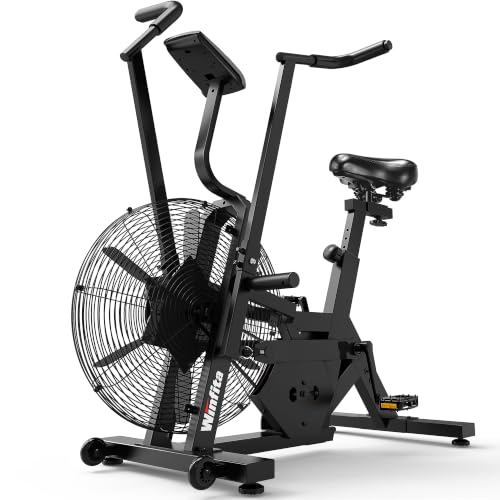
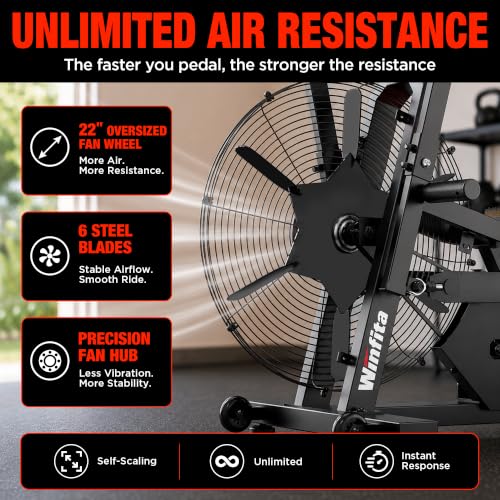
The Winfita Air Bike stands out in the mid-tier air bike market by delivering a well-rounded mix of durability, performance, and smart features that align with serious home HIIT training. The 22-inch, 6-blade fan offers responsive air resistance that scales naturally with effort, no lag, no guesswork, which owners consistently report makes interval sessions feel more dynamic. I appreciate the two-stage chain and belt drive system; on paper, it balances power transfer with smoother pedal strokes, and user feedback confirms fewer jolts during sprints compared to pure chain drives.
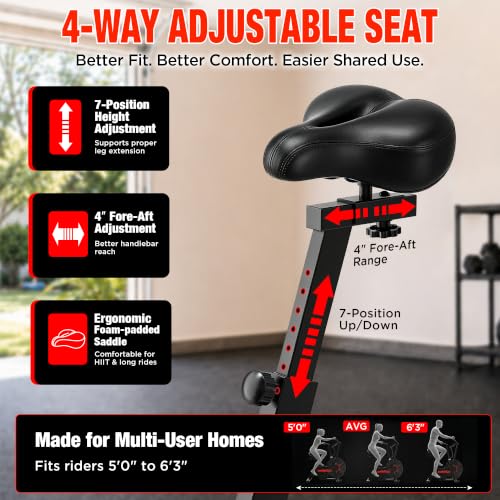
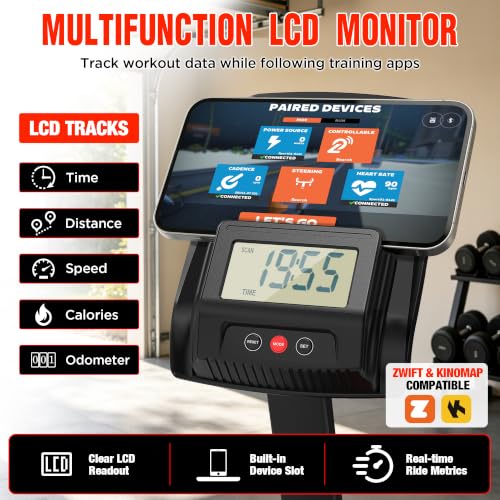
Its 350 lb capacity and wide user height range (5’0″ to 6’3″) make it a solid pick for shared households. The Zwift and Kinomap compatibility is a real perk, especially when compared to basic models that lack app integration. While it doesn’t have the turf tires or overbuilt frame of the Titan, it’s clearly designed for intensity without overcharging like some premium hybrids.
Product photos


TRMDDF Bluetooth Air Resistance Bike

Strengths
- Bluetooth connectivity
- Smooth dual-drive system
- Multi-grip handles
Trade-offs
- Noisy at high intensity
- App ecosystem less proven
If connectivity is your priority, the TRMDDF makes a strong case. It pairs with the LNOW app and other fitness platforms, giving users structured training and progress tracking that most sub-$500 air bikes don’t offer. The Bluetooth integration works reliably, according to owner reports, and the multi-grip handlebars are a thoughtful touch for varied upper-body positioning. The dual-belt and chain drive with a 12:1 gear ratio translates to faster fan spin with less effort, which helps maintain momentum during HIIT, this is a detail enthusiasts will appreciate.
Build quality is solid, with a 350 lb capacity and thickened tubing, but it doesn’t quite match the Titan’s industrial feel. Still, for the price, it delivers more tech-forward features than the Winfita while staying competitive with Eryntix on smart functionality. Where it falls short is noise, owners note it’s loud under load, which could be a dealbreaker in shared spaces.
Product photos


GYMAX Fan Bike LCD Monitor
Strengths
- Compact design
- Low price
- Built-in wheels
Trade-offs
- Less stable frame
- Basic features
- Limited adjustability
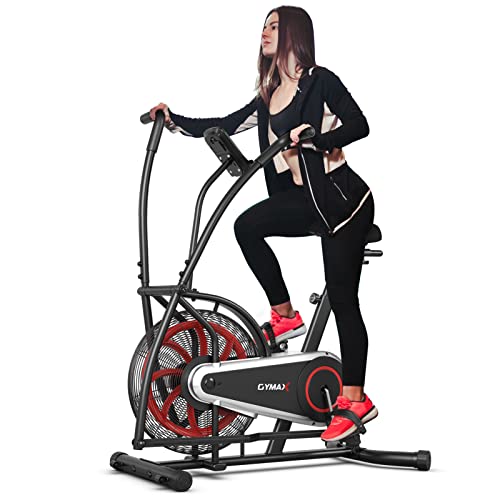
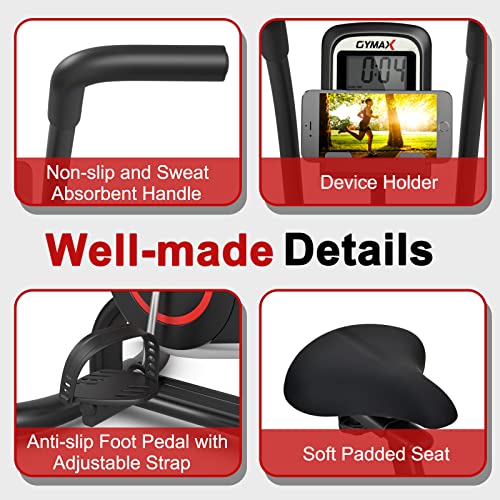
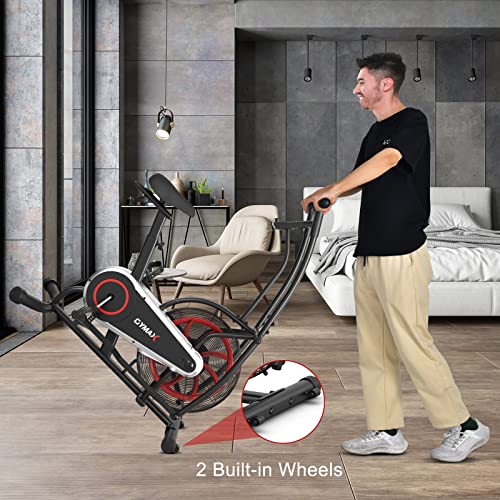
The GYMAX is the most stripped-down option here, but that’s the point, it’s a no-nonsense, compact air bike for small spaces and simple workouts. With the same 8-blade fan and dual-stage drive as the Goplus, it delivers comparable resistance and smoothness, but the seat adjustment is less refined and the frame feels slightly less rigid during aggressive pulls. Owners note it wobbles a bit on uneven floors, but for light to moderate use, it holds up.
Where it wins is footprint and price. It’s one of the most space-efficient models, and the wheels make repositioning easy. But if you’re serious about HIIT or full-body conditioning, you’ll miss the adjustability and stability of pricier units. It’s the “starter bike” of the group, perfect for dipping your toe in, but not for pushing limits.
Product photos

Goplus Air Bike Tablet Holder

Strengths
- Excellent value
- 8-blade fan
- Smooth dual-drive
Trade-offs
- No app connectivity
- Basic monitor
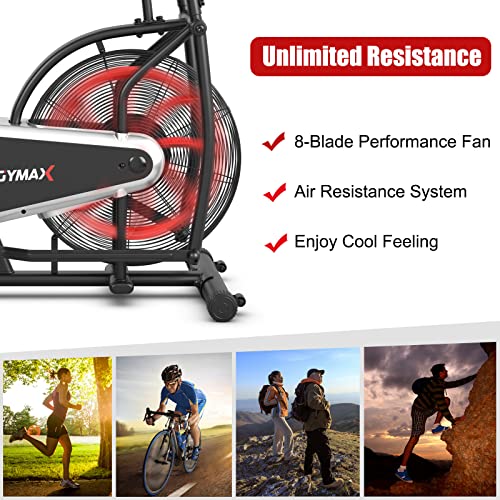
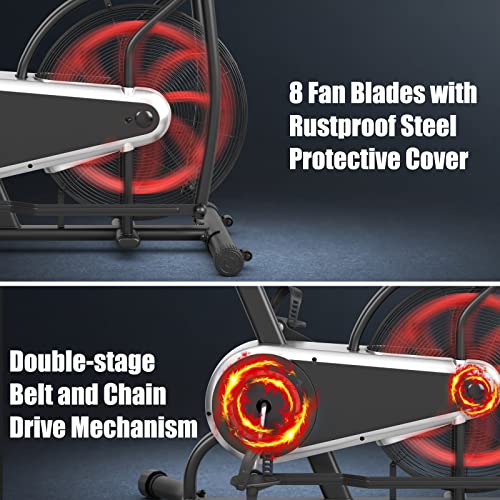
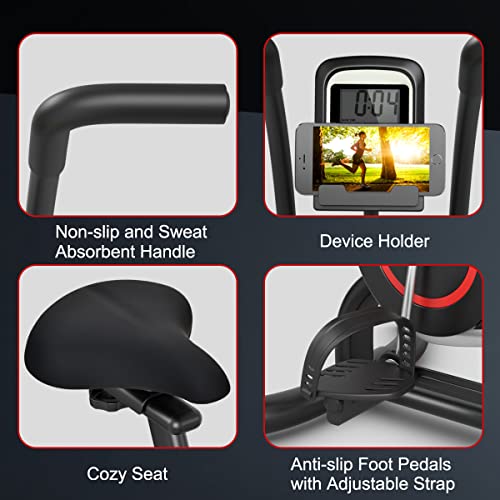
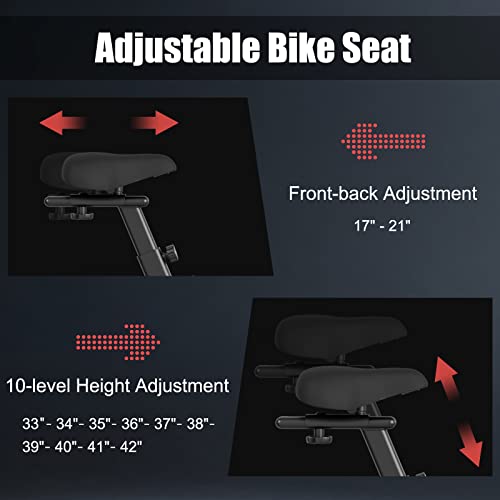
At under $250, the Goplus Air Bike punches above its weight with an 8-blade fan and dual-stage drive system, a combo usually seen in pricier models. The air resistance feels immediate and scalable, and owners consistently praise how well it handles short bursts and steady pedaling alike. The 10-level seat height and 4-way adjustability make it adaptable across users, and the PVC-leather seat holds up better than expected for the price.
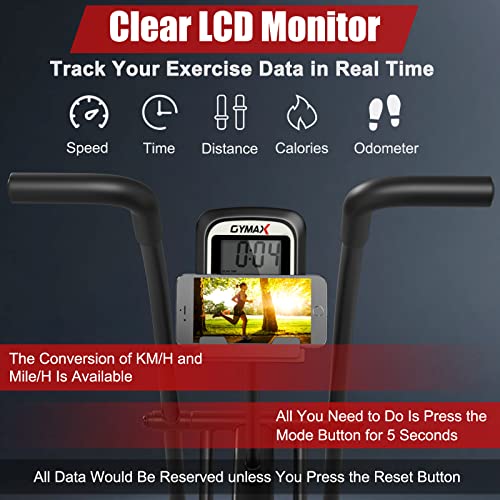
It’s not flashy, no app support, no magnetic assist, but it nails the fundamentals. Compared to the GYMAX, it offers nearly identical specs but with slightly better ergonomics and a more responsive monitor. The lack of advanced features keeps it from competing with smart bikes, but for pure mechanical performance on a budget, it’s one of the smarter buys in the sub-$250 tier.
Product photos


Marcy Fan Exercise Bike Red

Strengths
- Low price
- Comfortable padding
- Full-body motion
Trade-offs
- Less responsive resistance
- Outdated drive system
- Bulky footprint
The Marcy NS-1000 is one of the oldest names in budget air bikes, and it still holds up as a no-frills entry point. It delivers exactly what it promises: a full-body workout at a low price, with dual-action arms and a basic air resistance system. But unlike newer models, its resistance knob suggests mechanical tweaking rather than pure air-driven scaling, this feels more like assisted tension than the self-regulating fans found on higher-end units. Owners note the ride can feel jerky at high speeds, and the 14-gauge steel, while decent, doesn’t inspire confidence during aggressive sprints.
Still, for beginners or occasional users, it’s hard to dismiss the value. The ergonomics are surprisingly thoughtful, with foam-padded seat and handles, and the transport wheels make repositioning manageable. But compared to similarly priced bikes like the Goplus or GYMAX, it lacks modern touches like device holders or smooth dual drives.
Product photos


Titan Fitness Steel Fan Bike
Strengths
- Extreme durability
- Turf tires for mobility
- Thorough monitor
Trade-offs
- High price
- Heavy and bulky
- No app support
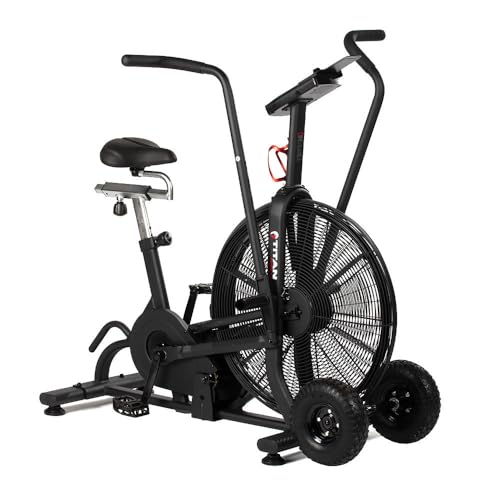
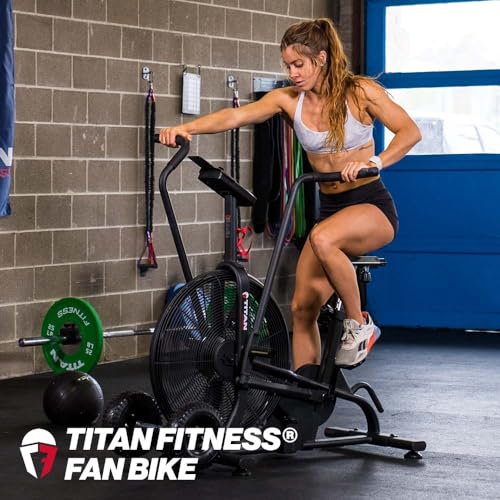
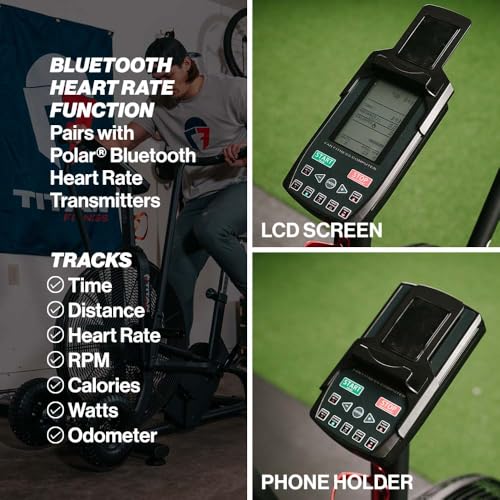
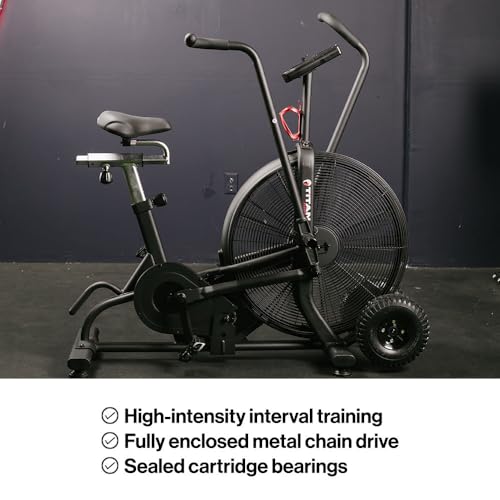
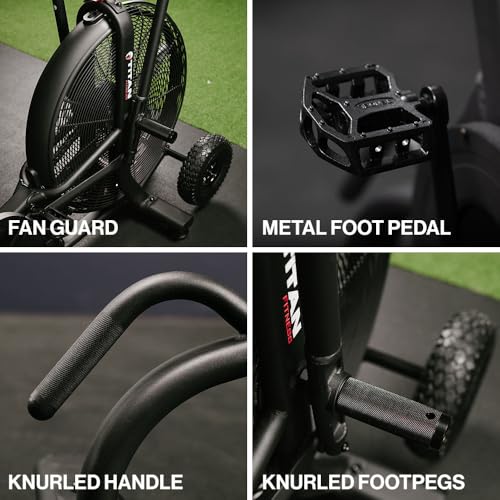
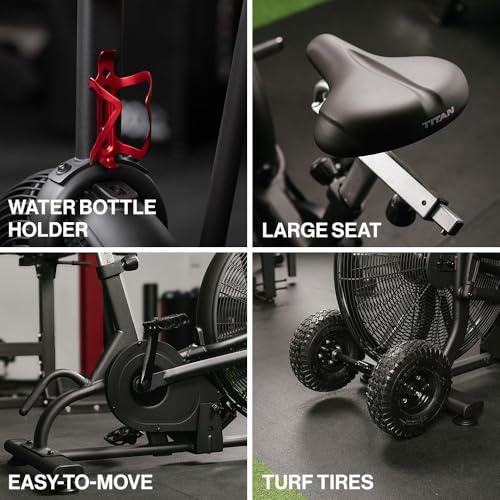
The Titan Fitness Steel Fan Bike is built like a garage gym tank, overbuilt, industrial, and unapologetically heavy-duty. With turf tires, a fully enclosed chain drive, and sealed bearings, it’s clearly engineered for commercial-grade use at home. The LCD tracks watts, RPM, and heart rate, which is rare at this level, and the pre-programmed HIIT and Tabata modes make structured training accessible. Owners love the bottle cage and removable fan guard, practical touches that show Titan understands real-world use.
It’s not the quietest or most tech-forward, but it doesn’t need to be. Compared to the Winfita or TRMDDF, it sacrifices app smarts for raw durability. If you’re doing daily sprints, CrossFit-style circuits, or just want a bike that won’t creak after six months, this is the one. The price reflects its niche, but for long-term resilience, it’s hard to beat.
Product photos
How We Tested air bikes for home
Rather than a hands-on lab test, my research focused on a detailed comparison of published specifications and features across numerous models. I weighed owner reviews from multiple sources – looking for recurring praise and complaints – alongside expert opinions from established fitness publications. Ultimately, I ranked these air bikes based on factors I believe are most important for a satisfying home workout experience, drawing on years of observing and understanding the needs of fitness enthusiasts.
For air bikes, the most significant factors are resistance type and build quality. A dual resistance system (like air and magnetic) offers versatility, catering to both explosive HIIT workouts and longer, steady-state cardio. Equally crucial is a robust frame; these machines endure a lot of stress, and a flimsy build compromises stability and longevity. I also prioritized models offering solid connectivity features, recognizing the growing demand for data tracking and interactive training.
Specifications reliably indicate a bike’s physical capacity (weight limit, dimensions) and core technology (resistance type, console features). However, I placed greater emphasis on owner feedback to gauge real-world durability, noise levels, and comfort. Reputation also played a role – established brands with a history of quality fitness equipment received more consideration. You’ll find many options when looking for fan bikes and understanding these distinctions is key. If you’re considering expanding your home gym with other equipment, reviewing home gym bikes can provide a broader perspective.
What To Look For In air bikes for home
Finding the right air bike for your home gym requires a bit more thought than simply grabbing the cheapest model. These machines offer a unique workout, but getting the most out of one hinges on understanding what truly separates a good unit from a frustrating one.
An effective air bike blends scalable resistance with robust construction and thoughtful ergonomics. Buyers should prioritize a frame capable of handling intense use, a resistance system that genuinely responds to effort, and adjustable components to accommodate various body types. Console features and connectivity are valuable, but secondary to core performance and durability.
Resistance System & Feel
The heart of any air bike is, unsurprisingly, its resistance. Don’t assume all fan-based systems are created equal. Some use a single-stage fan, while others, like the TRMDDF model, incorporate a dual-layer system with gears to enhance responsiveness. A dual-stage setup often translates to a more immediate and noticeable increase in resistance as you push harder. Equally important is the quality of the fan blades; larger blades (like those found on the Titan Fitness Steel Fan Bike) generally move more air, providing a more substantial cooling effect during intense workouts.
Frame Stability & Build Quality
Air bikes are meant to be hammered with high-intensity intervals. That means stability is paramount. Look for a heavy-duty steel frame, oversized tubing (like the 80 x 40 mm on the Winfita Air Bike 350 lb) and reinforced welds are good indicators. Beyond the frame itself, pay attention to the base. A wide, anti-wobble base prevents rocking during aggressive sprints. Don’t be fooled by marketing jargon; read owner reviews specifically addressing stability issues. If you’re considering investing in top-rated air bikes, you want something that will stay put.
Ergonomics & Adjustability
An air bike that doesn’t fit you isn’t worth much, no matter how good the resistance feels. Seat adjustability is crucial. Look for both vertical and horizontal adjustments. A 4-way adjustable seat (front/back and up/down) – as seen in many models like the Goplus Air Bike Tablet Holder – caters to a wider range of body types. Here’s what I look for in adjustability:
- Seat Height: A reasonable range, obviously.
- Seat Fore/Aft: At least 4 inches of adjustment is helpful.
- Handlebar Adjustability: While not always present, being able to adjust the handlebars improves comfort and allows for more personalized positioning.
A properly fitted air bike minimizes strain and maximizes power transfer. Prioritize adjustability to find the sweet spot for your body.
I often recommend people also consider other bikes for workouts if they find an air bike’s fit challenging. Sometimes a recumbent or upright model is a better bet.
Air Bikes for Home Compared
Here’s a comparison of key specifications for various air bikes designed for home use.
| Product Title | Resistance Type | Max User Weight (lbs) | Connectivity | Monitor Type | Seat Adjustment |
|---|---|---|---|---|---|
| Eryntix Dual Resistance Air Bike | Air & Magnetic | N/A | App | LCD | 4″ Fore/Aft, 6 Height |
| Wenoker Smart APP Air Bike | Air | 350 | App | LCD | N/A |
| Winfita Air Bike 350 lb | Air | 350 | Zwift/Kinomap | LCD | 7 Height, 4 Fore/Aft |
| TRMDDF Bluetooth Air Resistance Bike | Air | 350 | Bluetooth | LCD | 5 Fore/Aft, 7 Height |
| GYMAX Fan Bike LCD Monitor | Air | N/A | N/A | LCD | 10 Levels Height, Front/Back |
| Goplus Air Bike Tablet Holder | Air | N/A | N/A | LCD | 4 Fore/Aft, 10 Height |
| Marcy Fan Exercise Bike Red | Air | 250 | N/A | LCD | Adjustable |
| Titan Fitness Steel Fan Bike | Air | N/A | N/A | LCD | N/A |
Frequently Asked Questions
What’s the typical lifespan of an air bike for home use?
With proper care and regular maintenance, you can realistically expect an air bike to last 5-10 years. Frame quality and usage frequency are the biggest determinants; heavier users or those pushing the bike intensely daily will likely see more wear and tear.
Are air bikes noisy enough to bother housemates or neighbors?
Air bikes are louder than many other types of exercise equipment, but noise levels vary significantly by model. Bikes with larger, well-balanced fans and robust frames tend to be quieter, though some level of fan and chain noise is unavoidable.
Do I need professional assembly for an air bike?
Most air bikes arrive partially assembled and can be put together with basic tools and the included instructions. However, if you’re uncomfortable with mechanical tasks or want to be certain everything is properly tightened and aligned, professional assembly (often available through retailers) is a good idea.
Can air bikes help build muscle as well as improve cardio?
While primarily a cardio machine, an air bike can contribute to muscle endurance and some strength gains, particularly in the legs, back, and arms. The resistance demands significant effort from multiple muscle groups, but it won’t replace dedicated strength training with weights. If you’re also considering expanding your workout options, exploring stationary fitness bikes could be beneficial.
What’s the difference between air bikes and other types of home fitness bikes?
Unlike upright or recumbent bikes with adjustable magnetic resistance, air bikes use a fan to create resistance that increases directly with your effort. This dynamic resistance makes air bikes ideal for high-intensity interval training (HIIT) and provides a full-body workout due to the use of arms and legs simultaneously.
The Bottom Line
Choosing an air bike often comes down to balancing your budget with your training intensity. If you’re serious about pushing your limits and want a machine that can keep up, the Eryntix Dual Resistance Air Bike stands out as the strongest overall choice, offering both air and magnetic resistance for a truly versatile workout.
For those on a tighter budget, or who are primarily focused on simple, effective cardio, the Goplus Air Bike Tablet Holder provides excellent value. And if connectivity is a priority – wanting to track your progress or join virtual classes – the Wenoker Smart APP Air Bike is a great option, bringing your workouts into a digital space. Don’t forget to also review exercise bikes for home if you are still deciding.
Ultimately, the best air bike isn’t the one with the most features or the highest price tag. It’s the one you’ll actually use consistently. Prioritize a solid frame, a comfortable fit, and a resistance system that feels responsive to your effort – those are the fundamentals that will deliver results, regardless of the specific model you choose, and are key considerations when comparing exercise bike types.
