
7 Best Battery Tenders for Motorcycles 2026
This post contains affiliate links. As an Amazon Associate, we earn from qualifying purchases.
The NOCO GENIUS1 stands out as the best overall battery tender for motorcycles, thanks to its smart charging, lithium compatibility, and robust build. For a budget-friendly option, the Battery Tender Junior delivers reliable performance without breaking the bank. If you need versatility across multiple battery types and voltages, the NOCO GENIUS1 remains the top pick.
Every rider knows the frustration of a dead battery right when you’re ready to hit the road. With so many tenders on the market, it’s easy to get lost in specs and promises. I looked beyond the hype, focusing on what actually matters: compatibility, safety, and real-world reliability.
This guide breaks down the top choices based on battery type support, charging intelligence, and owner feedback. I compared features that protect your bike’s electrical system and extend battery life, so you can pick the right one for your ride, whether it’s a vintage cruiser or a modern sportbike.
Top 7 Battery Tenders For Motorcycles in the Market
The Best Battery Tenders For Motorcycles, Reviewed
Battery Tender Plus 12V 1.25A

Strengths
- 4-step smart charge
- 10-year warranty
- Quick disconnect
Trade-offs
- No lithium mode
- Only 12V
This is the gold standard for a reason, the Battery Tender Plus sets the benchmark most others are measured against. The 1.25A output strikes the ideal balance between speed and safety for motorcycle batteries, and the 4-step charging program is noticeably smarter than basic float chargers. Reviewers consistently praise its reliability over years of storage cycles, and the 10-year warranty speaks volumes about its build confidence.
It doesn’t support lithium out of the box, which feels like a miss in 2024, but for lead-acid, especially AGM and flooded types, it’s nearly flawless. The quick disconnect harness is a small luxury that makes routine maintenance effortless. Compared to the Unocho or MOTOPOWER models, it’s more refined, with better long-term monitoring and brand trust.
Video review
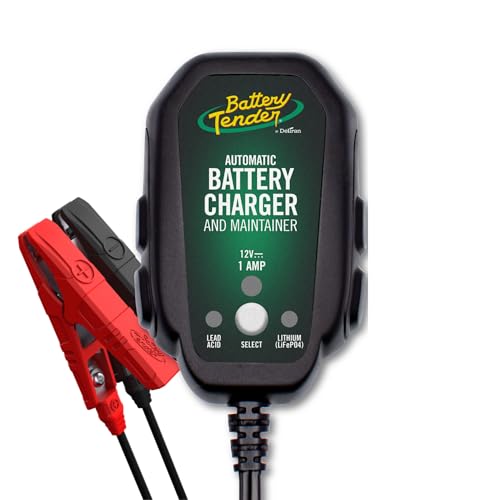
Battery Tender Junior 12V 800mA
Strengths
- Lithium compatible
- 5-year warranty
- Compact size
Trade-offs
- Slow charge rate
- No 6V support
The Junior is the little brother that still earns its stripes. With switchable lead-acid and lithium (LiFePO4) modes, it’s one of the few budget-smart chargers that plays well with modern lithium powersport batteries. The 800mA rate is slow, but that’s fine for seasonal storage, this is a true maintainer, not a charger for dead batteries.
It’s compact, safe, and the ETL certification adds peace of mind. While the NOCO GENIUS1 offers more recovery features and temperature compensation, the Junior wins on price and simplicity. Owners appreciate the 5-year warranty, which is unusually long at this tier. It’s not powerful enough for large batteries, but for a single motorcycle or scooter, it’s a solid, set-and-forget pick.
Video review
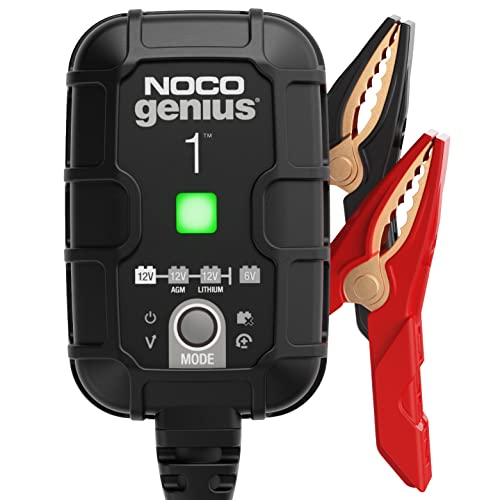
NOCO GENIUS1 1A 6/12V
Strengths
- Lithium compatible
- Thermal compensation
- Recovers dead batteries
Trade-offs
- Cable length could be longer
- No 2A+ fast charge
The NOCO GENIUS1 is the kind of charger you buy once and forget about, in the best way. It’s not just smart, it’s adaptive, with a thermal sensor that adjusts charging based on ambient temperature, which is huge if you’re parking in garages that freeze or bake. The ability to recover batteries as low as 1 volt, or even zero in Force Mode, makes it a lifesaver for winterized bikes or storage lapses. Plus, it handles both 6V and 12V systems, which is rare at this size.
Owners love how it just works, and the build quality feels premium despite the compact form. It’s 35% more powerful than the older G750, and the microprocessor-driven cycle keeps batteries in peak condition without risk of overcharge. Compared to the Battery Tender Junior, it’s more versatile, especially with lithium (LiFePO4) support baked in.
Product photos


Battery Tender 5A 12V Charger

Strengths
- 5A fast charge
- ISM adaptive logic
- Long cables
Trade-offs
- Too powerful for small bikes
- No 6V or lithium
When you need to charge fast, not just maintain, this 5A beast is the answer. Most motorcycle tenders crawl at 1-2A, but this one delivers full automotive-grade power, ideal for large-displacement bikes, touring rigs, or when you’ve drained the battery and need it back yesterday. The ISM adaptive charging ensures it doesn’t cook the battery once full, switching to float mode intelligently.
It’s overkill for small bikes, but for cruisers, baggers, or dual-sport bikes with big batteries, it’s a major upgrade. Compared to the 1.25A Plus model, it’s faster but less delicate, better for active use than long-term storage. The 11 feet of cable reach is a practical bonus in tight garages.
Product photos


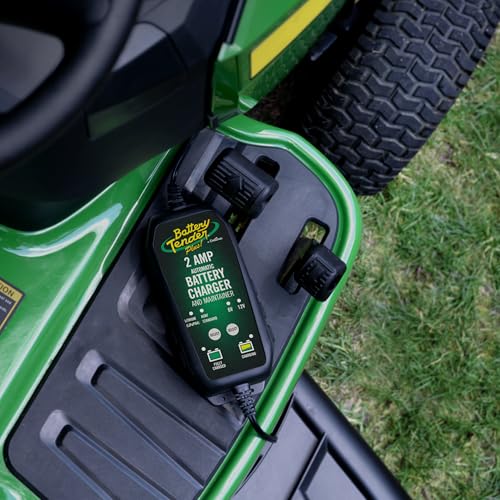
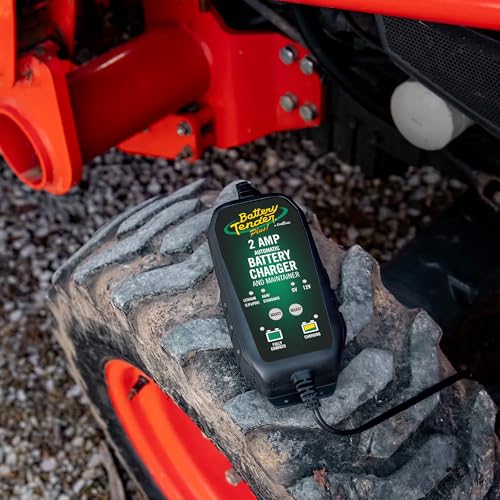
Battery Tender 6/12V 2A

Strengths
- 6V and 12V modes
- Lithium compatible
- 2A charging speed
Trade-offs
- No ultra-fast 5A mode
- Higher price
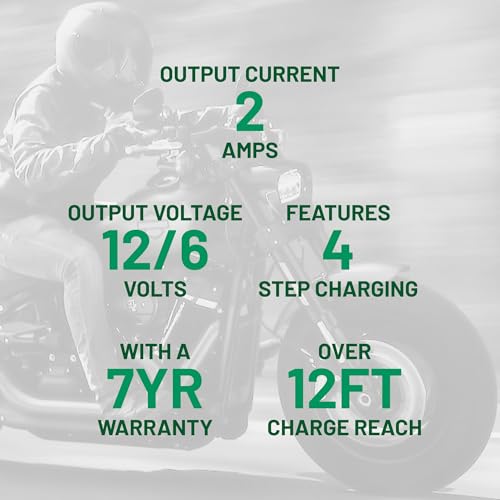
This is the do-it-all charger for the modern garage, 2A output, dual voltage, and lithium support, all in one rugged package. The ability to switch between 6V and 12V without buying separate units is a standout for enthusiasts with older bikes and newer ones. The 4-step program ensures deep, efficient charging, and the lithium compatibility means you’re covered whether you’re running AGM or LiFePO4.
Compared to the standard Battery Tender Plus, this model adds critical flexibility. Reviewers note it handles both quick top-ups and long storage with equal ease. The 7-year warranty is another nod to its durability. It’s not the fastest on the market, but for a powersport-focused charger, it’s one of the most complete.
Product photos

MOTOPOWER MP00205A 12V 800mA
Strengths
- Compact design
- Desulfation mode
- Spark proof
Trade-offs
- No lithium support
- Basic LED indicators
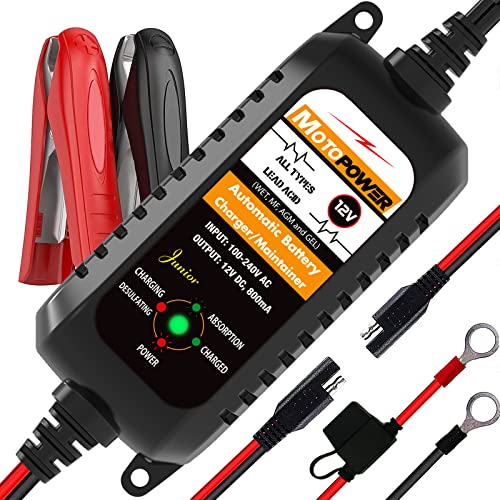
This little charger punches above its weight for the price, especially if you’re dealing with older or neglected batteries. The 800mA output is modest, but the inclusion of automatic desulfation is a standout feature at this price point. Owners consistently report it bringing back batteries they thought were dead, thanks to the pulse current tech that breaks down sulfate crystals. On paper, it’s a basic but smart maintainer, and reviewers note it handles seasonal storage well for motorcycles and small vehicles.
It’s not flashy, but it’s reliable for what it is, a no-nonsense, weather-resistant charger that defaults to safety with spark-free connections and solid protection against reverse polarity and overcharging. While it lacks the refined smart logic of pricier models, the 24-hour timer that shifts into maintenance mode is a thoughtful touch.
Product photos


Unocho 6V/12V 1.5A Charger
Strengths
- 6V and 12V support
- 5-stage charging
- SAE quick disconnect
Trade-offs
- Build quality average
- No lithium charging
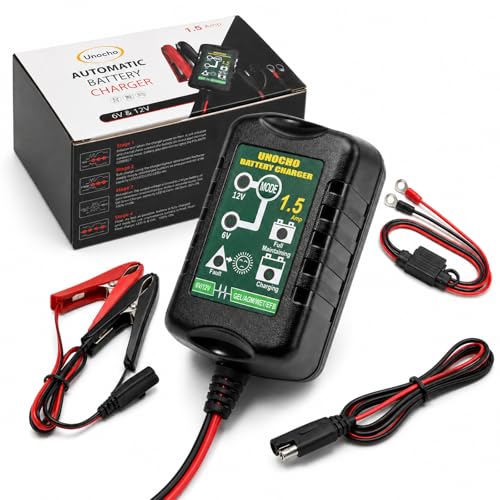
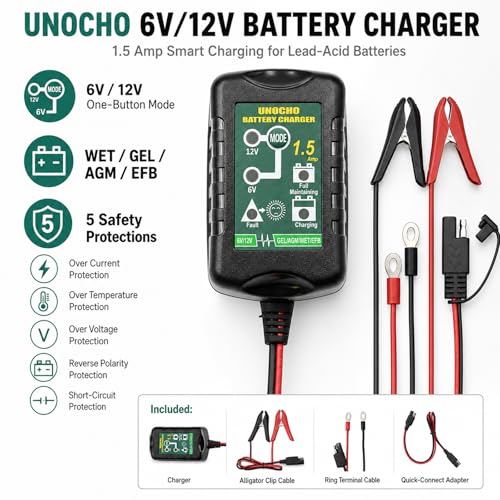
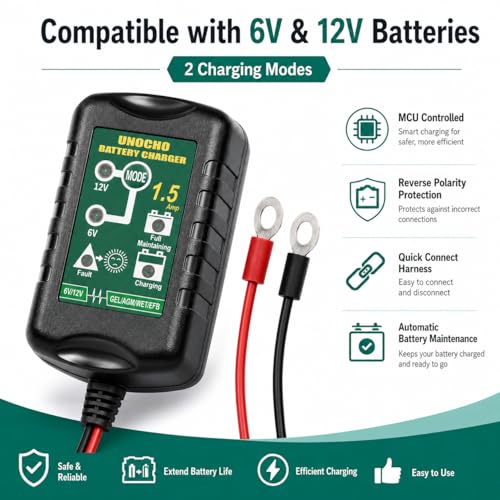
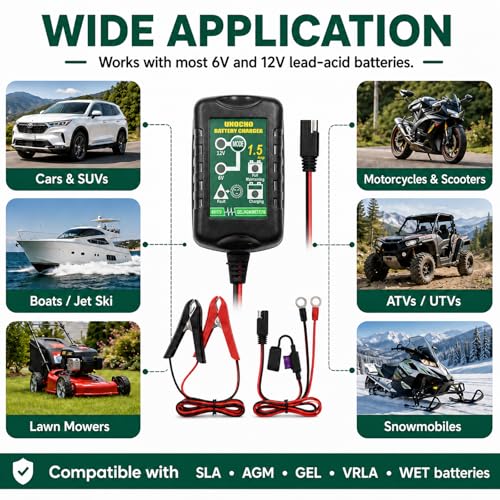
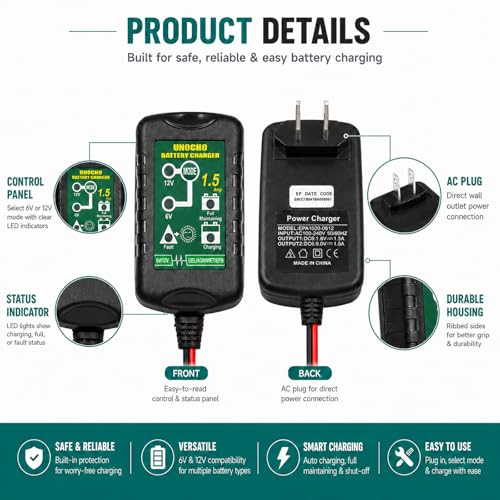
If you’re maintaining a garage full of mixed-voltage gear, a 6V vintage bike, a 12V ATV, a lawn tractor, the Unocho 1.5A is a stealth bargain. The 5-stage charging process is more advanced than most in this price range, and the microprocessor logic handles transitions smoothly. At just under 20 bucks, it’s hard to beat for flexibility, especially with SAE quick disconnects and dual connector options included.
It’s not as polished as NOCO or Battery Tender, and the build feels a bit plasticky, but owners report solid performance over time. Compared to the MOTOPOWER, it offers better stage control and wider voltage support, though it lacks desulfation. The 72-hour safety timer is a nice safeguard, and the LED indicators are clear enough for basic monitoring.
Product photos

How We Picked These battery tenders for motorcycles
My approach to evaluating battery tenders for motorcycles wasn’t about long-term use with each unit; rather, it was a research-led comparison of published specifications, feature sets, and a careful weighing of owner and expert reviews. I focused on identifying consistent strengths and weaknesses reported across multiple sources. This allowed me to rank these devices based on their suitability for different rider needs and budgets, offering a guide that goes beyond simple marketing claims.
For motorcycle applications, I prioritized charging speed, battery type compatibility (especially lithium-ion), and built-in safety features. A tender’s ability to quickly restore a depleted battery is crucial for spontaneous rides, while support for modern lithium batteries is increasingly important. Equally vital are protections against overcharging, reverse polarity, and short circuits – features that safeguard both the battery and the motorcycle’s electrical system. You’ll find a detailed look at various chargers for motorcycle batteries.
Specifications reliably reveal a tender’s maximum amperage and supported battery voltages. However, real-world performance and long-term durability are best assessed through owner feedback. I paid close attention to comments regarding ease of use, the accuracy of charge status indicators, and any reported failures. Reputable expert reviews provided valuable context, helping to separate genuine innovations from marketing hype, and also highlight the best ATV battery tenders options available.
What To Look For In battery tenders for motorcycles
Choosing the right battery tender for your motorcycle isn’t just about keeping it running; it’s about protecting your investment and ensuring reliable performance when you’re ready to ride.
A good battery tender delivers a consistent, controlled charge, preventing overcharging and sulfation. Key features include compatibility with your battery type (lead-acid, lithium-ion), automatic voltage selection, and safety protections like reverse polarity and short-circuit protection. Look for models with multiple charging stages for optimal battery health and consider amperage output based on your battery’s capacity.
Understanding Amperage & Battery Size
The amperage rating of a battery tender is often the first spec people look at, but it’s easily misunderstood. A higher amperage doesn’t always mean “better.” In fact, a tender with too much amperage can actually damage your battery. Generally, you want an amperage rating around 10-20% of your battery’s amp-hour (Ah) rating. For most motorcycle batteries (typically 12Ah), a 1.25A to 2A tender is plenty. Larger batteries, like those found in some cruisers or touring bikes, might benefit from a 5A model, but even then, the smarter tenders will automatically adjust the charge rate. Don’t assume more power is always the right answer; it’s about matching the tender to the battery’s needs.
Battery Type Compatibility
This is a big one. Older, traditional battery tenders were designed solely for lead-acid batteries (flooded, AGM, gel). Modern motorcycles increasingly use lithium-ion (specifically LiFePO4) batteries, which require a different charging profile. Using a lead-acid tender on a lithium-ion battery can cause significant damage, and vice-versa. Before you purchase, always confirm the tender explicitly supports your battery type. If you’re unsure what type of battery your bike uses, consult your owner’s manual or a qualified mechanic. Many newer tenders, like the NOCO GENIUS1, offer both lead-acid and lithium-ion modes, adding valuable versatility.
- A tender compatible with multiple battery types offers the most future-proofing.
- Lithium-ion batteries are becoming increasingly common, so prioritizing compatibility is wise, even if your current bike has a lead-acid battery.
- Incorrect charging profiles can void your battery warranty and even pose a safety hazard.
Features and Practicality
Beyond the core charging function, consider the features that will make your life easier. Quick-disconnect connectors are a huge convenience, allowing you to easily attach and detach the tender without repeatedly working with the battery terminals. A built-in thermal sensor, as found in the NOCO GENIUS1, is also a nice touch, especially if you live in an area with extreme temperatures. It’s also worth considering the length of the charging cables. You don’t want a tender with cables that are too short to comfortably reach your battery. If you’re looking for options tailored to a specific bike, explore resources like our guide to Harley-Davidson battery tenders for models designed to work perfectly with those machines. Ultimately, finding a balance between features, ease of use, and price is key. You can find excellent motorcycle battery tenders that offer great value without breaking the bank.
A little preventative maintenance goes a long way. Always connect the tender in a well-ventilated area, and never attempt to charge a damaged battery.
Battery Tenders for Motorcycles Compared
Here’s a comparison of key specifications for motorcycle battery tenders to help you choose the right one.
| Product Name | Voltage (V) | Output Current (A) | Battery Types Supported | Smart Charging | Desulfation | Warranty (Years) |
|---|---|---|---|---|---|---|
| Battery Tender Plus | 12 | 1.25 | Lead-Acid | Yes | No | 10 |
| Battery Tender Junior | 12 | 0.8 | Lead-Acid, Lithium | Yes | No | 5 |
| NOCO GENIUS1 | 6/12 | 1 | Lead-Acid, Lithium | Yes | Yes | 3 |
| Battery Tender 5A | 12 | 5 | Lead-Acid | Yes | No | 5 |
| Battery Tender 6/12V 2A | 6/12 | 2 | Lead-Acid | Yes | No | 7 |
| MOTOPOWER MP00205A | 12 | 0.8 | Lead-Acid | No | Yes | N/A |
| Unocho 6V/12V 1.5A | 6/12 | 1.5 | Lead-Acid | Yes | No | N/A |
Frequently Asked Questions
Will a battery tender damage my motorcycle’s battery if left connected for extended periods?
No, a quality battery tender is designed to prevent overcharging. Smart tenders automatically switch to a maintenance mode once the battery is fully charged, providing a trickle charge to offset natural discharge without harming the cells.
Can I use a car battery tender on my motorcycle battery?
Generally, no. While some tenders offer multiple voltage settings, motorcycle batteries often have different charging requirements than car batteries. Using an incompatible car battery tenders could shorten the battery’s lifespan or, in the case of lithium-ion batteries, even cause a fire.
Is a higher amperage battery tender always better?
Not necessarily. A higher amperage tender isn’t always ideal; it’s best to match the amperage to the battery’s Ah rating (around 10-20%). Too much amperage can overheat or damage the battery, while too little may not provide a sufficient charge.
What’s the difference between a battery tender and a battery charger?
A battery charger delivers a high current to quickly restore a deeply discharged battery, while a battery tender provides a low, consistent current to maintain a fully charged battery. For long-term storage, a tender is the better choice, whereas a charger is for bringing a dead battery back to life, and you might also want to explore motorcycle battery charger options.
How do I know if my battery tender is working correctly?
Most tenders have LED indicators that show the charging status (charging, fully charged, or fault). A properly functioning tender should show a change in status as the battery charges, and the battery should retain a consistent voltage when disconnected from the charger.
The Bottom Line
Choosing a battery tender often comes down to how much control you want versus how little fuss you’re willing to tolerate. While some tenders offer extensive customization, the NOCO GENIUS1 strikes a superb balance – it’s smart enough to handle both lead-acid and lithium-ion batteries, and reliable enough to be our overall recommendation. It’s a tender that thoughtfully addresses the needs of most riders without unnecessary complication.
For those on a tighter budget, the Battery Tender Junior provides excellent value, supporting both lead-acid and lithium batteries, though it lacks the desulfation feature of some pricier options. If you frequently ride a classic motorcycle with a lead-acid battery and need a higher amperage for quicker recovery, the Battery Tender 5A is a solid choice. And if you’re also looking to protect your fuel system during storage, consider pairing your tender with one of the top-rated fuel stabilizers to keep your bike running smoothly.
Ultimately, the best battery tender isn’t about the highest amperage or the most features. It’s about consistently maintaining the correct voltage and current for your battery type, and using a quality motorcycle trickle charger is a small investment that can save you significant headaches and expense down the road. Prioritize compatibility and safety above all else – a healthy battery is the foundation of any enjoyable ride.
