
9 Best Bike Speedos in 2026
This post contains affiliate links. As an Amazon Associate, we earn from qualifying purchases.
For most cyclists, the Garmin Edge 540 GPS Cycling Computer is the best overall bike speedo because it combines multi-band GNSS for accurate positioning, up to 26-hour battery life, and personalized coaching metrics in a durable button-controlled package. Riders who prefer a touchscreen should look to the iGPSPORT BSC500, while the Wahoo ELEMNT BOLT V3 leads for hands-free turn-by-turn navigation.
The challenge is that “bike speedo” means different things to different riders. Some want a simple wireless speedometer for their commute, while others need a full GPS computer with navigation, climb planning, and power meter integration. The wrong choice means either paying for features you never use or missing the data that could improve your riding.
Our research-based guide compares nine bike speedos across every meaningful category, from budget-friendly wired computers to premium GPS units. We analyzed specifications, manufacturer documentation, expert round-ups, and patterns in owner feedback to help you match the right computer to your riding style.
Top 9 Bike Speedos in the Market
Certain content that appears on this site comes from Amazon. This content is provided "as is" and is subject to change or removal at any time.
The Best Bike Speedos, Reviewed
Garmin Edge 540 GPS Cycling Computer

What We Like
- Multi-band GNSS for accurate positioning
- Up to 26-hour battery life
- Personalized coaching with power meter and HR monitor
- ClimbPro ascent planner on every ride
Trade-offs
- Requires compatible power meter and HR monitor for coaching features
- Button controls only, no touch screen
A 26-hour battery life in demanding use means you can tackle a full day of riding without hunting for a charge mid-ride. Whether that is a long training loop or an all-day gravel adventure, this compact unit packs multi-band GNSS, so it locks onto satellites quickly and holds position even in tree cover or urban canyons, giving you reliable tracking when the route gets tricky. It is built for the cyclist who wants more than just speed and distance: daily suggested workouts adapt to your actual training load when paired with a power meter and heart rate monitor, turning every ride into a focused session.
The trade-off is that those advanced coaching features only come alive with extra sensors, so if you ride without a power meter or heart rate strap, you are paying for capability you cannot use. Compared to the Wahoo ELEMNT BOLT V3, which offers a touch interface, the Garmin relies on button controls, which some riders find slower for scrolling through data screens on the fly. But for anyone committed to structured training and navigation that works in tough terrain, this computer delivers the tools to measure effort, plan climbs, and push your limits without guesswork.
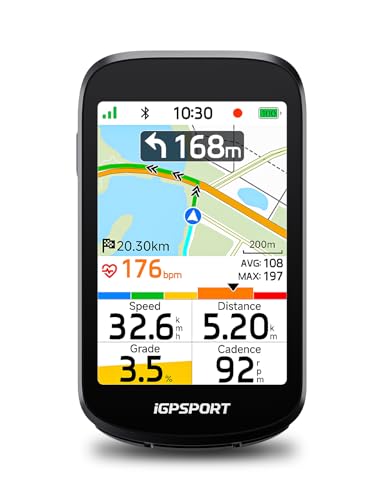
iGPSPORT BSC500 GPS Bike Computer
What We Like
- 3.3" touchscreen with button backup
- Dual-band 5-satellite positioning
- Smart MAP with turn reminders
- iClimb 2.0 hill planning
Trade-offs
- Relies on app for route setup
- Screen is small for complex navigation maps.
A 3.3-inch touchscreen gives you clear, glanceable data and map guidance without squinting. Dual-band reception across five satellite systems locks your position fast even under tree cover or in city canyons, so you stay on course when the route gets tricky. The smart turn reminder adjusts its warning distance based on your speed, early enough on a fast descent, tight enough on a climb, so you never miss a turn. Between the voice prompts and the large screen, this computer helps you navigate with less screen-glancing.
Size is the main consideration here: at 4.1 inches long, the BSC500 is larger than some compact models like the Wahoo BOLT V3, which some riders prefer for aero bars or tight handlebar space. You also need the iGPSPORT app to set routes, so route planning requires the app. If you value big-screen clarity and voice-guided routing over pocket-size portability, this is the touchscreen computer to grab.
Wahoo ELEMNT BOLT V3 GPS Bike Computer
What We Like
- On-device turn-by-turn navigation
- Automatic route downloads from apps
- Take Me To on-demand route generation
- ANT+ radar integration for vehicle alerts
Trade-offs
- 20hr battery trails some competitors
- No touch screen for map interaction
The BOLT V3 is built around one job: getting you where you want to go without pulling out your phone. Its on-device turn-by-turn navigation works with GPX and TCX files, plus routes from Strava, Ride With GPS, and Komoot. So you can load a friend’s gravel loop or a curated century ride and follow the prompts right on the 2.3-inch color screen. The top LEDs and audible cues let you know at a glance what your next turn is or if you’ve gotten off-course. For anyone who explores new roads or tackles unfamiliar routes, this is the computer that keeps your eyes on the pavement instead of a map.
The BOLT V3’s 20-hour battery life is a real limitation if you regularly ride back-to-back long days or multi-day tours, the Garmin Edge 540 offers up to 26 hours. That extra six hours can mean the difference between charging mid-trip or not. For focused navigation with automatic route downloads and radar integration for rear traffic alerts, though, the BOLT V3 gives you exactly what you need without extra screen distractions.
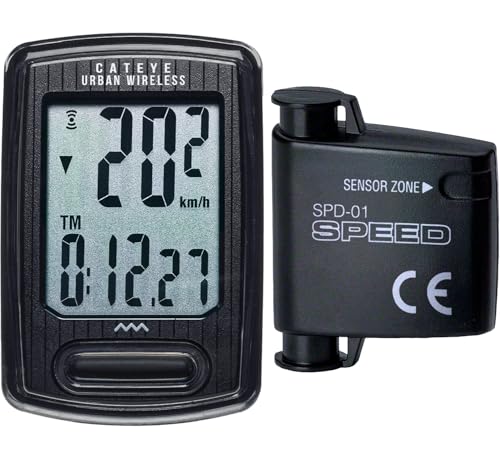
CATEYE Urban Wireless Bike Computer
What We Like
- Programmable odometer keeps miles after battery change
- Includes calorie tracking for fitness-minded riders
- FlexTight bracket mounts without tools
Trade-offs
- No navigation or turn-by-turn directions
- No GPS: relies on wheel sensor for speed data
A wireless speedometer that skips the GPS fuss and focuses on the basics you actually check on every ride. It displays current, max, and average speed, total and trip distance, elapsed time, and calorie burn, with a programmable odometer that saves your miles when you change the battery. The FlexTight bracket lets you mount, adjust, and move the computer by hand without tools. For casual riders, commuters, or anyone who wants clean speed and distance data without the learning curve or smartphone pairing that comes with GPS units, this is the right fit.
Without GPS, you won’t get route tracking or navigation. If your rides stay local and you do not need maps, that is fine, but a rider eyeing the Garmin Edge 540 for its turn-by-turn guidance will find this CatEye too limited. The screen is compact and the data fields are fixed, so you cannot customize what you see. Still, it delivers reliable wireless speed and distance with a mount you can move between bikes by hand, and that is exactly what a simple wireless speedometer should do.
Product photos
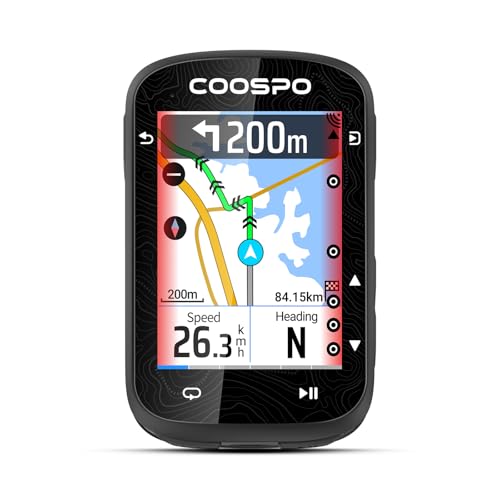
COOSPO Color Touchscreen GPS Bike Computer CS600
What We Like
- Auto-brightness color touchscreen
- 36-hour battery life
- IPX7 waterproof rating
- 150+ data metrics
Trade-offs
- 2.4" screen smaller than some rivals
- No dual-band GPS like Wahoo ELEMNT BOLT V3
A 2.4-inch color touchscreen with auto-backlight that adjusts to ambient light means you get crisp, easy-to-read data in changing conditions. That screen, paired with 36 hours of battery life, makes this computer a strong fit for multi-day tours or long weekend rides where you don’t want to hunt for a USB-C outlet every evening. The IPX7 waterproofing adds confidence for riders who keep going through sudden downpours, and the 150-plus data fields give plenty of room to track everything from speed to climbing metrics.
Screen size involves a practical trade-off. At 2.4 inches, the display is smaller than the 3.3-inch screen found on the iGPSPORT BSC500, so route maps appear more compact during a quick glance. Owners still get a high-resolution color touchscreen with auto-backlight that adjusts to ambient light, keeping data readable in bright sun or low light. The ultra-responsive touch control allows easy navigation and crisp data visualization without fumbling. For riders who prioritize a larger map view, the smaller panel may feel tighter, but the trade-off keeps the unit lightweight at 0.3 pounds, making it easy to mount on crowded handlebars.
CYCPLUS GPS Wireless Bike Computer G1

What We Like
- Over 55 hours of battery life
- Automatic backlight with FSTN technology
- IPX6 waterproof for rain riding
- Auto sleep mode after 10 minutes
Trade-offs
- No color display for maps or navigation
- No touchscreen interface
A 1200 mAh battery that delivers over 55 hours of working time means you can ride for days without reaching for a charger. That kind of endurance makes this little computer a natural fit for commuters, touring cyclists, or anyone who forgets to plug things in. The 2.0-inch FSTN screen with automatic backlight is designed to be highly visible in sunlight, so you can read your data easily during the day. For the rider who wants reliable GPS tracking without paying for color maps or touchscreens, this delivers the core data, ride time, distance, altitude, and total mileage, in a compact, waterproof package.
Screen size is the main trade-off. At 2.0 inches, the display is smaller than some competitors that offer turn-by-turn navigation and color displays. If you need detailed route guidance or want to glance at data from farther away, a larger-screen model may be easier to read. But if battery life and straightforward GPS logging matter more than maps, the CYCPLUS G1 gives you more than 55 hours of runtime compared to 20 hours on the Wahoo BOLT V3. It is a practical, no-frills tool that does the essentials well.
Product photos
iGPSPORT BSC100S GPS Bike Computer
What We Like
- 40-hour battery for long-distance rides
- IPX7 waterproof in heavy rain
- ANT+ and Bluetooth 5.0 dual protocol
- 5-satellite positioning for accurate tracking
Trade-offs
- No touchscreen or map navigation
- 2.6-inch screen smaller than some competitors
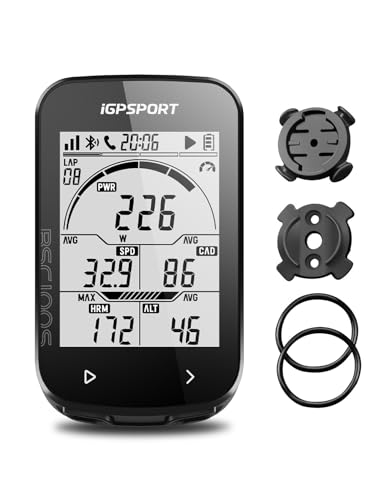
The BSC100S offers up to 40 hours of battery life, so you can ride multiple days or tackle a century without hunting for a charger mid-route. That endurance comes from a 600mAh battery and a Type-C port that takes less time to fully charge than older micro USB units. Beyond the runtime, the computer locks onto five satellite systems at once, so your speed and distance data stay reliable even under tree cover or in urban canyons. For riders who prioritize staying out longer over fiddling with maps, this computer delivers steady, accurate tracking that doesn’t quit.
A simpler interface is the main compromise here. There is no touchscreen, no turn-by-turn navigation, and the 2.6-inch display, while anti-glare, is smaller than the color screens on the iGPSPORT BSC500 or the Wahoo BOLT V3. You get 40-plus data fields, but you scroll through them with buttons rather than swiping. That keeps the unit light at 0.3 pounds and rugged with IPX7 waterproofing, but if you need on-screen maps or a larger display for quick glances, you will want to look at the BSC500 instead.
Product photos
BKVTOP Wireless GPS Bike Computer
What We Like
- 50g lightweight with standard mount
- 28-hour rechargeable battery
- IPX7 waterproof for rainy rides
- Green auto backlight for low light
Trade-offs
- No color screen or touchscreen
- No turn-by-turn navigation
- No heart rate or cadence sensors
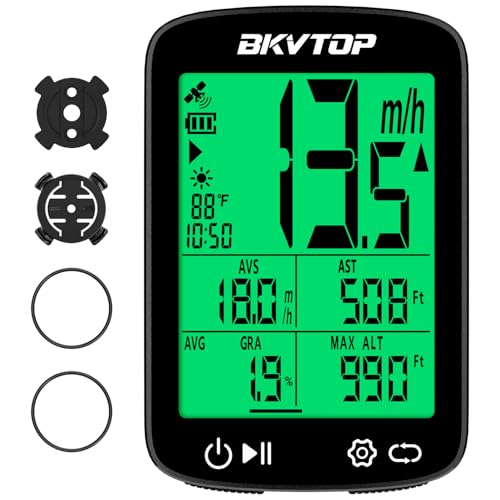
At just 50 grams, this GPS computer is light enough to forget it’s on your handlebar, yet it packs a built-in GPS that tracks speed, distance, and elevation without any wheel sensors. The 2.4-inch LCD screen with green auto backlight makes it easy to read at a glance, even during dusk or night rides. For commuters and casual cyclists who want reliable data without extra bulk or complexity, this is a practical, budget-friendly choice that keeps things simple.
With a 28-hour battery and IPX7 waterproofing, this computer handles wet commutes and long weekend loops without needing a wheel sensor. It skips color displays and turn-by-turn directions, so it’s best for riders who just want straightforward ride logging rather than route guidance.
Product photos
CATEYE Velo 7 Wired Bike Computer

What We Like
- Auto Start/Stop pauses when you stop
- Battery lasts up to 3 years
- Shows current, max, and average speed
- Easy setup for beginner cyclists
Trade-offs
- Wired sensor requires careful cable routing
- No GPS or navigation features
- No wireless connectivity for data sync
A battery that lasts up to three years means you can mount this computer and forget about battery changes for nearly the life of a typical bike. That kind of reliability, paired with automatic start/stop that pauses your stats at red lights or coffee stops, makes the Velo 7 a straightforward tool for a beginner who just wants to track speed and distance without fuss. It shows current, max, and average speed, total and trip distance, elapsed time, a pace arrow, and a clock. Everything a new cyclist needs to see progress on weekend rides.
The wired sensor requires a bit of patience. You’ll need to run a thin wire from the fork-mounted sensor up to the handlebar unit, which takes a bit of patience to route cleanly. Compared to the CATEYE Urban Wireless, which skips the wire entirely, the Velo 7 asks for a few extra minutes of installation in exchange for that multi-year battery and a lower entry point into tracking your rides. If you prefer a cleaner look and don’t mind changing a coin cell every year or two, the wireless version is worth a look; if you want set-and-forget simplicity, this wired model delivers.
Product photos
How We Evaluated Bike Speedos
We built this guide by examining product specifications, manufacturer documentation, expert round-ups from cycling publications, and recurring patterns in owner feedback across thousands of user reports.
The four criteria that mattered most were navigation capability, battery life, display quality, and sensor compatibility. Navigation ranged from simple speed-only wired units to full turn-by-turn GPS computers with climb planning. Battery life varied from 20 hours on premium navigation units to over 55 hours on budget-focused models. Display considerations included touchscreen versus button control, color versus monochrome, and screen size for map readability. Sensor compatibility determined whether a unit could pair with power meters, heart rate monitors, and radar for advanced training data.
A research-led evaluation has honest limits. We cannot report on real-world battery drain in cold weather, touchscreen responsiveness in rain, or long-term durability after years of use. What we can do is identify the products that consistently meet their stated specifications and match those capabilities to specific rider needs.
What To Look For In Bike Speedos
Choosing the right bike speedo starts with understanding what you actually need on your rides. The key is matching the computer’s features to your riding style rather than buying the most expensive option.
Look for a bike speedo that matches your ride type: commuters need basic speed and distance, road riders want GPS and navigation, and racers require power meter and heart rate integration.
Navigation and Mapping
Navigation capability is the biggest differentiator between bike speedos. Simple wireless computers like the CATEYE Urban Wireless use wheel sensors to track speed and distance but offer no mapping. Mid-range GPS units like the iGPSPORT BSC100S record your route for later review but do not show maps on the screen. Premium computers such as the Garmin Edge 540 and Wahoo ELEMNT BOLT V3 provide full turn-by-turn directions on the device, with some models including climb planning tools like the ClimbPro ascent planner.
Consider how often you ride unfamiliar routes. If you rely on your computer to guide you through new areas, invest in a model with on-device navigation and automatic route downloads. For riders who only need to know how fast and how far, a simpler unit saves money and complexity.
Battery Life and Charging
Battery life varies dramatically across bike speedos, from 20 hours on the Wahoo ELEMNT BOLT V3 to over 55 hours on the CYCPLUS G1. For daily commutes and weekend rides under four hours, even the shortest battery life is sufficient. Multi-day touring cyclists and ultra-endurance riders should prioritize models with longer battery life.
Pay attention to how the battery is charged. Most modern GPS computers use USB-C or proprietary charging cables. Some budget models use coin cell batteries that last years without recharging, like the CATEYE Velo 7 wired computer. Consider whether you want to recharge after every few rides or prefer a set-and-forget battery approach.
Display and Interface
The display determines how easily you can read your data while riding. Color touchscreens like those on the iGPSPORT BSC500 and COOSPO CS600 offer intuitive navigation and clear map viewing, but they can be harder to read in direct sunlight and less responsive with wet fingers. Button-controlled displays like the Garmin Edge 540 are reliable in all weather conditions but require more menu navigation.
Screen size matters for map readability. Larger displays around 3.3 inches work well for navigation, while compact 2.4-inch screens are fine for basic data fields. Auto-brightness and anti-glare coatings improve visibility, and backlit screens are essential for night or low-light riding.
Sensor and App Compatibility
Advanced training features require compatible sensors. Power meter and heart rate monitor integration turns a basic speedo into a coaching tool, but only if the computer supports ANT+ and Bluetooth protocols. The Garmin Edge 540 offers personalized coaching with these sensors, while budget models like the BKVTOP have no sensor support at all.
- Verify ANT+ and Bluetooth compatibility for your existing sensors
- Check if the computer pairs with your preferred cycling app (Strava, TrainingPeaks, etc.)
- Consider radar integration if you ride on roads with vehicle traffic
- Look for automatic data sync to avoid manual file transfers
A bike speedo is only as useful as the data it can collect, so match sensor support to your training goals.
Bike Speedos Compared
The table below compares the nine bike speedos across the key specifications that matter most for choosing the right computer for your rides.
| Product | Screen Size | GPS Type | Weight |
|---|---|---|---|
| Garmin Edge 540 GPS Cycling Computer | 2.3 x 3.4 inches | Multi-band GNSS | 0.2 pounds |
| iGPSPORT BSC500 GPS Bike Computer | 3.3" touchscreen | 5-system dual-band | 0.2 pounds |
| Wahoo ELEMNT BOLT V3 GPS Bike Computer | 2.3in Color | DualBand GPS | 0.2 pounds |
| CATEYE Urban Wireless Bike Computer | N/A | N/A | 0.1 Pounds |
| COOSPO Color Touchscreen GPS Bike Computer CS600 | 2.4" color touchscreen | GPS + GLONASS | 0.3 pounds |
| CYCPLUS GPS Wireless Bike Computer G1 | 2.0 inches | Dynamic GPS Positioning | 0.2 Pounds |
| iGPSPORT BSC100S GPS Bike Computer | 2.6 inches | 5 systems | 0.3 pounds |
| BKVTOP Wireless GPS Bike Computer | 2.4-inch LCD | Built-in | 0.1 Pounds |
| CATEYE Velo 7 Wired Bike Computer | N/A | N/A | 0.1 Pounds |
Frequently Asked Questions
What is the difference between a bike speedo and a GPS bike computer?
A basic bike speedo measures speed and distance using a wheel sensor, while a GPS bike computer uses satellite positioning to track your route, elevation, and location. GPS computers can also provide navigation, record ride data for later analysis, and pair with sensors like heart rate monitors and power meters.
How accurate are GPS bike speedos compared to wheel sensors?
GPS bike speedos are generally accurate for speed and distance on open roads with clear sky views. Wheel sensors can be more consistent in areas with tunnels, dense tree cover, or tall buildings that block satellite signals. Many riders use both, with GPS for route recording and wheel sensors for real-time speed display.
Do I need a bike speedo with turn-by-turn navigation?
Only if you regularly ride unfamiliar routes. Turn-by-turn navigation is valuable for cyclists exploring new areas, following pre-planned routes, or participating in organized rides with course files. Riders who stick to the same local roads or trails can save money with a simpler speedo that records basic data.
Can I use a bike speedo without a smartphone?
Yes, many bike speedos work independently of a smartphone. Basic wireless and wired computers display speed and distance without any phone connection. GPS computers record ride data that you can view later on a computer. However, some features like route setup, data analysis, and software updates often require a smartphone app.
How long do bike speedo batteries typically last?
Battery life ranges from 20 hours on premium navigation computers to over 55 hours on budget-focused GPS models. Simple wired computers with coin cell batteries can last up to three years without replacement. For most riders, any battery life over 20 hours is sufficient for a full week of commuting or a weekend of long rides.
The Bottom Line
The Garmin Edge 540 GPS Cycling Computer is the best overall bike speedo for cyclists who want advanced training metrics and reliable navigation in a long-lasting, button-controlled computer. Its multi-band GNSS, 26-hour battery, and ClimbPro ascent planner make it a versatile companion for everything from daily training to weekend adventures.
If your priority is a large touchscreen with voice navigation, the iGPSPORT BSC500 delivers excellent value with its dual-band GPS and hill planning features. Budget-conscious riders should consider the CYCPLUS G1 for over 55 hours of battery life, while beginners will appreciate the simplicity and long battery of the CATEYE Velo 7 wired computer.
The single most important buying factor is matching the computer’s features to your actual rides. A commuter who never leaves paved roads does not need a premium navigation unit, and a racer tracking power data will outgrow a basic speedometer quickly. Choose based on how and where you ride, not on the feature list alone.
