
10 Best Car Audio Equalizers in 2026
This post contains affiliate links. As an Amazon Associate, we earn from qualifying purchases.
For drivers who want their music to sound crisp and balanced, a car audio equalizer is the key. The AudioControl DM-810 8×10 Channel Matrix DSP is our best overall pick because it combines a 30-band equalizer with an auto-EQ system and AccuBASS to recover lost bass at high volume. For those on a budget, the Skar Audio SKA7EQ offers solid analog control, while the Banda Audiopart X8AiR provides an incredible 79 bands of adjustment per channel for the ultimate enthusiast.
Getting great sound in a car is a challenge. Factory stereos often compress frequencies, road noise masks details, and speaker placement is far from ideal. An equalizer lets you cut harsh highs, boost missing bass, and tailor the soundstage to your specific vehicle and listening taste.
This guide is research-based. We have analyzed specifications, manufacturer documentation, and patterns in owner feedback from expert round-ups to bring you a clear, practical overview of the ten best car audio equalizers available. We are here to help you match the right unit to your system and your goals.
Top 10 Car Audio Equalizers in the Market

Certain content that appears on this site comes from Amazon. This content is provided "as is" and is subject to change or removal at any time.
The Best Car Audio Equalizers, Reviewed
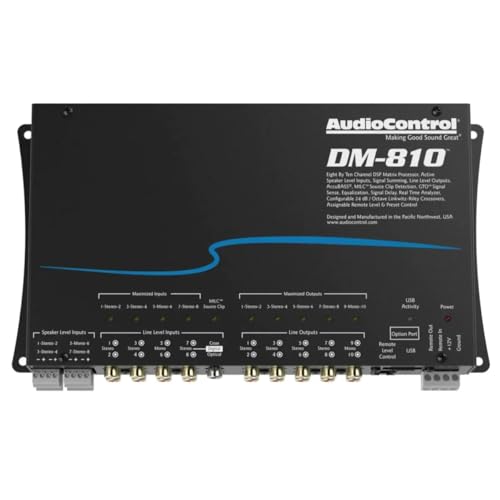
AudioControl DM-810 8×10 Channel Matrix DSP
What We Like
- 30-band equalizer with auto EQ
- AccuBASS recovers bass at high volume
- Input and output real-time analyzers
- Variable crossovers for flexible tuning
Trade-offs
- At 3.0 pounds, heavier than many DSPs
- Requires laptop or PC for full control
With four sets of speaker-level inputs, four sets of RCA inputs, plus S/PDIF and TOSLINK digital inputs, this processor can accept signals from a factory radio or an aftermarket head unit. The 30-band equalizer with auto EQ lets you dial in the exact sound you want, while AccuBASS recovers bass that factory systems often roll off at higher volumes. This makes it a strong fit for anyone building a detailed, multi-speaker audio system who wants precise control over every frequency.
The DM-810 weighs 3.0 pounds and has a footprint roughly the size of a hardcover book, so it will take up noticeable space in your install. Tuning is done through the DM Smart app, which requires a laptop or PC, no smartphone control here. That trade-off buys you four sets of speaker-level inputs, four RCA preamp inputs, plus S/PDIF and TOSLINK digital inputs, giving you serious flexibility for integrating factory or aftermarket systems.
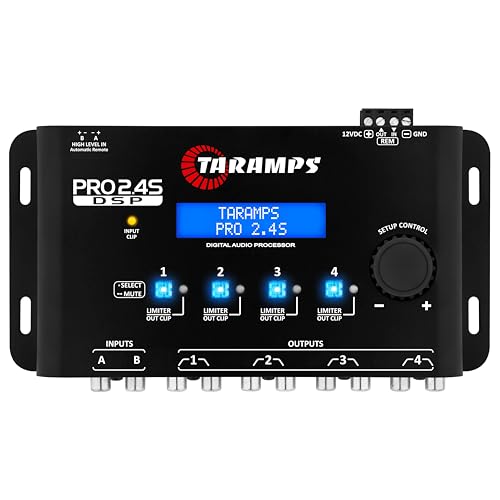
Taramps PRO 2.4S Car Audio DSP Equalizer
What We Like
- 15-band graphic EQ for fine tuning
- Anti-Pop System reduces turn-on/off noise
- RCA and high-level inputs for OEM radios
- Adjustable HPF/LPF crossover up to 48dB/octave
Trade-offs
- Only 4 outputs limits multi-speaker systems
- No Bluetooth or app control for adjustments
- Heavier than some compact DSPs at 1.0 pounds
A 15-band graphic equalizer with adjustable crossover slopes up to 48dB per octave gives you the precision to shape your car’s sound without needing a degree in audio engineering. This DSP is built for drivers who want to upgrade from a factory stereo or basic aftermarket head unit. Its RCA and high-level inputs connect directly to either, and the Anti-Pop System spares you that jarring thump every time you power the system on or off. It suits someone who values clean, quiet operation and straightforward tuning over extra frills.
The trade-off is channel count. With only 4 outputs, you cannot run a full front-stage plus subwoofer setup independently the way you could with an 8-channel processor like the AudioControl DM-810. For the price-conscious enthusiast focused on solid basics and noise-free startup, this is a clean, capable choice.
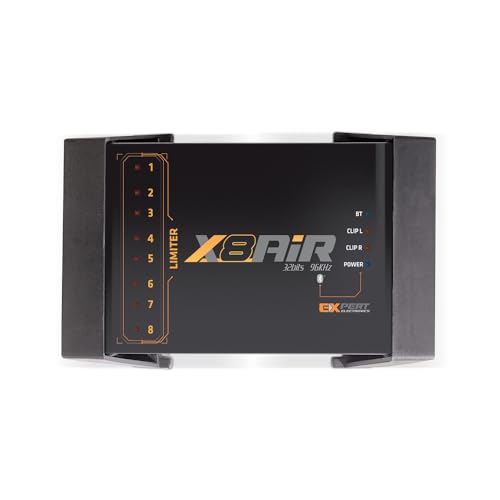
Banda Audiopart X8AiR 8-Channel DSP Processor
What We Like
- 79-band EQ per channel for fine tuning
- Bluetooth app control from your phone
- 8 output channels for complex setups
- 32-bit/96kHz processing for clean sound
Trade-offs
- 0.7 lb is light but still needs secure mounting
- App-based control means smartphone required for adjustments
- No physical controls on the unit itself
A 79-band equalizer per channel is the kind of granular control that lets you shape every frequency exactly how you want it, from the deepest bass to the highest treble. That extreme band count makes this DSP a natural fit for audiophiles who want to dial in their system with surgical precision. This is especially true when paired with the 8 output channels that can run separate amplifiers for components and subwoofers. The Bluetooth app control means you can tweak crossover points, time alignment, and limiter settings from the driver’s seat, which is a lot more convenient than bending under a seat or dashboard.
At 0.7 pounds and roughly the size of a thick paperback, the X8AiR is compact enough to tuck under a seat or in a glovebox. But it still needs a solid mounting spot to keep the wiring secure. The unit has no knobs or buttons, so every adjustment depends on your phone and the app working properly. That works fine for most people, but if you prefer old-school sliders or need to make quick changes without pulling out your phone, a simpler unit with physical controls might suit you better.
Product photos
Rockford Fosgate DSR1 8-Channel Interactive Signal Processor
What We Like
- 245 bands of equalization for precise tuning
- Integrated iDatalink Maestro for Ford/Chrysler factory integration
- Bluetooth 4.0 for wireless setup and adjustments
- Compact 0.5-pound design fits tight spaces
Trade-offs
- Requires iOS/Android device for full tuning control
- Only 4 high-level inputs limit multi-source setups
- No built-in amplifier; needs external amp for speakers
With 245 bands of equalization, this processor lets you dial in frequencies with surgical precision, giving you far more control over your car’s sound than most alternatives. The integrated iDatalink Maestro module directly replaces factory amplifiers and speakers in Ford and Chrysler vehicles, so you don’t have to rip out your dashboard to get better audio. The Bluetooth app allows wireless setup and adjustments, making tuning convenient from anywhere in the car. The catch is that you’ll need a smartphone or tablet to control it, since there’s no physical interface on the unit itself. The four high-level inputs also mean you’re limited in how many source signals you can feed in at once. Compared to the AudioControl DM-810, which offers an 8×10 channel matrix DSP and an RTA for precise sound tuning, the Rockford Fosgate is far lighter at half a pound, making it easier to install in tight spaces.
You will need a smartphone or tablet to control it, since there’s no physical interface on the unit itself. The four high-level inputs also mean you’re limited in how many source signals you can feed in at once. Compared to the AudioControl DM-810, which provides an 8×10 matrix for more complex routing and a built-in RTA microphone, the Rockford Fosgate is simpler and far lighter at half a pound, making it easier to hide under a seat. It’s not for someone building a multi-zone competition system, but for upgrading a daily driver with factory gear, this processor hits the sweet spot.
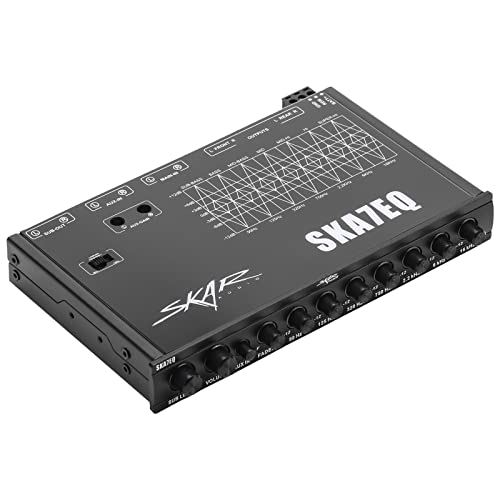
Skar Audio SKA7EQ 7-Band Pre-Amp Equalizer
What We Like
- 7-band EQ with -12 dB to +12 dB adjustment
- High-voltage 7V gold-plated RCA outputs
- Separate subwoofer level control on front
- Aux input with variable gain control
Trade-offs
- No digital signal processing or time alignment
- Lacks Bluetooth or app-based control
A 7-band graphic equalizer with a 7-volt max output gives you plenty of headroom to send a clean, strong signal to your amplifiers without introducing noise. That kind of voltage helps overcome long RCA cable runs and keeps the sound crisp even in a system with multiple amps. It’s a straightforward, hands-on tool for someone who wants to shape their sound with physical sliders rather than diving into a smartphone app or laptop software. The dedicated subwoofer level control on the front panel makes it easy to dial in bass without hunting through menus.
This is an analog equalizer, so you won’t get digital features like time alignment, crossover slopes, or presets that you’d find in a DSP unit such as the AudioControl DM-810. That means fine-tuning a complex multi-speaker setup takes more patience and manual adjustment. But if you prefer a tactile interface and a clear upgrade path from a basic head unit, the Skar Audio SKA7EQ delivers strong signal quality and straightforward control at a budget-friendly price point.
Clarion EQS755V 7-Band Graphic Equalizer/Crossover

What We Like
- 6-channel 8-volt RCA outputs for strong signal
- Independent subwoofer level and master volume controls
- Front 3.5mm AUX input for easy phone connection
Trade-offs
- Only 7 EQ bands limit fine-tuning compared to DSP units
- Analog EQ lacks digital time alignment and presets
- No Bluetooth or app-based control
With 6-channel 8-volt RCA outputs, it sends a clean, strong signal to your amplifiers, and the independent subwoofer level control lets you dial in bass without touching the main volume. The front 3.5mm AUX input is a nice touch for plugging in a phone or portable player directly.
This is an analog 7-band equalizer with fixed frequency sliders from 50Hz to 16kHz, so it lacks the flexibility of a digital signal processor. You cannot adjust crossover slopes, set time alignment, or save presets. For a straightforward install where you want simple slider adjustments and a built-in ground loop isolation circuit, this unit delivers the features listed in its specifications.
Timpano TPT-EQ7 7-Band Graphic Equalizer

What We Like
- Slim 1-inch profile fits tight spaces
- 10V line driver for clean long runs
- Built-in speaker-to-RCA converter
- Dedicated subwoofer level and crossover
Trade-offs
- Only 7 bands limits fine-tuning precision
- No digital processing or time alignment
With a height of just 1 inch, this equalizer fits into tight spaces like under a dashboard or alongside an amplifier. The built-in high-level input converter lets you connect to factory speaker wires, making it easy to add amplifiers to a stock stereo. The up-to-10-volt RCA output keeps signal clean over long cable runs, useful when the EQ is mounted out of the way. It’s a simple tool for adjusting bass, mid, and treble without complex menus.
Seven bands give you broad tonal control, but they can’t match the precision of a digital signal processor like the AudioControl DM-810, which offers 30 bands and time alignment. If you need fine frequency correction or staging adjustments, the Timpano’s fixed bands are limited. But for someone adding a subwoofer and wanting to shape sound from a factory radio, this compact EQ provides straightforward slider-based control.
Product photos
Orion XEQ-X7 7-Band Graphic Equalizer
What We Like
- Front 3.5mm AUX for portable devices
- High- and low-level inputs for flexible setups
- Dedicated subwoofer output with adjustable level
- Variable low-pass filter for bass tuning
Trade-offs
- Half-DIN size limits front-panel controls space
- No digital signal processing or time alignment
- Only 7 bands limit fine frequency adjustments
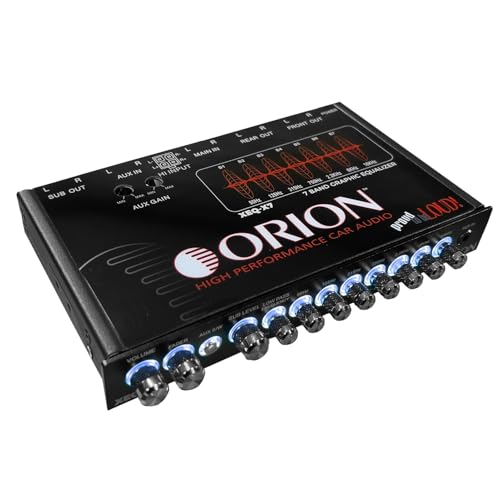
The Orion XEQ-X7 packs a dedicated subwoofer output with adjustable level and variable low-pass filter, giving you real control over bass without needing a separate processor. Its front 3.5mm AUX input lets you plug in a phone or portable player directly, while both high-level (speaker) and low-level (RCA) inputs mean it works with factory radios or aftermarket head units. This is a straightforward, hands-on equalizer for drivers who want to shape their sound without diving into a laptop-based tuning session.
If you need more frequency bands or digital processing, the AudioControl is a better fit. But for someone upgrading a basic system or adding bass management without the complexity of a full DSP, the Orion gives you the essential tools in a compact, easy-to-wire package.
Product photos
PRV AUDIO DSP 2.4X Digital Crossover and Equalizer

What We Like
- Real-time LCD display for adjustments
- 15-band graphic EQ plus parametric EQ
- 12 built-in sound presets
- Sequencer feature for remote trigger
Trade-offs
- Only 4 output channels limits complex systems
- Small LCD with 16×2 characters shows less info
- No Bluetooth or app control for tuning
The 16×2 character LCD shows each adjustment as you make it, so you can see what you’re doing rather than guessing from unlabeled knobs. That real-time feedback makes tuning more intuitive for anyone who prefers a screen over a phone app. The 15-band graphic EQ plus a parametric equalizer on both input and output gives you control over the frequencies that shape your soundstage. Twelve presets. Flat, Loudness, Bass Boost, and more, let you start quickly without deep audio knowledge. This unit works well for drivers who want hands-on control and visual feedback without relying on a phone app.
The main limit is output channels: four crossover outputs mean this DSP fits a simple front-stage and subwoofer setup, not a multi-zone system with separate tweeters, mids, and rear fills. The 16×2 character LCD shows basic info but not the detailed spectrum graphs you might see on a larger display. If you need eight channels of processing with measurement tools like RTA, the AudioControl DM-810 covers more ground, but it also takes up far more space at 15 inches long. The PRV DSP 2.4X keeps things straightforward for the driver who wants a clear screen and solid EQ control without the complexity of a full matrix processor.
Product photos
Stetsom EQX764 7-Band Graphic Equalizer
What We Like
- Dedicated subwoofer level and frequency controls
- 4 inputs and 6 outputs for flexible setup
- Compact size fits tight spaces
Trade-offs
- Analog graphic equalizer, not a digital signal processor
- 7 fixed frequency bands limit adjustment range
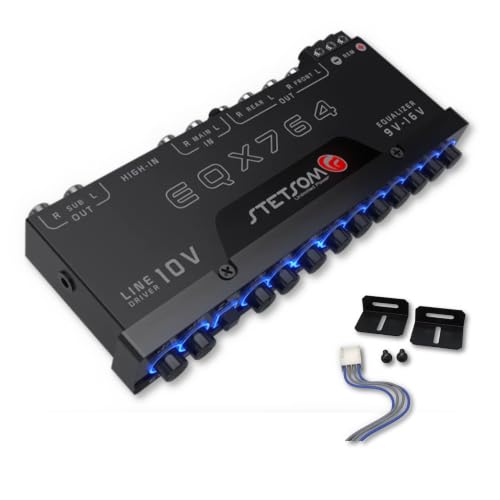
A dedicated subwoofer level and frequency control puts the bass firmly in your hands, letting you dial in thump without muddying the rest of the mix. This Stetsom EQX764 suits drivers who want straightforward, hands-on control of their low end and prefer sliders and knobs over scrolling through menus. Its four inputs and six outputs give you room to connect multiple sources and amps, all in a package that tucks easily under a dash or in a glovebox.
This is an analog graphic equalizer with seven fixed frequency bands, so you get less fine-tuning than something like the AudioControl DM-810, which offers a 30-band EQ and built-in crossover adjustments. If you need precise time alignment or multi-channel crossover settings, a DSP will serve you better. But if your goal is to shape the bass response quickly and cleanly, the Stetsom delivers that control without the learning curve of digital software. It is a focused tool for a specific job.
Product photos
How We Evaluated Car Audio Equalizers
Our evaluation began with the core specifications: the number of EQ bands, output channels, and input flexibility. We looked at the difference between analog graphic equalizers and digital signal processors (DSPs), as each serves a different purpose. A 7-band graphic EQ is simple and effective for basic tone shaping, while a DSP with dozens of bands offers surgical precision for a multi-amp system.
We prioritized four key criteria. First, tuning capability, how many bands and what type of equalization (graphic or parametric) a unit offers. Second, connectivity and integration, including the types of inputs (RCA, high-level, auxiliary) and whether the unit works with factory stereos. Third, build quality and form factor, considering weight, size, and the presence of features like ground loop isolation. Finally, user control, whether adjustments are made via physical sliders, a laptop, or a smartphone app.
Because this is a research-led evaluation, we do not claim to have tested these units in a lab. Instead, we have synthesized the most reliable data from manufacturer specs and the collective experience of owner communities. This approach helps you understand the trade-offs between a simple, affordable analog EQ and a powerful, complex DSP before you buy.
What To Look For In Car Audio Equalizers
Choosing the right equalizer depends entirely on your current system and your goals. A simple upgrade for a factory stereo requires different features than a full competition-grade build.
Key buying criteria: Number of EQ bands (7 for basic, 15-30+ for precision), type of equalizer (analog graphic vs. Digital signal processor), number of input/output channels, control method (physical knobs vs. App/laptop), and integration features like high-level inputs for factory stereos. These factors determine how much control you have over your car’s sound.
EQ Bands and Type
The number of EQ bands determines how precisely you can adjust specific frequencies. A 7-band graphic equalizer, like the Skar Audio SKA7EQ, lets you boost or cut seven fixed frequency ranges, enough to adjust the overall tone. A digital signal processor (DSP) like the Banda Audiopart X8AiR offers 79 bands per channel, allowing you to correct for specific speaker resonances or cabin reflections. If you are chasing audiophile-level sound, more bands and parametric EQ (which lets you adjust the center frequency of each band) are worth paying more for.
Inputs, Outputs, and System Integration
Your equalizer must match your source unit and amplifiers. A basic setup with a single stereo and one amp needs only two inputs and two outputs. A complex system with a subwoofer and multiple speaker amps requires more outputs, like the six found on the Clarion EQS755V. For those keeping a factory stereo, high-level (speaker wire) inputs are essential. The Rockford Fosgate DSR1 excels here, with iDatalink Maestro integration for direct control of Ford and Chrysler factory systems.
Control Method and Form Factor
Think about where you will install the unit and how you will adjust it. Analog equalizers with physical sliders, like the Stetsom EQX764, give you instant, tactile control. DSPs often require a laptop or smartphone app for setup, which offers far more precision. The Timpano TPT-EQ7 has a slim 1-inch profile for tight glovebox or under-seat mounting. Consider whether you want to make quick adjustments while driving or prefer to set it once and forget it.
- Ensure the equalizer’s output voltage matches your amplifier’s input sensitivity.
- Verify the unit’s size (single-DIN, half-DIN, or compact) fits your chosen mounting location.
- Check for a subwoofer output with independent level control if you run a sub.
- Look for ground loop isolation if you hear alternator whine through your speakers.
A good rule of thumb: A 7-band graphic EQ is perfect for a single upgrade; choose a DSP with multiple outputs and time alignment for a full, multi-amp system.
Car Audio Equalizers Compared
The table below compares the key specs of our top picks side-by-side, helping you quickly see which equalizer fits your system’s needs.
| Product | Equalizer Bands | Input Types | Channels |
|---|---|---|---|
| AudioControl DM-810 8×10 Channel Matrix DSP | 30-band | Speaker-level, RCA, S/PDIF, TOSLINK | 8×10 |
| Taramps PRO 2.4S Car Audio DSP Equalizer | 15-band | RCA and high-level | 2 inputs, 4 outputs |
| Banda Audiopart X8AiR 8-Channel DSP Processor | 79-band | N/A | 4 inputs / 8 outputs |
| Rockford Fosgate DSR1 8-Channel Interactive Signal Processor | 245 bands | 4 high-level, 4 balanced differential, RCA, SPDIF, Bluetooth | N/A |
| Skar Audio SKA7EQ 7-Band Pre-Amp Equalizer | 7 bands | RCA | N/A |
| Clarion EQS755V 7-Band Graphic Equalizer/Crossover | 7 | RCA, High-Level, 3.5mm AUX | N/A |
| Timpano TPT-EQ7 7-Band Graphic Equalizer | 7 | N/A | 6-channel RCA output |
| Orion XEQ-X7 7-Band Graphic Equalizer | 7 | High-level & low-level (RCA) | N/A |
| PRV AUDIO DSP 2.4X Digital Crossover and Equalizer | 15-band | N/A | 2 inputs / 4 crossover outputs |
| Stetsom EQX764 7-Band Graphic Equalizer | 7 bands | RCA & High | 4 inputs / 6 outputs |
Frequently Asked Questions
What is the difference between a graphic equalizer and a digital signal processor?
A graphic equalizer uses fixed frequency bands with physical sliders to boost or cut sound. It is simple to use and great for basic tone shaping. A digital signal processor (DSP) offers far more control, including parametric EQ (adjustable frequency centers), time alignment to correct speaker distance delays, and precise crossovers. A DSP is the choice for building a complex, high-fidelity car audio system.
Can I use a car audio equalizer with a factory stereo?
Yes, many equalizers are designed for factory integration. Look for models with high-level (speaker wire) inputs, which allow them to accept the amplified signal from your stock radio. The Rockford Fosgate DSR1 is specifically built for this, offering direct integration with certain Ford and Chrysler vehicles via the iDatalink Maestro module.
How many EQ bands do I need?
For a basic improvement in sound quality, a 7-band equalizer is usually sufficient to adjust the overall balance of bass, midrange, and treble. If you are building a more critical system or want to correct specific problem frequencies in your car’s cabin, a DSP with 15 to 30 or more bands per channel will give you the precision you need. That level of control lets you target exact peaks and dips in the listening environment.
Do I need a separate amplifier with a car audio equalizer?
Most equalizers and DSPs are line-level processors that output a signal to an amplifier. They do not power speakers. You will need a separate amplifier (or multiple amps) to drive your speakers. The only exception is if you are using a very basic EQ that installs between your head unit and factory amp.
Will an equalizer fix alternator whine or other noise?
Some equalizers, like the Clarion EQS755V, include features to help reduce ground loop noise, which is a common cause of alternator whine. However, an equalizer is not a dedicated noise filter. The best approach is to address the root cause of the noise, check your grounding points, RCA cable routing, and power cable shielding first.
The Bottom Line
The AudioControl DM-810 is our best overall pick for drivers who want the highest level of control and precision. Its 30-band equalizer, auto-EQ, and AccuBASS technology make it ideal for a complex, multi-amp system where you need to dial in every detail. If you are building a serious sound system and are comfortable using a laptop for tuning, this is the unit to buy.
If your budget is more limited, the Skar Audio SKA7EQ offers great value for a simple, effective 7-band analog upgrade. For those integrating a factory stereo, the Rockford Fosgate DSR1 is the specialist you need, especially for Ford and Chrysler vehicles. And for the enthusiast who wants maximum control, the Banda Audiopart X8AiR delivers an unmatched 79 bands of equalization per channel.
The single most important factor in choosing an equalizer is matching its features to your system’s complexity. A simple 7-band EQ is perfect for one amplifier and a subwoofer. A powerful DSP is required for a multi-way, actively crossed-over system. Choose the tool that fits the job you need to do.
