
10 Best Car Sound System Speakers in 2026
This post contains affiliate links. As an Amazon Associate, we earn from qualifying purchases.
For most drivers, the KICKER CS-Series CSC65 6.5″ Coaxial Speakers are the best overall upgrade because they deliver ultra-clean bass with a shallow mounting depth that fits nearly any vehicle. If you’re building a system around an external amplifier, the JBL GTO629 offers higher efficiency, while the Pioneer F-Series TS-F1634R is our Budget Pick for an affordable factory replacement.
Upgrading your car’s factory speakers is one of the most effective ways to improve sound quality, but the options can be overwhelming. You need speakers that fit your vehicle’s mounting depth, match your head unit or amplifier’s power, and deliver the kind of sound you actually want to listen to.
This guide is built on manufacturer specifications, expert round-ups, and patterns in owner feedback to help you choose with confidence. We break down the key criteria, fitment, power handling, and sensitivity, so you can match the right speaker to your car and your listening habits.
Top 10 Car Sound System Speakers in the Market

Certain content that appears on this site comes from Amazon. This content is provided "as is" and is subject to change or removal at any time.
The Best Car Sound System Speakers, Reviewed
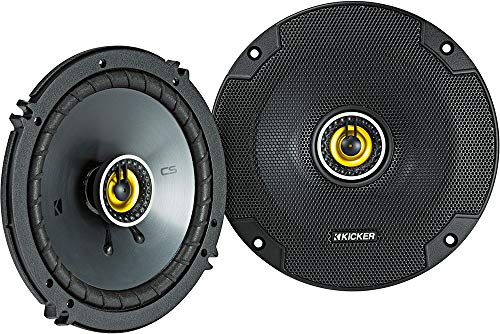
KICKER CS-Series CSC65 6.5" Coaxial Speakers
What We Like
- Ultra-clean bass with Extended Voice Coil
- Shallow mounting depth fits nearly any vehicle
- UV-treated poly-foam surround resists heat and sunlight
- Neodymium tweeter magnets for louder highs
Trade-offs
- Stamped-steel frame less rigid than cast alternatives
- Not for high-power competition builds
The CS-Series uses a heavy-duty motor and Extended Voice Coil to deliver ultra-clean bass from a 6.5-inch coaxial speaker, giving you deeper lows than typical factory speakers. The shallow mounting depth means these KICKERs fit into nearly any factory location, making them a straightforward upgrade for drivers who want better sound without cutting door panels or building adapters. That combination of low-frequency authority and easy installation makes them a strong candidate for most people looking to improve their car audio.
The stamped-steel frame and polypropylene cone keep costs reasonable, but they trade a bit of rigidity compared to some alternatives. If you value outright detail over bass extension and installation simplicity, other speakers like the JBL GTO629 deserve a look. For everyone else wanting a balanced step up from stock that fits without headaches, these KICKERs hit the sweet spot.
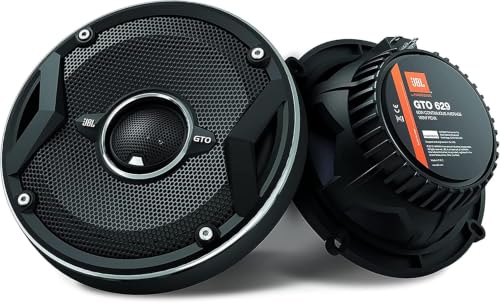
JBL GTO629 6.5" Coaxial Speakers
What We Like
- Low 3Ω impedance for higher amplifier power
- Wide 53Hz-21kHz frequency response
- Compact 2.0-inch mounting depth
Trade-offs
- Mounting diameter 5.1 inches limits some installations
- Requires an external amplifier for best performance
A 3-ohm impedance is the standout spec here, and it means these JBLs will draw more power from your amplifier than standard 4-ohm speakers, giving you noticeably louder, punchier sound without needing a bigger amp. The 53Hz low end is solid for a 6.5-inch coaxial, too, bringing bass that feels full rather than thin.
That same 3-ohm design comes with a catch: many factory car stereos are built for 4-ohm speakers. So if you’re running them off a stock head unit without an external amp, you might not get the full benefit, and in rare cases, the lower resistance can stress the built-in amplifier. Compared to the KICKER CS-Series CSC65, which uses a standard 4-ohm setup, the JBLs are better suited for buyers who already have or plan to add a separate amplifier. For a straightforward factory replacement without extra gear, the KICKER is the safer call.
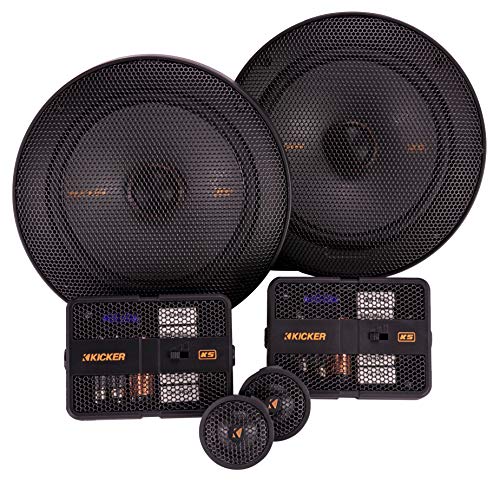
KICKER KS-Series 6.5" Component System
What We Like
- Internally dampened polypropylene cones
- Extended Voice Coil for deep bass
- Tough rubber surrounds for durability
- Flexible mounting options
Trade-offs
- Component system requires separate tweeter placement
- Heavier than many 6.5" coaxial speakers at 7.1 pounds
The KICKER KS-Series component system uses an Extended Voice Coil and powerful magnets to deliver deep, smooth bass that holds together even when you push the volume. The internally dampened polypropylene cones and rubber surrounds mean the midrange stays clear and detailed, not muddy. This is the set for anyone who wants to feel the music in their chest without losing the subtle notes in between. It suits drivers who regularly crank up the volume on long trips or enjoy live-sounding playback in their daily commute.
These are component speakers, so the tweeters mount separately from the woofers, which takes more installation time and planning than a simple coaxial swap. If you are after the most effortless drop-in replacement, a coaxial like the KICKER CS-Series might be simpler, but if you want true concert-like staging and bass punch, the KS-Series delivers where simpler designs cannot.
Rockford Fosgate Punch P165-SI Component System

What We Like
- FlexFit2 basket for adjustable mounting
- PEI dome tweeters with flush/surface mounts
- Injection molded polypropylene cone with rubber surround
- Built-in crossovers for clean frequency split
Trade-offs
- Component design requires separate tweeter placement
- 60W RMS needs an external amplifier for full output
The FlexFit2 basket design lets you shift the mounting position slot by slot, so these 6.5-inch midranges fit tighter spots than most fixed-frame speakers. That makes the Punch P165-SI a natural pick for custom installs where factory holes don’t line up or you’re building your own pods. The injection-molded polypropylene cone with santoprene rubber surround is built for high output and accurate frequency reproduction, while the 1-inch PEI dome tweeters handle highs through built-in crossovers. If you’re mapping out a tailored system, this set gives you the flexibility to place each driver exactly where it works best.
Component speakers demand more installation work than coaxial designs. You’ll need to mount the tweeters separately and run the crossover wiring, which adds time compared to dropping in a pair of KICKER CS-Series coaxials. At 60 watts RMS, these Rockfords also perform best with an external amplifier rather than head-unit power, so factor that into your build budget. For a custom install where you’re already planning amp wiring and speaker placement, the P165-SI’s adjustable fit and component separation can help you achieve a cleaner soundstage that coaxials may not match.
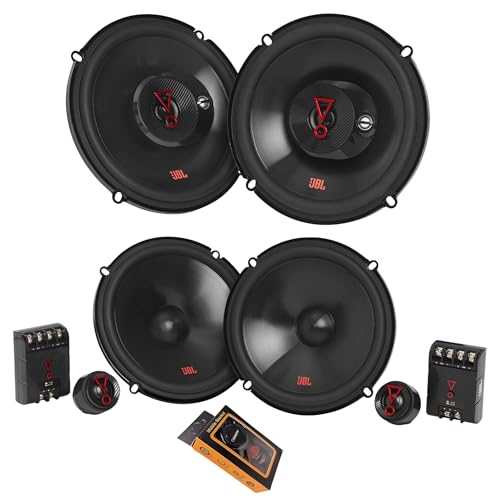
JBL Stage 3637F & 3607CF Speaker Bundle
What We Like
- Plus One woofers boost efficiency 2dB
- Edge-driven dome tweeters for clear highs
- Vented basket keeps voice coils cool
- Includes crossovers and mounting hardware
Trade-offs
- Bundle requires more installation effort than single set
- Component system means separate tweeter placement needed
A combined 660W max power across four speakers means this bundle can fill a cabin with clean, energetic sound without straining. The Plus One woofer cones can increase overall efficiency by up to 2dB compared to standard designs, so every watt from your head unit or amp works harder. This setup is for the buyer who wants a total overhaul of their factory audio, not just a quick speaker swap. JBL pairs two coaxial speakers for the rear with a component system up front, giving you dedicated tweeters and crossovers to shape the soundstage. It’s a thoughtful package that treats front and rear differently, the way many higher-end builds do.
Installation complexity is the main thing to consider here. Unlike dropping in a single set of coaxials, this bundle asks you to mount tweeters separately, run crossover wiring, and decide where to place the component speakers for best imaging. That takes more time and comfort with door panel removal. If you’re willing to put in the extra effort, the bundle offers a complete front-and-rear solution that a single set of coaxials can’t provide. It’s a full audio upgrade for the hands-on enthusiast who wants to do it once and do it right.
Pioneer Z-Series TS-Z65F 6.5" Coaxial Speakers

What We Like
- Separate drivers for accurate, balanced sound
- 330W max power handling for dynamic playback
- 96 kHz frequency response for extended treble
Trade-offs
- Low 85 dB sensitivity needs more amplifier power
- Weighs 2.1 pounds, heavier than some similar models
A 96 kHz frequency response lets these speakers reproduce the finest details in recordings, putting them in a different league from typical car coaxials. That makes the Pioneer Z-Series TS-Z65F a natural fit for listeners who want to hear the breath between notes. The 2-way design with separate drivers for highs and lows also delivers a cleaner, more balanced stage than single-cone speakers, so vocals and instruments stay distinct even in noisy cabin environments.
Sensitivity is the key factor here: at 85 dB, these speakers need more power from an amplifier to reach the same volume as a pair with higher sensitivity. That means you should budget for an external amp to get the full benefit. If you are simply replacing factory speakers on a factory head unit, the extra amplifier requirement makes this a less straightforward upgrade. But for the listener willing to build a proper system, the Z-Series reward that effort with clarity that standard coaxials cannot touch.
Product photos
Rockford Fosgate Power T1675-S Component System
What We Like
- Separate audiophile-grade tweeter and crossover
- 100W RMS power handling for clean output
- Includes grilles and mounting hardware
- Famous Rockford Fosgate build quality
Trade-offs
- Component design requires more installation effort than coaxial
- Heavier than many coaxial options at 8.0 lbs
With 100 watts RMS power handling, this component system can play louder before distorting than many entry-level coaxial speakers, making it a good fit for listeners who want clean output at higher volumes. The separate 1-inch fabric dome tweeter and dedicated crossover allow you to position each driver independently, which helps create a more accurate soundstage when installed carefully. This kit is designed for someone who is willing to spend time on placement and wiring to get the most out of the system.
A component system with separate woofers, tweeters, and crossovers requires more installation work than a pair of coaxial speakers. You will need to mount the tweeters in a separate location and connect the crossover between the amplifier and each driver, so this is not a quick swap. But if you prioritize sound quality and are ready to put in the effort, the result can be a more detailed and spacious listening experience.
Product photos
Pioneer F-Series TS-F1634R 6.5" Coaxial Speakers

What We Like
- High sensitivity for clear sound at low power
- Standard 6.5" size fits most cars
- Coaxial design blends woofer and tweeter
- Sleek black finish matches interiors
Trade-offs
- 25W nominal power limits headroom with loud music
- 88 dB sensitivity is moderate, not ultra-efficient
These Pioneer coaxial speakers deliver 200 watts peak power with 25 watts nominal, and their 88 dB sensitivity means they produce clear sound even with the lower power from a factory stereo. The 2-way coaxial design combines a woofer and tweeter in a single 6.5-inch frame, so installation is straightforward in most cars without needing separate components. If you want a simple upgrade that works with your existing head unit and improves overall audio quality, these fit the bill.
With 25 watts nominal power and 88dB sensitivity, these speakers deliver clear audio at moderate volumes without needing a separate amplifier. They weigh just 2.2 pounds, making them easy to install in most factory locations. For everyday driving where you want balanced sound without pushing extreme loudness, they fit the bill.
Product photos
Skar Audio TX65 6.5" Coaxial Speakers

What We Like
- Silk dome tweeter for smooth treble
- TPE surround for durability and flexibility
- 1" silk dome tweeter
Trade-offs
- 100W RMS limits use with high-power amplifiers
- Heavy 6.4-pound pair adds to installation difficulty.
A sensitivity rating of 89 dB means these speakers produce decent volume from a factory stereo or a basic aftermarket head unit without needing a separate amplifier. The 1-inch silk dome tweeter handles high frequencies, and the 45 Hz to 20,000 Hz frequency response covers the audible range for most music. For anyone wanting a simple speaker swap that works with stock power, this pair fits the bill.
Product photos
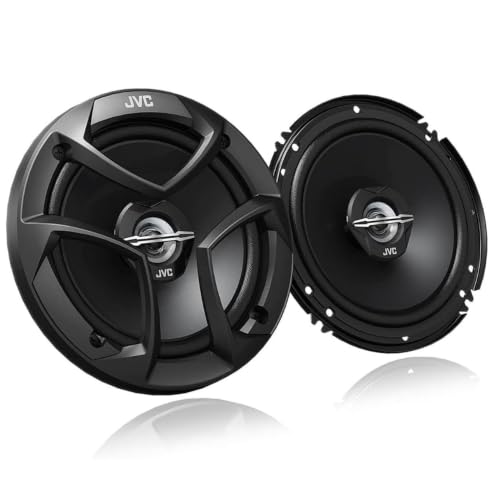
JVC CS-J620 6.5" Coaxial Speakers
What We Like
- Shallow 1-23/32" mounting depth
- Includes extension cables and mounting tabs
- Mica cone and PEI tweeter
Trade-offs
- 30W RMS limits high-volume headroom
- Coaxial design lacks separate crossover tuning
A shallow 1-23/32″ top mount depth lets these JVC CS-J620 speakers fit into tight factory spots where many other 6.5″ models won’t go. The included wire extension cables, screws, and mounting tabs make installation straightforward for anyone swapping out worn OEM speakers. With 92 dB sensitivity, they play loud enough on a standard head unit without needing an external amp, while the mica cone and PEI tweeter deliver clear mids and highs for everyday listening.
Modest power handling is the main trade-off: 30W RMS per speaker won’t satisfy someone chasing concert-level volume or deep bass. If you’re after a simple drop-in replacement that gets you better sound without cutting or drilling, this set makes that job about as easy as it gets.
Product photos
How We Evaluated Car Sound System Speakers
Our evaluation is research-based, drawing on manufacturer specifications, expert round-ups from automotive audio publications, and patterns in owner feedback across dozens of models. We focused on the specs that actually matter for real-world performance, not marketing claims.
The three most important criteria were fitment (mounting depth, diameter, and vehicle compatibility), power handling (RMS and peak ratings relative to real-world amplifier output), and sensitivity (how efficiently a speaker converts power into volume). For component systems, we also weighed installation complexity and crossover quality.
A research-led evaluation can’t replace hands-on listening, but it does reveal which speakers are engineered to work well together and which trade-offs you’ll need to accept. We prioritize models with consistent owner satisfaction and clear, verifiable specifications.
What To Look For In Car Sound System Speakers
Choosing the right speakers starts with knowing your car’s limitations and your own listening goals. Focus on fitment first, then match power and sensitivity to your system.
Match the speaker’s mounting depth and diameter to your vehicle’s door or dashboard openings. Then choose a sensitivity rating that works with your amplifier or head unit’s power output.
Fitment and Installation
The most expensive speakers are useless if they don’t fit. Measure your vehicle’s factory speaker openings: mounting depth is often the tightest constraint, especially in shallow doors. A shallow-mount speaker like the JVC CS-J620 (1-23/32″) or KICKER CS-Series makes installation much easier. Component systems require separate tweeter placement, which means cutting or modifying panels.
Power Handling and Sensitivity
Power handling (RMS) tells you how much continuous power a speaker can take, while sensitivity (dB) tells you how loud it gets per watt. High-sensitivity speakers (92dB and above) work well with factory head units. Lower-sensitivity speakers (85-88dB) need a dedicated amplifier to reach satisfying volume levels. The Pioneer Z-Series TS-Z65F has an 85dB sensitivity, meaning it needs more power than the Pioneer F-Series at 88dB.
Speaker Type: Coaxial vs. Component
Coaxial speakers combine woofer and tweeter in one unit for a simple drop-in upgrade. Component systems separate the drivers for better sound staging but require more installation work. Component systems like the Rockford Fosgate Punch P165-SI offer flexible tweeter mounting for a tailored soundstage, while coaxial options like the Skar Audio TX65 are easier to install.
- Measure your car’s speaker mounting depth and diameter before buying.
- Check your head unit or amplifier’s RMS power output per channel.
- Decide whether you want a simple drop-in (coaxial) or a more involved install (component).
- Look for UV-treated surrounds or rubber surrounds if your car gets hot or sits in direct sunlight.
A good rule of thumb: if your factory stereo sounds muddy at moderate volume, start with a high-sensitivity coaxial speaker before adding an amplifier.
Car Sound System Speakers Compared
The table below compares all ten speakers across the specs that matter most: mounting depth, RMS power, sensitivity, and speaker type.
| Product | Type | Size | Impedance |
|---|---|---|---|
| KICKER CS-Series CSC65 6.5" Coaxial Speakers | Coaxial (2-way) | 6.5-inch (160mm) | 4-ohm |
| JBL GTO629 6.5" Coaxial Speakers | Coaxial | 6.5-Inch | 3Ω |
| KICKER KS-Series 6.5" Component System | Component System | 6.5" | 4-Ohm |
| Rockford Fosgate Punch P165-SI Component System | 2-Way Component | 6.5" | 4 Ohms |
| JBL Stage 3637F & 3607CF Speaker Bundle | 2 coaxial + 2 component | 6.5" | N/A |
| Pioneer Z-Series TS-Z65F 6.5" Coaxial Speakers | 2-Way Coaxial | 6.5" | N/A |
| Rockford Fosgate Power T1675-S Component System | 2-Way Component | 6.75" | 4 Ohm |
| Pioneer F-Series TS-F1634R 6.5" Coaxial Speakers | 2-Way Coaxial | 6.5" | 4 ohms |
| Skar Audio TX65 6.5" Coaxial Speakers | 2-Way Coaxial | 6.5" | 4 Ohm |
| JVC CS-J620 6.5" Coaxial Speakers | 2-Way Coaxial | 6.5" | 4 ohms |
Frequently Asked Questions
What size car speakers do I need?
Measure the factory speaker opening in your door or dashboard. Most cars use 6.5-inch or 6×9-inch speakers, but some models use smaller drivers. Check your owner’s manual or measure the mounting depth and diameter yourself.
Do I need an amplifier for new car speakers?
It depends on the speakers. High-sensitivity speakers (88dB or higher) can sound good with a factory head unit. Lower-sensitivity speakers and component systems generally need an external amplifier to reach their potential.
What is the difference between coaxial and component speakers?
Coaxial speakers have the woofer and tweeter built into one unit for easy installation. Component systems separate the drivers for better sound staging but require more work to install.
How much should I spend on car speakers?
Budget options like the Pioneer F-Series offer noticeable improvement over factory speakers for less. Premium component systems and high-power coaxials cost more but deliver better clarity and volume. Focus on fitment and power matching first.
Can I install car speakers myself?
Yes, if you’re comfortable with basic wiring and trim removal. Coaxial speakers are the easiest to install. Component systems and bundles like the JBL Stage set require more work, including running wires and mounting tweeters.
The Bottom Line
For the vast majority of drivers, the KICKER CS-Series CSC65 is the best overall choice. It fits nearly any vehicle, delivers clean bass, and doesn’t require an external amplifier to sound good. It’s the upgrade that works without complicating your life.
If you’re on a tighter budget, the Pioneer F-Series TS-F1634R gives you a noticeable improvement over factory speakers for less. For those building a system around an amplifier, the JBL GTO629 or Rockford Fosgate Punch P165-SI offer more performance and flexibility.
The single most important factor is fitment. No matter how good a speaker sounds on paper, it can’t perform if it doesn’t fit your car. Measure first, then choose the speaker that matches your power and listening preferences.
