
10 Best Car Speakers For Bass And Sound Qualities in 2026
This post contains affiliate links. As an Amazon Associate, we earn from qualifying purchases.
For drivers who want deep, punchy bass without sacrificing vocal clarity, the KICKER KS-Series 6.5″ Coaxial Speakers earn the top spot with polypropylene cones for detailed midrange and rubber surrounds for durable, pounding bass. The Pioneer P.R.O. Series TS-M651PRO Component Speakers are our Best For High-SPL Builds, while the Pioneer A-Series Plus TS-A6991FH 6×9 Coaxial Speakers deliver the Best Large 6×9 Bass.
The challenge with car speakers is balancing low-end thump with clear highs and midrange, especially when working with factory head units and limited mounting space. Many budget speakers boost bass at the expense of detail, leaving vocals muffled or harsh at higher volumes.
This guide is research-based, drawing on manufacturer specifications, expert round-ups, and patterns in owner feedback to help you choose the right speakers for your vehicle and listening preferences. We break down the key specs and trade-offs for each of the ten picks.
Top 10 Car Speakers For Bass And Sound Qualities in the Market
Certain content that appears on this site comes from Amazon. This content is provided "as is" and is subject to change or removal at any time.
The Best Car Speakers For Bass And Sound Qualities, Reviewed
KICKER KS-Series 6.5" Coaxial Speakers

What We Like
- Polypropylene cones for detailed midrange
- Rubber surrounds for durable, pounding bass
- Minimal tweeter protrusion for easy fit
- Redesigned voice coils and crossovers
Trade-offs
- Coaxial design limits staging vs component sets
- Heavier than most 6.5-inch competitors at 5.7 pounds per pair
The KICKER KS-Series 6.5-inch coaxial speakers use internally dampened polypropylene cones and rubber surrounds, which the manufacturer says deliver outstanding midrange detail and pounding bass at concert-like volume levels. That combination makes them a strong choice for anyone who wants big, clean sound from a straightforward upgrade. The redesigned voice coils and crossovers are part of a complete overhaul from previous models, so you get modern engineering without needing to modify your vehicle’s factory openings.
If your car accepts 6.5-inch speakers, these KICKER KS-Series coaxials deliver concert-like volume with smooth, detailed sound, thanks to internally dampened polypropylene cones and rubber surrounds that handle pounding bass and clear midrange. The zero-tweeter-protrusion design means they fit most vehicles without modifications, so you can upgrade factory sound without cutting or drilling. Just keep in mind they’re a coaxial pair, not a component system, so the tweeter and woofer are fixed together in one unit.
Pioneer P.R.O. Series TS-M651PRO Component Speakers

What We Like
- Lightweight pulp cone minimizes distortion
- 500W max power for high-SPL builds
Trade-offs
- Component design requires separate crossover and tweeter mounting
- Requires separate crossover mounting for full component setup.
The trade-off is that these are component speakers, not a simple coaxial swap. You must mount the tweeter separately and wire in the included crossover, which adds installation time and requires careful placement. The frequency response drops off at 50 Hz, so you will need a subwoofer to reproduce deep bass below that point. If you are willing to put in the extra work, the payoff is a system that can handle the demands of pro-level audio builds.
Pioneer A-Series Plus TS-A6991FH 6×9 Coaxial Speakers

What We Like
- 5-way design for balanced sound
- 29 Hz low-end for deep bass
- 93 dB sensitivity for loud, clear playback
- 750W max power handling
Trade-offs
- Large 6×9 size limits fit to select vehicles
- Requires reading the owner's manual for full setup details
With a frequency response that reaches down to 29 Hz, these Pioneer 6×9 speakers can reproduce very low bass notes that many car speakers miss. The 5-way design uses separate drivers for different frequency ranges, which helps keep the sound accurate and balanced across the board. That means you get clear highs and a full low end without needing a separate subwoofer, as long as your vehicle has the space for a 6×9 speaker.
The trade-off is that these speakers need the right vehicle, their 6×9 size won’t drop into standard 6.5-inch openings without modification. Compared to the JBL Club 64 6.5-inch two-ways, the Pioneers offer far deeper bass extension (29 Hz vs. 48 Hz) and higher sensitivity, but the JBLs slide into more common factory locations.
JVC CS-J6930 6×9 3-Way Car Speakers

What We Like
- Carbon mica woofer for smooth bass
- Wide frequency response down to 30 Hz
- Includes grilles for protection
- Easy installation in car doors
Trade-offs
- Peak power rating is max, not continuous
- 3-way design can add complexity to tuning
The JVC CS-J6930 6×9 3-way speakers offer a frequency response that extends down to 30 Hz, which means they can reproduce low bass notes that many factory speakers miss. The carbon mica woofer handles mids and lows, while the polyetherimide dome tweeter adds treble clarity. For someone upgrading from stock speakers, these provide a noticeable improvement in sound range without requiring additional amplifiers or complex installation.
The 400-watt peak power rating is a maximum figure, not a continuous rating, so these speakers won’t handle sustained high-volume abuse like the Pioneer A-Series Plus TS-A6991FH, which has a 750-watt peak rating. However, for everyday listening at moderate volumes, the JVCs deliver solid performance that justifies their cost.
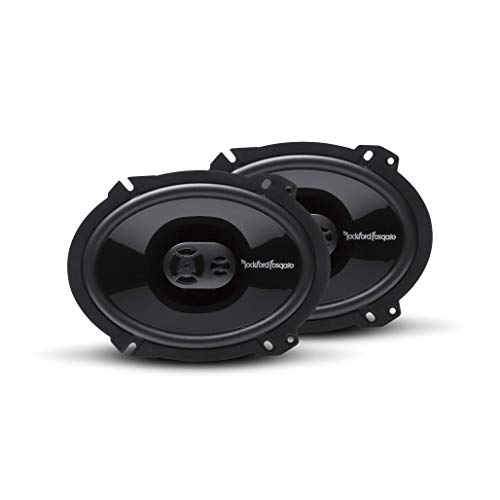
Rockford Fosgate P1683 Punch 6×8 Coaxial Speakers
What We Like
- FlexFit basket adjusts to OEM holes
- Includes mounting hardware and adapter plate
- Butyl rubber surround for accurate bass
- 3-way full-range design for clear highs
Trade-offs
- 6×8 size limits aftermarket speaker choices
- PEI tweeter can sound bright for some listeners
The FlexFit basket design uses adjustable slots instead of fixed holes, so the speaker shifts slightly to match your factory mounting holes without drilling or adapter headaches. The pair includes mounting hardware and an OEM adapter plate, making it a straightforward swap for vehicles that came with 6×8 speakers. The injection molded mineral filled polypropylene cone with a butyl rubber surround keeps bass tight and midrange clean, while the PEI dome tweeter with built-in crossover handles high frequencies without extra components. You get better sound without cutting door panels or rewiring.
The trade-off comes down to power and size. And while the 6×8 shape fits many OEM slots perfectly, it locks you into that specific size, you can’t swap in a round 6.5-inch speaker later without adapters.
JBL Club 64 6.5" Two-Way Car Speakers

What We Like
- Plus One cone boosts low-frequency output
- Edge-driven silk dome tweeter for smooth highs
- Adjustable tweeter level (0dB or +3dB)
- UV-resistant polypropylene cone for durability
Trade-offs
- Peak power lower than some competitors in guide
- 3-ohm impedance limits compatibility with standard car stereos.
An edge-driven silk dome tweeter handles the top end, extending high-frequency response without the harshness common to many w-dome designs. This means vocals and cymbal strikes remain clear and natural even when you turn up the volume. The tweeter output level can be set to 0dB or +3dB, letting you fine-tune the system’s linearity depending on where the speakers are mounted in the vehicle.
Compared to the KICKER KS-Series 6.5-inch coaxials, the JBL Club 64 offers a higher sensitivity and that adjustable tweeter control, but the KICKERs stick with a more universal 4-ohm design.
Product photos
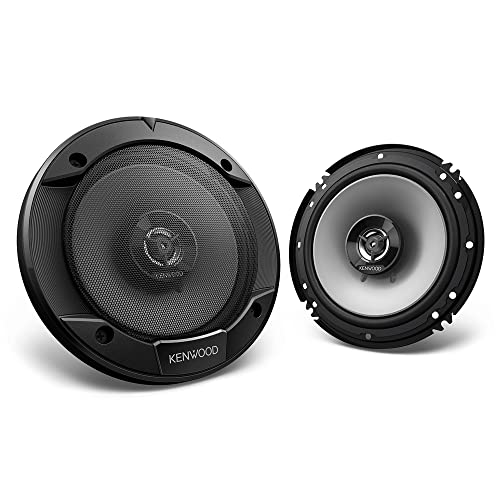
Kenwood KFC-1666S 6.5" 2-Way Speakers
What We Like
- Polypropylene woofer with treated cloth surround
- Includes grilles for quick installation
- 300W peak power handling
- Wide 40-22,000 Hz frequency range
Trade-offs
- 2-way design limits high-frequency detail vs. 3-way
- Peak power rating, not RMS, so real output is lower
A 300-watt peak power rating and a polypropylene woofer with a treated cloth surround give these Kenwoods a solid foundation for punchy bass without distortion. The included grilles mean you can mount them right out of the box, skipping the extra step of finding or buying covers. This is a straightforward upgrade for someone who wants better low-end response and clearer highs without wrestling with complex wiring or custom fitting.
The 90 dB sensitivity means these speakers convert power into sound at a standard efficiency level, so they work fine with most factory or aftermarket head units. Compared to the Pioneer TS-M651PRO component set, these coaxials are simpler to install but won’t deliver the same soundstage separation for critical listening. If you value a quick, fuss-free swap over absolute audiophile detail, these Kenwoods hit the mark.
Product photos
KICKER DSC6930 6×9 3-Way Speakers

What We Like
- 30 Hz low end for deep bass
- 92 dB sensitivity for efficient output
- 360W peak power handling
- 3-way design for wide coverage
Trade-offs
- 6×9 size limits fit in some vehicles
- Heavier than many 6.5" speakers at 7.9 lbs
A frequency response that drops to 30 Hz means these KICKER 6x9s can produce bass notes you feel in your chest, not just hear, rare for a coaxial speaker without a separate subwoofer. With a sensitivity rating of 92 dB, they convert power into volume efficiently, which is useful when driving them from a factory head unit. The 3-way design uses separate drivers for different frequency ranges, a common approach for improving sound clarity over a basic two-way speaker.
The 6×9 size requires a specific mounting hole, so these speakers will not fit vehicles that only accept smaller round speakers. At 7.9 pounds per pair, they are heavier than some alternatives like the Pioneer A-Series Plus TS-A6991FH (2.8 lbs), which means the mounting surface needs to be sturdy. For drivers who can accommodate the size and weight, the low-frequency extension is a key advantage over many full-range speakers.
Product photos
CT Sounds Meso 6.5" Coaxial Car Speakers

What We Like
- Fiberglass cone for crisp sound
- Nitrile butadiene rubber surround for durability
- Silk-dome tweeters with CCAW voice coil
- Engineered for high tonal accuracy
Trade-offs
- 75W RMS per speaker limits high-volume use
- Not suited for high-SPL builds or pro-level competition systems
The CT Sounds Meso 6.5″ coaxial speaker uses a fiberglass cone paired with a nitrile butadiene rubber surround, a combination that delivers crisp, well-defined sound without the muddiness you often get from cheaper paper or polypropylene cones. The attached silk-dome tweeter uses a CCAW voice coil and a neo magnet, which the manufacturer says helps recreate vocals and high frequencies clearly. This makes the Meso a strong fit for anyone who values tonal accuracy and balanced mid-bass, as the speakers are engineered for that purpose. It’s a speaker designed for listeners who appreciate clarity in their music.
At 75W RMS per speaker, the Meso is designed for clean, accurate sound rather than competing with high-SPL builds. Owners who pair these with a clean amp and avoid clipping will get balanced mid-bass and crisp highs from the fiberglass cone and rubber surround. For everyday listening that prioritizes tonal accuracy over sheer volume, this speaker delivers.
Product photos
Skar Audio TX65 6.5" Elite Coaxial Speakers

What We Like
- Silk dome tweeter for smooth highs
- 1.25" copper voice coil for power handling
- TPE surround for durability
Trade-offs
- 89 dB sensitivity needs more amplifier power
- 6.4 lbs per pair adds weight for mounting
The trade-off comes with that 89 dB sensitivity rating, which is lower than many competitors like the JBL Club 64 (93 dB). That means these Skar speakers will need a decent amplifier to wake up and perform their best; running them off a basic head unit will leave you underwhelmed.
Product photos
How We Evaluated Car Speakers For Bass And Sound Qualities
Our evaluation starts with the technical specs that matter most for bass and sound quality: frequency response range, sensitivity rating, power handling, and cone material. We cross-reference these with manufacturer documentation and expert commentary from automotive audio forums and industry publications to understand real-world performance.
The three criteria that mattered most were low-frequency extension (how deep the bass goes), sensitivity (how loud the speakers play with limited power), and cone/surround construction (which directly affects bass accuracy and durability). We also considered mounting depth and size compatibility since a speaker that doesn’t fit is useless.
The honest limit of a research-led evaluation is that we can’t hear these speakers in your specific vehicle. Acoustics vary wildly between car models, and personal taste in sound signature differs. Use this guide to narrow your options, then listen to a similar setup if possible.
What To Look For In Car Speakers For Bass And Sound Qualities
Finding the right car speakers means matching your listening goals with your vehicle’s physical constraints and your audio system’s power output.
Choose speakers with a low frequency response below 40 Hz for deep bass. Look for a sensitivity of 90 dB or higher so they play loudly from a factory stereo. Durable surrounds, like rubber or butyl rubber, ensure long-lasting performance.
Frequency Response and Low-End Extension
The frequency response range tells you how low the speaker can go. For deep, satisfying bass without a separate subwoofer, look for speakers with a low-end extension of 40 Hz or lower. The Pioneer A-Series Plus TS-A6991FH reaches down to 29 Hz, while the JVC CS-J6930 and KICKER DSC6930 both hit 30 Hz. A lower number means deeper bass, but remember that a 6×9 speaker will naturally produce more bass than a 6.5-inch due to its larger cone area.
Sensitivity and Power Handling
Sensitivity, measured in dB, indicates how efficiently a speaker converts power into sound. Higher sensitivity (93 dB or more) means louder output from a factory head unit without external amplification. The Pioneer A-Series Plus TS-A6991FH leads at 93 dB. If you’re running speakers off a factory stereo, aim for 90 dB or higher. If you have an external amplifier, you can use lower-sensitivity speakers like the Skar Audio TX65 (89 dB) and still get excellent volume.
Cone Material and Surround Construction
The cone material affects sound character and durability. Polypropylene cones offer a good balance of weight and rigidity for detailed midrange. Fiberglass cones, like those in the CT Sounds Meso, provide crisp, accurate sound. The surround material is critical for bass: rubber and butyl rubber surrounds are more durable and produce tighter, more accurate bass than foam surrounds, which degrade faster. Look for treated cloth or rubber surrounds for long-term reliability.
- Check your vehicle’s speaker size and mounting depth before buying.
- Match the speaker’s impedance (ohms) to your stereo or amplifier.
- Consider coaxial speakers for easy installation or component sets for better staging.
- Look for included grilles if your vehicle doesn’t have factory speaker covers.
- Read the owner’s manual for your vehicle to confirm speaker opening dimensions.
A good rule of thumb: if you want bass that hits hard, prioritize low frequency response and rubber surrounds over peak power ratings.
Car Speakers For Bass And Sound Qualities Compared
The table below compares the ten speakers across the specifications that matter most for bass and sound quality, including frequency response, sensitivity, and power handling.
| Product | Speaker Size | Impedance | Frequency Response |
|---|---|---|---|
| KICKER KS-Series 6.5" Coaxial Speakers | 6.5" | 4 Ohm | N/A |
| Pioneer P.R.O. Series TS-M651PRO Component Speakers | 6.5" | N/A | 50 Hz, 18 kHz |
| Pioneer A-Series Plus TS-A6991FH 6×9 Coaxial Speakers | 6" x 9" | N/A | 29 Hz, 31 kHz |
| JVC CS-J6930 6×9 3-Way Car Speakers | 6"x9" | N/A | 30-22,000 Hz |
| Rockford Fosgate P1683 Punch 6×8 Coaxial Speakers | 6×8 inches | 4 Ohm | N/A |
| JBL Club 64 6.5" Two-Way Car Speakers | 6.5" | 3.0 ohms | 48Hz – 21kHz |
| Kenwood KFC-1666S 6.5" 2-Way Speakers | 6-1/2" | 4 ohms | 40-22,000 Hz |
| KICKER DSC6930 6×9 3-Way Speakers | 6×9" | 4 Ohms | 30-20k Hz |
| CT Sounds Meso 6.5" Coaxial Car Speakers | 6.5" | 4 Ohm | N/A |
| Skar Audio TX65 6.5" Elite Coaxial Speakers | 6.5" | 4 Ohm | 45 Hz, 20,000 Hz |
Frequently Asked Questions
What size car speakers are best for bass?
6×9 speakers generally produce the deepest bass because their larger cone area moves more air. The Pioneer A-Series Plus TS-A6991FH and KICKER DSC6930 both reach down to 30 Hz or lower, rivaling small subwoofers. If your vehicle only accepts round speakers, 6.5-inch models with rubber surrounds and low frequency response can still deliver strong bass.
Do I need an amplifier for good bass from car speakers?
An amplifier helps, but it’s not always required. Speakers with high sensitivity (93 dB or more) can produce satisfying bass from a factory head unit. The Pioneer A-Series Plus TS-A6991FH and KICKER DSC6930 are both efficient enough for stock systems. For lower-sensitivity speakers like the Skar Audio TX65 (89 dB), an external amplifier is recommended to achieve their full bass potential.
What is the difference between coaxial and component speakers for bass?
Coaxial speakers have the woofer and tweeter in one unit, making installation simple and offering good bass for a direct factory replacement. Component speakers separate the woofer and tweeter for better staging but require more complex installation. For bass specifically, both types can perform well, but component systems often allow for larger woofers that produce deeper low-end.
How do I know if car speakers will fit my vehicle?
Check your vehicle’s factory speaker size (typically 6.5-inch, 6×9, or 6×8), mounting depth, and bolt pattern. The Rockford Fosgate P1683 Punch features a FlexFit basket that adjusts to fit various OEM hole patterns, making it ideal for 6×8 slots. Always measure the depth behind your factory speaker grille to ensure the new speaker doesn’t hit the window mechanism.
Which speaker material is best for bass?
Rubber surrounds are the best choice for bass because they’re durable and produce tight, accurate low-end without distortion. The KICKER KS-Series and Rockford Fosgate P1683 both use rubber surrounds. Cone material matters less for bass than surround quality, but polypropylene and fiberglass cones offer a good balance of rigidity and weight for clear bass response.
The Bottom Line
The KICKER KS-Series 6.5″ Coaxial Speakers are the best overall choice for most drivers seeking a simple factory replacement that delivers strong bass and clear detail at high volumes. Their polypropylene cones and rubber surrounds provide a winning combination of midrange clarity and durable, pounding low-end that works well with factory or aftermarket systems.
For budget-conscious buyers, the JVC CS-J6930 6×9 3-Way Speakers add deeper bass and clearer highs without requiring extra equipment. Enthusiasts building a high-output system should look to the Pioneer P.R.O. Series TS-M651PRO Component Speakers, which handle 500W max power for serious SPL builds.
The single most important factor when buying car speakers for bass and sound quality is matching the speaker’s frequency response and sensitivity to your vehicle’s power source and listening habits. Choose a speaker that fits your car first, then prioritize low-end extension and surround material for the bass you want.
