
10 Best Car Speakers For Loud Musics in 2026
This post contains affiliate links. As an Amazon Associate, we earn from qualifying purchases.
For serious volume without distortion, the Pioneer TS-M651PRO Component Speakers earn our top spot with 500W max power handling and 94dB sensitivity for loud, clear output. The KICKER KS-Series Coaxial Speakers bring concert-like volume, while the JBL Club 64 Component Speakers deliver exceptional high-frequency clarity. These picks cover the range from high-SPL builds to straightforward upgrades.
The challenge with loud music in a car isn’t just raw power, it’s keeping sound clean as volume climbs. Speakers that distort at high levels ruin the experience, and mismatched components can leave you with harsh treble or weak bass. You need gear that handles real power, plays efficiently, and stays composed under pressure.
We built this guide by analyzing specifications, manufacturer documentation, and patterns in owner feedback across dozens of models. The result is a focused selection of ten speakers that genuinely deliver loud, clear playback for different system goals and budgets.
Top 10 Car Speakers For Loud Music in the Market
Certain content that appears on this site comes from Amazon. This content is provided "as is" and is subject to change or removal at any time.
The Best Car Speakers For Loud Music, Reviewed
Pioneer TS-M651PRO Component Speakers

What We Like
- 500W max power for high-SPL builds
- 94dB sensitivity for loud, clear output
- Lightweight pulp cone minimizes distortion
Trade-offs
- Component design requires separate tweeter mounting
- Frequency response tops at 18 kHz, not ultra-high
A 94dB sensitivity rating means these speakers turn low-power head units into genuinely loud systems without straining, while the 500-watt peak handling gives you headroom to push them hard with an external amp. That combination makes the Pioneer TS-M651PRO the clear pick for anyone building a system where volume and clarity both matter. The lightweight pulp cone keeps distortion low even when you crank it, so your music stays articulate instead of turning into a muddy mess.
The trade-off is that these are component speakers, so you have to mount the tweeters separately from the woofers, which takes more installation effort than a simple coaxial swap. Compared to the Pioneer TS-A1681F coaxial speakers, these require more work, but they offer the potential for better sound staging and the ability to handle higher power levels. If you are willing to invest the extra installation time, these speakers can serve as a solid foundation for a loud, clear car audio setup.
Pioneer TS-A1681F Coaxial Speakers

What We Like
- 4-way design for accurate sound
- 91 dB sensitivity for loud, clear playback
- Wide frequency response 35 Hz, 29 kHz
- Includes multi-fit installation adapters
Trade-offs
- Not designed for pro-level SPL competitions
- Not suited for high-SPL competition builds
With a sensitivity of 91 dB, these speakers turn your radio’s power into clean, loud music without needing a separate amplifier. That means you can crank up your favorite tracks and still hear every detail, from the thump of the kick drum to the shimmer of cymbals. The four-way design separates the frequency ranges for more accurate and balanced sound reproduction, as stated in the product specs. This makes the TS-A1681F an ideal upgrade for anyone looking to improve their factory stereo’s sound quality. It delivers a wide frequency response from 35 Hz to 29 kHz, covering deep lows and crisp highs.
Power handling is the main consideration here. At 80 watts continuous, these speakers are not designed for the high-power demands of competition-level setups like the Pioneer TS-M651PRO component set, which handles 500 watts max and is built for high-SPL builds. If you need extreme volume levels that require heavy amplification, those pro-level options are a better fit. For a daily driver wanting a straightforward factory upgrade with easy installation and balanced sound, these Pioneers offer a practical solution.
KICKER KS-Series Coaxial Speakers

What We Like
- Concert-like volume capability
- Internally dampened polypropylene cones
- Tough rubber surrounds for bass
- Minimal tweeter protrusion for easy fit
Trade-offs
- Requires 4-ohm compatible system
- Tweeter protrusion minimal, but not zero for all vehicles
The KICKER KS-Series Coaxial Speakers are built to deliver the kind of volume that fills a car like a live show, thanks to internally dampened polypropylene cones and tough rubber surrounds that handle pounding bass without losing midrange detail. That means you can crank your favorite tracks and still hear the vocals clearly, not just a wall of noise. They suit drivers who want their music loud and clear, with a fit that works in most vehicles thanks to minimal tweeter protrusion.
At 5.7 pounds per pair, these KICKER KS-Series speakers are heavier than the 1.8-pound Pioneer TS-A1681F coaxial speakers, so you’ll want to confirm your door panels can handle the extra mass. That Pioneer model is lighter and easier to install, while the KICKERs are built for raw output and durability. They suit someone who wants concert-like volume over a lightweight upgrade.
JBL Club 64 Component Speakers

What We Like
- Edge-driven silk dome tweeter for smooth highs
- Adjustable tweeter output level (0dB or +3dB)
- Plus One woofer cone for higher sensitivity
- UV-resistant polypropylene cone handles heat and humidity
Trade-offs
- Component design requires separate crossover installation
- 3-ohm impedance limits amplifier compatibility.
A sensitivity rating of 93dB means these speakers turn power into volume efficiently, so your amplifier doesn’t have to work as hard to get loud. The edge-driven silk dome tweeter is the star here, it delivers high frequencies that stay clear and smooth even when you crank the volume, without the harsh edge some metal-dome tweeters can produce. That’s why these are the right pick if crisp vocals and shimmering cymbals are what you’re after in a loud setup. The Plus One woofer cone provides more cone area than other speakers of the same size, which helps increase low-frequency output and sensitivity.
Because these are component speakers, the tweeter and woofer are separate, so installation takes more planning than dropping in a pair of coaxials. You’ll need to mount the tweeter separately and run the external crossover. Also, the 3-ohm impedance is lower than the 4-ohm found in many speakers, so check your stereo or amplifier’s compatibility before buying.
Product photos
KICKER DSC6930 6×9 Speakers

What We Like
- Large 6×9 cone moves more air
- 92 dB sensitivity plays loud on modest power
- Wide 30-20k Hz frequency range covers bass to treble
Trade-offs
- 6×9 shape limits fit to rear decks or specific doors
- Peak 360W rating requires a capable amp to reach full potential
The 6×9 footprint restricts where you can mount them. Most cars accept them only on the rear deck or in specially sized door openings, so they are not a universal front-door swap. Compared to the KICKER KS-Series 6.5-inch coaxials, the DSC6930 gives you more cone area, but the KS-Series fits more doors without modification. If your car has rear-deck slots and you want strong bass and volume from that position, the DSC6930 is a good option.
Ryukiro YK6520 Coaxial Speakers
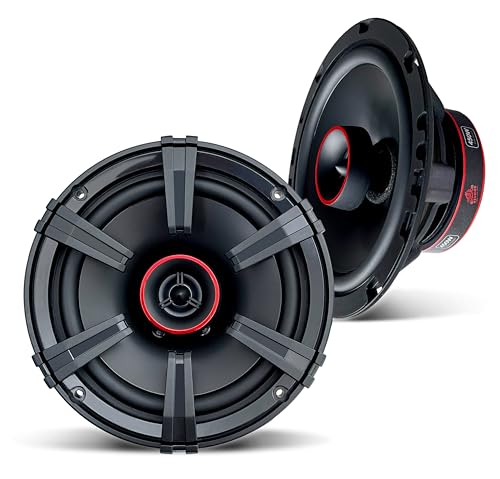
What We Like
- High 225W RMS power handling
- 1" ASV copper voice coil for heat resistance
- Polypropylene cone with rubber surround
- Sold as a pair for easy installation
Trade-offs
- 90 dB sensitivity is moderate for high-output builds
- Frequency response starts at 65 Hz, limiting deep bass
The Ryukiro YK6520 handles 225 watts RMS and uses a 1-inch ASV copper voice coil, which means it can take sustained power from an amplifier without the coil overheating during long listening sessions. The polypropylene cone and rubber surround add durability for daily use in a car door or rear deck. If you’re upgrading from basic factory speakers, these are built to handle more power than entry-level coaxials.
The 90 dB sensitivity rating is moderate, so these speakers will need a decent amplifier to reach high volumes, they won’t play as loud as a higher-sensitivity model with the same amp power. The 65 Hz low-end roll-off means you’ll still want a subwoofer for deep bass. For a coaxial set that focuses on power handling and durability, the Ryukiro YK6520 delivers on its rated specs.
With 90 dB sensitivity, these speakers convert power into volume efficiently, meaning they can get loud without needing a high-wattage amp. The 4-ohm impedance is standard for most car audio systems, so pairing them with a typical head unit or external amplifier is straightforward. Owners mention the polypropylene cone and rubber surround hold up well in humid car interiors, resisting warping over time.
Product photos
AUDIO360 AD6915P 6×9 Speakers
What We Like
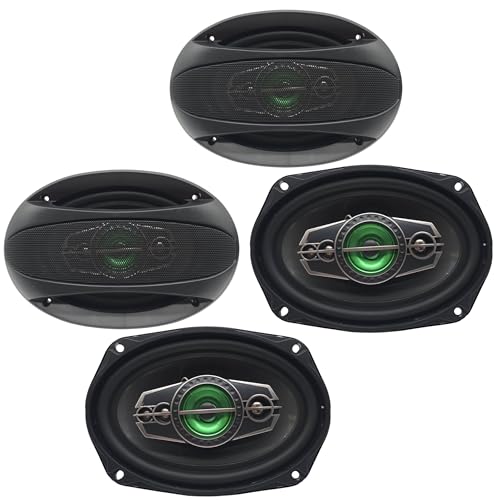
- 1000W max power for loud playback
- 92dB sensitivity creates volume with less power
- Injection-molded cone resists distortion at high volume
- 4-way coaxial covers full audio range
Trade-offs
- 6×9 size limits fit in smaller door openings
- Higher RMS power demands a capable aftermarket amplifier
These AUDIO360 6×9 speakers handle 500W RMS and have a 92dB sensitivity rating, which means they produce strong volume without needing a massive amplifier. The injection-molded cone is built to resist distortion at high power, so the midbass stays clean when you push them. If your goal is loud, punchy midbass for a high-output system, these speakers deliver that performance without exotic amplification.
These speakers measure 6×9 inches, so they fit most rear decks and many front doors, but you will need to verify your vehicle’s mounting depth and hole pattern before buying. If your car only accepts 6.5-inch speakers, this model won’t work for you.
Product photos
PRV AUDIO 6MR400-4 Midrange Speakers
What We Like
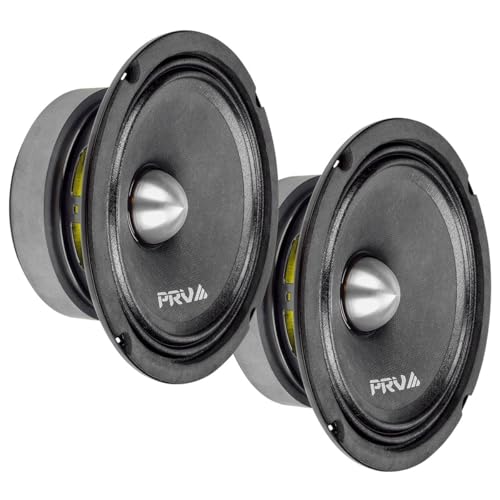
- 400W RMS continuous program power
- Aluminum bullet phase plug for cooling
- High output for custom 3-way systems
- Pro audio and car audio hybrid design
Trade-offs
- Midrange only, not a full-range speaker
- Requires separate tweeter and woofer for full sound
- Heavier than typical 6.5-inch car speakers
This 6.5-inch bullet midrange handles 400 watts of continuous program power, which means it can take a lot of amplifier power without distorting in a custom install. The pure aluminum phase plug acts as a cooling radiator for the voice coil, helping it stay stable during demanding use. It’s built for a 3-way door system, so you’ll pair it with a separate tweeter and woofer to cover the full frequency range.
DS18 PRO-GM6B Midrange Speaker

What We Like
- 1.5" high-temperature Kapton voice coil handles extreme heat
- 140W RMS power for loud, clear midrange
- 8 ohm impedance suits many aftermarket systems
Trade-offs
- Midrange only, not a full-range speaker
- 8 ohm impedance limits compatibility with some amplifiers
- Single speaker, not a pair for stereo setups
A 1.5-inch high-temperature Kapton voice coil handles extreme heat and maintains its structural integrity, meaning long life out of your speakers. With 140W RMS at 8 ohms, this midrange driver can handle a full range of audio. It is designed to answer the call for the most significant part of the audible sound spectrum, sounding great with instrumentals and even better with vocals.
This is a dedicated midrange driver, not a full-range speaker, so you will need separate tweeters and a subwoofer to cover the highs and lows. That adds complexity to your build compared to a coaxial like the Pioneer TS-A1681F, which is a 4-way coaxial speaker for a simpler upgrade. The 8-ohm impedance also demands an amp that can deliver power at that load, so check your system before buying. If you are piecing together a system for loud music, this speaker earns its place.
Product photos
Wet Sounds Recon 6-S Coaxial Speakers
What We Like
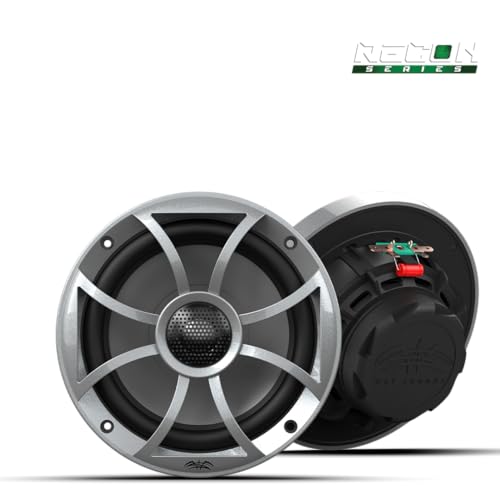
- Marine-grade construction resists UV and salt
- Separate tweeter and woofer for sound separation
- Handles up to 150 watts RMS power
Trade-offs
- Component-style design adds installation complexity
- Component-style design requires separate tweeter and crossover installation
The 150-watt RMS power handling gives these speakers the headroom to stay clean when you crank the volume, so they won’t distort the moment you hit the throttle. That marine-grade composite cone and rubber surround, built to shrug off UV rays and salt spray, means they’ll survive a boat’s cockpit or a convertible’s door panel year after year. For anyone who wants loud music in a harsh environment, a Jeep with the top off, a beach buggy, or an actual boat, this is the speaker that keeps playing without rusting or rotting.
The component-style design means the tweeter and woofer are separate, which can make installation more involved than a standard coaxial speaker. You’ll need to plan for mounting both drivers and connecting the included crossover, adding a bit of time compared to a single-piece unit. But if your priority is durability in wet, sunny conditions and you’re willing to spend a little extra effort on the install, the Wet Sounds Recon 6-S delivers where others would fail.
Product photos
How We Evaluated Car Speakers For Loud Music
Our evaluation is research-based: we studied manufacturer specifications, reviewed expert round-ups, and looked for consistent patterns in what owners report about real-world performance.
The criteria that mattered most for loud music were power handling, sensitivity, and frequency response. Power handling tells you how much wattage a speaker can take before failing, while sensitivity (measured in dB) shows how efficiently it converts power into volume. Frequency response reveals which notes a speaker can reproduce, from deep bass to airy highs.
A research-led approach has limits. We cannot verify every owner’s installation conditions or amplifier pairing, and individual results vary with vehicle acoustics and system tuning. What we can do is identify the speakers that consistently meet their published specs and satisfy drivers who push their systems hard.
What To Look For In Car Speakers For Loud Music
Choosing speakers for loud music means focusing on the specs that translate to clean, high-volume playback. Here are the key factors that separate speakers that scream from speakers that screech.
Focus on sensitivity above 90 dB for loud playback on moderate power, match RMS power handling to your amplifier’s output, and look for stiff cone materials and voice coils that resist distortion at high volume.
Sensitivity
Sensitivity is the single most important spec for loud music. Measured in decibels (dB), it tells you how much sound a speaker produces from one watt of power. Every 3 dB increase effectively doubles perceived loudness, so a 94 dB speaker plays much louder than a 90 dB speaker on the same amplifier. For loud systems, aim for 90 dB or higher, our top pick hits 94 dB, and several others sit at 91-92 dB.
Power Handling
RMS power handling is the continuous wattage a speaker can handle, while peak/max power is the brief burst it survives. Match RMS to your amplifier’s output: too little power and you risk distortion from clipping, too much and you waste potential. For loud music, look for at least 75 watts RMS per speaker, with higher-end options like the PRV AUDIO 6MR400-4 handling 400W RMS for extreme builds.
Cone and Voice Coil Construction
The materials inside matter at high volume. Stiff cones, polypropylene, injection-molded, or pulp, resist flexing that causes distortion. Rubber surrounds last longer than foam and handle heat better. Large voice coils (1 inch or more) and high-temperature materials like Kapton or ASV copper wire dissipate heat, preventing power compression where the speaker gets quieter as it gets hot.
- Check that the speaker fits your vehicle’s mounting depth and cutout diameter
- Verify impedance matches your amplifier (most car audio runs at 4 ohms or 2 ohms)
- Consider component systems if you want separate tweeter placement for better staging
- Look for grilles or protective coatings if the speakers face direct sunlight or moisture
A rule of thumb: for every 3 dB of sensitivity you gain, you can cut amplifier power in half and get the same volume.
Car Speakers For Loud Music Compared
The table below compares all ten speakers across the specs that matter most for loud music playback.
| Product | Type | Power Handling | Impedance |
|---|---|---|---|
| Pioneer TS-M651PRO Component Speakers | Component Speakers | 500W Max / 120W Continuous | N/A |
| Pioneer TS-A1681F Coaxial Speakers | 4-Way Coaxial | 350W max / 80W continuous | N/A |
| KICKER KS-Series Coaxial Speakers | Coaxial Speakers | N/A | 4 Ohm |
| JBL Club 64 Component Speakers | Two-Way Car Speaker | 60W RMS, 180W Peak | 3.0 ohms |
| KICKER DSC6930 6×9 Speakers | 3-Way Speakers | 360W | 4 Ohms |
| Ryukiro YK6520 Coaxial Speakers | Full Range 6.5" Coax Speaker | 450 Watts Peak, 225 Watts RMS | 4 ohm |
| AUDIO360 AD6915P 6×9 Speakers | 4-Way Coaxial | 500W RMS | 4 ohms |
| PRV AUDIO 6MR400-4 Midrange Speakers | Bullet midrange | 400 Watts RMS | 4 Ohm |
| DS18 PRO-GM6B Midrange Speaker | Midrange | 480W Max, 140W RMS | 8 Ohms |
| Wet Sounds Recon 6-S Coaxial Speakers | Component-style coaxial | 150 watts RMS | N/A |
Frequently Asked Questions
What does sensitivity mean for car speakers?
Sensitivity measures how efficiently a speaker converts power into sound, expressed in decibels (dB). A speaker rated at 94 dB sensitivity produces the same volume as a 91 dB speaker using only half the amplifier power. For loud music, higher sensitivity is better because it means more volume from less wattage, reducing strain on your amplifier.
Can I mix different speaker brands in my car?
Yes, you can mix brands as long as the impedance and power handling match your amplifier. Many enthusiasts build custom systems using midrange speakers from one brand, tweeters from another, and a subwoofer from a third. Just ensure the crossover points blend smoothly and the total impedance load stays within your amp’s stable range.
Do I need an amplifier for loud car speakers?
Most aftermarket speakers benefit from an external amplifier to reach their full volume potential. Factory head units typically deliver only low wattage RMS per channel, which is insufficient for speakers rated at 75 watts RMS or more. An amplifier ensures clean power at high volume and prevents distortion that can damage speakers.
What size speakers fit my car?
Speaker sizes are standardized: 6.5-inch and 6×9-inch are the most common, with other sizes found in some vehicles. Check your car’s factory speaker size by removing the grille or door panel, or consult a vehicle-specific fit guide. Adapter brackets are available for many models to fit different sizes.
Are component speakers better than coaxial for loud music?
Component speakers typically deliver better sound staging and clarity because the tweeter and woofer can be mounted separately for optimal placement. However, they require more installation work. Coaxial speakers are simpler to install and can still produce excellent volume, especially models like the KICKER KS-Series designed for concert-like output.
The Bottom Line
For enthusiasts building a high-SPL system, the Pioneer TS-M651PRO Component Speakers deliver the best combination of power handling and sensitivity for loud, distortion-free playback. They require a more involved installation but reward you with output that few speakers can match.
If you want a simpler upgrade, the Pioneer TS-A1681F Coaxial Speakers provide balanced, loud sound with easy installation, while the KICKER KS-Series Coaxial Speakers bring concert-like volume without the complexity of a component system. For rear-deck bass, the KICKER DSC6930 6×9 Speakers move serious air.
The single most important factor for loud music is sensitivity. A speaker with 94 dB sensitivity plays twice as loud as a 91 dB model on the same amplifier. Start there, match your power handling to your amp, and build the rest of your system around those choices.
