
10 Best Deep Cycle Batteries in 2026
This post contains affiliate links. As an Amazon Associate, we earn from qualifying purchases.
The Renogy 12V 100Ah AGM Deep Cycle Battery wins as our best overall pick because it delivers safe, stable AGM chemistry with a low 3% monthly self-discharge. That makes it a reliable workhorse for RV and cabin owners. For cold-weather off-grid use, the VATRER POWER 12V 300Ah LiFePO4 Battery offers self-heating and app monitoring. Boaters should look at the Renogy 12V 100Ah Trolling Motor LiFePO4 Battery for its IP67 waterproof rating.
Choosing a deep cycle battery means balancing chemistry, weight, capacity, and how you plan to charge and discharge it day after day. AGM batteries are durable and forgiving, while LiFePO4 lithium batteries offer lighter weight and deeper usable capacity but often require specific chargers and temperature management.
This guide ranks 10 top deep cycle batteries based on manufacturer specifications, expert analysis of chemistry types, and patterns in owner feedback. We focus on real-world trade-offs so you can match a battery to your specific setup.
Top 10 Deep Cycle Batteries in the Market
Certain content that appears on this site comes from Amazon. This content is provided "as is" and is subject to change or removal at any time.
The Best Deep Cycle Batteries, Reviewed
Renogy 12V 100Ah AGM Deep Cycle Battery

What We Like
- Safe, stable AGM chemistry
- Low 3% monthly self-discharge
- Supports series and parallel connections
Trade-offs
- Heavier than lithium alternatives at 63.9 lb
- Limited to 4 batteries in parallel
A 1100A max discharge current (5 seconds) means this battery can surge-start a fridge, microwave, or coffee maker without breaking a sweat, making it a reliable workhorse for off-grid setups, RVs, and cabins. The AGM chemistry is sealed and stable, so you don’t need to worry about spills or internal troubleshooting. That simplicity, combined with a self-discharge rate under 3% per month at 77°F, means it holds its charge during storage. This is the battery for someone who wants proven, straightforward power without the learning curve of newer chemistries.
The trade-off is weight: at 63.9 pounds, it’s noticeably heavier than a comparable LiFePO4 battery like the LiTime 12V 100Ah (21 pounds), so you’ll want a sturdy mounting spot and a hand truck for installation.
Product photos
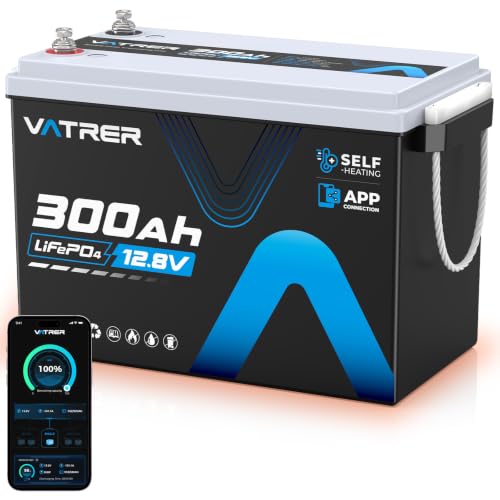
VATRER POWER 12V 300Ah LiFePO4 Battery
What We Like
- Self-heating below 0°C for winter use
- APP monitoring of capacity, voltage, faults
- Built-in 200A BMS with full protections
- Supports solar, generator, and lithium charger
Trade-offs
- At 54.7 lb, it is heavy to move
- Not suitable for series connection in golf carts
- Requires 10A charging current to activate heating
A 300Ah capacity means this battery can power a refrigerator, lights, and a microwave for extended periods, though exact runtime depends on the load. The self-heating feature is the standout. Once the temperature drops below freezing and a charger supplies at least 10A, the BMS activates an internal heating film until the battery warms to 5°C, then switches back to normal charging. That makes it a practical choice for cold-weather RV camping or off-grid cabins. The dedicated app provides real-time data on remaining capacity, voltage, current, and fault alerts, so you can monitor the battery’s status remotely.
Weight and size are the main drawbacks. You will want a secure mounting spot and possibly a helper to lift it into place. It also cannot be wired in series for golf cart use, so if that is your application, look elsewhere.
Product photos
LiTime 12V 100Ah LiFePO4 RV Battery

What We Like
- Weighs 1/3 less than AGM
- 100% usable capacity vs. 60% for AGM
- Grade-A cells with protective BMS
- Expandable up to 20.48kWh
Trade-offs
- Not compatible with MerCruiser/Mercury motors without current regulator
- No Bluetooth or app monitoring included
A 1.28kWh capacity that is fully usable, unlike AGM batteries where you only get about 60% before damaging them, means this LiTime delivers real power for your RV lights, fridge, and electronics without the weight penalty. At 21 pounds, it is about one-third lighter than a typical Group 24 AGM battery. That makes a noticeable difference when you’re loading gear or trying to keep tongue weight in check. The built-in BMS watches over the Grade-A cells to prevent overcharge or overdischarge, so you can trust it through years of weekend trips and cross-country adventures alike.
This battery lacks the Bluetooth monitoring you get with the HeyFuture 12V 100Ah LiFePO4, so you won’t be checking state of charge from your phone. It also won’t work with MerCruiser or Mercury outboards unless you add a current regulator, which is a specific limitation for boaters. But for RV owners who want a drop-in replacement that’s lighter, lasts longer, and can be expanded later, the LiTime delivers where it counts.
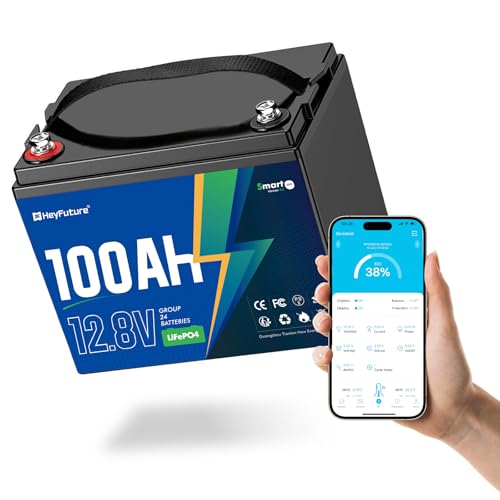
HeyFuture 12V 100Ah Bluetooth LiFePO4 Battery
What We Like
- Built-in Bluetooth monitoring
- Lightweight at 21.5 lb
- Intelligent BMS with low-temp cutoff
- Supports 4S or 4P expansion
Trade-offs
- Not compatible with old lead-acid chargers
- Group 24 size limits capacity per battery
A 21.5-pound weight makes this LiFePO4 battery roughly one-third the heft of a comparable AGM battery, so lifting it into a trolling motor compartment or RV battery tray is genuinely easy. The built-in Bluetooth lets you check state of charge, voltage, and temperature from your phone, which takes the guesswork out of managing your power on the water or at a campsite. This is a battery for anyone who wants real-time battery data without wiring in a separate monitor, and the 100A BMS with low-temperature cutoff protects the cells in cold weather.
This Group 24 battery holds 100Ah, so if you need 200Ah or more for a large solar bank or extended off-grid use, you will have to parallel multiple units, which adds wiring complexity. For a single-battery marine or RV setup where weight and monitoring matter, this is a smart pick.
Renogy 12V 100Ah Trolling Motor LiFePO4 Battery

What We Like
- IP67 waterproof for flooded compartments
- Half the weight of lead-acid at 21.8 lbs
- 150A continuous discharge for trolling motors
- Bluetooth 5.3 with Renogy App
Trade-offs
- 100Ah capacity limits long trips on high-draw motors
- Bluetooth requires app setup and phone nearby
The Renogy battery is not only suitable for trolling motors but also serves as a power source for everyday electricity needs in RVs, workshops, and off-road systems. Its IP67 waterproofing, light weight, and app monitoring make it a practical choice for marine environments where conditions can be wet and space is limited. For larger power demands, other options like the VATRER POWER 12V 300Ah LiFePO4 Battery offer higher capacity, but the Renogy’s combination of features meets diverse project needs across all seasons.
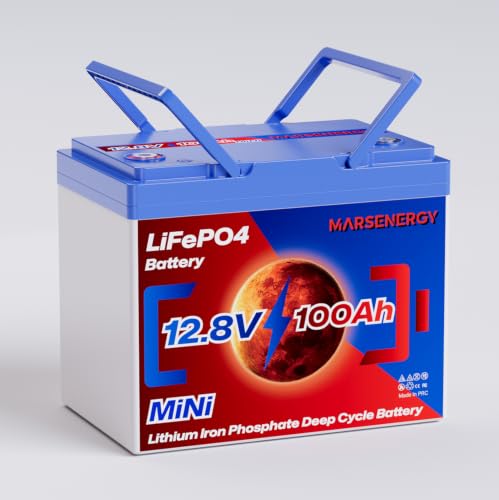
MARSENERGY 12V 100Ah LiFePO4 Battery
What We Like
- Up to 15000 deep cycles
- 100% DOD after 4500 cycles
- Weighs only 21 pounds
- Grade A cells with safety BMS
Trade-offs
- BMS cuts off charging below 32°F
- Sleep mode requires manual activation
With a cycle life ranging from 4500 cycles at full depth of discharge to 15000 cycles at 60% DOD, this battery outlasts traditional lead-acid options by a wide margin. That kind of longevity means fewer replacements over a decade of service, making it a smart fit for RV owners or off-grid campers who want a set-it-and-forget-it power source. The lightweight 21-pound build also makes installation easier than hauling a heavy lead-acid unit into a tight battery compartment.
Cold weather brings a limitation: the BMS cuts off charging below 32°F to protect the cells, so if you regularly camp in freezing conditions, you will need to keep the battery warm or plan around that limit. That makes it a strong choice for warm-weather road trippers and stationary solar setups.
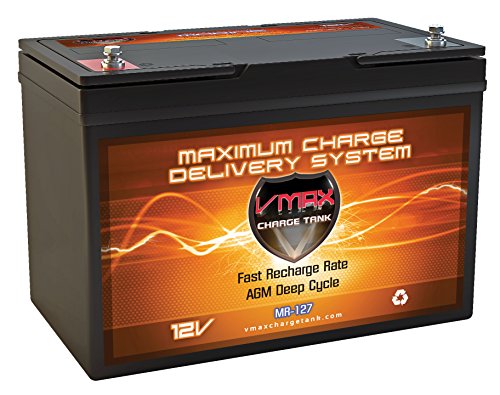
VMAXTANKS MR127 MA Deep Cycle Batterie
What We Like
- Electrolyte suspension system prevents spills
- Heavy duty grids handle repeated over discharges
- Includes carrying handles for easier lifting
Trade-offs
- At 68 pounds, it is heavy to move alone
- AGM chemistry limits capacity vs. lithium options
The VMAXTANKS MR127 MA is a 12-volt, 100Ah AGM deep cycle battery in Group 27 size. Its absorbed glass mat design locks the electrolyte inside the mats, so you don’t have to worry about acid spills or adding water. The heavy duty lead tin alloy grids are built to survive repeated deep discharges, which matters if you regularly drain the battery with a trolling motor or other marine gear. That construction also means it can handle the vibration and constant cycling that come with boat use.
Weight is the main drawback here. At 68 pounds, this AGM battery is significantly heavier than a lithium alternative such as the LiFePO4 model from LiTime, which weighs only 21 pounds. That extra mass matters if you frequently remove the battery for charging or storage.
Product photos
VMAXTANKS SLR100 Deep Cycle Batterie

What We Like
- Military-grade lead-tin alloys
- 8-10 year design life
- Ultra-low 1-2% monthly self-discharge
- Operates from -4°F to 140°F
Trade-offs
- At 68 lb, very heavy to move
- AGM chemistry limits cycle life vs lithium
With 1.35kWh of energy storage and an 8-10 year design life in float service, this AGM battery is built to sit quietly in a solar setup and deliver power year after year. The military-grade lead-tin alloys resist corrosion and the extra-strong ABS case prevents bulging, so it can handle the temperature swings and vibration that come with off-grid living. For anyone wiring a Renogy solar array or a cabin system that needs steady, maintenance-free storage, this is a rugged workhorse that doesn’t demand attention.
Weight is the main drawback: at 68 pounds, this battery is nearly three times heavier than a comparable LiFePO4 like the LiTime 12V 100Ah, which weighs just 21 pounds. That makes installation a two-person job and limits portability if you ever need to move or swap batteries. The AGM chemistry also gives fewer total charge cycles than a lithium battery, so for daily deep cycling, a lithium option may last longer. But if you want a sealed, spill-proof battery that can sit in a solar shed for a decade without fuss, the VMAXTANKS delivers exactly that.
Product photos
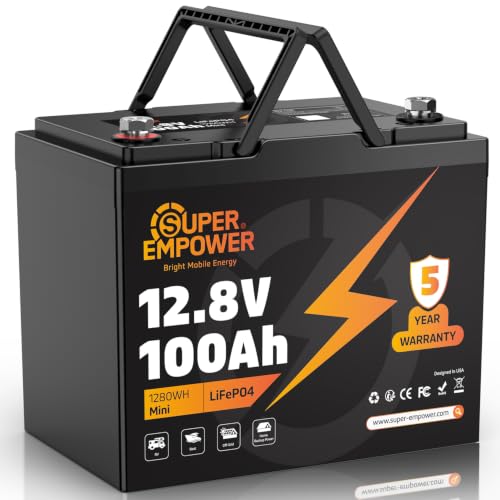
SUPER EMPOWER 12V 100Ah LiFePO4 Battery
What We Like
- Supports up to 4S4P expansion for 20.48kWh
- Low-temp charging cutoff at 32°F
- Grade A LiFePO₄ cells with 5-year warranty
Trade-offs
- Not for engine starting or cranking
- Charging disabled below 32°F until warmed
- Requires lithium-specific charger for best results
The ability to connect up to four batteries in series and four in parallel gives this battery a maximum capacity of 20.48kWh, which suits anyone planning a larger off-grid or RV power bank. You can configure multiple units without extra hardware, as the built-in BMS manages balancing across the bank. That flexibility lets campers and van dwellers scale their system as budget or space allows, rather than buying one massive battery upfront.
This battery won’t start your engine, and it needs a lithium-specific charger (or a solar controller set to lithium mode) to charge properly. Compared to the Renogy 12V 100Ah AGM, which weighs nearly three times as much and offers no expansion path, the SUPER EMPOWER gives you a lighter, scalable alternative for house power. Just remember that charging pauses automatically below freezing, so cold-weather users should keep it inside or rely on discharge-only operation down to -4°F.
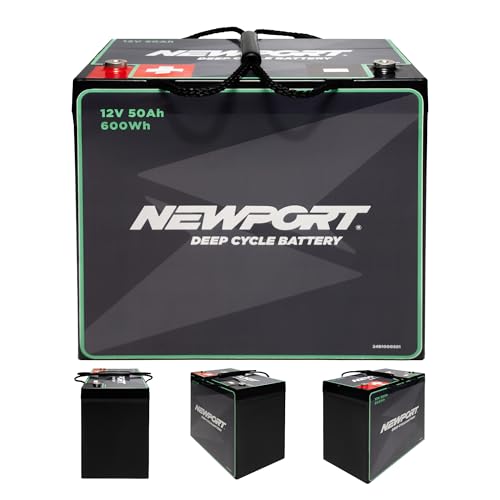
Newport 12V 50Ah AGM Marine Battery
What We Like
- Compact for kayaks and small boats
- Sealed AGM, low-maintenance design
- Optimized for Newport trolling motors
- USA-based customer support
Trade-offs
- 50Ah capacity limits run time for larger boats
- At 32 lb, heavier than lithium alternatives
- Lead acid chemistry means slower charging than LiFePO4
The Newport’s 50Ah capacity is half what many deep-cycle batteries offer, but that’s deliberate, it keeps the battery compact and lightweight for small watercraft like kayaks, inflatable boats, and jon boats. The sealed AGM construction means no maintenance and no risk of acid leaks, so it’s safe for tight spaces. Reviewers note the battery arrives with a charger included, making setup straightforward for a weekend fisherman running a trolling motor on a 12-foot boat.
Runtime is the main drawback here. With half the amp-hours of a typical 100Ah battery, you will need to recharge sooner or carry a spare for long days on the water. But if your priority is a compact, low-maintenance power source for a small boat, this AGM delivers dependable performance.
Product photos
How We Evaluated Deep Cycle Batteries
This evaluation is based on manufacturer specification sheets, expert breakdowns of AGM and LiFePO4 chemistry, and trends reported by owners across RV, marine, and solar forums.
The four criteria that mattered most were usable capacity versus rated capacity, cycle life at meaningful depth of discharge, temperature tolerance for charging and storage, and physical weight relative to the application. A battery that delivers 100% of its rated amp-hours is far more valuable than one that requires derating.
The honest limit of a research-led evaluation is that real-world performance depends heavily on your charger, temperature swings, and discharge patterns. We present the data and trade-offs so you can weigh what matters for your setup.
What To Look For In Deep Cycle Batteries
Choosing the right deep cycle battery comes down to matching chemistry to your use case, understanding how much usable capacity you actually get, and knowing the limits of your charging system.
Match battery chemistry to your climate and charging gear. LiFePO4 gives you more usable capacity per pound but needs a compatible charger and temperature management. AGM is simpler and safer in extreme cold but heavier.
Battery Chemistry: AGM vs. LiFePO4
Absorbent Glass Mat (AGM) batteries are sealed, spill-proof, and tolerant of cold and vibration. They typically offer 50-60% usable capacity before voltage drops too low, and they last roughly 500 cycles at 50% depth of discharge. They work with most standard chargers and are a straightforward upgrade from flooded lead-acid.
Lithium Iron Phosphate (LiFePO4) batteries deliver nearly 100% usable capacity and can last thousands of cycles depending on build quality. They weigh about half as much as AGM for the same usable energy. However, they require a lithium-specific charger, and most built-in Battery Management Systems (BMS) will cut off charging below freezing unless the battery has self-heating.
Capacity, Amp-Hours, and Usable Power
A battery’s rated amp-hour (Ah) number is only half the story. With AGM, you should plan to use only about 50-60% of that number to avoid damaging the battery. A 100Ah AGM battery gives you roughly 50-60Ah of usable energy. With LiFePO4, you can use 100% of the rated capacity in most cases, meaning a 100Ah lithium battery effectively doubles your usable power compared to AGM.
For trolling motors, a 50Ah battery might run a small kayak motor for a few hours, while a 100Ah battery suits a full day on a medium boat. For solar systems, match battery capacity to your daily energy consumption and panel output.
Temperature Tolerance and Charging Limits
Cold weather is the biggest challenge for lithium batteries. Most LiFePO4 batteries will not charge below 32°F unless they have a built-in self-heating function. If you camp or boat in freezing conditions, you need either a self-heating lithium battery or an AGM battery that can charge down to -4°F.
AGM batteries handle cold better but lose capacity in extreme heat. Operating range for quality AGM batteries typically spans -4°F to 140°F. Always check the manufacturer’s charging temperature limits before installing.
- Confirm your charger is compatible with the battery chemistry you choose.
- Measure your battery tray or compartment dimensions before buying.
- Check the maximum number of batteries you can connect in series or parallel.
- Verify the continuous discharge current rating if you run a trolling motor or inverter.
- Look for a BMS with low-voltage cutoff to protect lithium batteries from over-discharge.
A battery that fits your charger and climate will always outperform a higher-spec battery that doesn’t.
Deep Cycle Batteries Compared
The table below compares all 10 batteries side by side on chemistry, weight, and key features to help you narrow down your choice quickly.
| Product | Capacity | Voltage | Chemistry | Weight |
|---|---|---|---|---|
| Renogy 12V 100Ah AGM Deep Cycle Battery | 100Ah | 12V | AGM | 63.9 lb |
| VATRER POWER 12V 300Ah LiFePO4 Battery | 300Ah | 12V | LiFePO4 | 54.7 lb |
| LiTime 12V 100Ah LiFePO4 RV Battery | 1.28kWh | 12V | LiFePO4 | 21.0 lb |
| HeyFuture 12V 100Ah Bluetooth LiFePO4 Battery | 100Ah | 12V | LiFePO4 | 21.5 lb |
| Renogy 12V 100Ah Trolling Motor LiFePO4 Battery | 100Ah | 12V | LiFePO4 | 21.8 lbs |
| MARSENERGY 12V 100Ah LiFePO4 Battery | 100Ah | 12V | LiFePO4 | 21.0 lbs |
| VMAXTANKS MR127 MA Deep Cycle Batterie | 100Ah | 12V | AGM | 68.0 Pounds |
| VMAXTANKS SLR100 Deep Cycle Batterie | 100Ah | 12V | AGM | 68.0 pounds |
| SUPER EMPOWER 12V 100Ah LiFePO4 Battery | 1280Wh | 12.8V | LiFePO4 | 21.6 lb |
| Newport 12V 50Ah AGM Marine Battery | 50Ah | 12V | AGM | 32.0 pounds |
Frequently Asked Questions
How long will a deep cycle battery last?
Lifespan depends heavily on chemistry and usage. A quality AGM battery typically lasts 3 to 5 years with proper maintenance, while a LiFePO4 battery can last 7 to 10 years or more, often exceeding many cycles at full depth of discharge. Frequent deep discharges and high temperatures shorten any battery’s life.
Can I use a regular car battery for deep cycling?
No. A standard starting battery is designed to deliver a short, high burst of power to start an engine. Deep cycle batteries are built with thicker plates and can handle repeated discharges down to 50% or more of their capacity without damage. Using a starting battery for deep cycling will quickly ruin it.
What does a BMS do in a lithium battery?
A Battery Management System (BMS) protects the battery from over-current, over-voltage, under-voltage, short circuits, and temperature extremes. It automatically disconnects the battery if any parameter goes outside safe limits. This prevents damage and is a key safety feature in any LiFePO4 battery.
Do I need a special charger for a LiFePO4 battery?
Yes. Most LiFePO4 batteries require a charger with a lithium-specific charging profile, typically charging to 14.4 to 14.6 volts and using a constant current/constant voltage algorithm. Standard lead-acid chargers may not reach the correct voltage or may have desulfation modes that can damage lithium cells.
Can I connect different brands of deep cycle batteries together?
It is not recommended. Mixing brands, ages, or chemistries in a series or parallel bank will cause uneven charging and discharging, leading to premature failure. For best performance and safety, use identical batteries from the same manufacturer and purchase them at the same time.
The Bottom Line
The Renogy 12V 100Ah AGM Deep Cycle Battery is the best overall choice for RV and cabin owners who want a safe, low-maintenance AGM battery. It works reliably across a wide temperature range without worrying about charging compatibility. Its low self-discharge and support for series and parallel connections make it a flexible foundation for most 12V systems.
If you need a lightweight lithium upgrade for your RV, the LiTime 12V 100Ah LiFePO4 RV Battery offers 100% usable capacity at one-third the weight of AGM. For boaters dealing with wet compartments, the Renogy 12V 100Ah Trolling Motor LiFePO4 Battery gives you IP67 waterproofing and Bluetooth monitoring. Cold-climate off-grid users should prioritize the VATRER POWER 12V 300Ah LiFePO4 Battery for its self-heating feature.
The single most important factor in choosing a deep cycle battery is matching the chemistry to your charging system and climate. Get that right, and you will get the most years and cycles from your investment.
