
4 Best Entry Level Carbon Fiber Road Bikes in 2026
This post contains affiliate links. As an Amazon Associate, we earn from qualifying purchases.
The SAVADECK Full Carbon Racing Bike is our best overall pick for entry level carbon fiber road bikes. Its ultralight T800 carbon frame and smooth Shimano R7120 24-speed shifting deliver race-ready performance without the race-ready price. For riders who want a premium groupset, the SAVADECK A7L Carbon Road Bike offers excellent value, while the Schwinn Fastback Carbon 105 is the top choice for smaller riders.
Entering the world of carbon fiber road bikes can feel like stepping into a maze of jargon and high price tags. You want the weight savings and ride quality of carbon without breaking the bank or needing a mechanic on speed dial for assembly and maintenance.
This guide is built from manufacturer specifications, expert round-ups, and patterns in owner feedback to cut through the noise. We focused on the features that matter most for a first carbon bike: frame quality, groupset reliability, braking performance, and ease of setup.
Top 4 Entry Level Carbon Fiber Road Bikes in the Market
Certain content that appears on this site comes from Amazon. This content is provided "as is" and is subject to change or removal at any time.
The Best Entry Level Carbon Fiber Road Bikes, Reviewed
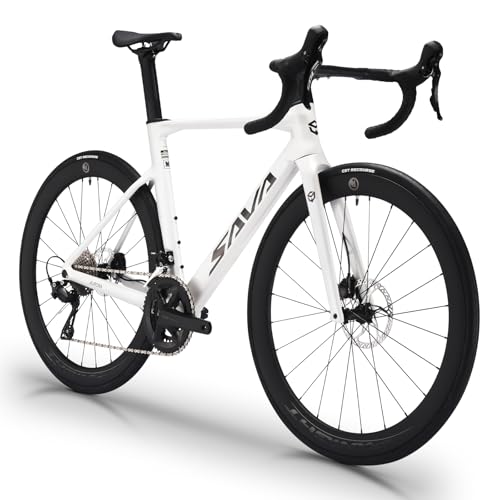
SAVADECK Full Carbon Racing Bike
What We Like
- Ultralight 8.8 kg T800 carbon frame
- Smooth Shimano R7120 24-speed shifting
- Powerful hydraulic disc brakes
- 90% pre-assembled for easy setup
Trade-offs
- Free clipless pedals included, no flat pedals
- Requires clipless pedals, not compatible with flat pedals
At just 8.8 kg with a full T800 carbon frame and wheelset, this bike makes climbing and accelerating feel effortless for riders of all levels. The Shimano R7120 24-speed groupset delivers crisp, reliable shifts whether you’re sprinting on flats or grinding up a hill, and the hydraulic disc brakes provide confident stopping power on descents. It’s a package that balances race-ready performance with beginner-friendly assembly, arriving 90% pre-assembled so you can be on the road in about 15 minutes. That combination of light weight, smooth drivetrain, and easy setup is why it stands out as a top pick for anyone stepping into carbon road bikes.
The stiff carbon frame and aero geometry prioritize speed and handling, which may feel less forgiving on rough pavement compared to a more endurance-oriented model like the Schwinn Fastback Carbon 105. Still, for riders who want a lightweight, responsive machine that’s ready to race, the SAVADECK Full Carbon delivers where it counts.
SAVADECK A7L Carbon Road Bike

What We Like
- Ultra-light 8.9 kg T800 carbon frame
- Shimano 105 R7100 24-speed groupset
- Hydraulic disc brakes for strong stopping
- Fully internal cable routing for clean look
Trade-offs
- 54cm frame limits fit for taller riders
- Assembly requires installing handlebar and pedals
The T800 carbon frame and fork keep this bike at just 8.9 kg, so climbing and accelerating feel noticeably easier. The Shimano 105 R7100 groupset shifts crisply, and the hydraulic disc brakes provide reliable stopping power in wet or dry conditions. Fully internal cable routing cleans up the front profile and reduces drag, making it a responsive choice for riders who prioritize weight savings.
The 54cm frame may not fit taller riders, so checking your measurements beforehand is smart. Compared to the KABON Carbon Road Bike, which also uses a Shimano 105 groupset, the SAVADECK’s lighter overall weight gives it an edge for riders focused on climbing and speed. If you want a featherweight build with solid components and don’t mind a more focused fit, this is worth considering.
KABON Carbon Road Bike

What We Like
- Lightweight T800 carbon frame and fork
- Shimano 105 22-speed drivetrain for precise shifting
- Internal cable routing for durability and clean look
- Mechanical disc brakes for confident stopping power
Trade-offs
- Mechanical disc brakes lack the modulation of hydraulic systems
- 22-speed drivetrain offers fewer gear options than 24-speed rivals
At 8.5 kg, the T800 carbon frame makes the KABON light enough for spirited climbs and daily commutes without breaking your back lifting it onto a rack. The Shimano 105 22-speed drivetrain delivers crisp, reliable shifts that entry-level riders will appreciate, while the mechanical disc brakes offer solid stopping power in wet or dry conditions.
Compared to the SAVADECK A7L with its 24-speed groupset and hydraulic disc brakes, the KABON uses a 22-speed mechanical disc system. Owners note that mechanical brakes require more hand strength at the lever than hydraulic discs, and they don’t offer the same fine modulation on long descents. For riders who value straightforward adjustments and a lower initial investment, this is a capable entry into carbon road biking.
Product photos
Schwinn Fastback Carbon 105

What We Like
- Full Shimano 105 22-speed drivetrain
- N LITENED Black Label Carbon frame
- Designed for riders 5'0"–5'3"
Trade-offs
- Caliper brakes instead of disc brakes
- Only fits riders up to 5 feet 3 inches tall
The Schwinn Fastback Carbon 105 is built around a N LITENED Black Label Carbon frame, keeping the bike light and responsive for riders who want to go farther and faster.
The trade-off here is the braking system. Shimano 105 dual-pivot caliper brakes are reliable and easy to maintain, but they don’t offer the same stopping power in wet conditions as the hydraulic disc brakes found on the SAVADECK Full Carbon Racing Bike. The aluminum Shimano WH-RS100 wheels are durable, though they are heavier than a full carbon wheelset would be. Riders who need maximum braking confidence in rain will want to consider a disc-brake model instead.
Product photos
How We Evaluated Entry Level Carbon Fiber Road Bikes
We started by combing through manufacturer specifications and expert round-ups to identify the bikes that offer genuine carbon fiber frames and reliable component groups at an entry-level price point. Owner feedback patterns helped us understand real-world assembly experiences, durability concerns, and how each bike performs on the road.
Our evaluation centered on four key criteria. Frame material and weight came first, as the whole point of a carbon bike is the weight savings and ride comfort. Groupset quality was next, since smooth shifting directly impacts your riding experience. Braking performance and type mattered, especially for riders who face wet conditions or steep descents. Finally, we considered fit and assembly ease, because a bike that doesn’t fit or requires a pro to build is a poor entry-level choice.
A research-led evaluation has limits: we cannot speak to long-term durability or ride feel without hands-on testing. We rely on the available data and the collective experience of the cycling community to guide our recommendations.
What To Look For In Entry Level Carbon Fiber Road Bikes
Choosing your first carbon road bike is about balancing weight, components, and fit. Here are the key factors to consider before you buy.
Look for a genuine carbon fiber frame from a trusted manufacturer, a groupset from Shimano or a comparable brand, and brakes that match your riding conditions and maintenance comfort.
Frame Material and Weight
The frame is the heart of any carbon bike. T800 carbon fiber, found on the SAVADECK and KABON models, offers a good balance of lightness and stiffness for entry-level bikes. A lighter frame makes climbing easier and acceleration snappier, which is the main reason to go carbon. The SAVADECK Full Carbon Racing Bike tips the scales at 8.8 kg, while the A7L is 8.9 kg, both respectable weights for this price tier.
Groupset and Gearing
The groupset controls your shifting and braking. Shimano 105 is the gold standard for entry-level performance, offering reliable, crisp shifts. The SAVADECK Full Carbon Racing Bike steps up to the newer Shimano R7120 24-speed groupset, giving you an extra gear for finding the perfect cadence. The KABON and Schwinn Fastback use the previous-generation 105 22-speed, which is still a very capable and proven drivetrain.
Braking System
Brakes are a critical safety and performance decision. Hydraulic disc brakes, found on the SAVADECK Full Carbon Racing Bike and A7L, offer superior stopping power and modulation, especially in wet conditions. Mechanical disc brakes, like those on the KABON, are easier to maintain and adjust at home but lack the fine control of hydraulics. Caliper brakes, as on the Schwinn Fastback, are lighter but significantly less powerful in the rain.
- Check the bike’s geometry and sizing chart against your height and inseam.
- Decide if you want to ride with clipless pedals or flat pedals before buying.
- Look at how much assembly is required; some bikes arrive 90% pre-assembled.
- Consider the cost and availability of replacement parts for the groupset and brakes.
For your first carbon bike, prioritize a frame that fits and a groupset you can trust over marginal weight savings.
Entry Level Carbon Fiber Road Bikes Compared
The table below compares the four entry level carbon fiber road bikes side by side, highlighting their frames, groupsets, brakes, and key trade-offs.
| Product | Frame Material | Weight | Groupset | Brakes |
|---|---|---|---|---|
| SAVADECK Full Carbon Racing Bike | T800 Carbon Fiber | 8.8 kg | Shimano R7120 24-Speed | Hydraulic Disc |
| SAVADECK A7L Carbon Road Bike | T800 Carbon Fiber | 8.9 kg (19.6 lbs) | Shimano 105 R7100 24 Speed | Hydraulic Disc Brakes |
| KABON Carbon Road Bike | T800 Carbon Fiber | 8.5 kg (18.7 lb) | Shimano 105 R7000 22-speed | Mechanical Disc |
| Schwinn Fastback Carbon 105 | N LITENED Black Label Carbon | N/A | Shimano 105 22-speed | Shimano 105 dual-pivot caliper |
Frequently Asked Questions
Are entry level carbon road bikes worth buying?
Yes, entry level carbon road bikes offer a genuine weight and ride quality advantage over aluminum bikes at a more accessible price point. They use proven component groups like Shimano 105 and frames made from T800 carbon fiber, giving you a bike that performs well without costing as much as a pro-level machine.
How much heavier is an aluminum road bike compared to carbon?
An entry-level aluminum road bike typically weighs about 2 to 3 pounds more than a comparable carbon model. That extra weight is most noticeable when climbing hills or accelerating from a stop, which is why many riders choose carbon for its lighter feel.
Can a beginner maintain a carbon fiber road bike?
Yes, carbon fiber road bikes require similar maintenance to aluminum bikes. The frame itself is durable, but you should avoid clamping it too tightly in a repair stand and inspect it for cracks after any crash. The components, like the drivetrain and brakes, are the same as on any other bike.
What size carbon road bike do I need for my height?
Bike sizing varies by brand, but most entry level carbon road bikes come in a range of frame sizes. You should measure your inseam and compare it to the manufacturer’s sizing chart. The Schwinn Fastback, for example, is specifically designed for riders between 5’0″ and 5’3″.
Are disc brakes necessary on a road bike?
Disc brakes, especially hydraulic ones, provide better stopping power and modulation than traditional caliper brakes, particularly in wet or muddy conditions. They are not strictly necessary if you ride only in dry weather, but they offer a significant safety advantage for most riders.
The Bottom Line
The SAVADECK Full Carbon Racing Bike is our best overall pick for anyone looking to get into carbon fiber road bikes. It combines an ultralight T800 frame, smooth 24-speed Shimano shifting, and powerful hydraulic disc brakes in a package that arrives 90% pre-assembled. This bike is ideal for entry-level racers and commuters who want a race-ready ride without the complexity of a full build.
If you want a slightly more premium groupset and prefer a clean, fully internal cable routing, the SAVADECK A7L Carbon Road Bike is a strong alternative. For smaller riders between 5’0″ and 5’3″, the Schwinn Fastback Carbon 105 offers a proper fit that many other carbon bikes overlook. Budget-conscious riders who prefer easier brake maintenance should consider the KABON Carbon Road Bike with its mechanical disc brakes.
The single most important factor in choosing your first carbon road bike is fit. A lightweight frame and premium groupset mean nothing if the bike is too large or too small for your body. Measure yourself, check the sizing chart, and pick the bike that fits first.
