
9 Best Eqs For Car Stereo in 2026
This post contains affiliate links. As an Amazon Associate, we earn from qualifying purchases.
For car audio enthusiasts who want total control over their sound, the PRV AUDIO DSP 2.4X Digital Crossover is the best overall equalizer. It combines a 15-band graphic EQ with 12 presets and a real-time LCD display. For those who prefer app-based tuning, the Banda Audiopart X8AiR DSP Processor offers 79-band per-channel EQ, while the Orion XEQ-X7 is our top choice for a compact analog unit.
The challenge with car stereo equalizers is matching the right features to your system. DSP units offer deep digital tuning but often require a smartphone app, while analog EQs give you hands-on control with physical sliders or knobs but lack time alignment and advanced crossover slopes.
This guide is based on a careful analysis of manufacturer specifications, expert round-ups, and patterns in owner feedback. We break down the key differences between analog and DSP units to help you choose the right tool for your build.
Top 9 Equalizers For Car Stereo in the Market
Certain content that appears on this site comes from Amazon. This content is provided "as is" and is subject to change or removal at any time.
The Best Equalizers For Car Stereo, Reviewed
PRV AUDIO DSP 2.4X Digital Crossover

What We Like
- 15-band graphic EQ with 12 presets
- LCD display for real-time adjustments
- Sequencer remote trigger for staged power-up
Trade-offs
- LCD is only 16×2 characters, small for complex menus
- No Bluetooth or app control for remote tuning
- At 1.0 lb, heavier than some compact DSPs
The PRV Audio DSP 2.4X combines a 15-band graphic equalizer with a parametric EQ that adjusts gain, frequency, and bandwidth, letting you shape your car’s sound without extra gear. That makes it a strong option for anyone who wants professional-level tuning flexibility, with 12 presets like Rock or Vocal for quick changes. The LCD display shows adjustments in real time, which beats guessing from blinking LEDs.
The trade-off is that the small 16×2 character screen can feel cramped when you’re deep in parametric settings, and there’s no Bluetooth or phone app for adjustments from the driver’s seat. Compared to the Banda Audiopart X8AiR, which offers 79 bands and app control, the PRV is less convenient for on-the-fly tweaks. But if you prefer hands-on, menu-driven control and want a sequencer relay to power up your amps in order, this DSP delivers serious sound-shaping authority without the complexity of a full PC-based system.
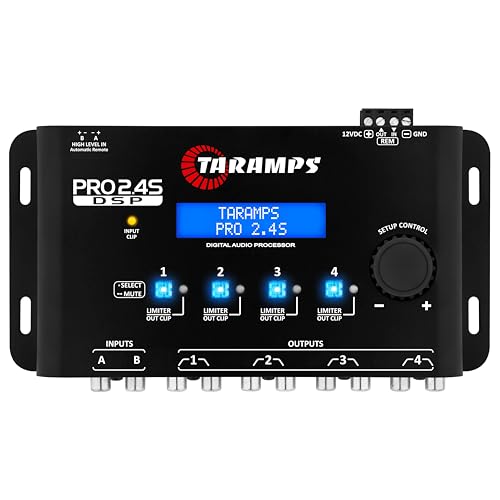
Taramps PRO 2.4S DSP Equalizer
What We Like
- Adjustable HPF/LPF filters up to 48dB/octave
- Time alignment and phase inversion
- Anti-pop system reduces power-on/off noise
Trade-offs
- Only 4 output channels limit complex multi-speaker setups
- No Bluetooth or app control for remote tuning
This DSP lets you shape the soundstage precisely, with adjustable high-pass and low-pass filters reaching up to 48dB per octave. It also includes time alignment and phase inversion, so you can correct for awkward speaker placement or blend a subwoofer with your main channels.
The four output channels limit you to a front-rear-sub setup without extra processing for dedicated midrange or tweeter channels. That works for a clean two-way system, but if you need more outputs, the eight-channel Banda Audiopart X8AiR DSP offers that flexibility. The Taramps also lacks Bluetooth or app-based control, so all adjustments happen at the unit or through a computer, which keeps things straightforward but less convenient than a phone-based interface.
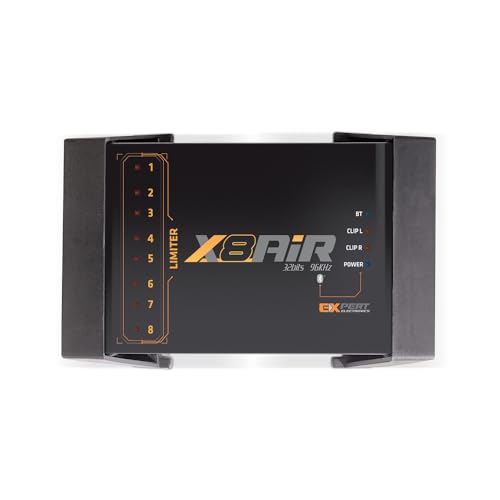
Banda Audiopart X8AiR DSP Processor
What We Like
- 79-band EQ per channel for extreme fine-tuning
- 32-bit/96kHz DSP reduces distortion
- Bluetooth app control for real-time adjustments
- 8-channel output supports complex multi-amp setups
Trade-offs
- Requires smartphone app for full tuning access
- No physical controls on the unit
The X8AiR offers 79 EQ bands per channel, which gives you far more control than a typical 7-band equalizer. That level of adjustment, combined with a 32-bit/96kHz DSP that reduces distortion, lets you shape highs, mids, and bass to your liking. This makes it a good fit for anyone setting up a multi-amplifier system with component speakers and subwoofers, where simpler equalizers may not offer the same flexibility.
At 0.7 pounds, the unit is light enough to tuck away, but you will want to secure it so it does not shift around. The catch is that all that tuning power lives inside the app, so you will be relying on your phone rather than knobs on the dash. Compared to the Orion XEQ-X7, which offers 7 EQ bands and physical controls, the X8AiR provides 79 EQ bands per channel and 8 output channels, but it requires using the app for adjustments rather than physical controls.
Product photos
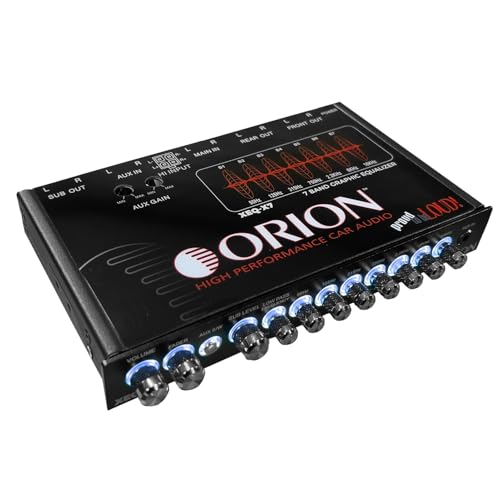
Orion XEQ-X7 7-Band Equalizer
What We Like
- Front 3.5mm AUX input for portable devices
- Dedicated subwoofer level and low-pass filter
- Half-DIN size fits tight dash spaces
- High and low level inputs for flexible setups
Trade-offs
- No digital signal processing or time alignment
- Only 7 bands limit fine-tuning compared to DSP units
- No Bluetooth or app control for adjustments
The Orion XEQ-X7 gives you seven adjustable frequency bands from 50Hz to 16kHz with ±12dB of boost or cut, so you can shape your car’s sound by hand. Its half-DIN chassis fits into tight dash spaces where larger gear won’t, and the front-panel 3.5mm AUX jack lets you connect a phone or MP3 player directly. This is an analog equalizer that offers straightforward tone control and a compact install, without the features of a digital processor.
Simplicity is the key here: you get seven analog bands, while DSP units like the Taramps PRO 2.4S offer 15 bands and the Banda Audiopart X8AiR provides 79 bands, plus features like Bluetooth and app control that this unit lacks. That means you adjust settings from the front panel, and you won’t have time alignment or digital crossovers for complex multi-speaker setups. For someone who wants basic tone shaping from a head unit or factory stereo, the Orion works. For an active system with multiple channels, a DSP would offer more control.
Rockville R7EQ 7-Band Equalizer

What We Like
- 7V line driver for strong signal
- Built-in subwoofer frequency and volume control
- Blue LED knobs for low-light visibility
- Metal chassis for durability
Trade-offs
- No digital signal processing for time alignment or advanced crossover slopes
- No digital time alignment for precise speaker delay tuning
A built-in 7V line driver gives this equalizer the muscle to send a clean, strong signal to your amplifiers, even over longer cable runs. That makes the Rockville R7EQ a natural fit for anyone building a system where noise rejection and signal integrity matter, especially if you’re running multiple amps for front, rear, and subwoofer channels. The seven bands cover the full audible range, and the dedicated sub frequency and volume knobs let you dial in bass without leaving the driver’s seat. The metal chassis and illuminated blue knobs add a sturdy, practical touch for dark interiors.
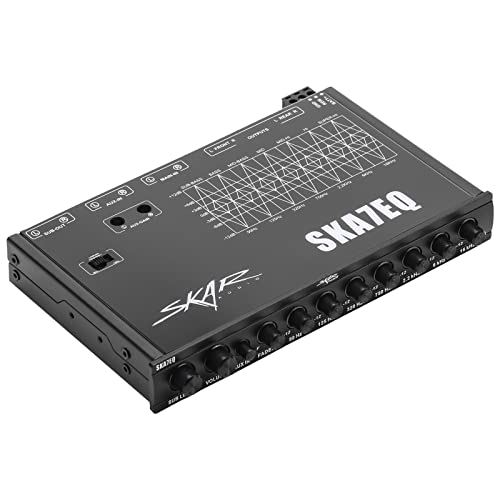
Skar Audio SKA7EQ 7-Band Equalizer
What We Like
- 7V max output voltage
- Gold-plated RCA outputs
- Front subwoofer level control
Trade-offs
- No digital signal processing (DSP) features
- No built-in Bluetooth or app control
A 7-volt max output voltage means this equalizer can drive even power-hungry amplifiers with a clean, strong signal, reducing the chance of noise creeping into your system. The front-mounted subwoofer level control gives you direct bass adjustment from the unit itself, and the gold-plated RCA outputs are included for the pre-amp connections.
This is an analog graphic equalizer, not a DSP. You get seven fixed frequency bands to shape your sound, but you miss the fine-tuned crossover slopes, time alignment, and parametric EQ that a processor like the PRV AUDIO DSP 2.4X offers. If you want simple, hands-on tone shaping with a voltage boost, this Skar delivers. If you need surgical precision or Bluetooth control, you will want to look at a digital unit instead.
Product photos
Stetsom EQX764 7-Band Equalizer
What We Like
- 4 inputs for multiple audio sources
- 6 outputs for front, rear, and sub
- 10V line driver for clean signal
- Dedicated sub level and frequency controls
Trade-offs
- No digital processing or time alignment
- Manual EQ sliders, not app-controlled
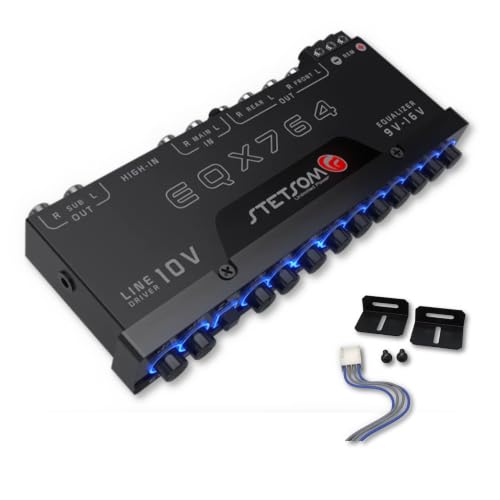
The Stetsom EQX764 offers four input channels and six output channels, letting you connect multiple sources and amplifiers in a single analog unit. Its 10-volt line driver provides up to 10 VRMS to your amplifiers, which helps maintain signal strength. This makes it a practical choice for setups that need flexible routing without digital processing.
Because this is an all-analog equalizer with slider controls, it lacks digital features like time alignment or parametric EQ that DSP-based units such as the Taramps PRO 2.4S include. Its 7.2-inch width means you should check your installation space before buying.
Product photos
Clarion EQS755V 7-Band Equalizer

What We Like
- Ground loop isolation circuit
- 6-channel 8-volt RCA outputs
- Separate subwoofer level control
- Front 3.5mm aux input
Trade-offs
- Analog EQ lacks digital signal processing flexibility
- No Bluetooth or app control
Because it is an analog design, it does not offer the advanced tuning options found in digital signal processors like the PRV AUDIO DSP 2.4X, which provides features such as parametric EQ and time alignment. The Clarion also lacks Bluetooth streaming and app control. Its strength is in providing a reliable, no-frills way to adjust your sound and manage inputs. If your system has a noise issue that a ground loop isolation circuit might address, this unit could be a practical choice. For those who need precise digital adjustments or wireless connectivity, a DSP-based unit would be more suitable.
Product photos
Timpano TPT-EQ7 7-Band Equalizer

What We Like
- Ultra-slim 1-inch profile fits tight spots
- 10V line driver for clean long RCA runs
- Built-in speaker-wire-to-RCA converter
- Dedicated subwoofer level and crossover
Trade-offs
- No digital processing or time alignment
- Only 7 bands limit fine-tuning compared to DSPs
The Timpano TPT-EQ7 is only one inch tall, which makes it easy to fit into tight spaces like under a seat or behind a dash panel. Its 10-volt RCA line driver helps keep the signal clean over longer cable runs, reducing the chance of noise from a distant amplifier. With seven bands from 50Hz to 16kHz, plus a dedicated subwoofer level and crossover, it offers straightforward tone shaping for systems that need basic adjustment rather than full digital processing.
Product photos
How We Evaluated Equalizers For Car Stereo
We evaluated these equalizers by reviewing manufacturer specifications, studying expert round-ups, and analyzing common patterns in owner feedback. Our goal was to identify the best options for different build priorities, from simple analog upgrades to full digital signal processing systems.
The four most important criteria for this category were: band count and EQ type, which determines how precisely you can shape the sound. Output voltage and line driver affects signal strength and noise floor. Digital signal processing features like time alignment and crossover slopes matter too. Installation flexibility, including physical size and input/output options, rounds out the list.
A research-led evaluation has one honest limit: we did not install and test each unit in a vehicle. Our recommendations are based on what the specifications and the collective experience of the car audio community tell us works best for specific needs.
What To Look For In Equalizers For Car Stereo
Choosing a car stereo equalizer comes down to matching the unit’s capabilities to your system’s complexity and your preferred tuning method.
Look for an EQ that matches your system’s channel count, offers enough bands for the frequency control you need, and provides a line driver voltage strong enough to overcome noise in long RCA runs.
Band Count and EQ Type
The number of EQ bands determines how many frequency ranges you can adjust independently. Analog units typically offer 7 bands, which is enough for basic tone shaping of a front/rear/sub system. DSP units like the Banda Audiopart X8AiR offer up to 79 bands per channel, allowing surgical precision for active multi-amp setups. For most drivers, a 7-band analog EQ provides plenty of control over bass, midrange, and treble.
Output Voltage and Line Driver
A higher output voltage from the line driver sends a stronger signal to your amplifiers, which helps overcome electrical noise from the car’s charging system. Units like the Stetsom EQX764 and Timpano TPT-EQ7 offer 10V line drivers, while the Rockville R7EQ and Skar Audio SKA7EQ provide 7V. A 7V or higher line driver is a good target for systems with long RCA cable runs.
Digital Signal Processing vs. Analog
DSP units offer features that analog EQs cannot match: time alignment to delay each speaker’s output for a proper soundstage, adjustable crossover slopes up to 48dB/octave, and per-channel EQ. The trade-off is that DSP tuning typically requires a laptop or smartphone app, while analog EQs give you immediate, physical control. If you are building a simple system with a subwoofer and coaxial speakers, an analog EQ is likely enough.
- Check the number of input and output channels against your amplifier count.
- Measure the available mounting space: half-DIN, 1-inch slim, or full-size chassis.
- Confirm the EQ has a subwoofer level control and low-pass filter if you run a sub.
- Look for a front AUX input if you want to connect a phone or portable player directly.
A good rule of thumb: if you need time alignment or active crossover slopes, buy a DSP. If you want plug-and-play control with a subwoofer knob, buy an analog EQ.
Equalizers For Car Stereo Compared
The table below compares the key specs and features of these nine equalizers side by side.
| Product | EQ Bands | Input Types | Dims |
|---|---|---|---|
| PRV AUDIO DSP 2.4X Digital Crossover | 15-band graphic + parametric | RCA | L 7.9 inches, W 4.0 inches, H 1.4 inches |
| Taramps PRO 2.4S DSP Equalizer | 15-band graphic EQ | RCA and high-level | L 4.4 Inches, W 7.8 inches, H 1.5 inches |
| Banda Audiopart X8AiR DSP Processor | 79 per channel | Bluetooth | 5.9 x 4.3 x 1.7 inches |
| Orion XEQ-X7 7-Band Equalizer | 7 | High-level & low-level (RCA) | 4.0 x 4.0 x 2.0 in |
| Rockville R7EQ 7-Band Equalizer | 7 bands | Aux input | 1.6 x 7.8 x 8.5 inches |
| Skar Audio SKA7EQ 7-Band Equalizer | 7 bands | 2 RCA (Main & Aux) | 9.0 x 6.5 x 1.8 inches |
| Stetsom EQX764 7-Band Equalizer | 7 bands | RCA & High | 7.2 x 3.2 x 1.0 inches |
| Clarion EQS755V 7-Band Equalizer | 7 | RCA, high-level, 3.5mm aux | 8.3 x 8.0 x 61.8 inches |
| Timpano TPT-EQ7 7-Band Equalizer | 7 | RCA + high-level | 2.2 x 7.0 x 1.0 inches |
Frequently Asked Questions
What does an EQ do for a car stereo?
An equalizer lets you adjust the volume of specific frequency ranges, like bass, midrange, and treble. This helps you correct for your car’s acoustics, reduce harshness, or boost bass without needing a subwoofer upgrade.
What is the difference between an analog EQ and a DSP?
An analog EQ uses physical sliders or knobs to adjust fixed frequency bands. A DSP (digital signal processor) lets you adjust frequencies per channel, add time alignment to delay individual speakers, and set precise crossover slopes. DSPs offer far more tuning control but require a computer or app to operate.
Do I need a line driver in my car EQ?
A line driver boosts the signal voltage from your head unit to your amplifiers. Higher voltage helps overcome electrical noise, which is especially useful in cars with long RCA cable runs or older wiring. If you hear alternator whine or hiss, a line driver can help clean up the signal.
How many bands do I need on a car EQ?
Seven bands are enough for most systems, covering the key frequencies from sub-bass to treble. If you are building a complex active system with multiple amplifiers and separate drivers for each frequency range, a DSP with more bands per channel gives you the fine-tuning you need.
Can I use an EQ with a factory radio?
Yes, but you need an EQ that accepts high-level speaker wire inputs. Units like the Timpano TPT-EQ7 include a built-in speaker-wire-to-RCA converter for this purpose. You will also need to verify that the EQ can handle the voltage from your factory radio’s outputs.
The Bottom Line
The PRV AUDIO DSP 2.4X Digital Crossover is the best overall equalizer for car stereo enthusiasts who want hands-on DSP control with a physical interface. Its 15-band EQ, 12 presets, and sequential power management make it a versatile tool for building a tuned system.
If you prefer smartphone-based tuning with extreme per-channel control, the Banda Audiopart X8AiR DSP Processor is the better choice with its 79-band EQ and Bluetooth app. For drivers on a budget building a simple system with a subwoofer, the Orion XEQ-X7 or Rockville R7EQ offer solid analog control without the complexity of DSP.
The single most important factor in choosing a car stereo equalizer is matching the unit’s features to your system’s needs. Buy a DSP if you want time alignment and active crossovers; buy an analog EQ if you want simple, physical control over your sound.
