
10 Best Fillers For Car Bodywork in 2026
This post contains affiliate links. As an Amazon Associate, we earn from qualifying purchases.
For car bodywork repairs, Roberlo Maxifill Superior Lightweight Body Filler earns our Best Overall spot because its microspheres cut sanding time by an estimated 40% while rust inhibitors help prevent future corrosion. It bonds to aluminum, steel, zinc, and fiberglass, often eliminating the need for a finish putty. Other top picks include the 3M Lightweight Body Filler for its creamy, tack-free formula and the Bondo Fast Dry Body Filler for DIYers needing same-day sanding.
The challenge with body fillers is matching the product to the repair. A lightweight formula that sands easily might lack the structural strength for drilled and tapped fasteners, while a fast-curing filler may not offer enough working time for large panels. You need to balance sanding effort, adhesion, cure time, and surface compatibility for your specific job.
This guide is based on research into manufacturer specifications, expert round-ups, and patterns in owner feedback. We evaluated fillers on sanding ease, adhesion to different substrates, cure time, and overall value for the repair. Here are our top picks for common bodywork scenarios.
Top 10 Fillers For Car Bodywork in the Market

Certain content that appears on this site comes from Amazon. This content is provided "as is" and is subject to change or removal at any time.
The Best Fillers For Car Bodywork, Reviewed
Roberlo Maxifill Superior Lightweight Body Filler

What We Like
- Microspheres cut sanding time 40%
- Rust inhibitors prevent future corrosion
- Bonds to aluminum, steel, zinc, fiberglass
- No finish putty required
Trade-offs
- 3-liter tub requires significant bench space.
- Kit includes hardener, but no mixing board or spreader.
The microspheres technology cuts sanding time by 40%, so you spend less effort smoothing out repairs. It bonds to aluminum, steel, zinc, galvanized panels, and fiberglass, covering the surfaces you are most likely to run into on a car. Rust inhibitors are included to prevent future corrosion, so the repair holds up over time. The formula eliminates the need for finish putty, letting you go from application to sanding to primer without an extra step.
The trade-off is the 3-liter tub. It holds enough material for several repairs, but it takes up bench space and might feel oversized if you only need to patch a single door ding. The lightweight formula spreads easily and sands fast, but on deeper damage you may need a second coat to build up enough thickness. Compared to the 3M Lightweight Body Filler, which comes in a 1-gallon can and also sands easily, the Roberlo kit includes the hardener and a more explicit rust-inhibition claim. If you work on a mix of metal and fiberglass panels and value speed in the sanding stage, this is the filler to reach for.
3M Lightweight Body Filler

What We Like
- Creamy formula for easy mixing and spreading
- Tack-free finish saves sanding time
- Vacuum processed to minimize pinholes
Trade-offs
- For industrial or occupational use only
- Two-component system requires mixing hardener
A vacuum-processed formula minimizes pinholes, so you spend less time filling and re-sanding tiny imperfections. The creamy texture spreads easily over dents and dings, and the tack-free finish means you can sand without waiting for a sticky surface to cure. This 1-gallon tub is built for regular body repair work where a clean, predictable result matters.
3M labels this for industrial or occupational use only, so it’s not aimed at casual weekend jobs. You’ll need to mix the included hardener yourself, which adds a step compared to some other products. For volume work where consistency and a smooth finish matter, this 3M filler delivers.
Product photos
Bondo Fast Dry Body Filler

What We Like
- Cures in 15 minutes for same-day sanding
- Spreads and sands easier than other Bondo fillers
- High adhesion to hard-to-stick surfaces
- Works on metal, aluminum, masonry, and concrete
Trade-offs
- At 7.0 pounds, heavier than lightweight fillers
- Two-part formula requires mixing before each use
A 15-minute cure time means you can sand and paint this filler the same day you apply it, no waiting overnight for the repair to harden. That speed comes from Bondo’s premium two-part formula, which chemically bonds to tricky surfaces like galvanized steel and aluminum. If you need to patch a door ding or a scratch on a Saturday morning and have the car back on the road by afternoon, this is the filler that keeps your schedule on track. The formula spreads and sands easier than other Bondo fillers, according to the manufacturer, for a consistent, smooth, and professional finish.
The trade-off for that fast cure is weight: at 7.0 pounds for the kit, this is a denser filler than lightweight options like Roberlo Maxifill Superior Lightweight Body Filler. That weight comes with high bond and excellent adhesion to hard-to-stick-to surfaces, with good vertical hang. For quick repairs on metal bodywork, the speed and adhesion make it a natural fit.
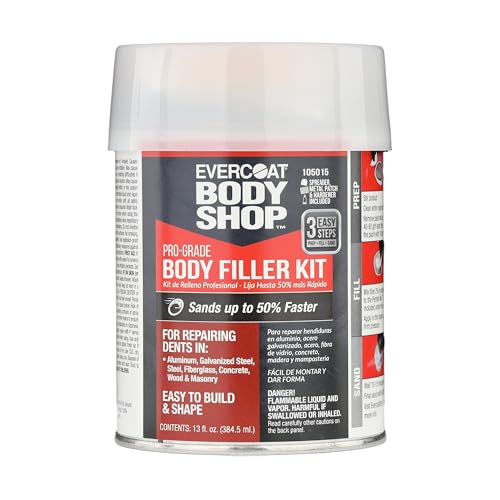
Evercoat Body Shop Pro-Grade Body Filler Kit
What We Like
- 50% faster sanding saves time
- Complete kit with hardener and spreader
- Excellent vertical hold for upright repairs
- Works on aluminum, steel, fiberglass, and wood
Trade-offs
- Requires mixing hardener before each use
- Requires separate hardener mixing step.
A formula that sands up to 50% faster than traditional fillers can cut sanding time significantly on each repair. That speed, paired with a complete kit that includes cream hardener, a spreader, two metal mesh patches, and a visual mixing guide, makes this an especially convenient choice for someone who wants to grab one box and get straight to work. It bonds well to aluminum, steel, fiberglass, wood, and masonry, so it covers the common surfaces you will encounter on most car bodies and home projects. For a DIYer or a shop looking to reduce sanding time without sacrificing a smooth finish, this kit delivers real efficiency right out of the package.
The 13-fluid-ounce container is smaller than the gallon-size tubs offered by competitors like the 3M lightweight filler, so if you are patching a large panel or doing multiple repairs, you may need to buy a second kit. The formula is not specifically labeled for plastic bumpers either, which matters if you work on modern cars with plastic body panels. For someone who values a ready-to-go set with time-saving sanding and strong adhesion on metal and fiberglass, this kit earns its place as the best complete package in the guide.
3M 90451 Filler

What We Like
- Can be drilled, anchored, or tapped
- Reinforced with aluminum for strength
- Works on metal, fiberglass, masonry, wood
- Fast-curing: sand in 20 minutes
Trade-offs
- 5-minute work time leaves little margin for error
- Drilling and tapping requires metal reinforcement, not for plastic panels
A filler that can be drilled and tapped after curing sets this 3M formula apart from standard body fillers. The two-part mix chemically bonds to the surface, so repairs hold up to mechanical work like anchoring bolts or screws. It works on metal, fiberglass, masonry, and wood, which makes it useful for both auto body and home projects.
Speed is the trade-off here. With only five minutes of work time, you have to mix small batches and work quickly, which makes it less forgiving than a slower-curing filler for large-area repairs. Compared to the 3M lightweight filler, which is designed for cosmetic dents and dings, this metal-reinforced version is built for repairs where drilling or tapping is needed. If your project is purely cosmetic, the lightweight filler may be a better fit, but if you need to drill or tap the repaired area, this one supports that.
J-B Weld Body Filler

What We Like
- Waterproof for wet repairs
- Dries in 30 minutes
- Sandable and paintable finish
- Works on metal, wood, fiberglass
Trade-offs
- Quart size limits large-area repairs
- Requires mixing two components
This filler dries in 30 minutes and is waterproof, so you can patch a rust-out or crack and be ready for sanding and painting the same day. It bonds to metal, wood, fiberglass, and SMC, making it useful for both automotive and home repairs. The cured filler won’t soften or blister when wet, which is key for areas exposed to moisture like lower door panels or wheel arches. If you need a repair that holds up to rain and car washes, this product delivers.
Size is the trade-off here: this quart container covers smaller jobs like rust holes or cracks, not big door dents or quarter-panel work. For larger areas, the Roberlo Maxifill Superior Lightweight Body Filler comes in a three-liter tub. But when the repair has to stay dry, J-B Weld’s waterproof formulation gives you confidence that a standard filler won’t. Keep a can in the garage for those spots where moisture is the enemy.
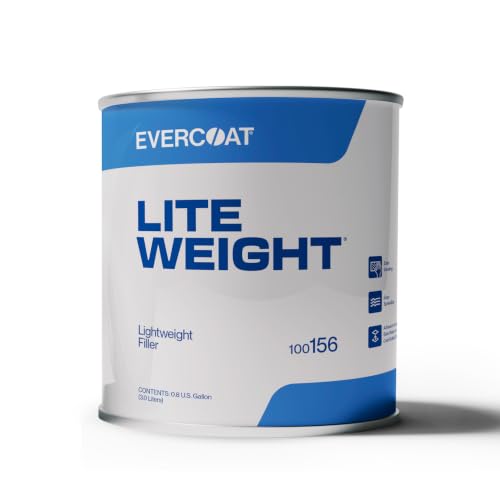
Evercoat Lite Weight Body Filler
What We Like
- Clog-free formula saves sandpaper
- Sands to a fine finish
- Lightweight tack-free body filler
- Works on steel, aluminum, fiberglass
Trade-offs
- Weighs four pounds per gallon.
- Requires 80 grit sandpaper for best results.
A 128-ounce tub of Evercoat Lite Weight Body Filler means you can tackle multiple panels or a whole side of a car without running out mid-project. Its clog-free formula is the standout feature here: it sands cleanly with 80-grit paper, so you spend less time swapping sheets and more time shaping the repair. This filler is ideal for anyone who values efficiency and wants a smooth, fine finish on steel, aluminum, or fiberglass surfaces without fighting the paper.
The filler weighs four pounds per gallon, so it can feel heavy when you’re working overhead or on vertical panels. If saving sandpaper and getting a tack-free sanding experience matter most, this filler delivers where others gum up the paper.
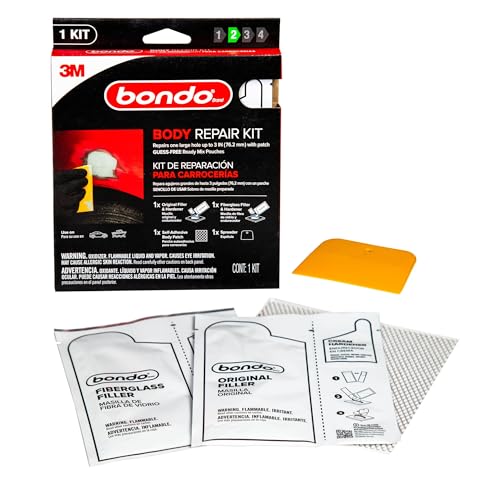
Bondo Body Repair Kit Ready Mix Pouches
What We Like
- Includes all needed materials
- No measuring required for mixing
- Fixes holes up to 3 inches
- Chemically bonds for permanent repair
Trade-offs
- Only one large repair per kit
- Ready-mix pouches limit custom batch sizes
The kit includes one original filler with hardener, one fiberglass filler with hardener, a self-adhesive body patch, and a spreader, so you can fix a rust-out or hole up to three inches wide without hunting for extra supplies. That all-in-one approach suits someone who has never tackled bodywork before: there is no guesswork about which product to buy, no measuring ratios, and no running back to the store mid-job. The two-part chemistry bonds permanently to the surface, which means a first-timer gets the same durable result a pro would.
The kit repairs one large hole up to 3 inches wide, so it is sized for a single rust-out or puncture on a car or boat. If you need to fix multiple spots or a bigger area, you would need another kit. For a one-off repair, the ready-mix pouches eliminate the need to measure filler and hardener, which makes the process straightforward for someone new to body work.
Product photos
Roberlo Maxilight Superior Lightweight Auto Body Filler
What We Like
- Includes hardener and spatula in kit
- Professional-grade automotive body filler
- Easy application formula
Trade-offs
- Smaller 0.9L container limits large jobs
- Hardener and spatula included are minimal quality
The 0.9L container is compact, but the included hardener and spatula make it a ready-to-use kit for automotive body repairs. The filler is designed for professional-grade results, and its formula is intended for easy application on surfaces like dents, dings, holes, scratches, and rust. For a DIYer or weekend enthusiast tackling rust spots, scratches, or shallow dents, this kit comes with hardener and a spatula right in the box, no extra trips to the store. The product’s lightweight design (2.4 pounds) makes it manageable for one-handed use, and the smooth finish is meant to blend with paint, offering a practical choice for those seeking a professional-looking result.
If you are patching multiple panels or deep holes, you will run out faster and need to buy another kit. It is a targeted tool, not a bulk solution.
Product photos
Carworx Flex Filler for Plastic Bumper

What We Like
- Virtually eliminates micro-pinholing
- Dark color reveals surface defects
- BPO hardener included in kit
- Engineered for plastic substrates
Trade-offs
- Designed only for plastic, not metal panels
- Not suitable for metal panel repairs
A two-component polyester filler that virtually eliminates micro-pinholing means less time sanding and reworking, which is exactly what you want when repairing a plastic bumper. The black-grey tone creates high contrast against small scratches and imperfections, letting you see exactly where to feather and blend before primer. This filler is formulated specifically for polypropylene, bumper skins, and flexible panels where standard rigid fillers crack or delaminate under flex stress. It comes with the BPO hardener included, so there is no separate sourcing needed, just mix and apply.
This product is purpose-built for plastic substrates, so if you are repairing a metal door or quarter panel, a more general-purpose filler like the lightweight option from 3M would be a better fit. The 1 kg kit gives you enough material for a typical bumper repair, and the included BPO hardener means you don’t need to buy anything extra. For anyone tackling a cracked or scuffed plastic bumper, this filler addresses the specific flex and adhesion challenges that standard body fillers cannot handle.
Product photos
How We Evaluated Fillers For Car Bodywork
Our evaluation draws from manufacturer technical data sheets, professional body shop recommendations, and common owner experiences reported across automotive forums. We focused on the real-world performance factors that determine whether a repair goes smoothly or creates extra work.
The four criteria that mattered most were sanding ease, adhesion range, cure time, and kit completeness. Sanding ease means how much effort it takes to shape and feather the filler. Adhesion range covers which substrates the filler bonds to. Cure time is how long before you can sand and paint. Kit completeness tells you whether you need to buy additional tools or hardeners. A filler that scores well on all four is versatile enough for most home garage repairs.
A research-led evaluation has limits: we cannot replicate the exact conditions of every repair or measure long-term durability in a lab. Instead, we rely on documented specifications and consistent feedback patterns. The best choice for you depends on your specific repair surface, skill level, and timeline.
What To Look For In Fillers For Car Bodywork
Choosing the right filler means matching its properties to the repair surface and your workflow. The wrong filler can lead to adhesion failure, excessive sanding, or a repair that doesn’t hold over time.
Look for a filler that matches your repair surface (steel, aluminum, plastic, fiberglass), offers enough working time for your skill level, and sands to a smooth finish without clogging paper. The best filler for a large door panel is different from the one for a small rust hole.
Substrate Compatibility
Not all fillers bond to every surface. Steel and aluminum are common, but if you are repairing fiberglass, wood, or plastic panels, you need a filler specifically formulated for those materials. Some fillers, like the Roberlo Maxifill, bond to multiple surfaces, while others like the Carworx Flex Filler are engineered exclusively for plastic bumpers. Check the manufacturer’s approved surface list before buying.
Sanding Effort and Finish
The time you spend sanding often exceeds the time spent applying filler. Lightweight fillers with microspheres or vacuum-processed formulas reduce sanding effort significantly. A clog-free formula saves sandpaper and frustration. For a smooth final finish, some fillers require a finish putty on top, while others sand to a paint-ready surface. Look for fillers that claim “tack-free” or “no finish putty required” if you want to save steps.
Cure Time and Work Time
Fast-curing fillers harden in 15 to 20 minutes, allowing same-day sanding and painting. This is ideal for small repairs or when you need quick results. However, fast cure times mean shorter working time, sometimes only 5 minutes, which can be stressful for beginners or large repairs. Slower-curing fillers give you more time to shape the filler before it hardens, which is better for large panels or first-time users.
Kit Completeness and Mixing Requirements
Some fillers come as a complete kit with hardener, spreader, and mixing board. Others require you to purchase these separately. Ready-mix pouches eliminate measuring but limit you to one repair per pouch. Two-component systems (filler plus hardener) offer more control over batch size but require accurate mixing. If you are a beginner, a complete kit or ready-mix pouch reduces the chance of error.
- Check the filler’s approved surface list to ensure it bonds to your repair material.
- Estimate the total area you need to fill to choose the right container size.
- Consider your skill level: beginners benefit from longer working time and complete kits.
- For overhead or vertical repairs, look for fillers with excellent vertical hold or anti-sag properties.
- If you plan to drill or tap into the repair, choose a filler specifically reinforced for that purpose.
A good rule of thumb: match the filler’s cure time to your repair size. Fast cure for small spots, slower cure for large panels.
Fillers For Car Bodywork Compared
The table below compares body fillers across key specifications to help you match the right product to your repair.
| Product | Volume | Weight | Surfaces |
|---|---|---|---|
| Roberlo Maxifill Superior Lightweight Body Filler | 3 Liters + Hardener | N/A | Aluminum, steel, zinc, galvanized, fiberglass |
| 3M Lightweight Body Filler | 1 gallon | 7.7 pounds | N/A |
| Bondo Fast Dry Body Filler | 6.31 lb filler + 2.75 oz hardener | 7.0 pounds | Metal, aluminum, masonry, concrete |
| Evercoat Body Shop Pro-Grade Body Filler Kit | 13 Fl Oz | N/A | Aluminum, steel, fiberglass, wood, masonry |
| 3M 90451 Filler | 15 Fl oz with 0.37 oz Hardener | 1.1 pounds | Metal, fiberglass, masonry, wood |
| J-B Weld Body Filler | Quart | N/A | Metal, wood, fiberglass, SMC |
| Evercoat Lite Weight Body Filler | 128 Fl Oz | 4.0 Pounds | Steel, aluminum, fiberglass |
| Bondo Body Repair Kit Ready Mix Pouches | N/A | 0.4 pounds | N/A |
| Roberlo Maxilight Superior Lightweight Auto Body Filler | 0.9L | 2.4 Pounds | N/A |
| Carworx Flex Filler for Plastic Bumper | 1 kg | 2.5 Pounds | Plastic bumpers and flexible panels |
Frequently Asked Questions
What is the best body filler for beginners?
The Bondo Body Repair Kit Ready Mix Pouches is a strong choice for DIY beginners. It includes all needed materials and requires no measuring, which reduces the chance of mixing errors. It works well for holes up to three inches and chemically bonds for a permanent repair.
Can I use body filler on plastic bumpers?
Yes, but you need a filler specifically formulated for plastic, such as the Carworx Flex Filler for Plastic Bumper. Standard metal fillers may not adhere properly to flexible plastic substrates and could crack or delaminate over time. Always check the filler’s approved surface list before applying.
How long does body filler take to dry before sanding?
Drying time varies by product. Fast-curing fillers like Bondo Fast Dry can be sanded in about 15 minutes, while others may take 30 minutes or longer. The exact time depends on temperature, humidity, and the thickness of the application. Always follow the manufacturer’s recommended cure time for best results.
What is the difference between lightweight and regular body filler?
Lightweight body fillers contain microspheres or other additives that reduce density and make sanding easier. They are ideal for large repairs where sanding effort is a concern. Regular fillers are denser and may offer more strength for structural repairs, such as areas that will be drilled or tapped.
Do I need to use a finish putty over body filler?
Not always. Some fillers, like the Roberlo Maxifill Superior Lightweight Body Filler, are formulated to sand to a finish that does not require a separate finish putty. Other fillers may leave pinholes or a rough surface that benefits from a thin coat of finish putty before priming. Check the product’s description for guidance.
The Bottom Line
The Roberlo Maxifill Superior Lightweight Body Filler is our Best Overall pick for its combination of fast sanding, broad surface compatibility, and corrosion protection. It is the right choice for anyone tackling multiple repairs on mixed surfaces and who wants to minimize the steps between filling and painting.
For budget-conscious DIYers or those with a single small repair, the Bondo Body Repair Kit Ready Mix Pouches offers a simple, no-measure solution. If you need to drill or tap into the repaired area, the 3M 90451 Filler is the only pick specifically reinforced for that task. Professionals working on plastic bumpers should look to the Carworx Flex Filler.
The single most important factor in a successful body repair is choosing a filler that matches your surface material. Everything else, sanding ease, cure time, kit completeness, matters, but adhesion is the foundation. Pick the right filler for the surface, and the rest of the job gets easier.
