
10 Best Glass Scratch Removers For Cars in 2026
This post contains affiliate links. As an Amazon Associate, we earn from qualifying purchases.
For removing scratches, wiper marks, and water spots from automotive glass, we recommend the 3D Glass Polish Cerium Oxide Polish as the best overall. Its cerium oxide formula tackles wiper marks and scratches effectively, with a long open time for extended workability. For deep scratches you can catch with a fingernail, the Glass Polish DIY Scratch Removal Kit is our pick for Best For Deep Scratches, while the SafeCope Glass Polishing Kit Cerium Oxide offers the best value for DIYers.
The challenge with glass scratch removers is matching the product to the severity of the damage and your available tools. Light haze and wiper streaks respond to gentle polishes, but deep scratches need a cerium oxide compound and a power tool like a rotary polisher or drill. Choosing the wrong product means wasted time and frustration.
This guide is based on manufacturer specifications, expert round-ups, and patterns in owner feedback. We evaluated ten products across key criteria like abrasive type, application method, and scratch severity to help you find the right match for your car and skill level.
Top 10 Glass Scratch Removers For Cars in the Market
Certain content that appears on this site comes from Amazon. This content is provided "as is" and is subject to change or removal at any time.
The Best Glass Scratch Removers For Cars, Reviewed
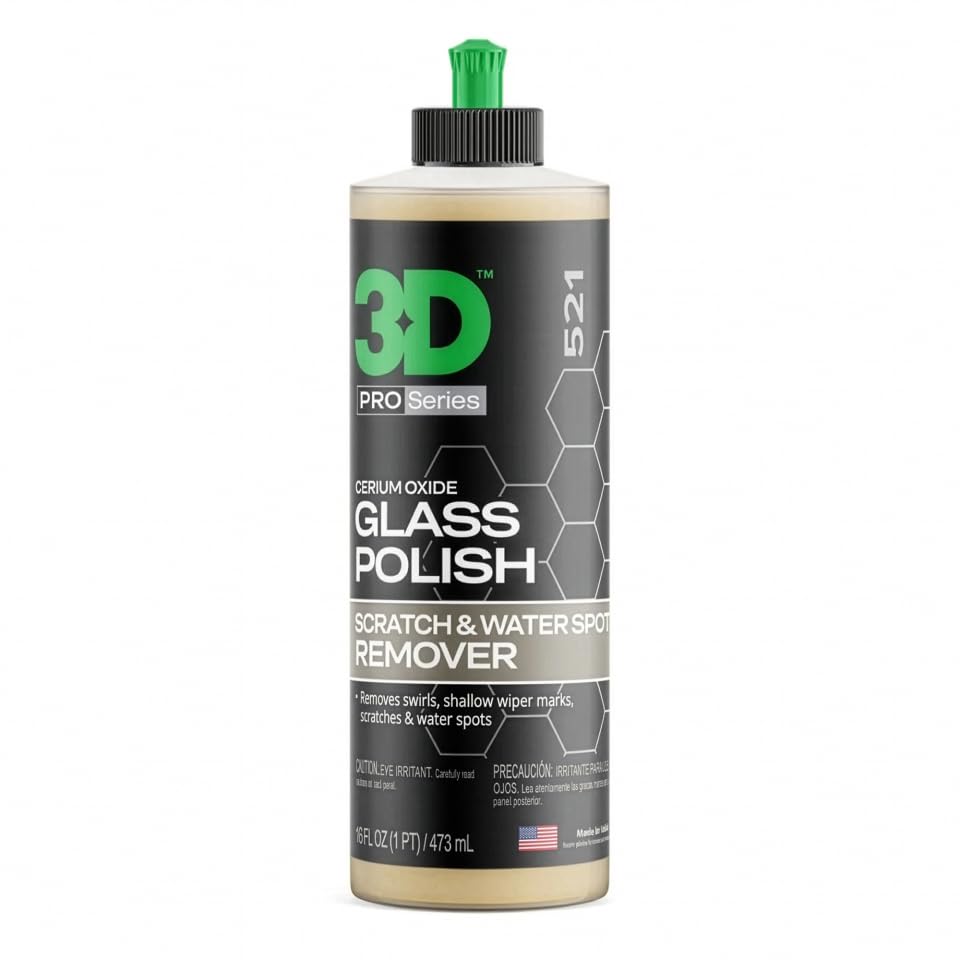
3D Glass Polish Cerium Oxide Polish
What We Like
- Cerium oxide formula tackles wiper marks and scratches
- Long open time for extended workability
- Smooth application with minimal scrubbing
- Prepares glass for ceramic coatings
Trade-offs
- Requires a rotary polisher and felt pad
- Not a DIY hand-polish option for casual users
A 16-ounce cerium oxide polish formulated for pro-level glass correction means this is the go-to for anyone serious about restoring clarity to a windshield or window. It targets stubborn wiper marks, etched water spots, fine scratches, and swirl marks, and the long open time gives you plenty of working room with a rotary polisher and felt pad. For the driver who wants a smooth surface before applying a ceramic coating, this polish is designed to remove imperfections and improve bonding for long-term coating durability.
The trade-off is that this polish is built for a rotary polisher and felt pad, not for hand application. If you don’t own a polisher or prefer a simple wipe-on approach, the DIY Scratch Removal Kit offers a drill-based alternative that suits casual users better.
Product photos
SONAX PROFILINE GlassPolish Cerium Oxide

What We Like
- Cerium oxide abrasives for light scratches
- Hand or machine application flexibility
- Removes water spots, haze, and etching
Trade-offs
- Deep chips and cracks need professional repair
- Requires a felt pad and machine for best results
Cerium oxide abrasives give this polish a chemical-mechanical edge over plain compounds, letting it tackle light windshield scratches and stubborn water spots that ordinary glass cleaners leave behind. That makes it a strong fit for detailers who want professional-grade results without stepping up to a full repair kit. It works by hand or with a felt pad on a machine, so you can spot-clean a wiper haze or polish a whole windshield depending on your setup.
The polish works only on uncoated glass, so if your windshield has a hydrophobic layer or your side windows are tinted, you’ll need a different product. Compared to the 3D Glass Polish, which comes in a 1-pound bottle, the SONAX weighs 0.4 pounds and holds 250 ml, so it’s actually less volume for larger jobs. Both brands use cerium oxide, but the SONAX is a better fit for spot treatments than full-windshield work.
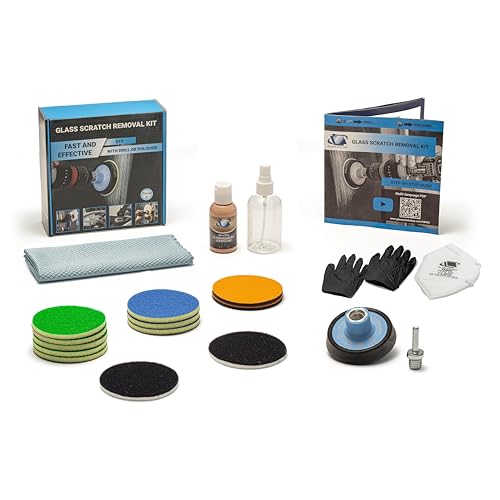
Glass Polish DIY Scratch Removal Kit
What We Like
- Removes deep scratches you can catch with a fingernail
- Works with drill or polisher via included adapter
- Safe for tempered, laminated, and ceramic glass
- Includes video tutorials via QR code
Trade-offs
- Requires a drill or polisher (not included)
- Multi-stage process needs careful step-by-step follow-through
The kit uses cerium oxide compound and 3-inch pads to remove scratches you can catch with a fingernail. That means it handles real damage like key marks, deep scuffs, and etching, not just haze or light swirls. It works on flat and curved glass, so windshields, side windows, shower doors, and fish tanks are all fair game. The included universal drill adapter lets you use a drill if you don’t have a dedicated polisher, though keeping the pad flat and moving steadily is key.
This process has a few stages: you sand, then polish, then buff. It takes patience and a steady hand, unlike a one-step wipe-on polish. If your glass has scratches you feel with your nail, this is the one to reach for.
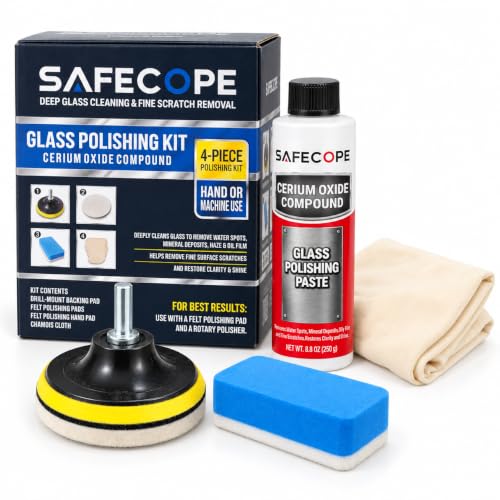
SafeCope Glass Polishing Kit Cerium Oxide
What We Like
- Includes drill-mount backing pad and felt pad
- Works by hand or with a drill
- Cerium oxide formula for fine scratches
- Suitable for windshields, windows, and shower glass
Trade-offs
- Power tool not included for machine use
- Only for fine surface imperfections, not deep scratches
The 8.8-ounce tub of cerium oxide paste, combined with a drill-mount backing pad and felt polishing pad, helps reduce the appearance of light wiper marks, haze, and mineral deposits on uncoated glass. That means you can start restoring clarity to windshields, side windows, or shower doors once you have a drill handy. The kit also includes a felt hand pad, chamois cloth, and a round felt pad for machine polishing, so everything you need for fine surface imperfections comes in one box.
This kit is strictly for uncoated glass, so if your vehicle has a rain-repellent coating or tinted windows, you will need a different product. Compared to the SONAX PROFILINE GlassPolish, which comes in a smaller 250 ml bottle, the SafeCope kit gives you both hand and drill options plus the felt pads right out of the box. That flexibility makes it a strong value for someone tackling a single windshield or household glass project without wanting to invest in extra gear.
Product photos
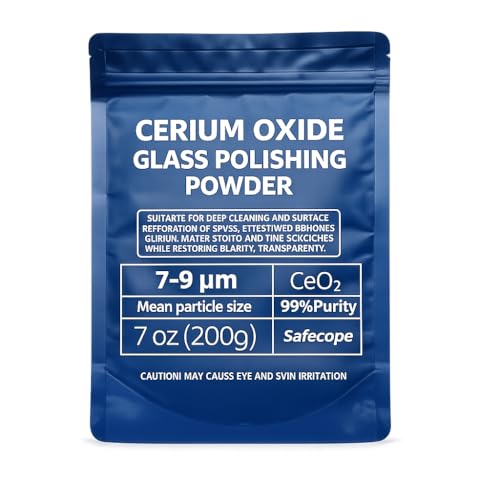
SafeCope Cerium Oxide Polishing Powder 99%
What We Like
- High 99% cerium oxide concentration
- Works by hand or machine
- Removes oil films, water spots, swirl marks
- Suitable for automotive and household glass
Trade-offs
- Must mix with water before use
- Requires firm pressure and 10+ minutes polishing
At 99% cerium oxide and a 7-9 micron particle size, this powder is formulated to tackle light scratches, water spots, oil film, wiper marks, and haze on glass. You mix it with water into a slurry, then apply by hand or with a rotary polisher at 500-2500 RPM.
You have to clean the glass first, mix the powder, keep the surface wet while polishing, and apply firm pressure for at least ten minutes. That’s more hands-on than a ready-to-use polish, but if you’re comfortable with the prep, the high cerium oxide content lets you tackle multiple glass surfaces with one container.
Product photos
Glass Polish Pro Cerium Oxide Powder
What We Like
- 85% pure cerium oxide for fine scratches
- Suspension-treated formula reduces splatter
- Works on mirrors, windshields, and household glass
Trade-offs
- Only for fine scratches you can barely feel
- Requires mixing with water before use
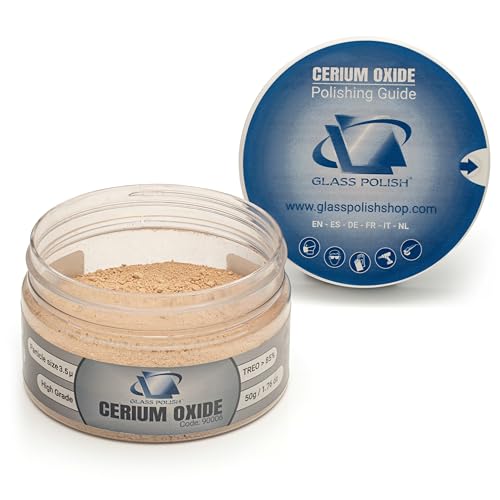
Mixing this powder with water creates a stable slurry that stays suspended longer, reducing the need to constantly re-wet the pad. That means more time spent actually polishing away wiper marks, water spots, and light haziness on windshields, mirrors, or shower glass. For anyone needing a targeted fix for faint, shallow scratches rather than a full heavy-duty restoration, this 1.76-ounce jar delivers professional-grade results without overkill. The 85% pure cerium oxide with 3.5-micron particles is formulated from over 20 years of professional glass repair experience, so it works fast on surface imperfections while being safe for all glass types.
This product is strictly for fine surface defects. If you try it on deeper scratches, you will be disappointed. For those cases, the DIY Scratch Removal Kit from the same brand offers a two-stage abrasive system that tackles deeper damage first. But if your glass has only light swirls or shallow etching, this powder is a direct option. Just be ready to mix it yourself and work with a rotary tool or drill for best results.
Durabasics Cerium Oxide Glass Polish
What We Like
- Includes 3" wool felt pad
- Concentrated cerium oxide formula
- Targets wiper marks and water spots
- Works with rotary polisher or drill
Trade-offs
- Requires rotary polisher or drill (not included)
- Useless for deep scratches or gouges
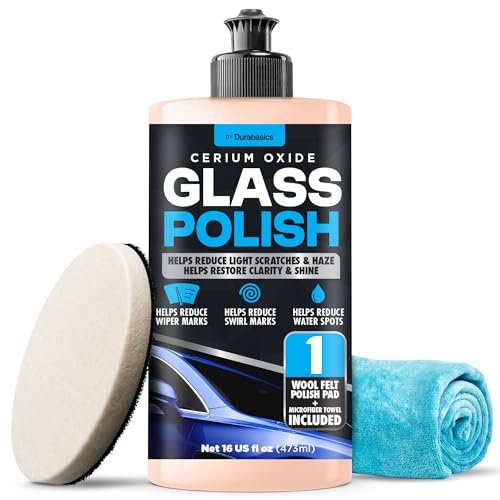
The included 3″ wool felt pad is a practical addition, designed to help maintain even contact during polishing, which supports smoother results. This makes the product a convenient option for those who already have a rotary polisher or drill, as the pad is included and compatible with both. The concentrated cerium oxide formula is efficient, so a small amount goes a long way, and the 16-ounce bottle provides ample product for multiple applications.
This polish is formulated for light scratches, haze, and surface-level imperfections. Deeper scratches may not be fully removed, though it can still be used on them with potentially limited results. For those dealing with severe gouges or scratches that catch a fingernail, the DIY Scratch Removal Kit is explicitly designed for deeper damage and may be a better fit. For everyday haze, wiper marks, and minor swirls, this product with its included felt pad offers a straightforward solution.
Product photos
Gold Label Detailing Optical Grade Cerium Oxide

What We Like
- Optical grade for delicate lenses
- Zinc-free formula avoids toxic additives
- Comes with felt bob wheel
- Works on windshields, cameras, scopes
Trade-offs
- Requires a high-speed drill separately
- Powder must be mixed before each use
- Small 0.5 lb container for larger jobs
Gold Label Detailing’s Optical Grade Cerium Oxide is safe to use on camera lenses, binoculars, and windshields alike, so you can tackle scratches on delicate optics without worrying about damage. The powder is zinc-free, which avoids the toxic ingredients found in some lower-quality red or pink cerium oxide. A 3-inch felt bob wheel comes with the 8-ounce container, and it attaches to a standard high-speed drill for easy application.
You do have to mix the powder with water yourself each time, and the 0.5-pound container is modest. If you plan to polish a full set of car windows or shower doors, a larger option like the SafeCope kit (8.8 oz paste with felt pads) might reduce prep time. But for precision jobs on optics or a single windshield scratch, the optical-grade purity and included wheel give you control without needing professional equipment.
Product photos
Nu Finish Scratch Doctor Glass Restore Kit
What We Like
- Two-step system combines polish and long-lasting ceramic sealant
- Patent-pending applicator reaches broad surfaces and corners
- Ceramic sealant repels water, tree sap, bird droppings
Trade-offs
- Two-step process takes more time than single-step polishes
- 90-minute sealant cure time requires patience
- Sealant looks cloudy or hazy while drying
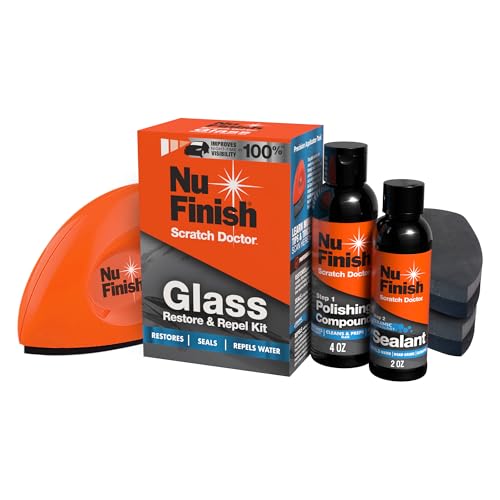
The kit’s polishing compound strips away old coatings, haze, and road grime, and the ceramic sealant repels water, rock chips, tree sap, bird droppings, and road grime for up to two years. That means you get both a clean surface and ongoing protection without frequent reapplication. The two-step system pairs a polish with a sealant, so it’s a complete package for anyone who wants to restore glass clarity and add a durable water-repelling layer.
After polishing, you apply the sealant, wait ten minutes, buff it, then let it cure for 90 minutes while it looks hazy. For drivers who prefer a one-step polish and don’t mind reapplying protection often, a simpler product like Griot’s Garage Fine Glass Polish might be faster. But if you want a system that polishes and then seals the glass for up to two years, this kit delivers everything in one box.
Griot's Garage Fine Glass Polish

What We Like
- Ready-to-use liquid, no mixing needed
- Gentle enough for regular use
- Works on shower doors and windows too
- Helps extend wiper blade life
Trade-offs
- Only removes mild water spots and stains
- Best results require a dual-action polisher
Griot’s Garage Fine Glass Polish is a ready-to-use liquid that comes in a 16-ounce bottle, so there is no need to mix powders or pastes. It is designed to lift mild water spots and stains from windshields, side glass, sunroofs, and even household glass like shower doors. The formula leaves a smooth, clean surface that helps wiper blades last longer and reduces streaking. Because it is gentle, you can apply it regularly without worrying about damaging the glass. This makes it a practical choice for anyone who wants to keep their car’s glass looking clear with minimal fuss, especially if you already own a dual-action polisher and a glass polishing pad.
If you have visible scratches, swirl marks, or deeper etching on your glass, you will need a cerium oxide polish or a dedicated scratch removal kit. The SONAX PROFILINE GlassPolish and the DIY Scratch Removal Kit are two examples. Griot’s Fine Glass Polish is best thought of as a maintenance polish for keeping glass bright and free of hard water spots, not a repair compound. For drivers who face only light mineral deposits or haze, it is an easy, effective solution. For those dealing with actual scratches, it will not deliver the fix you need.
How We Evaluated Glass Scratch Removers For Cars
Our evaluation began with a close look at each product’s formulation. Cerium oxide is the industry standard for glass polishing, so we noted the concentration and purity levels listed by manufacturers. We also checked whether the product was ready-to-use or required mixing with water, as this affects convenience and consistency.
We then examined the application method required for each product. Some polishes work by hand, while others demand a rotary polisher, dual-action polisher, or drill for effective results. We cross-referenced these requirements with the included accessories, felt pads, backing plates, and applicators, to determine what a buyer actually needs to get started.
Finally, we categorized each product by the type of scratch it can address. We looked for clear manufacturer guidance on whether a formula handles light haze, wiper marks, fingernail-catching scratches, or deep gouges. Owner feedback patterns helped confirm whether these claims hold up in real-world use.
What To Look For In Glass Scratch Removers For Cars
Choosing the right glass scratch remover starts with understanding your scratch and your tools. Here are the key criteria to guide your decision.
Look for cerium oxide for real scratch removal, check whether the product works by hand or needs a power tool, and match the abrasive strength to your scratch depth. Avoid products that promise to remove deep scratches without a machine.
Cerium Oxide Content and Purity
Cerium oxide is the active abrasive that actually removes glass. Higher purity, like 99% in the SafeCope Polishing Powder, means more cutting power per application. Lower concentrations, such as 85%, are better suited for fine, faint scratches. Some products list the percentage clearly; others describe their formula as “cerium oxide-based” without a number. When in doubt, a higher concentration gives you more versatility.
Application Method: Hand vs. Machine
Glass is hard, so removing scratches requires friction. Hand polishing works for very light haze and water spots but demands firm pressure and patience, often 10 minutes or more per area. For wiper marks and deeper scratches, a rotary polisher, dual-action polisher, or drill is necessary. Some kits include a felt pad and adapter; others require you to supply the tool separately. Know what you own before you buy.
Scratch Depth Compatibility
Not all scratches are the same. Light scratches you can barely feel respond to fine polishes and ready-to-use liquids. Scratches you can catch with a fingernail need a multi-stage kit with a more aggressive cerium oxide compound. Deep gouges and cracks typically require professional repair. A product that claims to remove all scratch types is likely overpromising. Match the product to the scratch.
- Run your fingernail across the scratch. If it catches, you need a deep-scratch kit.
- Check whether the product works on coated, tinted, or treated glass. Many cerium oxide polishes do not.
- Verify that the kit includes everything you need: pad, backing plate, and adapter if required.
- Read the cure or dry time for sealants if you want protection after polishing.
A scratch you can feel with a fingernail needs a multi-step kit and a power tool. A light haze may only need a gentle liquid polish and a bit of elbow grease.
Glass Scratch Removers For Cars Compared
The table below compares all ten glass scratch removers side by side, including the type of scratches they address, their application method, and whether they come ready-to-use or need mixing.
| Product | Form/Type | Size/Weight | Application Method | Glass Type |
|---|---|---|---|---|
| 3D Glass Polish Cerium Oxide Polish | Cerium Oxide | 16 oz, 1.0 lb | Rotary polisher + felt pad | Uncoated glass |
| SONAX PROFILINE GlassPolish Cerium Oxide | Cerium Oxide | 250 ml, 0.4 lb | Hand or Machine | Uncoated glass only |
| Glass Polish DIY Scratch Removal Kit | Kit | 0.7 lb | Drill or polisher | Flat and curved |
| SafeCope Glass Polishing Kit Cerium Oxide | Cerium Oxide paste | 8.8 oz (250 g) | Hand or drill-mounted machine | Uncoated glass only |
| SafeCope Cerium Oxide Polishing Powder 99% | 99% Cerium Oxide powder | 7 oz (200 g) | Hand or machine (500-2500 RPM) | Glass only |
| Glass Polish Pro Cerium Oxide Powder | Cerium Oxide powder | 1.76 oz (50g) | Rotary tool, drill, or by hand | All glass |
| Durabasics Cerium Oxide Glass Polish | Cerium Oxide | 16 oz | Included 3" wool felt pad | Automotive glass |
| Gold Label Detailing Optical Grade Cerium Oxide | Cerium Oxide powder | 0.5 lb | Mix with water | Different types of glass |
| Nu Finish Scratch Doctor Glass Restore Kit | Kit (polish + sealant) | 4 fl oz polish, 2 fl oz sealant | Precision Applicator Tool | Exterior auto glass |
| Griot's Garage Fine Glass Polish | Liquid | 16 oz, 1.0 lb | Cotton polishing pad or DA polisher | All automotive and household glass |
Frequently Asked Questions
Can you really remove scratches from car glass?
Yes, you can remove light to moderate scratches from automotive glass using a cerium oxide polish and the right tool. Scratches that catch a fingernail require a multi-stage kit and a drill or rotary polisher. Deep gouges and cracks that go through the glass usually need professional replacement.
What is the best product to remove scratches from car windows?
The best product depends on the scratch depth and your tools. For overall performance, the 3D Glass Polish Cerium Oxide Polish is our top pick for car enthusiasts with a rotary polisher. For deep scratches, the Glass Polish DIY Scratch Removal Kit is designed specifically for that job and works with a drill.
Do glass scratch removers work on windshield scratches?
Yes, most glass scratch removers work on windshields, provided the windshield is not coated or treated. Cerium oxide polishes are safe for tempered and laminated glass. Always check the product label to confirm compatibility with your specific windshield type.
Can I remove scratches from car glass by hand?
You can remove very light haze, water spots, and faint wiper marks by hand, but it requires firm pressure and several minutes of polishing. Deeper scratches and wiper marks that are visible and feelable need a machine, either a drill, rotary polisher, or dual-action polisher, to generate enough friction.
How long does glass scratch remover take to work?
A hand-applied polish may take ten minutes or more per area. A machine polish with cerium oxide typically shows results in two to five minutes per section. Multi-step kits for deep scratches require careful follow-through of each stage, which can take a significant amount of time for a single window.
The Bottom Line
For most car owners who own a rotary polisher and want professional-grade scratch removal, the 3D Glass Polish Cerium Oxide Polish is the best overall choice. Its cerium oxide formula handles wiper marks and scratches with a long working time and smooth application. If you do not own a rotary polisher, consider the Glass Polish DIY Scratch Removal Kit for deep scratches. Or look at the SafeCope Glass Polishing Kit Cerium Oxide for a complete value option that works with a drill.
Budget-conscious buyers who are comfortable mixing powder and polishing by hand will find the SafeCope Cerium Oxide Polishing Powder 99% a solid, affordable option for light scratches. For those who prefer a ready-to-use liquid for gentle maintenance, the Griot’s Garage Fine Glass Polish is a convenient choice that works on mild water spots.
The single most important factor in choosing a glass scratch remover is matching the product to your scratch depth and your available tools. A deep scratch needs a multi-stage kit and a drill; a light haze may only need a gentle polish and some patience. Know your scratch, know your tools, and choose accordingly.
