
10 Best Iphone 15 Car Chargers in 2026
This post contains affiliate links. As an Amazon Associate, we earn from qualifying purchases.
The Anker 167.5W Ultra-Compact Car Charger is the best overall car charger for iPhone 15 owners. Its 100W USB-C port can charge a MacBook Pro to 50% in 47 minutes. The Belkin BoostCharge 42W is the best fast charging compact option for a tiny footprint. The UGREEN 145W 4-Port Retractable is the top choice for drivers who want high power with a tidy, built-in cable.
The switch to USB-C on the iPhone 15 line means you can finally use the same fast-charging cable for your phone, laptop, and tablet. But not all car chargers are created equal: wattage, port configuration, and physical size vary widely, and picking the wrong one can mean slow charging or a bulky plug that blocks your other ports.
This guide is based on manufacturer specifications, expert round-ups, and patterns in owner feedback. We’ve ranked ten chargers to help you find the right balance of power, portability, and price for your daily drive.
Top 10 iPhone 15 Car Chargers in the Market
Certain content that appears on this site comes from Amazon. This content is provided "as is" and is subject to change or removal at any time.
The Best iPhone 15 Car Chargers, Reviewed
Anker 167.5W Ultra-Compact Car Charger

What We Like
- 100W USB-C port charges a MacBook Pro to 50% in 47 minutes
- Ultra-compact design won't clutter your car interior
- Includes a 3.3 ft USB-C to USB-C cable
- Triple-port setup powers multiple devices at once
Trade-offs
- No retractable cable, so you'll need to manage the included cord
- Bulky for tight cigarette lighter locations
With a 100W USB-C port that can charge a 16-inch MacBook Pro from zero to 50% in just 47 minutes, this Anker charger brings laptop-grade power to your car. The triple-port setup, 100W, 45W, and 22.5W, means you can juice up an iPhone 15, a tablet, and a friend’s phone at the same time without playing musical chairs with ports. It’s designed to be ultra-compact, so it stays out of the way in your center console or cup holder. That makes it a natural fit for anyone who wants one charger to handle everything from a quick phone top-up to a full laptop recharge on a road trip.
You don’t get a retractable cable like the UGREEN 145W 4-Port Retractable Car Charger offers, so you’ll need to stow the included 3.3 ft USB-C cable yourself. That’s a minor inconvenience when you consider the raw power per port. The 100W output is significantly higher than the 30W you’d get from the Anker 30W PowerIQ 3.0 Car Charger, making this the better choice if you regularly charge a laptop on the go. If you prioritize tidy cable management over maximum speed, a retractable model might suit you better, but for pure charging capability in a small package, this is hard to beat.
Product photos
Anker 30W PowerIQ 3.0 Car Charger

What We Like
- Ultra-compact size fits tight spaces
- 30W USB-C charges iPhone 15 three times faster than 5W
- Dual-port charging for two devices
- Multiple built-in safety protections
Trade-offs
- 30W total limits simultaneous fast charging
- No cable included for immediate use
- USB-A port slower than USB-C for newer devices
The 30W USB-C port offers a charging speed that’s three times faster than standard 5W chargers, which means an iPhone 15 can gain a meaningful amount of charge during a quick errand. Its ultra-compact body is designed to fit in the smallest of spaces, so it slips into tight cigarette lighter sockets without sticking out or blocking nearby controls. That makes it a practical pick for anyone who wants fast charging without a bulky adapter taking up room on the dashboard.
The 30W total power is shared between the USB-C and USB-A ports, so plugging in two devices will split the output and slow each one compared to using the USB-C port alone. If you need to charge a phone and a tablet at the same time, a higher-wattage option like the UGREEN 130W 3-Port Car Charger can deliver more power to both ports simultaneously. For daily commutes where a single phone is the priority, this Anker charger provides the speed most users need in a very small package.
Product photos
UGREEN 130W 3-Port Car Charger

What We Like
- 130W total output for laptops and tablets
- Two USB-C ports plus one USB-A
- 45W PPS fast charging on USB-C2
- Scratch-resistant PC body with soft blue LED
Trade-offs
- No charging cable included in the box
- Single PPS port limits fast charging to one Samsung device at a time
With 130 watts of total output, this UGREEN car charger can juice up a MacBook, an iPad, and an iPhone all at once without slowing down. That kind of power makes it the go-to choice for drivers who carry multiple devices or share the charger with passengers on long road trips. The three-port layout, two USB-C and one USB-A, covers everything from modern laptops to older phones. The dedicated 45W PPS port on the second USB-C means Samsung Galaxy S24 Ultra or S23 Ultra owners get their fastest possible charge. It also packs protection against overheating and short circuits, so you can plug in without worrying about your gear or your car’s electrical system.
This charger does not come with a cable, so you will need to supply your own USB-C or USB-A cord for each device. That is not a dealbreaker for most people who already have cables lying around, but it does add a small step before you can use it. Compared to the Spigen ArcStation Essential 113W, which includes an E-Marker cable, the UGREEN asks you to bring your own. For anyone who needs maximum power across multiple ports and does not mind supplying their own cables, this is a capable and well-protected choice.
Belkin BoostCharge 42W Car Charger
What We Like
- Charges iPhone 0-50% in 21 minutes
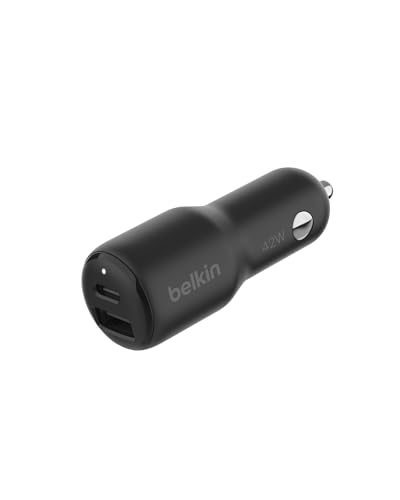
- Compact 0.9 x 1.0 x 2.6 inch body
- PPS dynamically adjusts voltage and current
- Housing uses post-consumer recycled content
Trade-offs
- 42W total limits charging a laptop
- USB-A port delivers only 12W
- Single USB-C port for high-speed charging
The 30W USB-C Power Delivery port can charge an iPhone from zero to fifty percent in 21 minutes, so a short errand or commute is enough to top off your phone. That speed, combined with a body barely larger than a lighter, makes this a natural fit for drivers who want maximum charging punch in minimum dashboard space. The PPS technology dynamically adjusts output voltage and current to match your phone’s needs, delivering safe, efficient power. It suits anyone who prioritizes a tidy install and fast iPhone charging over raw total wattage.
The 42W total output means you cannot charge a laptop from either port, and the USB-A port maxes out at 12W, so only the USB-C port delivers modern fast charging. If you regularly need to juice a MacBook or two high-power phones at once, the Anker 167.5W Ultra-Compact Car Charger offers far more total wattage and a third port. For the driver who keeps a single phone charged quickly and values a charger that disappears into the cigarette lighter socket, this Belkin delivers exactly that without wasted bulk.
Product photos
Belkin 75W Retractable Cable Car Charger
What We Like
- Built-in retractable cable stays tangle-free
- 75W max output charges multiple devices
Trade-offs
- Only one USB-C port (cable is fixed)
- Retractable cable limited to 60W, not full 75W
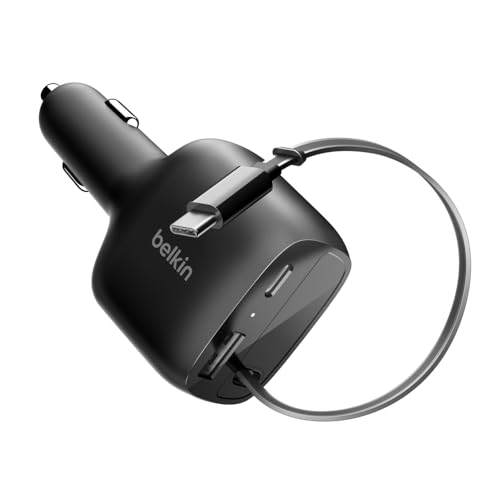
A 30-inch retractable USB-C cable built into the charger means you never have to dig for a loose cord or fight with tangles, just pull out what you need and it snaps back when you’re done. It’s a great fit for drivers who want one straightforward, always-ready cable without extra clutter.
The retractable cable tops out at 60W, so if you need to charge a larger laptop at full speed, you’ll have to use the separate USB-A port instead, which provides lower power. Compared to other car chargers without a retractable cord, this Belkin’s built-in cable makes it far more convenient for daily commutes where a single phone is the main device.
Spigen ArcStation Essential 113W Car Charger
What We Like
- Charges a MacBook Air 51% in 30 min
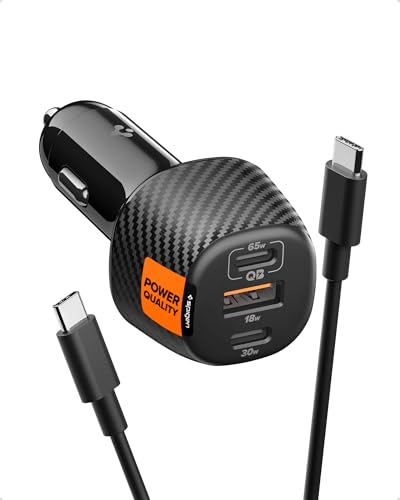
- Includes 1m USB-C E-Marker 100W cable
- Compact 1.41-inch square design
- Blue LED and carbon pattern finish
Trade-offs
- USB-A limited to 18W for older devices
- No retractable cable for tidy storage
The Spigen ArcStation Essential 113W delivers 65W through its primary USB-C port, enough to push a MacBook Air 13″ M3 to 51% charge in half an hour. That kind of speed matters when you are on a road trip and need your laptop ready for the next stop. With two USB-C ports and one USB-A, you can juice up a phone, a tablet, and a laptop at the same time without juggling adapters. The included 1-meter E-Marker cable handles the full 100W, so you do not have to buy one separately. This charger suits anyone who travels with a laptop and wants one compact plug to handle everything.
The total 113W is split across three ports, so plugging in multiple devices will reduce the power available to each. For example, using both USB-C ports at the same time cuts the top port from 65W to something lower, which slows down a hungry laptop. Compared to the Anker 167.5W Ultra-Compact Car Charger, the Spigen offers less total wattage but includes the cable. If your main goal is charging a laptop at full speed while also topping off a phone, this is a tidy solution. If you regularly need to power three high-draw devices at once, the Anker’s higher ceiling might fit better.
Product photos
LISEN 84W Retractable Car Charger

What We Like
- Retractable cables reduce clutter
- Charges up to 4 devices at once
- 180° adjustable angle for tight spaces
Trade-offs
- No CarPlay or data transfer support
- Peak PD speed drops to 36W on 12V cars
- Not compatible with Micro-USB devices
The trade-off is that this is strictly a power tool: no CarPlay, Bluetooth, or data transfer, and it won’t work with older Micro-USB gear. For most drivers who want clean, fast phone charging without cord mess, this is a practical option.
Product photos
LISEN 90W Coiled Cable Car Charger
What We Like
- 0-80% charge in 30 minutes
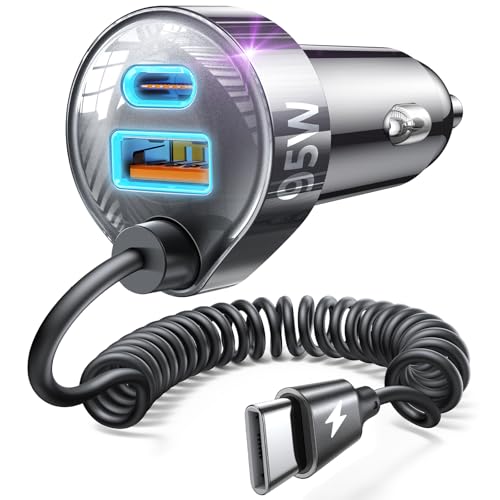
- 60-inch coiled cable snaps back cleanly
- Powers three devices at once
- Soft glow ring for night use
Trade-offs
- Built-in cable is USB-C only; older iPhones need separate Lightning cable
- 45W cable limits charging speed for larger tablets
A 60-inch coiled cable that stretches to backseat passengers and then retracts into a neat coil means no more tangled cords cluttering your center console. This LISEN charger pushes 90W total, so a single device can go from dead to 80% in about half an hour, enough for a quick drive-thru stop or a short commute. The built-in cable is always ready for a USB-C iPhone or Samsung, and two additional ports let you top off a tablet and earbuds at the same time. A soft ambient ring around the face helps you find the ports in the dark without blinding glare, which keeps your eyes where they belong: on the road.
The coiled cable is tidy, but it has a fixed maximum stretch. If your rear passengers sit far back, the 60-inch reach may be tight. The cable is USB-C only, so if you own an iPhone 14 or earlier, you will need to keep your original Lightning cable handy and plug it into one of the PD/QC ports. Compared to the Belkin 75W Retractable Cable Car Charger, which has a shorter 2.5-foot retractable cable, this LISEN gives you nearly double the reach and higher total wattage, making it the better pick for families or ride-share drivers who regularly charge devices in the back seat.
Product photos
WODENTA 67W 3-Port Car Charger

What We Like
- 67W total output charges three devices at once
- Includes a 3 ft USB-C to C cable
- PD 37W and QC 30W per port
- Works with 12-24V cars, SUVs, trucks, RVs
Trade-offs
- 67W total is shared across three ports
- No USB-A port supports fast charging above 30W
- Cable length is fixed at 3 ft
A 67W total output across three ports means you can juice up an iPhone 15 Pro Max, a second phone, and a tablet all at once without swapping cables. For anyone on a tight budget who still wants simultaneous charging for the whole car, this is a smart way to keep everyone powered during a road trip or daily commute.
The 67W has to be split among all three ports, so plugging in a power-hungry laptop or two high-draw devices will slow things down noticeably. But if your main goal is keeping iPhones and iPads topped off without spending extra, the included cable and three-port layout make it a practical, no-fuss choice.
UGREEN 145W 4-Port Retractable Car Charger
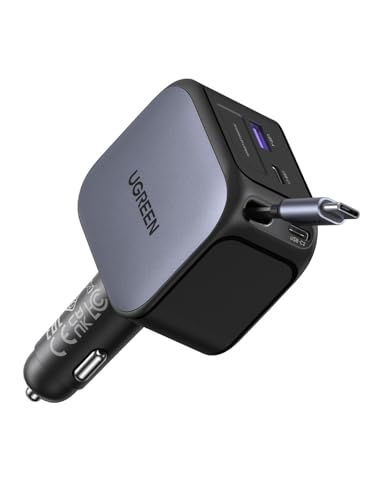
What We Like
- 145W total output across four ports
- 60W retractable cable keeps car tidy
- 100W USB-C2 charges a MacBook Pro fast
- Works with 12V and 24V vehicles
Trade-offs
- Retractable cable fixed length at 70cm
- Heavier than some compact chargers at 0.3 lb
A total of 145W spread across four ports means this charger can power a laptop, tablet, and two phones at the same time without slowing down. The 100W USB-C2 port alone can top off a 16-inch MacBook Pro from empty in about an hour and a half, which is a real time-saver during a commute or road trip. That kind of output makes it a natural fit for anyone who carries multiple devices and wants one plug to handle them all, especially if you prefer keeping your car interior tidy.
The built-in retractable cable extends to 70cm and delivers 60W, which is plenty for fast charging a phone, but that fixed length means you can’t swap in a longer cord if your backseat passengers need to reach. Compared to the Anker 167.5W Ultra-Compact Car Charger, this UGREEN gives you an extra port and a retractable cable for less clutter, but the Anker is physically smaller and lighter if space is tight. Still, if you value high power across multiple ports and a neat cable solution, this UGREEN delivers exactly that.
Product photos
How We Evaluated iPhone 15 Car Chargers
Our evaluation started with the technical specs that matter most for iPhone 15 charging: USB-C Power Delivery (PD) wattage, total output, and port count. We looked at manufacturer datasheets to confirm which chargers could deliver the wattage needed for optimal iPhone 15 fast charging, and which offered enough headroom for laptops.
We then focused on three criteria that separate a good charger from a great one. Charging speed was the first priority. A charger that only delivers 12W will charge an iPhone 15 far slower than one that can output 27W or more. Physical design came next, since a charger that sticks out too far or blocks adjacent ports is a daily annoyance. Finally, we considered cable management and port flexibility. A tangle of loose cords in the car is both frustrating and a safety hazard.
A research-led evaluation has limits: we haven’t tested these chargers in a lab or on the road, so we rely on published specs and the consensus of expert reviewers and long-term owners. This approach gives you a reliable starting point, but real-world performance can vary with vehicle voltage and cable quality.
What To Look For In iPhone 15 Car Chargers
Before you buy, understand the three specs that define how well a charger will work with your iPhone 15 and other devices.
Choose a charger that delivers sufficient wattage over USB-C for true iPhone 15 fast charging, and consider a higher-wattage model if you want to charge a laptop or tablet alongside your phone.
Charging Speed and Power Delivery (PD) Wattage
The iPhone 15 line supports fast charging over USB-C Power Delivery. A charger that outputs enough wattage will charge noticeably faster than an old 5W or 12W unit, but a higher-wattage port gives you headroom for simultaneous device charging. For laptop users, look for a single USB-C port rated at 60W or more to avoid slow top-ups on the road.
Physical Size and Port Placement
Car chargers vary dramatically in length and width. A compact design under two inches long will sit flush in most 12V sockets, while larger units can block the adjacent power outlet or make it hard to close a center console lid. Check the dimensions against your specific vehicle’s layout, especially if the socket is recessed or located near a shifter.
Cable Management and Port Count
Built-in retractable cables keep the car tidy but lock you into a fixed length and often a single USB-C port. Separate-cable chargers offer more flexibility in port count and cable length but require you to store the cord. Consider how many devices you typically charge and whether you need a long cable to reach rear-seat passengers.
- Measure the depth of your 12V socket before buying a bulky charger.
- Check the total output wattage: a 30W charger can’t fast-charge two iPhones simultaneously.
- Look for a charger that includes a USB-C to USB-C cable if you don’t have one handy.
- Verify that the charger supports 12V and 24V systems if you drive a truck or RV.
A good rule of thumb: buy a charger with at least 30W total output for a single iPhone, and 60W+ if you plan to charge a laptop.
iPhone 15 Car Chargers Compared
The table below compares the ten chargers side by side, focusing on charging speed, port layout, and physical size.
| Product | Total Power | Ports | USB-C Output |
|---|---|---|---|
| Anker 167.5W Ultra-Compact Car Charger | 167.5W | 3 (2 USB-C, 1 USB-A) | 100W, 45W |
| Anker 30W PowerIQ 3.0 Car Charger | 30W | 2 (USB-C + USB-A) | 30W |
| UGREEN 130W 3-Port Car Charger | 130W | 2 USB-C, 1 USB-A | 45W (PPS) |
| Belkin BoostCharge 42W Car Charger | 42W | 1 USB-C, 1 USB-A | 30W PD |
| Belkin 75W Retractable Cable Car Charger | 75W | 1 USB-C (retractable) + 1 USB-A | 60W |
| Spigen ArcStation Essential 113W Car Charger | 113W | 2 USB-C, 1 USB-A | 65W PD, 30W PD |
| LISEN 84W Retractable Car Charger | 84W | 4 (2 retractable cables + 2 USB ports) | 45W |
| LISEN 90W Coiled Cable Car Charger | 90W | 3-in-1 (built-in cable + 2 ports) | 45W |
| WODENTA 67W 3-Port Car Charger | 67W | 2 USB-C, 1 USB-A | 37W |
| UGREEN 145W 4-Port Retractable Car Charger | 145W | 2 USB-C, 1 USB-A, 1 retractable USB-C cable | 100W, 60W |
Frequently Asked Questions
Can I use my old Lightning cable with an iPhone 15 car charger?
No. The iPhone 15 models use a USB-C port, not Lightning. You will need a USB-C to USB-C cable to fast charge your phone. Some chargers include one, but many do not, so check the box before you buy.
How many watts do I need to fast charge an iPhone 15 in the car?
You need a USB-C Power Delivery charger that outputs sufficient wattage. A higher-wattage charger will provide the fastest possible charge for the iPhone 15 and iPhone 15 Pro, while a moderate wattage still delivers a significant speed boost over a standard 5W charger.
Will a 100W car charger damage my iPhone 15?
No. The iPhone 15 and all modern smartphones negotiate the correct amount of power with the charger. A 100W charger will only deliver what the phone requests, which is up to about 27W. The extra wattage is available for charging a laptop or other high-power device simultaneously.
What is the difference between PD and PPS charging?
Power Delivery (PD) is the standard fast-charging protocol used by iPhones and most laptops. Programmable Power Supply (PPS) is an advanced version of PD that allows finer voltage adjustments, which can improve charging efficiency and reduce heat in compatible Samsung phones. For an iPhone 15, standard PD is all you need.
Can I charge my iPhone 15 and a MacBook at the same time?
Yes, but you need a charger with enough total output. A charger like the Anker 167.5W or UGREEN 145W has a dedicated high-power USB-C port for the laptop and a second port for the phone. Lower-wattage chargers will split the power, slowing down both devices.
The Bottom Line
For most iPhone 15 drivers, the Anker 167.5W Ultra-Compact Car Charger is the best choice. It delivers genuine laptop-charging speed from a compact body, includes a high-quality cable, and powers multiple devices without compromise. It’s the one charger that can handle your phone, your passenger’s tablet, and your work laptop on a single road trip.
If your priority is the smallest possible charger for quick iPhone top-ups, the Belkin BoostCharge 42W is a better fit. For drivers who want a retractable cable to keep the car clean, the Belkin 75W Retractable Cable is an excellent option. The UGREEN 145W 4-Port Retractable is also a strong choice depending on how many devices you need to charge.
The single most important factor is matching the charger’s wattage to your needs. Buy enough power for your most demanding device, and you’ll never be stuck with a slow charge when you need it most.
