
10 Best Lithium Ion Motorcycle Batteries in 2026
This post contains affiliate links. As an Amazon Associate, we earn from qualifying purchases.
For a lighter, stronger start, the Bosch BLP14 Li-ion Phosphate Battery is our Best Overall pick for its exceptional lifespan and built-in diagnostics. Riders after raw cranking power should look to our Best High-Performance Pick, the NOCO Lithium NLP20, while those wanting a safety net will appreciate the Antigravity ATX12HD, our Best Built-In Jump Start.
Switching to lithium means shedding pounds, gaining starting power, and often adding years of service compared to a standard lead-acid battery. But not every lithium battery fits every bike or every riding style. Cranking amps, physical dimensions, and charging system compatibility all matter.
We built this guide by analyzing manufacturer specifications, expert round-ups, and patterns in owner feedback across hundreds of lithium battery models. The result is a clear set of picks for different needs, from track-day sportbikes to heavy cruisers.
Top 10 Lithium Ion Motorcycle Batteries in the Market
Certain content that appears on this site comes from Amazon. This content is provided "as is" and is subject to change or removal at any time.
The Best Lithium Ion Motorcycle Batteries, Reviewed
Bosch BLP14 Li-ion Phosphate Battery
What We Like
- Up to 4x longer lifespan than lead-acid
- Built-in charge indicator and cell balancer
- 18-month free-replacement warranty
Trade-offs
- 4 Ah capacity is lower than some rivals
- 240 cranking amps limit use in high-compression engines
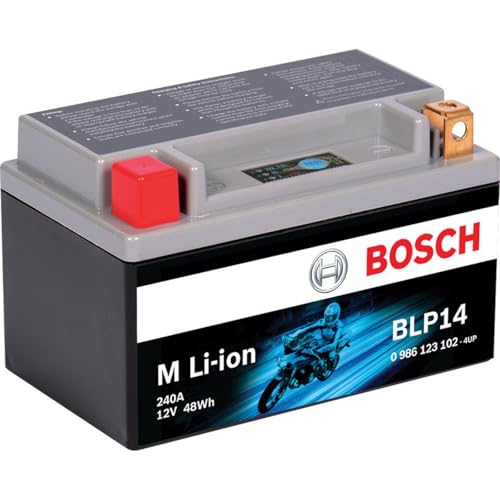
A 4 Ah capacity and 240 cranking amps might not sound huge on paper, but this Bosch BLP14 is built for reliability over raw power. The real story is its lithium-ion chemistry, which delivers up to four times the lifespan of a standard lead-acid battery, so you won’t be swapping it out every season. It also includes a built-in charge indicator, voltage tester, and cell balancer, meaning you can keep an eye on its health without extra gear. For riders who want a lightweight, maintenance-free battery that starts consistently and lasts, this is the one to grab.
If you’re running a big touring bike or a high-compression engine, something like the NOCO NLP20 with 600 cranking amps and 7 Ah is a better fit. But for everyday bikes and powersports vehicles where weight savings and long life matter most, the Bosch BLP14 offers exceptional value and peace of mind backed by an 18-month warranty.
NOCO Lithium NLP20 Powersport Battery

What We Like
- 600 amps starting power
- 50,000+ starts and 2,000 cycles
- Intelligent BMS with temperature protection
- Superfast charging in minutes
Trade-offs
- At 5.0 lb, heavier than many lithium options
- Large footprint: 7.8 x 7.6 x 8.2 inches
With 600 amps of cranking power and a LiFePO4 chemistry rated for over 2,000 cycles, this battery is built for riders who want serious starting muscle and long-term reliability. The intelligent BMS handles overcharge, short-circuit, and extreme temperatures automatically, so you don’t have to think about maintenance once it’s installed. It also recharges quickly: five minutes of charge delivers enough current to crank your engine. That makes it a strong match for high-performance motorcycles and powersports gear where quick restarts and consistent power matter most.
The trade-off is size and weight. At 5.0 pounds and roughly 7.8 inches long, the NLP20 is noticeably larger and heavier than something like the Antigravity ATX12HD, which weighs only 3.0 pounds and fits tighter spaces. If you have a cramped battery tray or want to shave every ounce, the NOCO may feel bulky. But if your priority is raw cranking amps and a battery that can handle thousands of starts without fading, this one delivers exactly what the specs promise.
Antigravity ATX12HD Motorcycle Battery

What We Like
- Built-in jump start button
- 480 cranking amps for strong starts
- Advanced BMS for overcharge/discharge protection
- Drop-in replacement for YTX12/YTX14 sizes
Trade-offs
- Heavier than some lithium competitors at 3.0 lb
- Not for cars or trucks
- Requires confirming fitment for YTX12/YTX14 sizes
The built-in Re-Start Technology automatically reserves power so you can restart your vehicle with the push of a button. With 480 cranking amps and 16Ah equivalent capacity, it provides stronger starts and reliable performance. The full Battery Management System protects against over-charge, over-discharge, temperature issues, and cell imbalance. For riders who have ever been stranded, this feature adds a layer of security that justifies the weight.
At 3.0 pounds, this battery is heavier than the Bosch BLP14 (2.0 lb), so if weight is your main concern, the Bosch saves a full pound. The Antigravity ATX12HD replaces YTX12 or YTX14 battery sizes and fits motorcycles, ATVs, and UTVs, but not cars or trucks. Its built-in jump starting reserves power so you can restart with a button push, which means you don’t need to carry jumper cables or rely on another vehicle.
Product photos
TYKOOL LFP20L-BS-STD Lithium Battery

What We Like
- Onboard digital readout for voltage and SOC
- 75% lighter than lead-acid YTX20L-BS
- IP66 waterproof and shock-proof housing
- Ultra-low self-discharge under 1% per month
Trade-offs
- Requires a qualified regulator under 15.0V
- Only works with dedicated LiFePO4 chargers
- Polarity is fixed [- +], not reversible
A digital readout screen shows real-time voltage and state-of-charge with one touch, so you always know the battery’s status before you start the engine. Weighing just 3.3 pounds, it’s 75% lighter than a 14-pound lead-acid YTX20L-BS, which lowers the bike’s center of gravity for easier cornering. Riders on Harley Softail or Fat Boy models get a clear handling benefit from that weight savings.
This battery requires a charging system that stays under 15.0V and a dedicated LiFePO4 charger; standard lead-acid chargers with desulfurization modes can damage the BMS. That puts it in a different camp from the NOCO NLP20, which offers 600A cranking but does not include a digital display. If you keep your bike on a tender over winter and value that live readout, the TYKOOL is a smart pick. For riders who swap batteries between different vehicles or use older chargers, the TYKOOL’s strict charging requirements mean you’ll need to verify your setup first.
Product photos
Weize Lithium YTX30L-BS LiFePO4 Battery
What We Like
- 700 CCA for high-cranking engines
- 2000 charge cycles for long life
- Built-in BMS protects against overcharge and short circuit
- Maintenance-free and ready to install
Trade-offs
- At 7.66 lb, heavier than many lithium batteries
- Does not fit compact sportbike or scooter trays
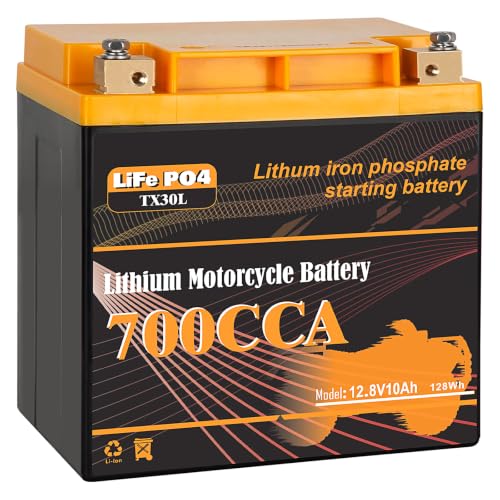
With 700 cold cranking amps and a 10Ah capacity, this Weize battery delivers the kind of punch that big-displacement motorcycles, ATVs, and even jet skis need to fire up reliably. Its LiFePO4 chemistry gives you 2,000 charge cycles and 50,000 starts, so it should outlast several lead-acid replacements without any water checks or acid spills. The built-in BMS handles overcharge, over-discharge, and short circuits automatically, and it reactivates on its own after a cutoff, no need for a special charger. This makes it a strong pick for riders who want high capacity without the fuss of maintenance, especially if your vehicle has a larger battery box.
TYKOOL YTX9-BS-PRO Lithium Battery

What We Like
- 300 CCA for high-compression engines
- Digital SOC percentage readout
- IP66 dust and water-jet sealed
- Ultra-light 2.1 lb weight
Trade-offs
- Requires charging voltage 14.4V±0.2V
- Incompatible with old shunt-style regulators
- 5 Ah capacity limits long-duration accessory use
A 300 CCA rating in a 2.1-pound package means this battery delivers the cranking power a high-compression sportbike needs while cutting weight compared to a lead-acid battery. That weight reduction lowers unsprung mass, which is a critical advantage for track days and high-speed cornering. The digital state-of-charge display shows you exactly how much energy remains, so you are not guessing before a track session. With IP66 sealing, it shrugs off rain and pressure washing without a second thought.
A properly regulated charging system is essential for this battery. If your bike still uses an older shunt-style regulator that can spike above 15 volts, you will need to upgrade to a MOSFET unit to avoid damaging the cells. Its 5 Ah capacity is fine for starting and powering electronics during a ride, but it does not have the reserve for extended periods with the engine off. For comparison, the NOCO Lithium NLP20 offers 7 Ah and 600 CCA, but at 5 pounds it is more than twice as heavy, a trade-off worth weighing if every ounce matters on your sportbike.
Product photos
KEMIMOTO Lithium Motorcycle Battery

What We Like
- Includes 5 adjustable EVA spacers
- Pre-charged with power display
- Threaded terminals for no-nut install
- Built-in BMS with temperature cutoff
Trade-offs
- BMS cuts out below -2°F for 6 hours
- Only 6Ah capacity limits long rides
A 480-CCA LiFePO4 battery that weighs 3.2 pounds means it’s lighter than many lead-acid equivalents, and the included five EVA spacers let it fit a wide range of trays from YTX9-BS to YTX16-BS. The pre-charged state and built-in power display save you the hassle of buying a charger upfront, and the threaded terminals eliminate the need for loose nuts during installation.
The KEMIMOTO lithium battery comes pre-charged and ready to install, with a power display and pure copper terminals for strong conductivity. It includes five adjustable EVA spacers and threaded-lug posts, so it can fit a wide range of battery boxes without extra hardware. The built-in BMS protects the battery by cutting power if temperatures drop below -2°F for six hours or rise above 172°F, which is useful for riders in extreme climates.
Product photos
Skyrich HJ-01 Lithium Motorcycle Battery
What We Like
- OEM-spec for Kawasaki KX450J, KX252C, KX450M
- IP67 waterproof rating
- 12G vibration resistance tested 20 hrs/axis
- Integrated over-charge/discharge/temperature safeguards
Trade-offs
- Very low 2 Ah capacity limits run time
- Only fits specific Kawasaki motocross models
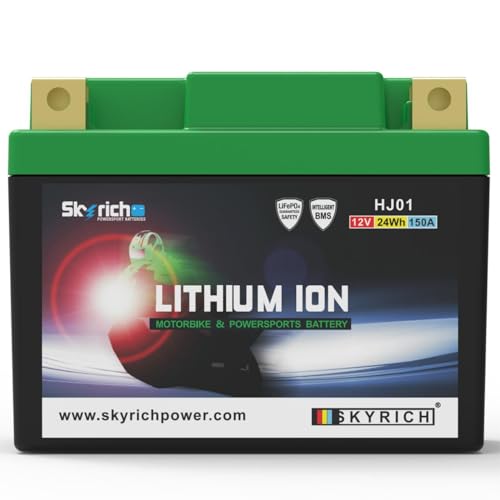
The 2 amp-hour capacity means this battery is designed for starting, not for powering extra lights or accessories for long periods. If your bike needs more cranking power for a larger engine, the NOCO NLP20 delivers 600 cranking amps and 7 amp-hours, though it weighs 5.0 pounds. For a lightweight motocross machine that just needs to start and go, the Skyrich fits the bill without adding unnecessary heft.
Product photos
Antigravity ATZ10-RS RE-START Battery
What We Like
- Includes BTR-3 Battery Tracker
- Built-in RE-START button for reserve power
- 360 cranking amps for reliable starts
Trade-offs
- Requires pressing the RE-START button to access reserve power
- Built-in BTR-3 tracker adds extra bulk to installation.
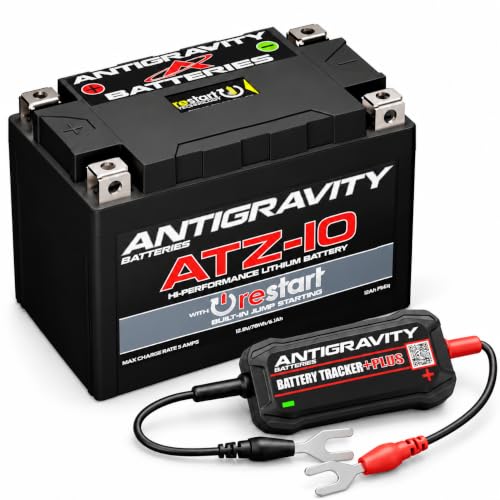
The 360 cranking amps are fine for most singles and twins, but that is noticeably less than the 600-700 amps you get from larger lithium options like the NOCO NLP20.
Product photos
NOCO Lithium NLP30 Powersport Battery

What We Like
- 700A starting power for big engines
- 50,000 starts and 2,000 cycles
- Smart BMS protects against overcharge
- Multi-terminal design fits many layouts
Trade-offs
- At 2.8 lbs, heavier than some lithium options
- 8Ah capacity limits long accessory use
With 700 cranking amps and a LiFePO4 chemistry that handles 2,000 cycles, this battery is built for riders who need serious starting power in a powersport machine. The intelligent BMS actively balances cells and guards against overcharge, short-circuit, and extreme temperatures, so you can trust it in a touring bike or a high-compression dirt bike. That 50,000-start rating means it will likely outlast the vehicle it goes into, and the multi-terminal design with modular trays makes swapping out an old lead-acid unit straightforward without hunting for adapters.
For most riders, the sheer cranking power and longevity make it worth the extra heft, especially if you are upgrading from a tired lead-acid battery that struggled on cold mornings.
How We Evaluated Lithium Ion Motorcycle Batteries
We started with the specs that matter most: cold cranking amps (CCA), amp-hour (Ah) capacity, weight, and physical dimensions. Every battery must match a real motorcycle application, so we compared each model’s published ratings against common engine sizes and battery tray dimensions.
Our three main criteria were starting power, cycle life, and protection features. A battery with a Battery Management System (BMS) that guards against overcharge, deep discharge, and temperature extremes will last longer and cause fewer headaches. We also prioritized models with clear fitment guides and straightforward installation.
Research-led evaluation has limits. Our conclusions come from spec sheets, manufacturer documentation, and the collective experience of owners as reported in forums and review patterns.
What To Look For In Lithium Ion Motorcycle Batteries
Choosing a lithium battery is different from buying a lead-acid replacement. Focus on cranking amps, physical fit, and your bike’s charging system.
Match the battery’s cold cranking amps to your engine size, confirm the dimensions fit your tray, and verify your bike’s charging voltage is compatible with LiFePO4 chemistry.
Cold Cranking Amps (CCA) and Capacity
CCA tells you how much starting power the battery delivers in cold conditions. A high-compression sportbike or big V-twin needs 300 CCA or more; a small scooter may start fine with fewer. Amp-hour (Ah) capacity affects how long you can run accessories without the engine. More Ah is better for heated gear or long rides, but extra capacity adds weight.
Physical Dimensions and Terminal Layout
Lithium batteries often have different footprints than the lead-acid units they replace. Measure your battery tray’s length, width, and height before buying. Check terminal polarity and thread size. Some batteries include adjustable spacers to fill a larger tray, but a battery that is too tall may not fit under the seat or side cover.
Charging System Compatibility
LiFePO4 batteries need a charging voltage typically between 14.0V and 15.0V. Older motorcycles with shunt-style regulators can overcharge a lithium battery, causing the BMS to shut down. If your bike’s charging system runs above 15.0V, you may need a regulator upgrade or a dedicated LiFePO4-compatible charger for maintenance.
- Measure your battery tray dimensions with a ruler, not by guess.
- Confirm your bike’s charging voltage with a multimeter at idle and at higher RPM.
- Check that the battery’s terminal type matches your cable ends.
- Look for a BMS that includes low-voltage cutoff to protect the battery.
- Read the fitment notes: some batteries list exact OEM replacement numbers.
A battery that fits your tray and matches your charging system will serve you reliably for years.
Lithium Ion Motorcycle Batteries Compared
The table below compares the key specs of our top picks so you can see at a glance which battery fits your bike and your budget.
| Product | Cranking Amps | Capacity | Weight |
|---|---|---|---|
| Bosch BLP14 Li-ion Phosphate Battery | 240 A | 4 Ah | 2.0 pounds |
| NOCO Lithium NLP20 Powersport Battery | 600A | 7Ah | 5.0 lbs |
| Antigravity ATX12HD Motorcycle Battery | 480 | 16Ah | 3.0 pounds |
| TYKOOL LFP20L-BS-STD Lithium Battery | 480CCA | 8Ah | 3.3 lbs |
| Weize Lithium YTX30L-BS LiFePO4 Battery | 700A | 12V 10Ah | 7.66 lbs |
| TYKOOL YTX9-BS-PRO Lithium Battery | 300 CCA | 5 Ah | 2.1 lbs |
| KEMIMOTO Lithium Motorcycle Battery | 480A | 12v 6Ah | 2.2 pounds |
| Skyrich HJ-01 Lithium Motorcycle Battery | 150 CCA | 2 Ah | 0.9 pounds |
| Antigravity ATZ10-RS RE-START Battery | 360 | 12 Ah PbEq | 2.6 lb |
| NOCO Lithium NLP30 Powersport Battery | 700A | 8Ah | 2.8 lbs |
Frequently Asked Questions
How long does a lithium ion motorcycle battery last?
A quality lithium battery can last 3 to 5 years or longer, depending on usage and maintenance. Many models are rated for 2000 charge cycles, which is several times the life of a typical lead-acid battery. Proper charging and storage extend that lifespan further.
Can I use a lithium battery in any motorcycle?
Not without checking compatibility. Your bike’s charging system must output between about 14.0V and 15.0V, and the battery must physically fit in the tray. Some older bikes with shunt-style regulators may overcharge a lithium battery, so a regulator upgrade or a compatible charger may be needed.
Is it safe to install a lithium battery in a motorcycle?
Yes, when installed correctly. Lithium iron phosphate (LiFePO4) chemistry is inherently stable, and a built-in Battery Management System (BMS) protects against overcharge, over-discharge, and short circuits. Always follow the manufacturer’s installation instructions and torque the terminals to spec.
How do I charge a lithium motorcycle battery?
Use a charger specifically designed for LiFePO4 batteries. A standard lead-acid charger may not have the correct voltage profile and can damage the battery. Many lithium batteries come with a charger or recommend a specific model. Never use a charger that exceeds 15.0V.
What does the RE-START or jump start button do on a lithium battery?
Some lithium batteries have a built-in reserve power feature. If you accidentally drain the battery, a button releases a small amount of stored energy to start the bike one more time. This is a safety net, not a replacement for a proper charger or jump pack.
The Bottom Line
The Bosch BLP14 Li-ion Phosphate Battery is our Best Overall pick for most riders. It delivers a long lifespan, a built-in charge indicator, and an 18-month warranty, all in a lightweight package that fits many powersports vehicles. If you need more cranking power for a high-performance engine, the NOCO Lithium NLP20 is the better choice.
Budget-conscious riders with large battery trays should consider the Weize Lithium YTX30L-BS for its high capacity and long cycle life. For sportbike owners chasing every ounce, the TYKOOL YTX9-BS-PRO is the lightest pick on our list.
The single most important factor is fitment. Measure your tray, check your charging voltage, and choose a battery with the right CCA for your engine. Do that, and a lithium battery will reward you with years of reliable, maintenance-free starts.
