
10 Best Manual Tire Pumps in 2026
This post contains affiliate links. As an Amazon Associate, we earn from qualifying purchases.
For reliable inflation without a power outlet, the Topeak JoeBlow Sport III Floor Pump is our Best Overall pick, offering a steel build and 160 psi capacity for everything from road bikes to car tires. The Franklin Sports High Pressure Foot Pump is our Best Foot Pump for drivers who want a hands-free option, while the Performance Tool W1638DB Foot Pump is our Best Budget Pick for casual use.
The challenge with manual tire pumps is finding one that matches your specific needs. A floor pump works great in a garage but is useless on a roadside, and a foot pump that maxes out at 100 psi won’t help a road cyclist. Getting the right type, pressure range, and valve compatibility is the real key.
This guide is based on a careful review of manufacturer specifications, expert round-ups, and patterns in owner feedback. We’ve broken down the top 10 manual tire pumps to help you find the right fit for your car, bike, or inflatables.
Top 10 Manual Tire Pumps in the Market
Certain content that appears on this site comes from Amazon. This content is provided "as is" and is subject to change or removal at any time.
The Best Manual Tire Pumps, Reviewed
Topeak JoeBlow Sport III Floor Pump

What We Like
- 160 psi max for high-pressure tires
- Steel barrel and base for stability
- Universal TwinHead fits three valve types
- Padded handle reduces hand fatigue
Trade-offs
- At 3.7 lb, heavier than compact pumps
- Large footprint (26.8 in tall) limits portability
A 160 psi max and a steel barrel and base keep this pump stable during high-pressure fills, so you can pump road tires without wobbling. The 3-inch analog gauge is clear and accurate. The TwinHead DX5 fits Presta, Schrader, and Dunlop valves without swapping parts, letting you move from a road bike to a mountain bike to a gravel bike without adapters. It’s a single floor pump that works on multiple bike types and stays steady on the floor.
The trade-off is size and weight. At 3.7 pounds and 26.8 inches tall, the JoeBlow Sport III is not something you toss in a backpack for a ride. Compared to the LEZYNE Pocket Drive HV hand pump, which weighs 0.2 pounds and fits in a jersey pocket, this is a shop-floor tool, not a trail companion. But for home use, the steel construction and 360-degree hose make inflation straightforward. That’s unlike a foot pump such as the Franklin Sports model, which has a different form factor and lower max pressure.
Product photos
Franklin Sports High Pressure Foot Pump

What We Like
- Heavy-duty iron construction
- Built-in PSI gauge for precise fill
- Foot-operated for less physical labor
- Compact design for easy storage
Trade-offs
- Max 100 PSI limits high-pressure bike tires
- At 2.6 lb, heavier than some compact pumps
A 100 PSI max pressure means this foot pump handles sports balls, bike tires, and car tires without breaking a sweat. Built from heavy-duty iron, it’s designed to last through years of garage use. The foot-operated design lets you pump steadily with your legs while keeping both hands free to hold the valve steady or check the built-in PSI gauge for an accurate fill. That gauge is a real time-saver, no guessing or over-inflating. For anyone who wants a simple, durable pump that does multiple jobs without taking up much storage space, this is a practical workhorse.
For inflating sports balls, bike tires, car tires, and other inflatables, this pump handles the job up to 100 PSI. The heavy-duty iron construction provides long-term durability, and the foot-operated design eliminates the physical labor required by a hand pump. A built-in PSI gauge allows you to fill to the exact pressure needed. The compact dimensions make it easy to store away when not in use. At 2.6 pounds, it is lighter than the Michelin Double Foot Pump (4.8 pounds) and similar in weight to the Schwinn Air Base Plus Foot Pump (3.1 pounds). So it won’t take up much space in a trunk or closet.
Michelin Double Foot Pump 7 bar

What We Like
- Double cylinder for faster inflation
- Built-in pressure gauge for accuracy
- Includes 4 adaptors for versatility
- TÜV/GS certified for safety
Trade-offs
- At 4.8 lb, heavier than most foot pumps
- No Presta valve adapter included for bicycle tires
With a maximum pressure of 7 bar, this Michelin pump is suitable for inflating tires of cars, motorcycles, and bicycles. The double-cylinder design is listed as a feature, and the included four adaptors and TÜV/GS certification add to its versatility. It is a straightforward tool for drivers who want a reliable foot pump that can be kept in the car.
At 4.8 pounds, this foot pump is noticeably heavier than the Franklin Sports model, which makes it less ideal for carrying to a track or storing in a tight glovebox. The trade-off is a stable, double-cylinder design that doesn’t need batteries or a cord, so it’s always ready for car, motorcycle, or bicycle tires.
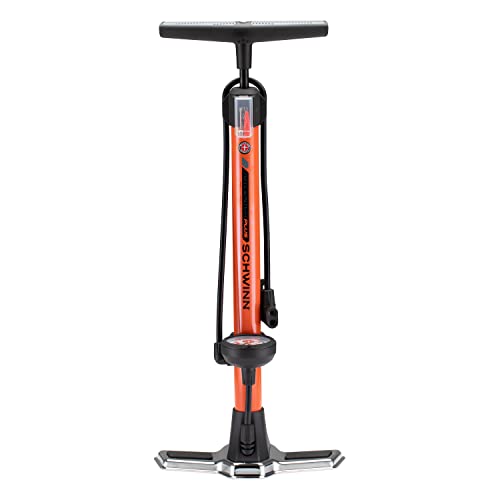
Schwinn Air Center Plus Floor Pump
What We Like
- Dual head with red/green indicator
- Stable wide steel base
- Soft grip handle for comfort
- Includes sports ball attachments
Trade-offs
- 120 PSI max limits high-pressure road tires
- 2.9 pounds is heavier than compact pumps
- No Dunlop valve support like some competitors
A 120 PSI rating and a dual head that clicks onto both Schrader and Presta valves make this pump a natural fit for mountain, cruiser, and electric bikes. The red/green indicator on the head tells you when you’ve seated it properly, so you’re not guessing. A wide steel base keeps the pump planted while you work, and the soft grip handle makes the up-and-down motion easier on your hands. This is the pump you grab for everyday bike maintenance, especially if your stable includes different valve types.
This Schwinn tops out at 120 PSI, well below the 160 PSI that Topeak JoeBlow Sport III delivers, so road cyclists running skinny high-pressure tires will want the extra headroom. At 2.9 pounds, this Schwinn isn’t a travel companion; it’s a shop-floor tool that stays put. For the rider who wants a stable, straightforward floor pump with a helpful visual indicator and the ability to top off a basketball or soccer ball, this one delivers exactly what it promises.
Product photos
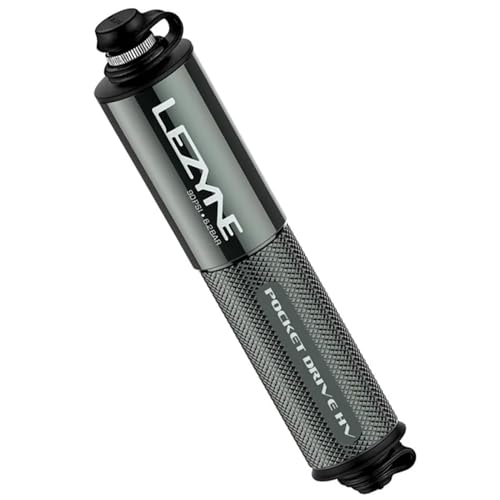
LEZYNE Pocket Drive HV Compact Hand Pump
What We Like
- Ultra-light at 0.2 pounds
- CNC-machined aluminum build
- Integrated ABS Flex Hose
- Rebuildable for long service
Trade-offs
- 90 PSI max limits road bike use
- Small size means slower inflation
- No built-in pressure gauge
At 0.2 pounds and 4.3 inches long, the LEZYNE Pocket Drive HV is designed to fit into a jersey pocket or saddle bag. Its CNC-machined aluminum body and rebuildable internals make it a durable emergency pump for mountain bikers and bikepackers running plus-size tires. The integrated ABS Flex Hose works with both Presta and Schrader valves without adapters, and the 90 PSI ceiling is plenty for high-volume tires, though it won’t satisfy road cyclists needing 100+ PSI.
The trade-off for this portability is speed and pressure ceiling. Against the Topeak JoeBlow Sport III floor pump, the Pocket Drive tops out at 90 PSI versus 160 PSI. But floor pumps don’t fit in your pocket. If your rides stay close to home or the garage, a floor pump makes more sense. For anyone who has ever been stranded miles from a gas station with a flat, this LEZYNE pump can get you back on the trail quickly. Its rebuildable design means it can be serviced for continued use.
Schwinn Air Base Plus Foot Pump

What We Like
- Folding steel feet for stable pumping
- Dual head with red/green inflation indicator
- Compact size stores easily
- Includes needle and cone attachments
Trade-offs
- 120 PSI max limits high-pressure road tires
- Foot pump requires more effort than floor pump
The Schwinn Air Base Plus Foot Pump delivers up to 120 PSI, which is enough for most mountain, hybrid, and cruiser bike tires, as well as sports balls and inflatables. Its folding steel feet give you a stable platform while pumping, then tuck away for a compact shape that stows in a gear bag or car trunk. The dual head nozzle fits both Schrader and Presta valves, and the red/green color indicator takes the guesswork out of getting a good seal. This pump suits anyone who values portability over raw power, someone who needs a reliable backup for weekend rides or a quick top-off without dragging out a full-size floor pump.
With a maximum of 120 PSI, this pump handles most bike tires but won’t satisfy anyone who needs higher pressures for certain high-performance setups. The Topeak JoeBlow Sport III floor pump reaches 160 psi, so the Schwinn foot pump trades top-end pressure for a more compact design. For casual riders, commuters, or anyone who wants a pump that stows easily in a trunk or on a shelf, it’s a space-saving choice that still gets the job done.
Product photos
Hycline Bike Floor Pump with Gauge

What We Like
- Folds and stores in tight spaces
- Hidden compartments for spare needles and small items
- Dual valve works with Presta and Schrader
Trade-offs
- T-handle requires assembly (rotate and install yourself)
- Compact size means shorter stroke than full-length floor pumps
At just 17.9 inches tall when stored, this pump fits into a trunk corner, under a seat, or on a cramped garage shelf without hogging space. That compact footprint is the whole point: you get a floor pump’s stable footing and high 160 PSI capacity in a package that disappears when you’re done. The dual valve head swaps between Presta and Schrader without any adapter fiddling, and the hidden compartments inside the T-handle store two ball needles plus whatever else you want to keep handy. It’s a smart solution for apartment dwellers, road-trippers, or anyone who values floor-pump performance but doesn’t have room for a full-size model.
The Hycline Bike Floor Pump with Gauge reaches up to 160 PSI, so it can handle road bike tires, but its compact design means the barrel is shorter than many floor pumps. Owners report that the T-handle arrives separate and needs to be screwed on, a minor assembly step. If you need a pump that folds up small and still delivers high pressure, this model’s foldable pedals and removable handle keep storage to a minimum.
Performance Tool W1638DB Foot Pump

What We Like
- Needle valve and inflatable adapter included
- Easy-to-read pressure gauge
- Lightweight foot pump design
Trade-offs
- 100 PSI limit is low for road bike tires
- Foot pump lacks the leverage of a floor pump
A 100 PSI capacity means this foot pump handles bike tires, sports balls, and inflatables just fine, but it won’t push a road tire to the high pressures many cyclists need. That makes it a smart fit for the casual rider or the person who keeps one in the trunk for topping off car tires or blowing up a beach ball.
The trade-off here is speed and effort. Foot pumps rely on your body weight rather than your arms, which can be easier on the back, but they deliver air in smaller bursts than a floor pump like the Topeak JoeBlow Sport III. At 0.1 pounds, this Performance Tool is extremely light, so it’s easy to carry or store in tight spaces. For a tool that covers the basics, it gets the job done.
Product photos
HHYSSG Foot Pump with Precision Gauge

What We Like
- Dual-cylinder design frees your hands
- Delivers up to 160 PSI
- Built-in precision pressure gauge
- Non-slip base and pedals for stability
Trade-offs
- No built-in hose storage or carry handle
- Steel cylinder can feel cold in winter use
A dual-cylinder foot pump that hits 160 PSI means you can top off car tires or road bike tires without breaking your back, just step and go. The built-in gauge lets you watch the needle climb, so you don’t overinflate or underinflate. This design suits anyone who wants a hands-free option for quick fills around the garage or driveway, especially if you’re tired of bending over a hand pump.
At 1.5 pounds, this pump is lighter than many floor pumps, which can make it less stable during use. The non-slip base helps keep it in place, but on smooth surfaces you may need to hold it steady with your foot. If you prioritize portability and easy storage over rock-solid stability, this foot pump delivers the pressure you need in a compact package.
Product photos
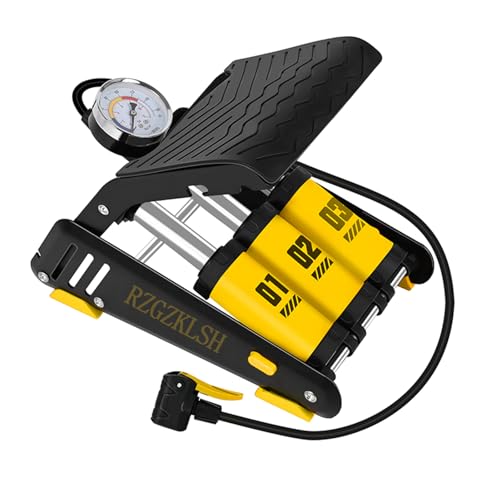
RZGZKLSH 3-Cylinder Foldable Foot Inflator
What We Like
- Three cylinders for fast inflation
- 160 PSI maximum pressure
- Foldable design for compact storage
- Universal valve adapter included
Trade-offs
- At 5.0 lb, heavier than many foot pumps
- Foot pump requires steady downward force
- No hose storage built into the frame
Three heavy-duty cylinders push air up to 160 PSI, which means this foot pump can handle standard car tires, motorcycle tubes, and high-pressure bike tires without overexertion. The triple-cylinder design moves more volume per stomp than a single or double cylinder, so you spend less time pumping. The foldable design also makes it easy to store in a trunk or garage corner.
This pump is heavier than the Franklin Sports foot pump, which weighs 2.6 pounds. That extra heft comes from the metal frame and three cylinders, so it feels solid underfoot, but it is less convenient to carry to a roadside tire or toss in a backpack. If your priority is inflation speed and you do not mind a heavier tool, this pump delivers. For those who need a very lightweight pump for frequent carrying, the Franklin is a better fit.
Product photos
How We Evaluated Manual Tire Pumps
We looked at the specifications and design of each pump, including maximum pressure, construction materials, and valve compatibility. Owner feedback helped us understand how each pump performs in real-world conditions, from the effort required to the durability of the gauge.
The three most important criteria were pressure range, build quality, and valve type support. A pump that can’t reach your tire’s required psi is useless, while a flimsy base or poor seal leads to frustration. We also considered portability and storage, as a pump that’s too bulky to carry or store won’t be used when needed.
This research-based approach helps identify the best options for different needs without subjective bias.
What To Look For In Manual Tire Pumps
Choosing the right manual tire pump means matching its features to the tires you inflate most often. Focus on the pressure range, the type of pump mechanism, and the valves it can handle.
A good manual tire pump must match your tire’s pressure needs, fit the valve type, and be stable enough to use without slipping or tipping over.
Pressure Range (PSI)
The maximum pressure a pump can deliver must meet or exceed your tire’s requirements. Road bike tires often need higher pressure, while car tires typically require lower pressure, and mountain bike tires are usually in a moderate range. A pump with a 160 psi max, like the Topeak JoeBlow Sport III, is versatile enough for high-pressure road tires and lower-pressure car tires. If you only need to inflate car tires, a pump with a 100 psi limit may be perfectly adequate and more affordable.
Pump Type: Floor vs. Foot vs. Hand
Floor pumps use a long stroke and a stable base for efficient, high-volume inflation and are best for home use. Foot pumps free your hands but require steady downward force and are great for cars and inflatables. Hand pumps are compact and portable, making them essential for roadside emergencies, but they are slower and require more physical effort. The best choice depends entirely on where and how you plan to use it.
Valve Compatibility
Most car tires use Schrader valves (the standard type found on cars and many bikes). Many higher-end bicycles use Presta valves, which are narrower. Some pumps, like the Topeak JoeBlow Sport III, have a dual head that works with both without an adapter. Others may require a separate adapter or only support one type. Check your tire valves before buying to ensure compatibility.
- Check the maximum PSI rating against your highest-pressure tire.
- Decide between a floor, foot, or hand pump based on your primary use.
- Confirm the pump head works with your valve types (Schrader, Presta, or both).
- Look for a built-in pressure gauge for accurate inflation.
- Consider the pump’s weight and size if you plan to store or carry it.
A pump with a built-in gauge is always preferable to guessing or using a separate tool.
Manual Tire Pumps Compared
The table below compares the top 10 manual tire pumps, highlighting their key specs and best-use cases to help you make the right choice.
| Product | Max Pressure | Weight | Gauge |
|---|---|---|---|
| Topeak JoeBlow Sport III Floor Pump | 160 psi | 3.7 pounds | 3-inch analog |
| Franklin Sports High Pressure Foot Pump | 100 PSI | 2.6 pounds | Built-in PSI gauge |
| Michelin Double Foot Pump 7 bar | 7 bar | 4.8 pounds | Pressure gauge |
| Schwinn Air Center Plus Floor Pump | 120 PSI | 2.9 Pounds | Air Zone gauge |
| LEZYNE Pocket Drive HV Compact Hand Pump | 90 PSI | 0.2 lbs | N/A |
| Schwinn Air Base Plus Foot Pump | 120 PSI | 3.1 Pounds | Air Zone gauge |
| Hycline Bike Floor Pump with Gauge | 160 PSI | N/A | high pressure gauge |
| Performance Tool W1638DB Foot Pump | 100 PSI | 0.1 Pounds | pressure gauge |
| HHYSSG Foot Pump with Precision Gauge | 160 PSI | 1.5 Pounds | precision pressure gauge |
| RZGZKLSH 3-Cylinder Foldable Foot Inflator | 160 PSI | 5.0 Pounds | pressure gauge |
Frequently Asked Questions
What is the best type of manual tire pump for a car?
A foot pump is often the best choice for car tires because it lets you use your body weight for leverage, is compact for storage, and typically includes a pressure gauge. The Franklin Sports High Pressure Foot Pump and Michelin Double Foot Pump are popular, durable options.
What PSI do I need for my bike tires?
The required PSI varies by bike type and tire width. Road bike tires often need higher pressure, while mountain bike tires usually require lower pressure. Check the sidewall of your tire for the recommended pressure range, and choose a pump that can reach the higher end of that range.
Can I use a bike pump for car tires?
Yes, you can, but it will take a long time. A standard bike floor pump can inflate a car tire, but the volume of air needed is much greater. A foot pump with a larger cylinder or a dedicated car pump is much more efficient for this task.
How do I know if a pump will fit my valve?
Check the valve on your tire. Most cars and many bikes use a Schrader valve, which looks like the valve on a car. Many high-end bikes use a Presta valve, which is narrower and has a small lock nut. Look for a pump head that explicitly states it works with both Schrader and Presta valves.
What is the difference between a floor pump and a foot pump?
A floor pump uses a long handle and a stable base, allowing you to use your arms and upper body for fast, high-volume inflation. A foot pump is operated by stepping on a pedal, which frees your hands to hold the valve or stabilizer, but it requires more leg effort and is generally slower for large volumes.
The Bottom Line
For most home mechanics and cyclists, the Topeak JoeBlow Sport III Floor Pump is the best overall choice, offering a stable, high-pressure design that works with multiple valve types. It’s the pump you’ll reach for in the garage for a reliable, consistent fill every time.
If you need a budget-friendly option for casual use, the Performance Tool W1638DB Foot Pump is a solid, lightweight choice. For drivers who want a certified, heavy-duty foot pump, the Michelin Double Foot Pump is built for car tires and comes with valuable adaptors.
The single most important factor is matching the pump to your tires. Know your required PSI and valve type, and you’ll find a manual pump that serves you well for years.
