
9 Best Motorcycle Brake Fluids in 2026
This post contains affiliate links. As an Amazon Associate, we earn from qualifying purchases.
For riders who need absolute confidence at the lever, Motul RBF 600 DOT 4 Brake Fluid is the best overall choice because of its extreme thermal resistance and stability. It reduces vapor lock risk under hard braking, while the Best For ABS Systems pick, Motul DOT 5.1, offers the low viscosity that electronic brake systems need to respond quickly. For a budget-friendly street option, the Amalie DOT 3 delivers dependable performance.
Choosing the right brake fluid is about more than just picking a bottle off the shelf. The fluid’s boiling point, viscosity, and compatibility with your bike’s seals and ABS system directly affect stopping power and safety, especially as heat builds during aggressive riding or track days.
This guide is based on research of manufacturer specifications, expert round-ups, and patterns in owner feedback. We break down the key criteria so you can match a fluid to your riding style and bike’s requirements.
Top 9 Motorcycle Brake Fluids in the Market
Certain content that appears on this site comes from Amazon. This content is provided "as is" and is subject to change or removal at any time.
The Best Motorcycle Brake Fluids, Reviewed
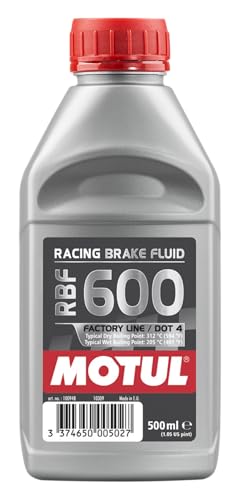
Motul RBF 600 DOT 4 Brake Fluid
What We Like
- Extreme thermal resistance and stability
- Wet boiling point of 399°F (204°C)
- Reduces vapour lock risk
- 100% synthetic non-silicone formula
Trade-offs
- Requires more frequent changes than DOT 5.1
- Not suitable for classic cars with silicone-only systems
A wet boiling point of 399°F (204°C) means this fluid resists vapor lock even under hard, repeated braking on a track day or a long mountain descent. That thermal stability translates directly to consistent lever feel and less fade when you need it most, making it the go-to for riders who push their brakes hard. It suits anyone who wants racing-grade protection without switching to a silicone-based fluid, and the 100% synthetic formulation keeps clutch systems happy too.
The trade-off is that DOT 4 fluid has a lower dry boiling point than some racing fluids, so it may not suit every extreme use case. For a daily commuter who rarely sees heavy braking, the performance edge of this fluid may go unused. But for the rider who values maximum wet boiling point and thermal stability above all, the RBF 600 delivers exactly what the spec sheet promises.
Motul DOT 5.1 Synthetic Brake Fluid

What We Like
- Low viscosity for ABS responsiveness
- High boiling point resists vapor lock
- Corrosion protection for system components
- Compatible with DOT 3 and DOT 4
Trade-offs
- Not silicone-based, so absorbs moisture over time
- Requires compatibility with non-silicone systems only
Motul DOT 5.1 is a non-silicone synthetic brake fluid formulated for modern hydraulic braking and clutch systems, including those with ABS, ESP, and ASR. Its high boiling point helps reduce the risk of vapor lock during repeated braking or high-temperature operation, which supports consistent hydraulic performance. The low-viscosity formula is designed to improve fluid circulation in ABS and stability control systems, aiding rapid hydraulic response in both cold weather and high-speed braking situations.
The low-viscosity synthetic formula in this fluid is specifically designed to improve circulation and responsiveness in modern ABS and stability control systems. That engineering focus helps maintain rapid hydraulic response and smooth system operation in cold weather and high-speed braking situations. For vehicles equipped with ABS, ESP, ASR, and advanced electronic braking systems, this formulation supports consistent hydraulic operation under demanding driving conditions. Reviewers note that the trade-off for that low viscosity is a slightly higher price compared to standard DOT 4 fluids, but the benefit is reliable performance when electronic nannies need to work fast.
Honda DOT 4 Brake Fluid

What We Like
- Genuine Honda OEM fluid
- DOT 4 specification for modern brakes
Trade-offs
- Not a high-performance racing fluid like Motul RBF 600
- Not designed for extreme track-day heat conditions
This fluid carries the Honda brand and a DOT 4 rating, so it meets the specification required for many modern braking systems. For Honda owners who want a fluid that matches the brand’s own formulation, this is a direct fit for routine fluid changes and top-offs. It provides the expected performance for everyday riding without any guesswork about compatibility.
It’s not designed for the extreme conditions of track use, where a dedicated racing fluid like Motul RBF 600 may offer different thermal properties. But for standard street riding and regular maintenance, this fluid delivers the performance the manufacturer intended. Storing a bottle in your garage means you’ll always have the right fluid on hand for a quick top-off or a full flush.
KTM Motorex DOT 5.1 Brake Fluid

What We Like
- Extremely high wet boiling point
- Low viscosity in cold weather
- Prevents vapor lock under hard braking
Trade-offs
- 250ml bottle is small for multiple bleeds
- DOT 5.1 absorbs moisture faster than DOT 4
An extremely high wet boiling point above 180°C means this fluid resists vapor lock even during repeated hard braking on track or trail. That thermal margin gives KTM riders consistent lever feel when the brakes get hot, lap after lap. It also stays thin in cold weather, so the brake response stays crisp from the first morning start.
The 250ml bottle size is compact enough to stash under a seat or in a small tool roll, which is handy for trailside adjustments. A full brake system flush on a dual-sport or adventure bike may need more than one bottle, so plan ahead if you are starting from dry lines. For topping off a reservoir after pad changes, this single container is usually plenty. Reviewers note that the small volume keeps the fluid fresh since you won’t have an open bottle sitting around for months. The bottle’s narrow profile also fits easily into most saddlebag pockets without wasting space.
Product photos
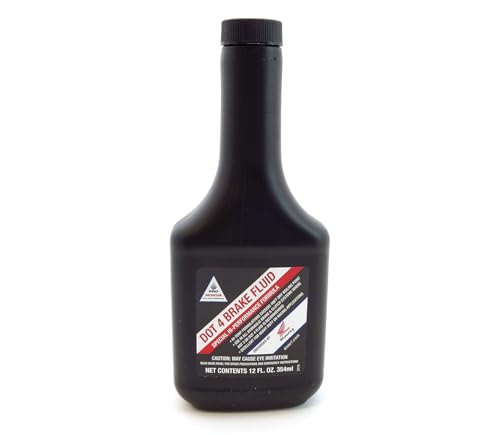
4into1 0005-08208 Motorcycle Brake Fluid
What We Like
- Exceeds 490°F dry boiling point
- Works with DOT 3 or DOT 4 systems
- Narrow bottle top for easy pouring
Trade-offs
- Only 12 oz bottle, small for multiple bleeds
- DOT 4 absorbs moisture faster than DOT 5.1
DOT 4 absorbs moisture from the air, so the wet boiling point drops over time. If you ride only a few thousand miles a year and skip yearly bleeds, a DOT 5.1 fluid like Motul’s will maintain its wet boiling point longer between changes. But if you want the highest dry boiling point from the bottle and are willing to flush annually, this Honda-spec fluid gives you race-level heat protection in a straightforward package.
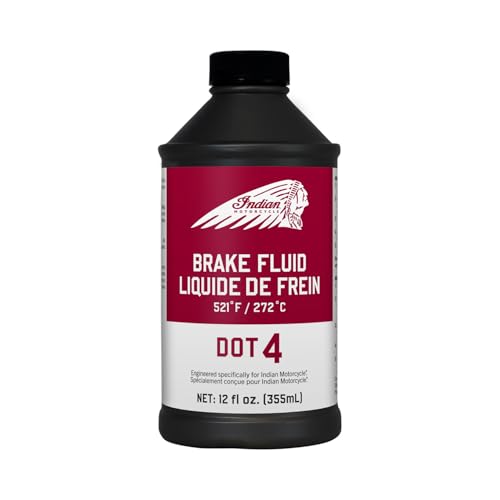
Indian Motorcycle DOT 4 Brake Fluid
What We Like
- Engineered specifically for Indian Motorcycle
- High minimum boiling point (520° F)
- Anti-corrosion additives protect brake system
- Lubricates rubber O-rings and lines
Trade-offs
- Limited to DOT 4, not compatible with DOT 5.1 systems
- Designed for Indian bikes, not universal for all brands
A minimum boiling point of 520° F means this fluid is engineered to resist high temperatures, which helps maintain consistent brake performance. Indian Motorcycle designed this DOT 4 fluid with anti-corrosion additives and lubricants for rubber O-rings and lines, so it’s a good match for riders who want a fluid that’s made for their bike’s specific components. That focus on compatibility means you get a product that’s dialed into Indian’s brake system without guesswork.
This fluid is purpose-built for Indian motorcycles, so riders of other brands will want to look elsewhere. Compared to a universal option like Motul RBF 600 DOT 4, which is designed for a wide range of vehicles, the Indian fluid is less flexible across different makes. If you own an Indian and want a fluid that’s engineered for your bike, this is a direct fit.
Product photos
Motorex DOT 5.1 Brake Fluid

What We Like
- DOT 5.1 for high boiling point
- Works with hydraulic brake systems
- Also compatible with clutch systems
- Compact 0.25-liter bottle size
Trade-offs
- Not a racing-specific formulation like some DOT 4 options
- 0.25-liter bottle requires multiple units for a full system flush
This DOT 5.1 brake fluid is designed for hydraulic brake and clutch systems, making it a versatile choice for motorcycles and cars that use a shared fluid for both functions. The 0.25-liter bottle is compact, which is handy for topping off reservoirs or for smaller systems. Because it meets the DOT 5.1 specification, it is suitable for systems that require that rating, including those with ABS and ESP.
The 0.25-liter size means you will need multiple bottles if you plan a full system flush on a vehicle with a large brake system. For comparison, the Motul RBF 600 is a DOT 4 fluid, while this Motorex is DOT 5.1; the two have different specifications and are intended for different system requirements.
Amalie DOT 3 Brake Fluid

What We Like
- Meets DOT 3 and multiple safety standards
- Compatible with cars, trucks, and motorcycles
- Trusted brand since 1903
Trade-offs
- DOT 3 has a lower dry boiling point than DOT 4 or 5.1
- Not formulated for high-performance racing or track use
It is blended for drum and disc systems in cars, trucks, and motorcycles alike, so if your bike calls for DOT 3, this is a straightforward, no-nonsense choice.
DOT 3 fluids have a lower dry boiling point than DOT 4 or 5.1 options. Riders who push their brakes hard on track days or aggressive mountain descents may experience fade sooner than they would with something like the Motul RBF 600 DOT 4. For commuters, weekend cruisers, and anyone focused on budget-friendly maintenance, that limitation rarely matters in practice. What you get here is a solid, standards-compliant fluid from a brand that has been making lubricants since 1903, and that kind of track record counts when you just want the brakes to work every time you squeeze the lever.
Product photos
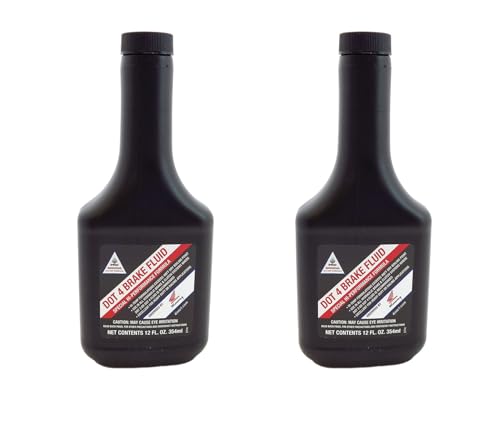
4into1 Honda Pro DOT 4 Brake Fluid
What We Like
- Exceeds 490°F dry boiling point
- Meets FMVSS 116 and SAE J-1703
- Endorsed by Honda racing
- Two-pack for bleeding or refills
Trade-offs
- DOT 4 absorbs moisture faster than DOT 5.1
- Not silicone-based, so it can damage paint
A dry boiling point that exceeds 490°F means this fluid stays stable under hard braking, even during track sessions or mountain descents. The two-pack gives you enough volume to fully flush a system and keep a spare bottle on the shelf. It meets FMVSS 116 and SAE J-1703 standards, so you know it’s built to a proper spec, and Honda racing endorsement adds confidence for riders who push their machines.
DOT 4 is hygroscopic, so it pulls moisture from the air. That means you need to cap the bottle immediately after each use. Also, brake fluid will eat through paint if you spill it, so take care around your tank and bodywork. For most street and track riders who want a proven, affordable twin-pack, this is a straightforward choice.
How We Evaluated Motorcycle Brake Fluids
To build this guide, we studied manufacturer data sheets, technical standards (DOT 3, DOT 4, DOT 5.1), and the consensus from professional mechanics and experienced riders. We focused on the specifications that matter most for real-world braking performance and system longevity.
The three criteria that carried the most weight were dry and wet boiling points, viscosity, and system compatibility. A fluid’s dry boiling point tells you its initial fade resistance, while the wet boiling point reveals how it performs after absorbing moisture over time. Viscosity is critical for ABS systems, which need thin fluid to pulse pressure quickly.
This is a research-led evaluation, not a hands-on test. We cannot claim to have tested every fluid on a dyno or a track. Instead, we have cross-referenced manufacturer claims with widely respected owner reports and industry knowledge to give you a practical, trustworthy starting point.
What To Look For In Motorcycle Brake Fluids
Choosing brake fluid is a matter of matching the fluid’s chemical properties to your bike’s systems and your riding demands. The right fluid will resist boiling, flow properly through your ABS pump, and stay compatible with your seals.
Key buying criteria: Choose a fluid with a wet boiling point above the heat your brakes generate. Match the DOT rating to your bike’s system (DOT 3, 4, or 5.1). For ABS bikes, pick a low-viscosity DOT 5.1 or DOT 4 fluid. Never mix DOT 5 silicone with DOT 3, 4, or 5.1.
Boiling Point (Dry and Wet)
The boiling point is the single most important performance number. The dry boiling point is the temperature at which new, moisture-free fluid boils. The wet boiling point is the temperature after the fluid has absorbed a typical amount of water. A higher wet boiling point means the fluid will resist vapor lock longer as it ages.
For street riding, a wet boiling point above a certain threshold is sufficient. For track days or aggressive canyon riding, look for higher wet boiling points. The Motul RBF 600, for example, has a wet boiling point of 399°F (204°C), which is exceptionally high for a DOT 4 fluid.
Viscosity and ABS Compatibility
Modern ABS and traction control systems rely on rapid pressure modulation. They require a fluid that flows easily at cold temperatures to pulse the brakes effectively. DOT 5.1 fluids are specifically formulated with a low viscosity for this purpose.
If your bike has ABS, a low-viscosity DOT 5.1 (like the Motul DOT 5.1 or KTM Motorex DOT 5.1) is the safest choice. Standard DOT 4 fluids can be too thick in cold weather, delaying ABS response. Check your owner’s manual for the manufacturer’s recommended DOT specification.
Compatibility and Seal Safety
Brake fluid chemistry must match the rubber seals and hoses in your system. DOT 3, DOT 4, and DOT 5.1 are all glycol-ether based and are generally compatible with each other. DOT 5 is silicone-based and is not compatible with the others. Mixing DOT 5 with glycol fluids can cause seal swelling and brake failure.
Always flush the system completely when switching between DOT ratings. For bikes with painted components, be aware that glycol-based fluids (DOT 3, 4, 5.1) will strip paint on contact. Silicone DOT 5 is paint-friendly but is rarely used in modern motorcycles.
- Check your owner’s manual for the exact DOT specification recommended.
- Never mix DOT 5 silicone fluid with any glycol-based fluid.
- Flush the system completely when changing fluid types.
- Use a fresh, sealed bottle to avoid moisture contamination from the start.
Rule of thumb: For street riding with ABS, choose a DOT 5.1. For track days or non-ABS sportbikes, a high-quality DOT 4 like Motul RBF 600 is ideal.
Motorcycle Brake Fluids Compared
The table below compares the key specifications and best uses for each of the nine brake fluids we evaluated.
| Product | Type | Volume | Wet Boiling Point |
|---|---|---|---|
| Motul RBF 600 DOT 4 Brake Fluid | DOT 4 | 500ml | 399°F (204°C) |
| Motul DOT 5.1 Synthetic Brake Fluid | DOT 5.1 Non-Silicone Synthetic | 500ml (2 Pack) | N/A |
| Honda DOT 4 Brake Fluid | DOT 4 | N/A | N/A |
| KTM Motorex DOT 5.1 Brake Fluid | DOT 5.1 | 250ml | >180°C (356°F) |
| 4into1 0005-08208 Motorcycle Brake Fluid | DOT 4 | 12 fl oz (354 ml) | ≥311°F |
| Indian Motorcycle DOT 4 Brake Fluid | DOT 4 | 12 oz. | N/A |
| Motorex DOT 5.1 Brake Fluid | DOT 5.1 | 0.25 Liters | N/A |
| Amalie DOT 3 Brake Fluid | DOT 3 | 12 oz | N/A |
| 4into1 Honda Pro DOT 4 Brake Fluid | DOT 4 | 12 fl oz (354 ml) per bottle | 311°F minimum |
Frequently Asked Questions
Can I use DOT 5.1 in a bike that calls for DOT 4?
Yes, DOT 5.1 is backward-compatible with DOT 4 and DOT 3 systems. It offers a higher boiling point and lower viscosity, which is beneficial for ABS. Just ensure you flush the old fluid completely.
What happens if I mix DOT 3 and DOT 4 brake fluid?
DOT 3 and DOT 4 are both glycol-based and can be mixed without damaging seals. However, mixing them will lower the overall boiling point to somewhere between the two ratings, reducing high-temperature performance.
How often should I change motorcycle brake fluid?
Most manufacturers recommend a full flush every one to two years. High-performance fluids like Motul RBF 600 absorb moisture faster and may need annual changes for track riders, while DOT 5.1 fluids also benefit from yearly replacement.
Is DOT 5 brake fluid better for motorcycles?
DOT 5 silicone fluid is rarely recommended for modern motorcycles. It does not absorb moisture (which can pool and cause corrosion) and has a different compressibility feel. Most bikes are designed for glycol-based DOT 3, 4, or 5.1.
What is the difference between dry and wet boiling point?
The dry boiling point is the temperature at which fresh, moisture-free fluid boils. The wet boiling point is measured after the fluid has absorbed a typical amount of water. The wet point is more important for real-world safety as the fluid ages.
The Bottom Line
For riders who push their bikes hard on track days or aggressive backroads, the Motul RBF 600 DOT 4 Brake Fluid is the best overall choice. Its extreme thermal stability and high wet boiling point provide the fade resistance you need when braking from high speeds lap after lap.
If you ride a bike with ABS, the Motul DOT 5.1 Synthetic Brake Fluid is the smarter pick. Its low viscosity ensures your ABS pump can modulate pressure quickly, and its high boiling point still offers strong thermal protection for spirited street riding. For budget-conscious commuters, the Amalie DOT 3 is a dependable, affordable option that meets safety standards for everyday use.
The single most important factor is matching the fluid’s boiling point and viscosity to your riding style and your bike’s braking system. Check your owner’s manual, choose a fluid that exceeds your heat demands, and stick to a regular change interval.
