
7 Best Oils For European Cars in 2026
This post contains affiliate links. As an Amazon Associate, we earn from qualifying purchases.
The Mobil 1 FS European Car Formula 0W-40 earns our Best Overall pick for its broad OEM approvals and proven 15,000-mile protection guarantee. For drivers who want full brand-specific approvals, the Valvoline European Vehicle Full Synthetic 5W-40 is our Best OEM Approved pick. The Pennzoil Platinum Euro Full Synthetic 5W-40 stands out for long engine life with its 500,000-mile protection guarantee.
European cars demand precise oil specifications that American or Asian models don’t. Using the wrong viscosity or certification can trigger warning lights, reduce performance, or accelerate engine wear. The right oil protects emissions systems, ensures proper lubrication at cold starts, and keeps engines running smoothly between long service intervals.
This guide is based on manufacturer specifications, OEM approval data, and patterns in owner feedback across the most common European brands. We focused on the approvals that matter for BMW, Mercedes-Benz, VW, Audi, Porsche, and Renault engines, and matched each oil to the drivers who need it most.
Top 7 Oils For European Cars in the Market
Certain content that appears on this site comes from Amazon. This content is provided "as is" and is subject to change or removal at any time.
The Best Oils For European Cars, Reviewed
Mobil 1 FS European Car Formula 0W-40

What We Like
- OEM approved for European vehicles
- Guaranteed 15,000-mile protection
- Excellent low-temperature startup protection
- Triple Action Formula reduces wear and deposits
Trade-offs
- Heavier weight than 0W-20 or 5W-30 options
- Not suitable for engines requiring 5W-40 or lower viscosity grades
A guaranteed 15,000-mile protection interval means you can stretch oil changes further without worrying about engine wear. Mobil 1 FS European Car Formula 0W-40 is OEM approved for European vehicles, so it meets the exact specs many German and other European automakers require. Its excellent low-temperature capabilities get oil flowing fast on cold mornings, reducing startup wear that can shorten engine life. For drivers who want a proven, long-lasting synthetic that handles both daily commutes and spirited driving, this oil delivers the peace of mind that comes from a major brand’s engineering.
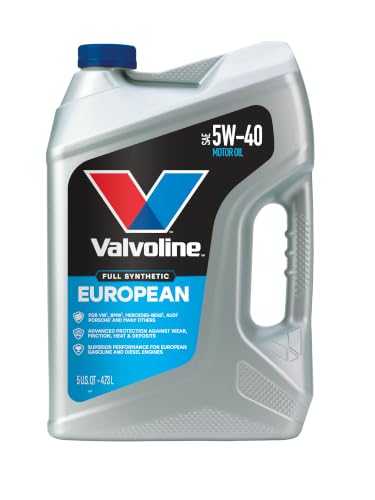
Valvoline European Vehicle Full Synthetic 5W-40
What We Like
- Approved for VW, BMW, Mercedes, Porsche
- Low-SAPS formula protects emissions systems
- Advanced anti-wear additives exceed OEM standards
Trade-offs
- Heavy 9.3 lb jug is less convenient for topping off
- Not approved for VW 508.00/509.00 or BMW LL-17 FE+
With approvals for VW 502.00/505.00, BMW LL-01, MB-Approval 229.5, and Porsche A40, this oil covers the most common European engines from the factory floor. The low-SAPS formulation keeps particulate filters and catalytic converters happy, while the extra anti-wear additives go beyond what those OEM specs demand. It’s a straightforward pick if you drive a late-model German car and want to stick with a single oil that meets multiple manufacturer requirements without guessing.
The 5W-40 viscosity suits many European gasoline and diesel engines that specify that weight in their manual. If your engine calls for a different viscosity, you’ll need to check your owner’s manual for the correct grade. For engines that list 5W-40, this Valvoline gives you a full suite of approvals in one jug.
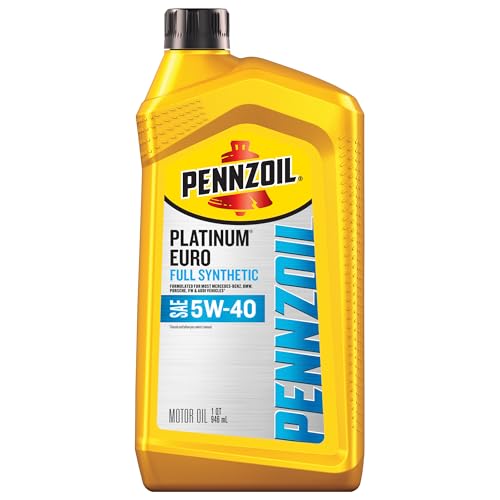
Pennzoil Platinum Euro Full Synthetic 5W-40
What We Like
- Formulated for European gasoline and diesel engines
- Guaranteed protection up to 500,000 miles
- Faster low-temperature flow and extreme heat protection
- Helps keep engine closer to factory clean
Trade-offs
- Not suitable for engines requiring 0W-20 or 0W-40 viscosity
- Not approved for engines requiring 0W-20 viscosity
Pennzoil backs this 5W-40 with a guarantee of protection for up to 15 years or 500,000 miles, whichever comes first. That is a strong vote of confidence for anyone planning to keep their European car on the road long-term. It’s formulated from natural gas for modern light-duty diesels and high-performance gasoline engines from brands like Mercedes-Benz, Porsche, and VW, and it delivers faster flow in cold starts while holding up under extreme heat. That combination of longevity and thermal stability is exactly what you want if your daily drive involves stop-and-go traffic followed by a highway sprint, or if you simply want to stretch the time between major engine work.
If your owner’s manual calls for a 0W-40, stick with that spec. But if your European car accepts a 5W-40, this oil’s natural-gas base and long-life guarantee offer peace of mind that a quart-at-a-time purchase can still deliver.
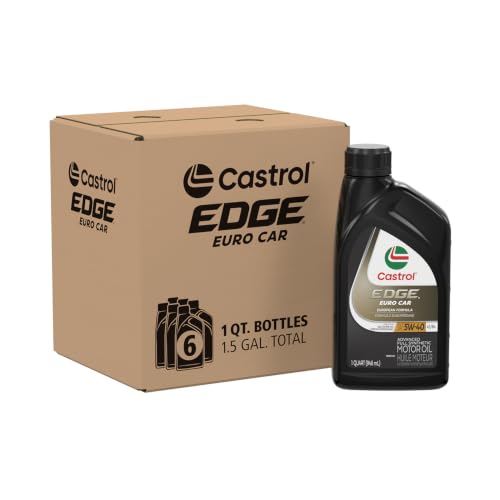
Castrol EDGE Euro 5W-40 A3/B4 Full Synthetic
What We Like
- 1.2X better viscosity control
- 2X better engine cleanliness
- ACEA A3/B4 and API SP certified
- Approved for BMW, MB, Porsche, Renault
Trade-offs
- Not designed for low-SAPS requirements
- Too thick for engines requiring 0W-20
With 1.2 times better viscosity control than the test limit, this oil helps engines run better for longer under the high heat that European turbos generate. That stability means the oil film stays intact rather than breaking down, which is critical for tight-clearance engines from BMW, Mercedes-Benz, Porsche, and Renault, all of which have officially approved this formulation. Owners report that sticking to a manufacturer-approved oil like this makes oil-change intervals straightforward and worry-free.
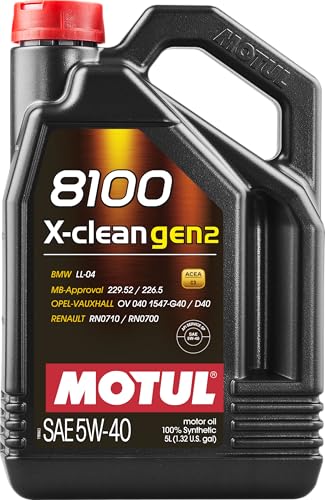
Motul 8100 X-clean Gen2 5W-40
What We Like
- ACEA C3 low SAPS protects emissions systems
- Approved for BMW, Mercedes, Opel, Renault
- High-temperature stability for heavy loads
- Resists oxidation, sludge, and deposits
Trade-offs
- Not backward-compatible with older ACEA A3/B4 specs
The ACEA C3 low SAPS formula in this oil is designed to reduce sulfated ash, phosphorus, and sulfur levels, which helps protect modern emissions systems like catalytic converters and particulate filters. That makes it a good fit for late-model BMW, Mercedes-Benz, Opel, and Renault vehicles that require this type of lubricant. The 5W-40 viscosity maintains strong oil film strength under high temperatures and heavy engine loads, providing reliable protection for turbochargers and other critical components during demanding driving conditions.
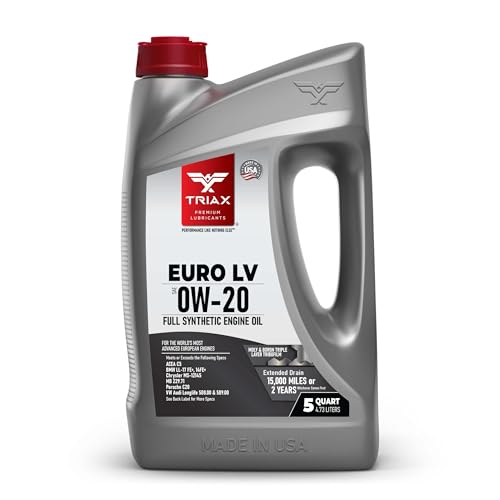
TRIAX Euro LV 0W-20 Full Synthetic
What We Like
- Meets VW 508.00/509.00 specs
- PAO/ester base with moly/boron
- 15,000-mile long-life interval
- Prevents coking and piston deposits
Trade-offs
- 0W-20 only suits late-model engines
The VW 508.00 and 509.00 specification is the key here, this oil is engineered specifically for late-model Volkswagen, Audi, and BMW engines that require a low-viscosity 0W-20 to protect tight tolerances and turbochargers. The PAO and ester full synthetic base, boosted with molybdenum and boron chemistry, keeps high-temperature film strength strong and prevents coking on hot-soak shutdown, which is a common failure point in modern small-displacement turbos. This is the oil to reach for if you own a recent VW or Audi that calls for 508.00 or 509.00, especially direct-injection turbo models where deposit control matters most.
The trade-off is that this narrow focus means it won’t work for older European cars that need a higher viscosity or a different spec like VW 502.00 or 505.01. But for owners of late-model VW and Audi gas or diesel engines, this oil delivers the exact factory-backed formulation with a 15,000-mile service interval, so you can follow the manufacturer’s long-life schedule without worry.
Product photos
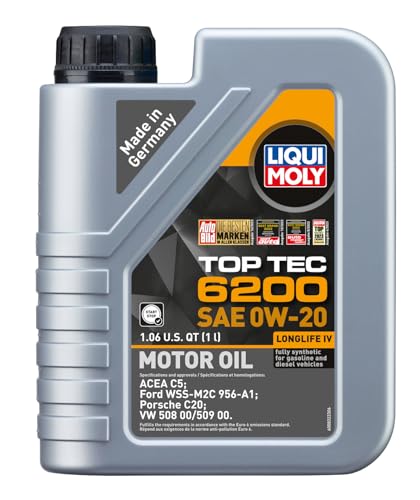
Liqui Moly Top Tec 6200 0W-20
What We Like
- Excellent cold-start behavior from low viscosity
- Developed for Audi, Porsche and VW requirements
- Enables extremely long oil change intervals
- Innovative additive technology for wear protection
Trade-offs
- Narrow brand focus excludes Mercedes, BMW, others
- Not suitable for engines requiring higher viscosity like 5W-40
A 0W-20 viscosity flows quickly at startup, which is exactly what modern Audi, Porsche, and VW engines need for excellent cold-start behavior. That low weight reduces drag on the engine, improving efficiency and cutting fuel consumption. The additive technology protects against wear and keeps the engine clean, while enabling extremely long oil change intervals. For anyone driving a late-model German car in a cold climate, this oil makes frosty mornings noticeably smoother.
The trade-off is that 0W-20 is not a universal choice. This oil is developed specifically for Audi, Porsche, and VW requirements, so it is not formulated for Mercedes, BMW, or other European brands. For those vehicles, a different viscosity like the 5W-40 options in this guide would be more appropriate. The 1-liter bottle is standard for this product, so check your engine’s capacity before ordering.
How We Evaluated Oils For European Cars
The evaluation started with manufacturer documentation and OEM approval lists. European automakers like BMW, VW, Mercedes-Benz, and Porsche each publish specific oil standards (such as LL-01, VW 508.00/509.00, or MB 229.5). We verified which oils carry these approvals and which simply claim compatibility.
We weighed four criteria most heavily. First, OEM approvals had to be genuine and current, not generic claims. Second, viscosity grade had to match the most common European engine requirements from 0W-20 to 5W-40. Third, additive chemistry mattered for emissions systems protection, especially low-SAPS formulations for modern turbocharged engines. Fourth, real-world protection guarantees gave us confidence in long-term performance claims.
A research-led evaluation has limits. We did not lab-test these oils or run them in engines. Our recommendations come from published specifications, expert round-ups, and patterns in thousands of owner experiences. The best oil for your car is always the one that meets your specific owner manual requirements.
What To Look For In Oils For European Cars
Choosing the right oil for a European car starts with your owner manual and ends with matching the exact specifications. Here are the key criteria to check before buying.
Look for the specific OEM approval code printed on the bottle (like VW 508.00 or BMW LL-01), not just a general “European vehicle” label. Viscosity, low-SAPS compatibility, and change interval guarantees follow from that approval.
OEM Approvals Are Non-Negotiable
European automakers design engines around precise oil formulations. A VW 508.00 oil is chemically different from a VW 502.00 oil, and using the wrong one can damage the particulate filter or cause piston deposit buildup. Always check the back of the bottle for the specific approval code your manufacturer requires, not just brand compatibility claims. Some oils carry approvals for multiple brands, like Valvoline European Vehicle Full Synthetic 5W-40, which covers VW, BMW, Mercedes, and Porsche in one bottle.
Viscosity Grade Matters More Than Brand
European engines typically use 0W-20, 5W-30, or 5W-40, and the wrong thickness can cause poor cold starts or inadequate high-temperature protection. Newer engines with turbochargers and particulate filters often require 0W-20 for proper flow and emissions system function. Older engines may need 5W-40 for bearing protection at high mileage. The Mobil 1 FS European Car Formula 0W-40 offers a middle ground for many applications, but always confirm your manual’s requirement before buying.
Low-SAPS vs. Full-SAPS Additive Packages
Modern European cars with gasoline particulate filters (GPF) or diesel particulate filters (DPF) need low-SAPS oils (low ash, sulfur, and phosphorus). These oils, like the Motul 8100 X-clean Gen2 5W-40, prevent emissions system clogging. Older European cars without these filters can use full-SAPS oils like Castrol EDGE Euro 5W-40, which offer stronger anti-wear protection. Using the wrong type can either clog your emissions system or leave your engine under-protected.
- Check your owner manual for the exact ACEA specification (A3/B4, C3, or C5)
- Verify the oil carries the specific OEM approval code, not just a general “meets or exceeds” claim
- Confirm the viscosity matches your engine’s requirement for both summer and winter temperatures
- Look for a protection guarantee if you plan extended oil change intervals
When in doubt, buy the oil that lists your car’s exact OEM approval code on the bottle, not the one that says “recommended for European cars.”
Oils For European Cars Compared
The table below compares all seven oils across the specifications that matter most for European car engines: OEM approvals, viscosity grades, and key features.
| Product | Viscosity | Volume | Base Oil |
|---|---|---|---|
| Mobil 1 FS European Car Formula 0W-40 | 0W-40 | 5 Quart | Full Synthetic |
| Valvoline European Vehicle Full Synthetic 5W-40 | 5W-40 | 5 Quart | Full Synthetic |
| Pennzoil Platinum Euro Full Synthetic 5W-40 | 5W-40 | 1 Quart | Natural gas-derived |
| Castrol EDGE Euro 5W-40 A3/B4 Full Synthetic | 5W-40 | 1 Qt, 6 Pack | Full Synthetic |
| Motul 8100 X-clean Gen2 5W-40 | 5W-40 | 5 Liter | Full Synthetic |
| TRIAX Euro LV 0W-20 Full Synthetic | 0W-20 | 5 Quart | PAO/Ester Full Synthetic |
| Liqui Moly Top Tec 6200 0W-20 | 0W-20 | 1 L | Fully synthetic |
Frequently Asked Questions
What makes European car oil different from regular oil?
European engines run hotter and have longer recommended oil change intervals than many American or Asian engines. European automakers also require specific additive packages to protect timing chains, turbochargers, and emissions systems. Using a non-approved oil can void warranties and cause premature engine wear.
Can I use 5W-30 instead of 5W-40 in my European car?
Only if your owner manual explicitly allows it. Some European engines are designed for 5W-40 to maintain oil pressure at high temperatures. Using a thinner 5W-30 where 5W-40 is specified can lead to inadequate bearing protection during sustained high-speed driving.
How often should I change oil in a European car?
Follow your manufacturer’s oil life monitoring system, which typically ranges from 10,000 to 15,000 miles for modern synthetic oils. Some oils like Pennzoil Platinum Euro guarantee protection up to 500,000 miles with proper maintenance, but always follow the interval recommended by your car’s computer or owner manual.
What does low-SAPS mean on European oil?
Low-SAPS stands for low sulfated ash, phosphorus, and sulfur. These oils are designed for modern European engines with gasoline particulate filters (GPF) or diesel particulate filters (DPF). Using a non-low-SAPS oil in these engines can clog the filter and trigger check engine lights.
Is 0W-20 oil safe for older European cars?
No, 0W-20 is only safe for late-model European engines specifically designed for it, such as those requiring VW 508.00/509.00 or BMW LL-17 FE+. Older European engines typically need 5W-30 or 5W-40 for proper bearing clearance and oil pressure. Using 0W-20 in an older engine can cause excessive wear.
The Bottom Line
The Mobil 1 FS European Car Formula 0W-40 is our Best Overall pick for most European car owners. It combines broad OEM approvals with a 15,000-mile protection guarantee and excellent cold-start performance. This is the oil to choose if you drive a BMW, Mercedes, VW, or Audi and want one product that covers multiple brands without checking individual approvals.
If you need a specific OEM-approved oil for your VW, BMW, or Porsche, the Valvoline European Vehicle Full Synthetic 5W-40 covers those approvals in a single bottle. For drivers of late-model VW or Audi cars requiring VW 508.00/509.00, the TRIAX Euro LV 0W-20 is the right choice. Budget-conscious owners or those wanting maximum engine life should consider the Pennzoil Platinum Euro for its 500,000-mile protection guarantee.
The single most important buying factor is matching the exact OEM approval code in your owner manual. No brand name or price difference matters more than getting the right specification for your engine. Start with your manual, then pick the oil that carries that code.
