
10 Best Sealants For Car Roof Leaks in 2026
This post contains affiliate links. As an Amazon Associate, we earn from qualifying purchases.
The Dicor Self-Leveling Lap Sealant is our Best Overall pick because it self-smooths for a clean, watertight seal on horizontal RV and car roof surfaces. For a clear formula that won’t yellow, the Dicor Ultra Sealant System stands out, while the Gorilla Waterproofing Sealant Spray offers fast, even coverage for larger areas.
The real challenge with a car roof leak is finding a sealant that stays flexible through temperature swings and bonds to your specific roof material. EPDM, TPO, or metal. A product that works perfectly on a rubber membrane can fail on a fiberglass surface or crack in freezing weather.
This guide is built from manufacturer specifications, expert round-ups, and patterns in owner feedback across ten products. We focus on adhesion, flexibility, application method, and durability so you can confidently pick the right sealant for your repair.
Top 10 Sealants For Car Roof Leaks in the Market
Certain content that appears on this site comes from Amazon. This content is provided "as is" and is subject to change or removal at any time.
The Best Sealants For Car Roof Leaks, Reviewed
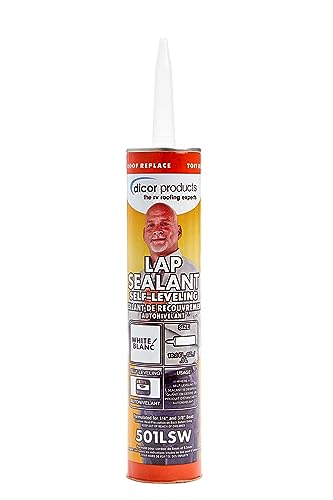
Dicor Self-Leveling Lap Sealant
What We Like
- Self-leveling for smooth horizontal application
- Sun-ray stabilized to prevent discoloration
- Works with EPDM, TPO, and PVC membranes
- Won't stain or discolor roofing materials
Trade-offs
- Only for horizontal surfaces, not vertical use
- Does not work on vertical walls or sloped sides
A 10.3-ounce tube of self-leveling sealant that flows into cracks and seams on its own, so you don’t have to spread it by hand. Dicor designed this for RV roofs made of EPDM, TPO, or PVC, and it also sticks to aluminum, wood, fiberglass, and concrete. The sun-ray stabilization means it won’t discolor or spoil, which is useful for roof repairs that see direct sunlight. For sealing around roof fixtures on a camper or trailer, this sealant’s compatibility with multiple materials gives you one tube that works on most surfaces.
The trade-off is that this sealant only works on horizontal surfaces. If you need to seal a vertical wall seam or a sloped gutter joint, it will run off before it sets. For those spots, a non-leveling sealant would hold better. But for flat roof repairs, the self-leveling action saves you time and gives a clean, even seal. It is a straightforward way to stop a leak on a level RV or camper roof without having to spread the material manually.
Dicor Ultra Sealant System

What We Like
- Non-yellowing formula stays clear
- Solvent-free and environmentally friendly
- Paints over with most paints
- Withstands extreme heat and cold
Trade-offs
- Requires primer on polypropylene and some membranes
- Non-leveling formula does not self-smooth
- Heavier than spray sealants at 0.6 lb per tube
A 10.1-ounce tube of polyether sealant that stays clear even after long sun exposure means you can seal a roof leak without the repair turning into an ugly yellow scar. The solvent-free formula keeps the job low-fume and safer to handle. It is fast curing, so you are not waiting around, and the UV stabilization means the sealant holds up through blistering summers and freezing winters without discoloring. If you want a clean, long-lasting fix that blends into a white roof, this is the one to reach for.
This is a non-leveling sealant, so it stays where you put it rather than flowing into cracks on its own. That gives you more control on vertical seams but means you need to spread it carefully. Compared to the Dicor Self-Leveling Lap Sealant, which flows smooth on horizontal surfaces, this one demands a steadier hand and a primer on polypropylene or certain membranes. For a roof leak that needs precision application or a repair you want to stay invisible, the extra effort pays off in a finish that does not yellow.
Product photos
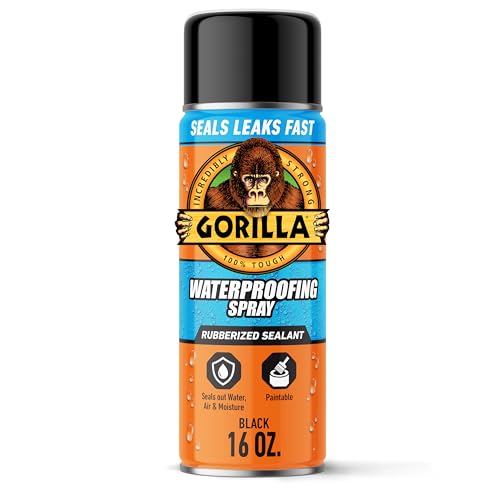
Gorilla Waterproofing Sealant Spray
What We Like
- Controlled spray pattern for even coat
- Self-leveling covers small gaps and cracks
- UV and temperature resistant when dry
- Paintable with latex or oil-based paints
Trade-offs
- Spray application can overspray in wind
- Requires primer before oil-based paint
The controlled spray pattern on this 16-ounce can means you get a clean, even coat without the messy drips that come with a brush or pour-on sealant. That self-leveling formula then flows into small gaps and cracks on its own, so you’re not chasing every tiny leak with a fingertip. It’s a good fit for sealing roofs, gutters, skylights, and other home repair projects where the black color blends with dark surfaces.
Black is the only color available, so on a white or tan roof the sealant will be visible. The 16-ounce spray can covers a large area quickly, which is useful for a whole roof or gutter section. For a narrow seam or a vertical surface, a tube of self-leveling sealant like Dicor’s lap sealant gives more control, but the spray is faster when you need to cover a lot of ground.
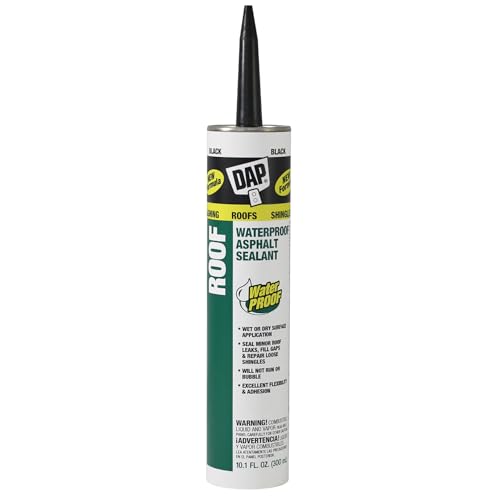
DAP Roof Waterproof Asphalt Sealant
What We Like
- 100% waterproof and weatherproof seal
- Works on wet or dry surfaces
- Dries tack free in 1 hour
- Resists UV, cracking, and crumbling
Trade-offs
- Paint ready only after 2 to 4 weeks
- Requires temperatures above 40°F to apply
This sealant can be applied on both wet and dry surfaces, so if a roof leak starts during rain or after washing, you don’t have to wait for everything to dry out. It dries tack free in one hour and is fully water ready in 24 hours, which means you can stop a leak quickly without perfect surface prep. That combination of wet-application ability and fast cure time makes it a practical choice for urgent repairs on RVs, trailers, or other vehicles with asphalt-compatible roofs.
The sealant dries tack free in 1 hour and is water ready in 24 hours, so you can stop a leak fast even in a sudden storm. But it takes 2 to 4 weeks to become paint ready, depending on temperature, humidity, and depth of fill. That means if you want to blend the repair into your roof’s color soon, you’ll need to plan ahead.
Liquid Rubber RV Roof Sealant

What We Like
- Solar reflective coating reduces heat absorption
- Flexible waterproof membrane for all temperatures
- Works on EPDM, TPO, fiberglass, and aluminum
- Water-based, zero VOC formula
Trade-offs
- Requires primer for best adhesion on EPDM and TPO
- Needs 50°F–90°F application window
- 1 gallon covers only 50 sq ft
A 10-year protection term backed by the manufacturer when applied as directed gives you serious peace of mind against leaks, while the solar reflective performance reduces heat absorption to help keep interior temperatures lower. The water-based, zero VOC formula rolls on like paint, so you can handle a full roof in a weekend without special tools or harsh solvents. It works on EPDM, TPO, fiberglass, and aluminum, covering the surfaces listed for this product.
You need to buy the companion primer separately for best adhesion on EPDM and TPO surfaces, adding a step and extra cost. Compared to a self-leveling lap sealant like Dicor 501LSW-1, this is a full-roof coating rather than a product for sealing individual seams, making it suitable for a complete refresh. For a whole-roof project where heat reflection matters, this system delivers lasting results.
Liquid Rubber Lap Sealant 4-Pack

What We Like
- Self-leveling for smooth waterproof seal
- Flexible barrier moves with temperature changes
- 4-pack covers typical 30 ft RV
- UV-resistant for outdoor durability
Trade-offs
- Won't adhere to silicone; must remove it first
- Requires clean, dry surface before application
Buying a four-pack makes sense when you have multiple sealing spots or want to keep a spare tube on hand for future touch-ups. The sealant flows into place by itself, so you do not have to fuss with smoothing it out by hand. Once cured, it stays flexible through hot summers and cold snaps without cracking. Reviewers note that for anyone resealing several roof penetrations at once, the multi-pack saves a trip to the store and keeps the job moving.
This sealant is strictly for horizontal surfaces. If you need to seal a vertical seam or a sidewall gap, you will need a different product, like the Dicor Self-Leveling Lap Sealant, which shares the same horizontal-only limitation but comes in single tubes. Also, you must remove any old silicone before applying, because this sealant will not stick to it. That extra prep step is straightforward with a scraper and cleaner, but it does add time to the project.
Product photos
Ziollo RV Roof Lap Sealant

What We Like
- Self-leveling for easy application
- Stays flexible in extreme temperatures
- Covers 25 linear feet per tube
- Safe around kids and pets
Trade-offs
- Only available in white color
- Requires caulk gun for application
A single 10-ounce tube covers 25 linear feet of roof seam, according to the manufacturer. The material spreads into cracks and around fixtures without needing manual smoothing, so you spend less time finishing and more time moving on. It sticks to EPDM, TPO, metal, and fiberglass with minimal prep, making it a strong fit for anyone who wants a flexible seal that handles desert heat and mountain frost without reapplication every year.
This sealant comes only in white, which works fine for most RV roofs but won’t blend in on darker surfaces. The formula is non-hazardous with no solvents, so there is no need to air out the campsite after application. If you prioritize safety around kids and pets, this tube delivers a flexible, waterproof seal without the chemical fuss.
Gorilla Patch & Seal Liquid Rubber

What We Like
- Self-leveling for smooth coverage over gaps
- UV and temperature resistant when dried
- Paintable with latex or oil-based paints
- Versatile application methods included
Trade-offs
- Self-leveling limits use on vertical surfaces
- Requires drying time before painting
A 32-ounce can of flexible rubberized coating gives you enough material to handle multiple leak points around skylights, vents, or seams on an RV roof without needing a second container right away. The sealant spreads and settles into small cracks and gaps as you apply it, so you can brush or pour it on and let it find the trouble spots. UV and temperature resistance help the repair hold up through sun and seasonal shifts.
Self-leveling sealants work best on flat or gently sloped surfaces because gravity pulls the coating downward before it sets on vertical walls or steep roof angles. For horizontal roof seams, gutters, and skylights, this Gorilla coating can be applied by brush, roll, trowel, dip, or pouring, and its self-leveling nature smoothly covers small gaps and cracks to create a watertight seal.
Product photos
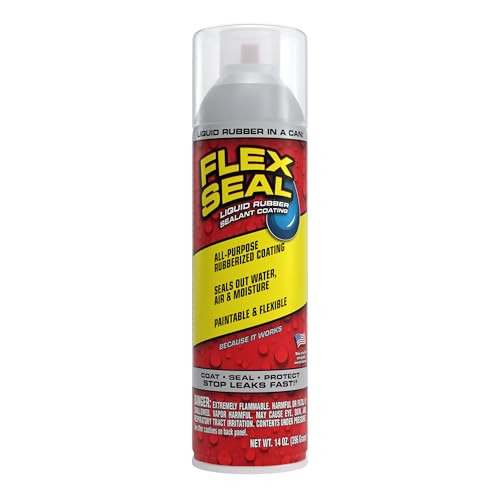
Flex Seal Spray Rubber Sealant
What We Like
- Sprays on wet or dry surfaces
- Dries flexible, won't crack in cold
- Won't sag or drip in summer heat
- Can be painted after drying
Trade-offs
- Requires multiple coats for thick coverage
- Not self-leveling like Dicor lap sealants
A 14-ounce spray can that seeps into cracks and holes and dries to a transparent, watertight, flexible rubberized coating. It stays flexible and pliable, will not sag or drip in summer heat, and will not crack or peel in winter cold. Once dry, it can be painted any color. This makes it suitable for gutters, wood, RVs, campers, roof repairs, skylights, windows, and more. For anyone who wants a spray sealant that can be applied on wet or dry surfaces and protects from corrosion, this is a versatile option.
A spray covers wide areas, but the clear formula will not hide the surface underneath. If you need a thicker, targeted bead for horizontal surfaces, a self-leveling lap sealant like the Dicor 501LSW-1 is designed for that purpose. But for coating larger areas or odd shapes, Flex Seal’s rubberized spray offers a simple application.
Product photos
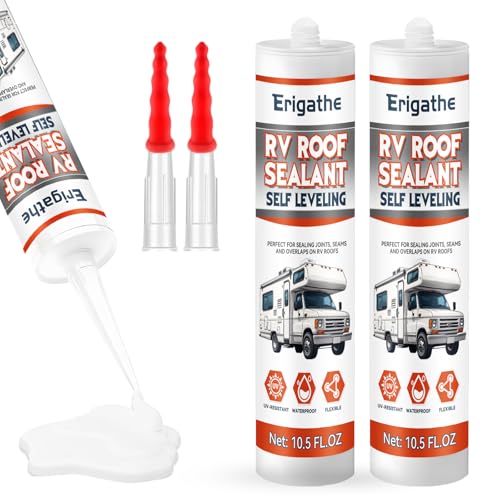
Erigathe Self-Leveling RV Roof Sealant
What We Like
- Self-leveling for smooth application
- Quick 15-minute set time
- UV-resistant and waterproof
- Bonds to metal, fiberglass, EPDM
Trade-offs
- White color only limits blending options
- Requires horizontal surfaces for self-leveling
A 15-minute set time means you can seal a leaking roof vent or skylight and have the repair set quickly, though the tack-free time is two hours, so avoid rain or driving during that period. The sealant works its way into cracks and laps by itself, so you don’t have to fuss with spreading or smoothing, and it bonds strongly to metal, fiberglass, and EPDM rubber without peeling or shrinking. For RV owners who want a fast, no-mess fix that holds up through sun, snow, and road vibrations, this is a practical choice.
This sealant is only available in white, so if your roof or trim is a different color, you’ll need to paint over it. And while the 15-minute set time is fast, the tack-free time is two hours, which means you can’t drive or expose the repair to rain immediately. Compared to the Dicor Self-Leveling Lap Sealant, which also self-levels, the Erigathe offers a quick set for patching. It’s a practical choice for RV owners who prioritize speed and ease over color flexibility.
Product photos
How We Evaluated Sealants For Car Roof Leaks
Our evaluation began with a close look at each product’s technical specifications and manufacturer documentation. We cross-referenced those claims with patterns we found in owner feedback from online forums and review aggregators, noting which sealants held up over time and which developed cracks or adhesion failures.
We judged every product against four criteria that matter most for car roof leaks. Those are bonding to common roof materials (EPDM, TPO, metal, fiberglass), flexibility in extreme temperatures, ease of application (self-leveling vs. Spray vs. Tube), and UV resistance to prevent cracking and discoloration. A sealant that fails on any one of these points is a leak waiting to happen.
Research-led evaluation has limits: we haven’t personally applied each sealant in a driveway repair, and real-world results depend heavily on surface preparation and application conditions. Our recommendations reflect what the data and user reports consistently show, not a controlled test.
What To Look For In Sealants For Car Roof Leaks
Choosing the right sealant means matching it to your roof material, the leak location, and how you prefer to apply it. Here are the key factors to consider.
Match the sealant to your roof material (EPDM, TPO, fiberglass, or metal) and the surface angle, self-leveling formulas work only on horizontal surfaces, while non-leveling or spray options handle vertical repairs.
Roof Material Compatibility
The most common car and RV roof materials are EPDM rubber, TPO, fiberglass, and aluminum. Some sealants bond to all four, while others require a primer on certain surfaces. The Dicor Lap Sealant, for example, works directly on EPDM, TPO, and PVC membranes, while the Liquid Rubber RV Roof Sealant needs a primer for best adhesion on EPDM and TPO. Check the manufacturer’s compatibility list before buying.
Application Method and Surface Angle
Self-leveling sealants like the Dicor Self-Leveling Lap Sealant flow into cracks and smooth themselves, but only on flat or low-slope surfaces. For vertical walls, sloped sides, or tight seams, you need a non-leveling formula or a spray sealant. Spray options like the Gorilla Waterproofing Sealant Spray cover large areas quickly but can overspray in wind. Tube-applied sealants give you precise control for spot repairs.
Flexibility and Temperature Resistance
A roof sealant must expand and contract with the roof as temperatures change. Look for products that stay flexible in extreme cold and don’t sag or drip in summer heat. The Ziollo RV Roof Lap Sealant and the Gorilla Patch & Seal Liquid Rubber both emphasize flexibility across temperature ranges. Rigid sealants crack over time, letting water back in.
- Identify your roof material before buying, check the owner’s manual or look for labels on the roof membrane.
- Measure the leak area: spot repairs need a tube sealant, while large sections call for a spray or roll-on coating.
- Check the application temperature range; many sealants require temperatures above 40°F.
- Read the cure time: some sealants set in 15 minutes, while others need 24 hours before rain exposure.
- For visible repairs, choose a clear or paintable formula to match your roof color.
If you’re unsure about your roof material, apply a small test patch in an inconspicuous area first to check adhesion.
Sealants For Car Roof Leaks Compared
The table below compares the ten sealants across key specs, including material compatibility, application type, and cure time, so you can see at a glance which one fits your repair.
| Product | Type | Size | UV Protection |
|---|---|---|---|
| Dicor Self-Leveling Lap Sealant | Self-leveling | 10.3 oz | Sun-ray stabilized |
| Dicor Ultra Sealant System | Non-Leveling Polyether | 10.1 oz | UV Stabilized |
| Gorilla Waterproofing Sealant Spray | Spray | 16 oz | UV Resistant |
| DAP Roof Waterproof Asphalt Sealant | Asphalt based | 10.1 oz | UV damage resistant |
| Liquid Rubber RV Roof Sealant | Water-based | 1 Gallon | Solar Reflective |
| Liquid Rubber Lap Sealant 4-Pack | Self-leveling paste | 4 x 10 oz | UV-Resistant |
| Ziollo RV Roof Lap Sealant | Self-leveling EPDM caulk | 10 oz | N/A |
| Gorilla Patch & Seal Liquid Rubber | Liquid rubber | 32 oz | UV resistant |
| Flex Seal Spray Rubber Sealant | Spray rubberized coating | 14 oz | N/A |
| Erigathe Self-Leveling RV Roof Sealant | Self-leveling | 2 x 10.5 fl oz | UV-resistant |
Frequently Asked Questions
Can I use a silicone sealant on my car roof?
Silicone sealants are not recommended for most car and RV roof repairs because many lap sealants, including the Liquid Rubber Lap Sealant 4-Pack, will not adhere to silicone. If silicone is already on your roof, you must remove it completely before applying a new sealant.
What is the difference between self-leveling and non-leveling sealant?
Self-leveling sealants flow into cracks and smooth themselves out, making them ideal for horizontal surfaces like flat RV roofs. Non-leveling sealants hold their shape and are better for vertical walls, sloped sides, and narrow seams where you need the bead to stay put.
How long does car roof sealant take to cure?
Cure times vary widely. The Erigathe Self-Leveling RV Roof Sealant sets in about 15 minutes, while the DAP Roof Waterproof Asphalt Sealant dries tack-free in one hour but takes two to four weeks before it can be painted. Most sealants need at least 24 hours before heavy rain exposure.
Can I paint over roof sealant?
Yes, many sealants are paintable. The Gorilla Waterproofing Sealant Spray accepts latex or oil-based paints, and the Dicor Ultra Sealant System paints over with most paints. However, the DAP Roof Waterproof Asphalt Sealant requires a two- to four-week wait before painting. Always check the label.
Do I need a primer before applying roof sealant?
Some sealants require a primer for proper adhesion on certain surfaces. The Dicor Ultra Sealant System needs primer on polypropylene and some membranes, and the Liquid Rubber RV Roof Sealant recommends primer for best adhesion on EPDM and TPO. Others, like the Dicor Self-Leveling Lap Sealant, bond directly to compatible materials without primer.
The Bottom Line
The Dicor Self-Leveling Lap Sealant is our Best Overall pick for anyone repairing horizontal seams, vents, or skylights on an EPDM, TPO, or PVC roof. Its self-leveling formula creates a smooth, watertight seal without manual spreading, and the UV-stabilized construction resists discoloration over time. If your roof is flat or low-slope, this is the most reliable choice.
If you need a clear, non-yellowing sealant for visible repairs, the Dicor Ultra Sealant System is the best pick. For a fast emergency repair on a wet surface, the DAP Roof Waterproof Asphalt Sealant works when you can’t wait for dry weather. RV owners resealing multiple fixtures will appreciate the value of the Liquid Rubber Lap Sealant 4-Pack.
The most important factor in any roof leak repair is matching the sealant to your roof material and surface angle. Check your roof type, measure the leak area, and pick the application method that fits your comfort level. A well-chosen sealant applied correctly will keep your car or RV dry for years.
