
5 Best Timing Lights For Classic Cars in 2026
This post contains affiliate links. As an Amazon Associate, we earn from qualifying purchases.
For dialing in the ignition on a classic car, the THIKPO Digital Automotive Timing Light is our best overall pick. It combines a bright linear xenon flash tube with an adjustable advance angle and a real-time digital tachometer. The ANCEL LT70 PRO is the best rechargeable option for multi-function checks, while the BINGOX Digital is the best lightweight design for long sessions in tight engine bays.
Setting the timing on a vintage engine is a precise job that requires a reliable strobe. You need a tool that is bright enough to read marks in a dim garage, accurate enough to trust your adjustments, and built to handle the quirks of an older distributor-based ignition system.
We evaluated these five timing lights based on their specifications, manufacturer documentation, and patterns in owner feedback from expert round-ups. This guide will help you match the right tool to your engine type and your budget.
Top 5 Timing Lights For Classic Cars in the Market
Certain content that appears on this site comes from Amazon. This content is provided "as is" and is subject to change or removal at any time.
The Best Timing Lights For Classic Cars, Reviewed
THIKPO Digital Automotive Timing Light

What We Like
- Bright linear xenon flash tube
- Adjustable advance angle 0-90°
- Digital tachometer and advance display
- Polarity protected and impact resistant
Trade-offs
- At 1.1 pounds, heavier than some competitors
- Sensor must point toward spark plug for accuracy
A 0-90° adjustable advance range combined with a bright linear xenon flash tube means you can read timing marks clearly even in daylight, then dial in the exact advance without guessing. The real-time RPM and advance readout on the display removes the old reliance on feel and sound, giving you concrete numbers to work with. This timing light works with 2- and 4-stroke 12V gasoline engines, including those in automotive, agricultural, and marine applications.
At 1.1 pounds, this timing light is heavier than the BINGOX Digital Timing Light (0.6 pounds), so it feels more substantial in hand. The inductive clamp must be oriented with the arrow pointing toward the spark plug, or you risk reading errors. That extra weight and careful setup are the price for real-time data monitoring and a bright xenon flash tube that works even in daylight.
Product photos
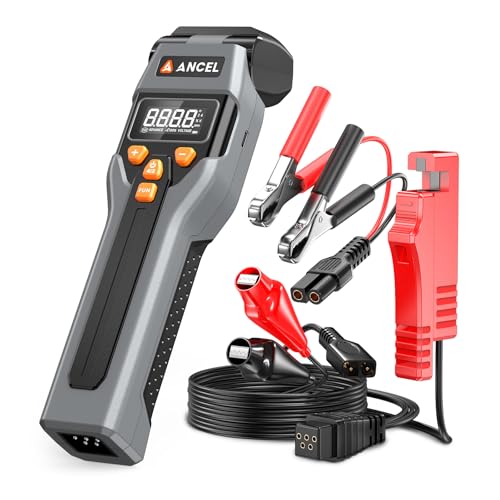
ANCEL LT70 PRO Timing Light
What We Like
- 5-in-1 checks: timing, RPM, advance, dwell, voltage
- 60° adjustable light head for aiming
- LED rated for 1,000,000+ flashes
Trade-offs
- Not compatible with diesel or CDI ignition systems
- Heavier at 1.5 pounds than some competitors
The 5-in-1 readouts, timing, RPM, advance, dwell, and voltage, let you evaluate ignition health from one tool instead of juggling a tachometer and multimeter, which simplifies tuning on older distributor-based engines. The built-in rechargeable power (via Type-C charging) means you can check timing without hunting for a 12V source or untangling power cords, just charge it up and walk out to the garage. That freedom is the main reason this light stands out for classic car owners who want a clean, mobile setup.
At 1.5 pounds, the LT70 PRO is heavier than the THIKPO Digital Automotive Timing Light (1.1 pounds), which may be noticeable during extended use. It is not compatible with diesel engines or CDI ignition systems, so if your vehicles include those, you will need a separate tool. For most 12V distributor-based gasoline engines, common in classic cars and muscle cars, the multi-function display and rechargeable convenience make it a practical option.
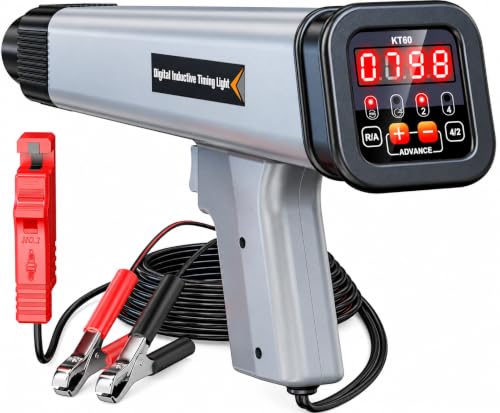
KZYEE KT60 Digital Timing Light
What We Like
- Bright xenon strobe for dim engine bays
- Digital LCD shows RPM and advance settings
- Adjustable 0-90° advance control
Trade-offs
- Heavier than some competitors at 1.4 pounds
- Not compatible with coil-on-plug ignition systems.
A digital LCD that shows both RPM and advance angle means you can dial in ignition timing without squinting at a dial or guessing. The bright xenon strobe cuts through the shadows of a classic car’s engine bay, making those timing marks easy to spot. That combination of precision readouts and a strong flash helps you verify ignition timing with less guesswork during routine maintenance. It works on distributor-equipped 2-stroke and 4-stroke gasoline engines, covering the vast majority of older cars, motorcycles, and marine engines.
The trade-off is weight: at 1.4 pounds, this is heavier than the BINGOX Digital Timing Light (0.6 pounds), so it’s a bit more to hold steady while you reach over a fender.
BINGOX Digital Timing Light

What We Like
- Weighs only 0.6 pounds
- Ultra-bright xenon strobe for daylight use
- Real-time RPM and advance angle display
- Reverse-polarity and overload protection
Trade-offs
- Not compatible with diesel or coil-on-plug systems
- No adapter for coil-on-plug or diesel engines
Weighing just 0.6 pounds, this timing light is easy to handle during long tuning sessions without tiring your arm. The high-visibility LED screen shows RPM from 249 to 9,990 and advance angle up to 90° BTDC, so you can set base timing and fine-tune advance without guesswork. The xenon strobe stays sharp even in direct sunlight, making timing marks easy to read on a classic car or motorcycle.
The trade-off is compatibility: this timing light works only with 12V gasoline engines that use spark plug wires, so it covers classic cars, motorcycles, ATVs, UTVs, lawn equipment, tractors, and 12V gasoline marine engines. It is not compatible with diesel or coil-on-plug (COP) ignition unless using an adapter. For the classic-car owner focused on tune-ups and performance builds, the BINGOX’s light weight and clear strobe make it a practical daily companion.
Product photos
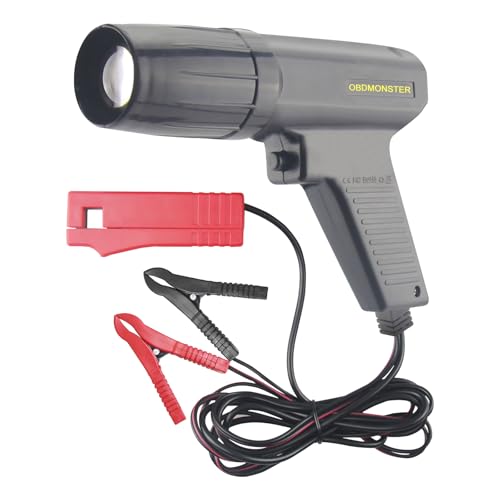
OBDMONSTER Automotive Timing Light
What We Like
- Lightweight 0.9 lb design
- Pistol-type grip for easy handling
- Red/black sensor clips for safe hookup
Trade-offs
- No built-in tachometer or digital display
- Requires 12V battery connection (no internal power)
- Advance readout is analog scale only
At just 0.9 pounds, this inductive timing light is one of the lightest options you can clamp onto a classic car’s ignition wires. The pistol-grip design makes it comfortable to hold while you’re leaning over an engine bay, and the red and black sensor clips take the guesswork out of polarity. It’s built for the basics: setting ignition timing on two- or four-stroke gasoline engines, with an advance function that lets you watch the timing mark shift as you rev the engine. For someone who just needs a straightforward, no-frills tool for dialing in an old distributor, this gets the job done without extra complexity.
The trade-off for that simplicity is that you won’t find a tachometer, digital readout, or rechargeable battery here, features the THIKPO Digital offers with its built-in tach and 0-90° digital advance. That makes the OBDMONSTER a better fit if you already own a separate timing light or tach and just want a spare, or if you prefer reading the timing scale directly off the flywheel. It’s a purely analog tool, so you’ll need to interpret the marks yourself, but for a classic car owner comfortable with that hands-on approach, this is a capable and affordable basic light.
Product photos
How We Evaluated Timing Lights For Classic Cars
Our evaluation is research-based. We studied manufacturer specifications, reviewed expert round-ups from automotive publications, and analyzed patterns in owner feedback to understand what makes a timing light work well for classic cars.
The three most important criteria were compatibility with distributor-based 12V gasoline engines, flash brightness for reading marks in various conditions, and the availability of useful features like a digital tachometer and adjustable advance. We also weighed build quality, weight, and overall value for a DIY enthusiast or professional.
An evaluation based on documented facts cannot replace actual use in a garage. The information here is presented as it is documented so you can make an informed decision based on your specific engine and needs.
What To Look For In Timing Lights For Classic Cars
Picking the right timing light for a classic car means matching the tool to your engine’s ignition system and your own working style. Here are the key factors to consider.
Look for a timing light that is compatible with your engine’s ignition type. It should work with distributor-based systems, not coil-on-plug or diesel. It also needs to be bright enough to read timing marks in daylight or a dim shop. If you need precise adjustments, look for a model that includes a tachometer or advance control.
Compatibility With Your Ignition System
Classic cars almost always use a distributor-based ignition system. Most timing lights on our list work with 2- and 4-stroke 12V gasoline engines of this type. However, some models are not compatible with diesel engines or modern coil-on-plug (COP) systems. If you own a classic car with a points or electronic distributor, a basic inductive timing light or a digital model will serve you well.
Flash Brightness and Readability
A bright strobe is essential for seeing timing marks clearly, especially in a dim garage or under a hood. Xenon flash tubes are common and provide a strong, daylight-visible pulse. LED lights are rated for very long life and can be just as bright. Consider your typical working environment: a brighter light helps you read marks faster and more accurately.
Features: Tachometer, Advance, and Display
Digital timing lights offer a built-in tachometer and adjustable advance angle, which let you verify RPM and dial in timing without a separate tool. A digital display makes readings easy. Basic inductive lights are simpler and lighter but lack these features. Decide if you want the convenience of all-in-one diagnostics or prefer a straightforward tool for reading marks directly.
- Confirm the timing light is compatible with your engine’s voltage (typically 12V for classic cars).
- Check the weight if you plan to hold the light for extended periods.
- Ensure the inductive pickup and clips fit your spark plug wires and battery terminals.
- Look for reverse-polarity protection to guard against accidental misconnections.
A digital timing light with an adjustable advance is a worthwhile investment if you plan to tune multiple vehicles or want precise control over your ignition timing.
Timing Lights For Classic Cars Compared
The table below compares the key specifications and trade-offs of each timing light to help you see the differences at a glance.
| Product | Engine Compatibility | Advance Range | Strobe Type | Weight |
|---|---|---|---|---|
| THIKPO Digital Automotive Timing Light | 2 & 4-stroke, 10-16V | 0-90° | Linear Xenon | 1.1 pounds |
| ANCEL LT70 PRO Timing Light | 9–16V distributor-based gasoline | 0-90° | LED | 1.5 Pounds |
| KZYEE KT60 Digital Timing Light | distributor-equipped gasoline | 0-90° | Xenon | 1.4 pounds |
| BINGOX Digital Timing Light | 12V gasoline, 2/4 stroke | 0-90° BTDC | Xenon | 0.6 Pounds |
| OBDMONSTER Automotive Timing Light | 2 & 4 stroke gasoline | N/A | N/A | 0.9 pounds |
Frequently Asked Questions
What type of timing light is best for a classic car?
A digital timing light with an adjustable advance and a bright xenon or LED strobe is ideal for most classic cars with distributor-based ignition. It gives you RPM and advance readings without a separate tachometer.
Can I use a timing light on a modern car with coil-on-plug ignition?
Most timing lights on this list are not compatible with coil-on-plug systems. They are designed for engines that have a spark plug wire you can clamp an inductive pickup onto.
Do I need a timing light with a built-in tachometer?
A built-in tachometer is very useful if you want to verify idle speed and check timing in one step. It saves you from juggling a separate tool, but a basic light works fine if you already have a tachometer.
How does an adjustable advance control work on a timing light?
The advance control lets you dial in a specific number of degrees on the light, which then shifts the strobe flash. You read the timing mark at the factory setting, and the light shows you the advance you have set.
Is a heavier timing light a problem for long use?
A heavier timing light can become tiring if you are holding it for extended periods in a cramped engine bay. Lightweight models, around 0.6 to 0.9 pounds, are easier to handle for long tuning sessions.
The Bottom Line
For most classic car owners, the THIKPO Digital Automotive Timing Light is the best overall choice. It offers a bright linear xenon flash, a digital tachometer and advance display, and solid build quality that suits both DIY enthusiasts and professionals working on distributor-based engines.
If you prefer a rechargeable tool with multiple diagnostic functions, the ANCEL LT70 PRO is a strong alternative. For those on a budget, the KZYEE KT60 delivers a bright strobe and digital readout at a more affordable price. And if weight is your top concern, the BINGOX Digital at just 0.6 pounds is the lightest option here.
The single most important factor in choosing a timing light is compatibility with your engine’s ignition system. Match the tool to your distributor-based gasoline engine, and you will get accurate, reliable timing adjustments every time.
