
8 Best Video Cameras For Motorcycle Riding in 2026
This post contains affiliate links. As an Amazon Associate, we earn from qualifying purchases.
The Insta360 X5 Motorcycle Bundle is the best video camera for motorcycle riding because it captures 8K 360° video with dual sensors. That means you never miss a single angle of the road ahead, the scenery beside you, or the action behind you. For riders who prioritize silky-smooth footage over 360° capture, the GoPro HERO12 Black with HyperSmooth 6.0 stabilization is the top choice. The DJI Osmo Action 6 Enhanced Combo delivers the best low-light performance for dawn and dusk rides.
The real challenge for motorcyclists is balancing video quality, battery life, and mounting versatility. A camera that excels on a smooth highway may struggle on a bumpy backroad, and a 360° camera requires post-ride editing that not every rider wants to do. We evaluated these eight cameras based on their ability to handle the unique demands of motorcycle riding, from wind noise and vibration to long days in the saddle.
This research-based guide combines manufacturer specifications, expert round-ups, and patterns in owner feedback to help you choose the camera that fits your riding style. Whether you need all-day battery life for touring, 360° capture for creative edits, or a compact POV setup for the helmet, we break down the strengths and trade-offs of each option.
Top 8 Video Cameras For Motorcycle Riding in the Market
Certain content that appears on this site comes from Amazon. This content is provided "as is" and is subject to change or removal at any time.
The Best Video Cameras For Motorcycle Riding, Reviewed
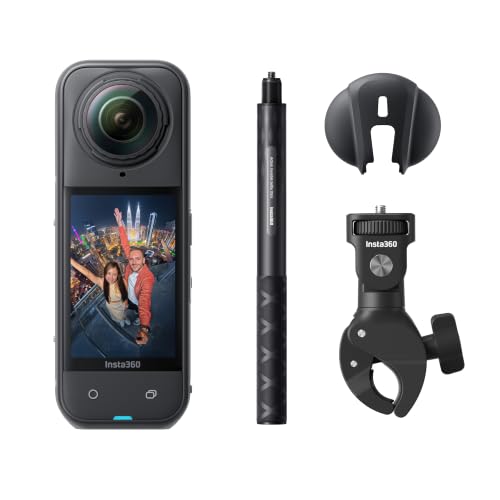
Insta360 X5 Motorcycle Bundle
What We Like
- 8K30fps 360° video with dual sensors
- 185-minute battery with fast charging
- Replaceable scratch-resistant lenses
- FlowState stabilization and Horizon Lock
Trade-offs
- 360° footage needs app reframing after the ride
- Heavier than most action cameras at 3.2 pounds
An 8K30fps 360° video with dual 1/1.28-inch sensors means you capture every angle of the ride in one take, then choose your shot later. The 185-minute battery covers long tours without swapping packs, and the 49-foot waterproof rating handles rain or a splashy river crossing. FlowState stabilization keeps footage smooth over bumps, while the replaceable lenses mean a gravel scratch won’t ruin the camera. For riders who want to document the full scene, road ahead, scenery beside, and bike details, without guessing which direction to point, this is the most versatile tool here.
The trade-off is weight. But for riders who want to capture everything and edit later, the X5’s 360° freedom and long battery make it the most capable choice.
GoPro HERO12 Black

What We Like
- HyperSmooth 6.0 with AutoBoost reduces cropping
- 5.3K video with 91% more resolution than 4K
- Waterproof to 33ft without a housing
- HDR for video and photo captures shadow detail
Trade-offs
- At 0.7 lb, heavier than many helmet cameras
- No built-in screen for rearview monitoring
The Emmy Award-winning HyperSmooth 6.0 stabilization in the GoPro HERO12 Black is the reason it lands here. This system uses in-camera sensor and software stabilization to smooth out the roughest pavement, gravel, or trail chatter, and the AutoBoost feature now delivers more stabilization while cropping less of your frame. That means you can mount it on a handlebar, helmet, or chest strap and get footage that looks like it was shot on a gimbal, even through bumpy corners. For riders who prioritize buttery-smooth video over every other feature, this camera delivers exactly that, backed by 5.3K resolution that gives you room to crop or reframe in editing without losing detail.
The GoPro HERO12 Black weighs 0.7 pounds, which is more than double the 0.3-pound Drift Ghost XL, so you’ll feel it on a helmet or fairing mount over a long ride. What you get for that weight is Emmy Award-winning HyperSmooth 6.0 stabilization that keeps footage silky smooth even on rough terrain, and rugged waterproofing down to 33 feet. If smooth video matters most, the extra heft is worth it; if lightweight all-day recording is your priority, the Drift Ghost XL is a lighter alternative.
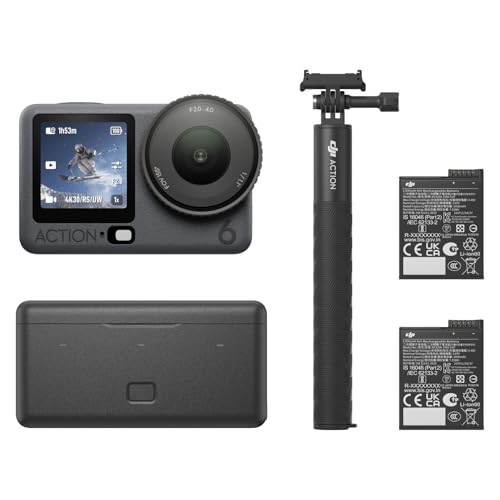
DJI Osmo Action 6 Enhanced Combo
What We Like
- Variable aperture f/2.0–f/4.0 for low light
- 8K video with 1/1.1" square sensor
- 4-hour battery in normal conditions
- 20m waterproof without extra housing
Trade-offs
- No helmet or handlebar mount included
- Requires separate purchase for helmet or handlebar mount
A variable aperture of f/2.0 to f/4.0 lets you adapt to changing light on the fly, which is exactly what you need when a ride takes you from open highway into tree-lined canyons or dusk. The 1/1.1-inch square sensor captures 8K footage with vivid color even when the sun is low, so your evening runs or dawn commutes stay sharp without that grainy look. This is the camera to grab if you ride at golden hour or through overcast conditions and want the details to pop.
The trade-off comes in weight and mounting. At 0.3 pounds, it is a bit heavier than a dedicated helmet cam like the Drift Ghost XL, so you will feel it more on a helmet mount over a long day.
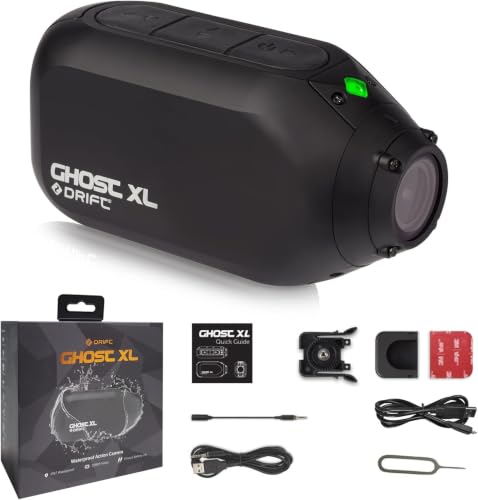
Drift Ghost XL Motorcycle Action Camera
What We Like
- 9-hour battery for all-day rides
- IPX7 waterproof without extra housing
- 300° rotating lens for level footage
- Dash cam loop recording mode
Trade-offs
- 1080P resolution only, no 4K option
- Side-profile design limits mounting positions
Nine hours of continuous recording means you can leave at dawn and still have battery left when you roll back into the garage after dark. That runtime makes the Drift Ghost XL a natural fit for touring riders, long-distance commuters, and anyone who hates stopping to swap batteries mid-ride. The IPX7 waterproofing keeps it running through rain without a clunky housing, and the 300-degree rotating lens lets you mount it sideways on a helmet while keeping the horizon level. Large controls work fine with gloves on, and the loop recording mode turns it into a reliable dash cam for documenting every mile.
The Drift Ghost XL records up to 9 hours of continuous HD footage, so you can ride all day without hunting for an outlet. That marathon runtime comes with a 1080P ceiling on video resolution, meaning riders who want 4K or 8K for cinematic edits would need to look at other cameras. The side-profile shape mounts cleanly to a helmet and cuts wind resistance, which keeps the camera stable at highway speeds.
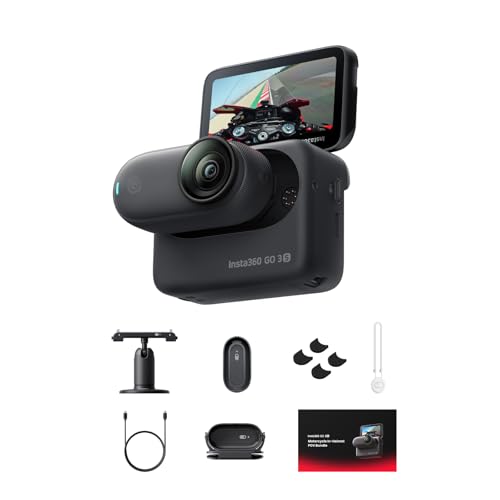
Insta360 GO 3S Motorcycle Bundle
What We Like
- Hands-free 4K POV with magnetic mounts
- FlowState Stabilization and Horizon Lock
- 140-minute battery via Action Pod
- Includes in-helmet mount and mic wind muff
Trade-offs
- Action Pod is only splashproof, not fully waterproof
- Magnet Pendant not suitable for pacemaker wearers
- No external storage expansion
A 0.3-pound camera that mounts magnetically anywhere lets you capture first-person riding footage without bulky straps or chest rigs. The bundle includes an in-helmet POV mount and a mic wind muff, while the Action Pod’s flip screen gives you live preview and remote control. This setup suits riders who want ultra-wide 4K clips of their commute or canyon run without fumbling with controls mid-ride.
Waterproofing is the key limitation: the GO 3S itself is IPX8-rated down to 10 meters, but the Action Pod is only splashproof, so you cannot submerge the whole bundle. For dry-weather helmet POVs and creative magnetic angles, this kit delivers freedom and tiny size.
Product photos
LKT 2K Motorcycle Helmet Camera
What We Like
- 2K front Sony Starvis sensor
- 5-6 hour battery for long rides
- 64GB card included
- WiFi app for phone preview
Trade-offs
- Rear lens only 1080P, not 2K
- Memory card must be formatted before first use
- No waterproof rating listed
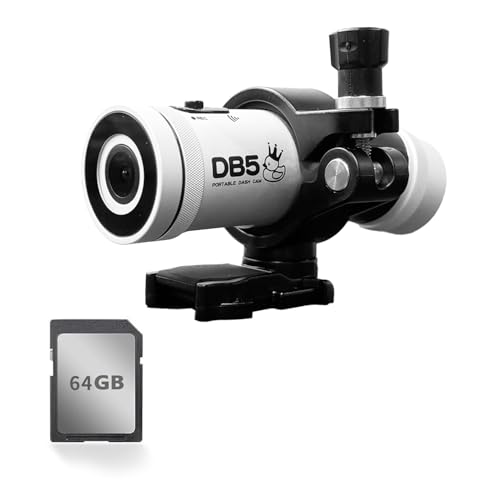
The rear camera tops out at 1080P, so you won’t get the same crisp detail from behind that the front delivers. Compared to the Drift Ghost XL, which offers 1080P video, a 9-hour battery, and a waterproof body, the LKT gives you two angles for better situational awareness. But you do need to format the memory card before first use. If you need front and rear coverage with long battery life, this setup fits the bill.
Product photos
GoPro HERO13 Black

What We Like
- HB-Series lenses with auto detection
- 5.3K60 video with 91% more resolution than 4K
- Burst Slo-Mo up to 13x normal speed
- Waterproof to 33ft without housing
Trade-offs
- Lenses sold separately from the camera
The HB-Series lens system with auto detection means you can swap from an ultra-wide POV for sweeping canyon roads to a macro lens for close-up chain or tire detail without diving into menus. That versatility is what sets this camera apart for riders who want more than just a fixed wide-angle view. With 5.3K60 video offering 91% more resolution than 4K, you get crisp footage even when you crop in later. The Burst Slo-Mo slows action to 13x normal speed, perfect for catching that exact moment your front wheel lifts or a puddle explodes. It’s a rugged, waterproof body that handles rain and mud without a second thought.
Specialty lenses cost extra, so if you only plan to mount it on your helmet and never change the lens, a simpler action camera might save you money. Compared to the Insta360 X5 Motorcycle Bundle, the GoPro gives you a traditional single-lens perspective rather than 360° footage, which means you have to aim it deliberately. But for riders who enjoy experimenting with different looks, cinematic anamorphic, soft motion blur with ND filters, or extreme close-ups, the HERO13 Black offers a modular approach no other action camera in this guide matches.
Product photos
MUFU V40S Motorcycle Dash Cam
What We Like
- 8-hour battery for all-day rides
- IP66 waterproof against rain and dust
- Emergency tilt lock saves crash footage
Trade-offs
- No 360° view like some competitors
- Side-mount design limits mounting options
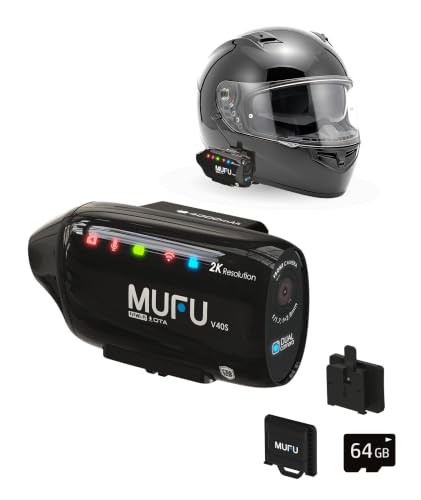
A built-in 4000mAh battery delivers up to eight hours of continuous recording, so you can ride through a full day of touring without stopping to recharge. That kind of runtime leaves most action cams behind. The dual 2K lenses capture clear front and rear footage even on unlit roads or in tunnels, giving you a reliable witness for safety and insurance purposes. Loop recording with intelligent tilt detection automatically locks the current file when a tilt occurs, so critical footage isn’t overwritten. This is the camera for riders who want a dedicated, always-on safety recorder rather than a multi-purpose action cam.
The V40S is designed as a side-mount helmet camera, not a versatile action cam you can strap to a handlebar or chest. If you prefer a chin-mount perspective or want 360-degree capture like the Insta360 X5 Motorcycle Bundle, this setup won’t deliver that view. It also lacks the ultra-high resolution of a GoPro HERO12 Black, but that camera can’t match its eight-hour battery or tilt-activated file lock. For the rider whose priority is continuous, worry-free recording with a dedicated safety focus, the V40S fills that role without the hassle of swapping batteries or checking settings mid-ride.
Product photos
How We Evaluated Video Cameras For Motorcycle Riding
Our evaluation is based on a thorough review of manufacturer specifications, professional video production standards, and patterns in owner feedback from motorcycle forums and action camera communities. We focused on the features that matter most when the camera is mounted to a helmet, handlebar, or motorcycle chassis at speed.
The four criteria that carried the most weight were video resolution and stabilization, battery life for long rides, mounting flexibility for different bike setups, and weather resistance. A camera that produces stunning 8K footage but dies after an hour is useless for a day trip, and a camera with great stabilization that cannot be mounted securely is a safety hazard. We gave extra consideration to cameras with replaceable lenses, as a scratched lens is a common problem when mounting cameras near road debris.
The honest limit of a research-led evaluation is that we cannot replicate the vibration profile of every motorcycle or the lighting conditions of every road. What we can do is identify the specifications and owner-reported patterns that consistently separate a good motorcycle camera from a frustrating one.
What To Look For In Video Cameras For Motorcycle Riding
Choosing the right camera depends on how you ride, where you mount it, and what you want to do with the footage afterward. Here are the key factors to consider before you buy.
Focus on stabilization, battery life, and mounting options first. Resolution matters, but shaky footage and a dead battery ruin any video, no matter how sharp.
Stabilization and Video Quality
The most important feature for motorcycle riding is electronic image stabilization. On a bike, the camera vibrates at engine frequency, bounces over bumps, and shakes from wind pressure. Look for cameras with advanced stabilization systems like GoPro’s HyperSmooth 6.0 or Insta360’s FlowState, which reduce cropping while keeping the horizon level. Resolution is secondary, 5.3K and 8K are impressive for editing flexibility, but 4K with excellent stabilization looks better than 8K with jitter.
Battery Life and Power Management
A motorcycle ride can last hours, and stopping to swap batteries or charge on the road is a hassle. Cameras with 4-hour or longer battery life, like the DJI Osmo Action 6’s 4-hour normal runtime or the Drift Ghost XL‘s 9-hour battery, are better suited for all-day touring. Loop recording modes, found on dash cam-style units, are valuable for riders who want continuous recording without filling the memory card.
Mounting and Weather Resistance
How you mount the camera determines what you can capture. Helmet mounts offer a first-person POV, handlebar mounts capture the road ahead, and tail mounts show the rider in action. Magnetic mounts, like those in the Insta360 GO 3S bundle, offer creative placement options but may not hold at high speeds. Weather resistance is critical, look for IPX7 or IP66 ratings if you ride in rain, and note that some cameras require a separate housing for full waterproofing.
- Check if the camera includes mounts in the box or if you need to buy them separately.
- Verify the maximum supported memory card size and whether the card is included.
- Confirm the waterproof rating without an external housing.
- Look for replaceable or scratch-resistant lenses if you mount near the front wheel.
- Ensure the camera’s weight is appropriate for your helmet or handlebar setup.
A camera that is too heavy for your helmet can cause neck fatigue on long rides. Aim for a lightweight model for helmet mounting.
Video Cameras For Motorcycle Riding Compared
The table below compares the key specifications of each camera to help you see the differences at a glance.
| Product | Video Resolution | Battery Life | Weight |
|---|---|---|---|
| Insta360 X5 Motorcycle Bundle | 8K30fps 360° | 185 minutes | 3.2 Pounds |
| GoPro HERO12 Black | 5.3K60 Ultra HD | N/A | 0.7 Pounds |
| DJI Osmo Action 6 Enhanced Combo | 8K | Up to 4 hours | 0.3 pounds |
| Drift Ghost XL Motorcycle Action Camera | 1080P | 9 hours | 0.3 pounds |
| Insta360 GO 3S Motorcycle Bundle | 4K | 140 minutes | 0.3 Pounds |
| LKT 2K Motorcycle Helmet Camera | 2K Sony Starvis | 5-6 hours | N/A |
| GoPro HERO13 Black | 5.3K60 | N/A | 0.3 pounds |
| MUFU V40S Motorcycle Dash Cam | 2K front and rear | Up to 8 hours | 0.3 pounds |
Frequently Asked Questions
What is the best video camera for motorcycle riding?
The Insta360 X5 Motorcycle Bundle is the best overall choice for motorcycle riding because it captures 8K 360° video with dual sensors, has a 185-minute battery, and features replaceable scratch-resistant lenses. Riders who want the smoothest footage should consider the GoPro HERO12 Black with HyperSmooth 6.0 stabilization.
How long does a motorcycle camera battery last?
Battery life varies significantly by model. The Drift Ghost XL offers up to 9 hours of recording, while the DJI Osmo Action 6 lasts about 4 hours in normal conditions. The Insta360 X5 provides 185 minutes, and the Insta360 GO 3S runs for 140 minutes via its Action Pod.
Is 4K resolution necessary for a motorcycle camera?
4K resolution is not strictly necessary, but it provides more flexibility for cropping and stabilizing footage in post-production. The Drift Ghost XL records only 1080P, which is sufficient for dash cam-style recording but limits editing options. For most riders, 4K with good stabilization is the sweet spot.
Can I use a motorcycle camera in the rain?
It depends on the camera’s waterproof rating. The GoPro HERO12 Black and HERO13 Black are waterproof to 33 feet without a housing, and the DJI Osmo Action 6 is waterproof to 20 meters. The MUFU V40S has an IP66 rating for rain and dust resistance, while the Insta360 GO 3S Action Pod is only splashproof.
What is the best mounting position for a motorcycle camera?
The best mounting position depends on what you want to capture. Helmet mounts provide a first-person POV that shows your head movements and road scanning. Handlebar mounts capture a stable forward view, and tail mounts show the rider in action. The Insta360 X5’s 360° capture eliminates the need to choose a single angle.
The Bottom Line
The Insta360 X5 Motorcycle Bundle is the best video camera for motorcycle riding because it captures every angle in 8K. It also has enough battery for a full day of riding and includes replaceable lenses that survive road debris. It is the right choice for riders who want to edit the perfect shot after the ride rather than frame it perfectly while riding.
If the X5’s 360° workflow does not fit your style, the GoPro HERO12 Black delivers the smoothest stabilization for bumpy roads, and the Drift Ghost XL offers the longest battery life for multi-day tours. Budget-conscious riders who need front and rear coverage should look at the LKT 2K Motorcycle Helmet Camera, which includes a 64GB card and long battery life.
The single most important factor is choosing a camera that matches how you actually ride. A 360° camera is wasted on a commuter who never edits footage, and a long battery life is overkill for a short ride. Match the camera to your ride, not the spec sheet.
