
9 Best Wireless Car Rear View Cameras in 2026
This post contains affiliate links. As an Amazon Associate, we earn from qualifying purchases.
For drivers who want a clear view behind their vehicle without running wires through the cabin, the Pemacom Magnetic Wireless Backup Camera stands out as the best overall. Its truly wireless, magnetic design installs in under a minute and delivers 1080P clarity with solar-recharged battery life. The LeeKooLuu HD offers the easiest wired install with a large screen, while the Venluna Dual Magnetic system is ideal for those needing multi-camera coverage and DVR recording.
The real challenge with wireless rear view cameras isn’t finding one that works; it’s finding one that works reliably for your specific vehicle. Range, power source, mounting method, and screen size all affect whether a camera will be a daily helper or a frustration.
This guide is based on a thorough evaluation of manufacturer specifications, expert round-ups, and patterns in owner feedback. We’ve organized the top nine wireless cameras by their strengths to help you match the right system to your truck, RV, trailer, or daily driver.
Top 9 Wireless Car Rear View Cameras in the Market
Certain content that appears on this site comes from Amazon. This content is provided "as is" and is subject to change or removal at any time.
The Best Wireless Car Rear View Cameras, Reviewed
Pemacom Magnetic Wireless Backup Camera
What We Like
- Magnetic install in under a minute
- 1080P clarity with enhanced night vision
- 24-hour battery with solar charging
- IP69 waterproof for all weather
Trade-offs
- 33-foot signal range limits larger rigs
- 5-hour full charge requires planning
- No second camera included for dual use
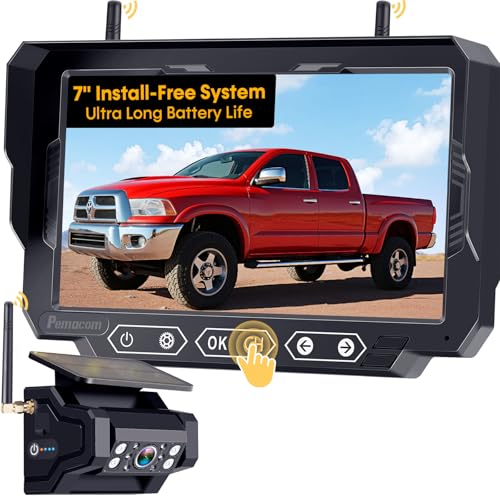
A 7-inch anti-glare monitor and 1080P resolution mean you get a crisp, clear view of what is behind you, even in low light or bright sun. The magnetic base with six rare-earth magnets lets you attach the camera in about a minute with no wiring at all, which is a real time-saver for anyone who tows or swaps vehicles often. A built-in 15,000mAh battery and 5W solar panel keep it running for up to 24 hours on a full charge, so long road trips or multi-day jobs are covered without hunting for a power outlet. This setup suits drivers who want straightforward, reliable rear visibility without permanent installation or complicated wiring.
The trade-off is the 33-foot signal range, which works fine for a pickup, small RV, or trailer but may feel tight on a longer combination or a large fifth-wheel. The 170-degree wide-angle lens gives you a broader view behind the vehicle, which helps reduce blind spots compared to narrower lenses. If your vehicle is compact or you swap the camera between cars, the quick magnetic mount and long battery life make this an easy everyday choice. For a permanent setup on a big rig, you might want a system with a longer transmission range.
LeeKooLuu HD Wireless Backup Camera

What We Like
- 15-minute setup with no complicated wiring
- IP69 waterproof rating handles extreme temperatures
- Starlight night vision for low-light clarity
- Adjustable parking lines for tight spaces
Trade-offs
- Camera requires wired power to reverse light or battery
- Monitor connects via Bluetooth, not digital signal
- Only supports up to 2 cameras for split-screen
A 15-minute setup with no complicated wiring means you can have a clear rear view in less time than it takes to run a quick errand. The system comes pre-paired, so you just connect the monitor to your vehicle’s power and the camera to a reverse light or other source, no pairing hassles. The 7-inch 1080P screen delivers sharp visuals even in dim driveways or evening towing, while the IP69 waterproof rating handles snow, rain, and extreme heat without flinching. That makes it a straightforward choice for truck owners who want a quick install without sacrificing image quality.
The camera still needs a wired power connection, so it’s not fully wireless like magnetic solar models such as the VOONOA Magnetic Wireless Backup Camera. That means you’ll need to tap into a reverse light or running light, which adds a small step but keeps the system reliable without worrying about battery life. The Bluetooth connection works automatically, pairing without any extra steps. If you value a simple, no-fuss setup that gets you a big, clear screen and rugged weather protection, this one delivers exactly what it promises.
Venluna Dual Magnetic Wireless Backup Camera

What We Like
- Magnetic 1-minute tool-free install
- 4-channel DVR loop recording
- Solar-assisted 15000mAh battery
- 170° adjustable lens with IR night vision
Trade-offs
- Solar is not primary charging method
- Monitor requires cigarette lighter power
- Magnetic mount only works on metal surfaces
A 15000mAh battery provides up to 24 hours of use on a full charge, with solar assistance that extends battery life on long trips, though the solar panel is not the primary charging method. The seven-inch 1080P monitor supports up to four cameras, so you can add extra views around a truck, RV, or trailer. Magnetic installation takes about a minute on any metal surface, and IP69 waterproofing handles extreme weather, making this a flexible option for owners who want multiple camera angles without permanent wiring.
The Venluna Dual Magnetic Wireless Backup Camera supports up to four cameras and includes DVR loop recording, making it a strong option for anyone who needs expandability and recorded footage. The solar panel extends battery life but isn’t the primary charging method, so you’ll still rely on the included cigarette-lighter adapter for the monitor. If magnetic convenience and multi-camera coverage matter, this system covers the essentials.
Product photos
VOONOA Magnetic Wireless Backup Camera

What We Like
- Two cameras for dual views
- 15000mAh battery lasts over 24 hours
- 6 super-strong magnets for quick install
- Solar panel extends battery life
Trade-offs
- Solar only supplements power on sunny days
- Battery requires recharging after 24 hours
A 15000mAh rechargeable battery that lasts over 24 hours means you can tow all day without hunting for a power outlet. The dual-camera setup gives you two angles at once, which is a real help when you’re backing a trailer into a tight spot or keeping an eye on both sides of a long load. Six super-strong magnets let you stick the cameras on in seconds, no wiring or drilling required. This system is built for people who swap trailers often or just want a setup that moves with them.
The battery, while generous, does need recharging after a full day’s use, and the solar panel only helps on sunny days. It’s a top-up, not a replacement for the charger. Compared to the LeeKooLuu, which offers a single-camera setup with a 15-minute install, the VOONOA gives you two camera views and a solar-assisted battery for longer run times. It’s a smart fit for anyone who values quick setup and multi-angle visibility over absolute zero-maintenance.
VTimes Wireless Backup Camera
What We Like
- 984 ft wireless range for large vehicles
- IP69K waterproof and shockproof camera
- Blind spot detection with audible alert
- 4-channel split screen recording
Trade-offs
- Camera requires hardwiring to tail light for power
- No built-in storage card included for recording
- Monitor plugs into cigarette lighter, limiting placement
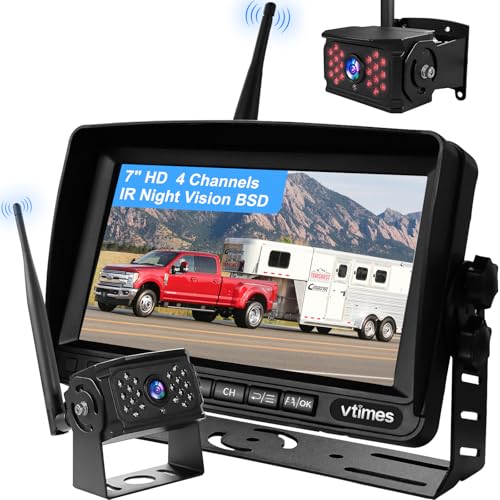
A wireless signal range of 984 feet means this camera can cover the gap between a long RV or truck and trailer without dropping the feed, which is the whole point of going wireless. That makes the VTimes system a natural fit for anyone towing a large camper or hauling a flatbed where a shorter range might not be enough. The 7-inch monitor shows up to four camera feeds at once, so you can keep an eye on your blind spots and the hitch area simultaneously. Blind spot detection with an audible alert adds an extra layer of awareness when changing lanes or backing into a tight spot.
The camera itself still needs a wired connection to your tail light or running light for power, so it is not a fully magnetic, stick-and-go setup like the Pemacom Magnetic Wireless Backup Camera. Installation is straightforward if you are comfortable tapping into a 12V line, but it takes more effort than a fully wireless magnetic model. The monitor also relies on the cigarette lighter socket, which can be awkward if your dash layout puts the port behind a gear shifter. For RV owners with a pre-installed Furrion bracket, the included mounting bracket and pigtail wire simplify the job considerably. This makes it a strong pick for those who want long-range reliability over instant installation.
Befumly Magnetic Wireless Backup Camera

What We Like
- 1296P resolution sharper than 1080P
- Auto 11-LED IR night vision to 10m
- Magnetic mount installs in one minute
- 32-hour battery with solar recharge
Trade-offs
- Non-detachable battery limits replacement
- Solar panel requires daylight to recharge
A native 1296P sensor with 44% more pixels than 1080P means this camera shows rear traffic, curbs, and small obstacles with noticeably finer detail than standard HD systems. The automatic 11-LED IR night vision, paired with a Starlight CMOS sensor and F1.1 lens, delivers clear visibility up to 10 meters after dark. This makes it a strong choice for drivers who regularly navigate poorly lit roads or job sites after sunset. The magnetic mount with six N52 rare-earth magnets holds securely at highway speeds up to 75 MPH. The 15,800mAh battery keeps it running up to 32 hours between charges, with a 5W solar panel to extend runtime during daylight hours.
The built-in battery is non-detachable, so when it eventually wears out, you cannot swap in a fresh pack. You have to recharge the whole camera via USB-C, which takes about eight hours. Compared to the Pemacom Magnetic Wireless Backup Camera, which also uses a magnetic mount and solar charging, the Befumly offers a higher-resolution 1296P image and longer battery life. The Pemacom’s 1080P resolution may be sufficient for buyers who prioritize simplicity over extra detail. This camera suits truck owners who want the best night vision and sharpest picture in a no-drill, magnetic setup.
SIXWIN Wireless Backup Camera
What We Like
- IP69 waterproof withstands high-pressure car washes
- Compact 5-inch monitor doesn't block windshield view
Trade-offs
- 5-inch screen is smaller than many competitors' 7-inch monitors
- Monitor must be plugged into 12V outlet, limiting placement options
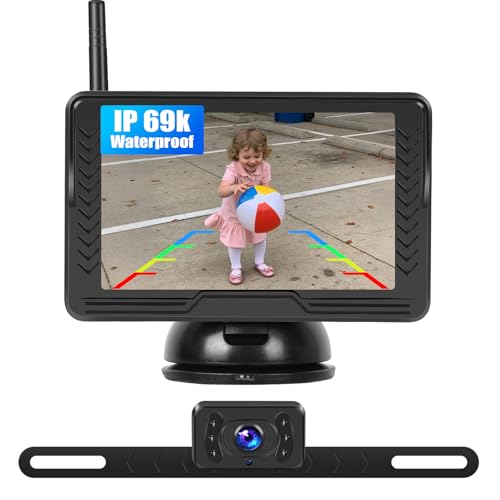
A 5-inch IPS monitor that’s large enough to see clearly yet compact enough to keep your windshield uncluttered, that’s the central trade-off the SIXWIN Wireless Backup Camera gets right. The camera itself packs six infrared LEDs and an F/1.8 aperture for night vision that picks out curbs and pedestrians in the dark. It also has an IP69 waterproof rating that shrugs off pressure washers and extreme temperatures. For drivers who want a clean, no-drill installation and a monitor that stays out of the way, this is a thoughtfully matched system.
The obvious compromise is screen real estate: at five inches, this monitor is smaller than the seven-inch displays found on models like the LeeKooLuu HD Wireless Backup Camera. The monitor draws power from your 12V cigarette lighter, which means it’s always on when the car is running. What you gain is a setup that installs in about 20 minutes with just a screwdriver, and a camera that handles rain, snow, and car-wash spray without fogging. If a compact, interference-free monitor matters more than a giant screen, this is the right fit.
Product photos
EWAY Magnetic Wireless Backup Camera

What We Like
- Split-screen supports two camera channels
- Strong magnetic mount with 15 lbs pull each
- Truly wireless, battery-powered, 2-minute install
- IP68P waterproof, submersible up to 5 feet
Trade-offs
- 5-inch monitor is smaller than many competitors
- 100 ft range drops to 60 ft recommended for vehicles
- Requires cigarette lighter to power monitor
A 5-inch split-screen monitor that accepts two separate camera feeds means you can keep an eye on both a rear hitch and a side blind spot without swapping views. Each camera mounts with four magnets rated at 15 pounds of pull, so they stay put on any flat metal surface even over rough roads. This setup works especially well for truck and RV owners who need to monitor a trailer hitch or a horse compartment while also watching the road behind them. The 1080P image and IR night vision deliver clear daytime and low-light video, and the whole system installs in about two minutes with no wiring beyond plugging the monitor into a cigarette lighter.
The five-inch monitor is noticeably smaller than the seven-inch screens on competitors like the LeeKooLuu or VOONOA, so drivers with older eyes or a long trailer may need to look more carefully to see details. The wireless range reaches up to 100 feet in open areas, but the manufacturer recommends using it on vehicles under 60 feet to avoid signal dropouts. If you want a compact, portable system that can add a second camera without extra wiring, this is a practical choice, though the screen won’t dominate your dashboard.
Product photos
Pyle Wireless Monitor and Camera

What We Like
- Wireless setup with built-in mic
- 7-inch IPS screen with sun visor
- Water and weather resistant construction
- IR night vision up to 3 meters
Trade-offs
- License plate mount limits camera placement options
- Single channel system covers only one camera view
A 7-inch IPS screen with 1080P HD resolution gives you a clear, wide-angle view behind your vehicle, and the wireless setup means you won’t spend hours fishing cables through the cabin. The camera has a built-in mic that sends audio to the screen, and the monitor includes a sun visor hood for convenient monitoring in bright conditions. This kit suits anyone who wants reliable backing assistance for larger vehicles like trucks, vans, and RVs where a wired install would be a real chore.
The recommended mounting position has the camera preferably mounted at the top of the back of the truck, which keeps installation simple but limits your ability to place it elsewhere for a different vantage point. Compared to the Pemacom Magnetic Wireless Backup Camera, which uses a magnetic mount for quick repositioning, the Pyle’s mount is less flexible for moving the camera between vehicles. If you need to swap the camera between trailers often, the Pyle’s fixed mounting approach may feel limiting. But for a single-vehicle owner who values straightforward installation and solid daytime clarity, it delivers exactly what you need.
Product photos
How We Evaluated Wireless Car Rear View Cameras
Our evaluation started with a close look at each camera’s core specifications: resolution, wireless range, power source, mounting method, and water resistance rating. We compared these specs against what real owners report about installation difficulty, video quality in different lighting, and battery life in daily use.
The three criteria that mattered most were installation simplicity, signal reliability, and video clarity. A camera that takes hours to wire up defeats the purpose of “wireless,” so we favored magnetic and tool-free designs. Signal range is critical for larger vehicles like trucks and RVs, where a short-range camera can drop out at the worst moment. And night vision quality separates a useful camera from one that goes dark when you need it most.
An evaluation like this cannot replace testing every camera in every vehicle configuration. What it can do is surface the important trade-offs, like the difference between a truly battery-powered camera and one that still needs a power wire, so you know exactly what to expect before you buy.
What To Look For In Wireless Car Rear View Cameras
Choosing a wireless backup camera means balancing power source, signal range, and mounting method against your vehicle type and daily driving needs.
Key criteria: camera power source (battery vs. Wired), wireless transmission range, mounting method (magnetic vs. License plate vs. Permanent), video resolution and night vision capability, monitor screen size, and water resistance rating.
Camera Power Source: Battery vs. Hardwired
A truly wireless camera runs on a rechargeable battery, often supplemented by a solar panel. This is the most convenient option for moving between vehicles or avoiding any wiring. The trade-off is limited run time, typically 24 to 32 hours, and the need to recharge. Solar panels help extend battery life but rarely charge a camera fully on their own.
Hardwired cameras require connecting to a reverse light or constant power source. This adds installation time but eliminates battery anxiety. If you plan to leave a camera on one vehicle permanently, a hardwired model may be the more reliable long-term choice.
Wireless Signal Range and Interference
Wireless range is measured in feet and is usually tested in open air. Real-world range through a vehicle’s metal body and glass is always shorter. For a sedan or small SUV, a rated range of around 100 feet is usually plenty. For a large RV or a truck towing a long trailer, look for models rated at 500 feet or more.
Digital signals (2.4 GHz) tend to be more stable than analog Bluetooth connections. Some cameras also offer multiple channels to avoid interference from other wireless devices.
Mounting Method and Camera Placement
Magnetic mounts are the fastest to install, just stick the camera to any metal surface. They are ideal for drivers who want to move the camera between vehicles or remove it for storage. The downside is that they only work on metal surfaces and can be stolen if not removed.
License plate mounts are semi-permanent and work on any vehicle with a standard plate bracket. They limit camera placement to the rear center, which is fine for most cars but may not offer the best angle on trucks or trailers. Permanent screw-mount cameras offer the most secure installation but require drilling.
- Confirm the monitor’s screen size: 5-inch monitors are compact and less obstructive, while 7-inch screens offer easier viewing.
- Look for adjustable parking lines that can be calibrated to your vehicle’s width.
- Verify that the camera’s night vision uses infrared LEDs for true low-light visibility, not just low-light sensors.
A good rule of thumb: Choose a battery-powered magnetic camera for flexibility and a hardwired camera for permanent, worry-free operation on a single vehicle.
Wireless Car Rear View Cameras Compared
The table below compares the nine wireless car rear view cameras side by side, highlighting their key specs and best-use cases so you can quickly narrow down your options.
| Product | Monitor Size | Resolution | Night Vision |
|---|---|---|---|
| Pemacom Magnetic Wireless Backup Camera | 7-inch | 1080P HD | Night vision |
| LeeKooLuu HD Wireless Backup Camera | 7 Inches | 1080P HD | Starlight Night Vision |
| Venluna Dual Magnetic Wireless Backup Camera | 7 inch | 1080P HD | IR Night Vision |
| VOONOA Magnetic Wireless Backup Camera | 7 inches | HD 1080P | N/A |
| VTimes Wireless Backup Camera | 7 inches | N/A | 20 IR LEDs |
| Befumly Magnetic Wireless Backup Camera | 7.2" | 1296P | 11 IR LEDs, 10m range |
| SIXWIN Wireless Backup Camera | 5 inches | N/A | 6 IR LEDs + F/1.8 aperture |
| EWAY Magnetic Wireless Backup Camera | 5 inches | HD 1080P | 9 IR lights |
| Pyle Wireless Monitor and Camera | 7 inch | 1080P HD | 3 meters |
Frequently Asked Questions
How do wireless backup cameras get power?
Wireless backup cameras get power either from a built-in rechargeable battery, often with solar panel assistance, or by hardwiring into the vehicle’s reverse light or constant power circuit. Battery-powered models offer the easiest installation but need periodic recharging, while hardwired models provide constant power at the cost of a more involved setup.
What is the difference between a wireless and a wired backup camera?
A wireless backup camera transmits video from the camera to the monitor via radio frequency rather than a physical video cable. This eliminates the need to run a long video wire through the vehicle’s interior. However, the camera still needs power, which may come from a battery or a short wire to a nearby light.
How far can a wireless backup camera transmit?
Transmission range varies widely by model. Small sedans and SUVs typically need around 100 feet of rated range, while large RVs and trucks towing trailers may require 500 feet or more. Real-world range through metal and glass is always shorter than the advertised open-air range, so it is wise to choose a model with extra range for your vehicle length.
Can I use a wireless backup camera on a trailer?
Yes, many wireless backup cameras are specifically designed for trailers. Look for models with long signal range, magnetic mounts for quick attachment to trailer frames, and high water resistance ratings. Dual-camera systems are popular for trailers because they can show both the rear and a side or hitch view.
Do I need to drill holes to install a wireless backup camera?
Not necessarily. Magnetic mount cameras require no drilling and can be placed on any metal surface in seconds. License plate mount cameras attach using existing plate screws, also without drilling. Only permanent screw-mount or flush-mount cameras require drilling into the vehicle body.
The Bottom Line
The Pemacom Magnetic Wireless Backup Camera is our best overall pick for drivers who want a truly wireless, no-wiring setup they can install in under a minute and move between vehicles. Its 1080P clarity, solar-recharged 24-hour battery, and IP69 waterproofing make it a versatile choice for most cars, trucks, and SUVs, as long as the 33-foot signal range works for your vehicle length.
If you need a camera for a large RV or trailer where range is critical, the VTimes Wireless Backup Camera offers a 984-foot signal and blind spot detection, though it requires hardwiring for power. For budget-minded shoppers, the Pyle Wireless Monitor and Camera provides a large 7-inch screen and reliable performance at a lower cost, even if the license plate mount limits placement options.
The single most important factor in choosing a wireless backup camera is matching the power source and signal range to your vehicle and how you plan to use it. Get that right, and the rest, screen size, night vision, mounting method, falls into place.
